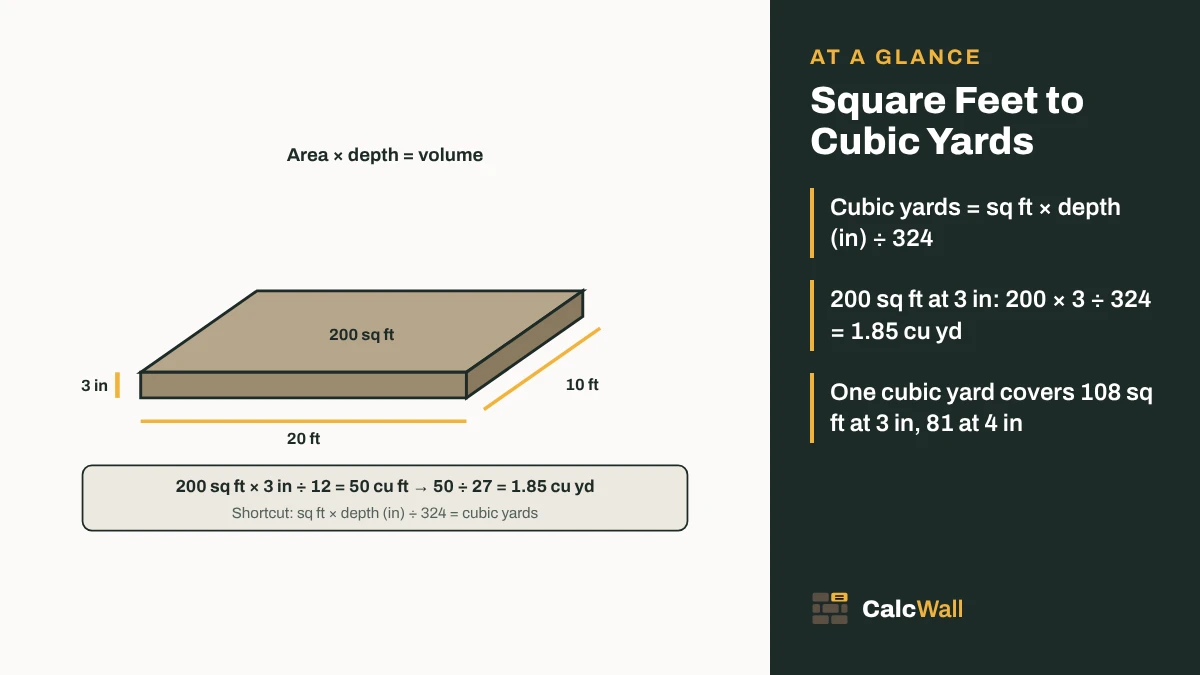
Quick answer: cubic yards = square feet × depth (in) ÷ 324. So 200 sq ft at 3 in is 200 × 3 ÷ 324 = 1.85 cubic yards. Going back, square feet = cubic yards × 324 ÷ depth (in): one cubic yard covers 108 sq ft at 3 in and 81 sq ft at 4 in.
How to convert square feet to cubic yards
Square feet measure a flat area. Cubic yards measure a volume. You can't turn one into the other without a third number, the depth, because the same cubic yard can be a thin layer over a big lawn or a deep fill in a small bed. Once you know how thick the layer is, the conversion is four short steps:
- Find the area in square feet. For a rectangle, length × width. For an odd shape, split it into rectangles and add them up, or use the Cubic Yards Calculator, which has 17 shapes.
- Decide the depth in inches. Mulch is usually 2–4 in, topsoil for a lawn 4–6 in, a concrete patio 4 in. Measure in a few spots if you are filling a low area.
- Multiply and divide by 324. Square feet × inches ÷ 324 = cubic yards.
- Add waste and round up to the half or whole yard your supplier sells.
The calculator above does the same thing as you type. It accepts square feet, square yards or square meters for the area and inches, feet, centimeters or millimeters for the depth, so you never have to convert first.
The formula and where 324 comes from
The long way is to turn everything into feet. Divide the depth in inches by 12 to get feet, multiply by the area to get cubic feet, then divide by 27, because a cubic yard is 3 ft × 3 ft × 3 ft = 27 cubic feet.
Cubic yards = sq ft × (depth in ÷ 12) ÷ 27 = sq ft × depth in ÷ 324
Dividing by 12 and then by 27 is the same as dividing once by 12 × 27 = 324. That one number is worth remembering: it is the number of square feet one cubic yard covers at exactly 1 inch deep. Every other coverage figure follows from it. At 2 in a yard covers half as much (162 sq ft), at 3 in a third (108 sq ft), and so on.
All the factors here are exact definitions, not rounded values. NIST Handbook 44 defines the foot as 0.3048 m and the inch as 2.54 cm, so a cubic yard is exactly 0.764554857984 m³. The calculator uses those full figures and only rounds what it shows you.
Coverage chart: square feet per cubic yard by depth
Use this chart to see how many square feet a cubic yard covers at each depth from 1 to 12 inches, or how many yards you need per 100 sq ft. The metric columns give the same layer in centimeters and m² per m³.
| Depth | Sq ft per cu yd | Cu yd per 100 sq ft | Same depth in cm | m² per m³ |
|---|---|---|---|---|
| 1 in | 324 | 0.31 | 2.54 | 39.37 |
| 2 in | 162 | 0.62 | 5.08 | 19.69 |
| 3 in | 108 | 0.93 | 7.62 | 13.12 |
| 4 in | 81 | 1.23 | 10.16 | 9.84 |
| 5 in | 64.80 | 1.54 | 12.70 | 7.87 |
| 6 in | 54 | 1.85 | 15.24 | 6.56 |
| 7 in | 46.29 | 2.16 | 17.78 | 5.62 |
| 8 in | 40.50 | 2.47 | 20.32 | 4.92 |
| 9 in | 36 | 2.78 | 22.86 | 4.37 |
| 10 in | 32.40 | 3.09 | 25.40 | 3.94 |
| 11 in | 29.45 | 3.40 | 27.94 | 3.58 |
| 12 in | 27 | 3.70 | 30.48 | 3.28 |
The chart assumes the material is spread evenly and not packed down. Loose material settles; see the notes on waste below.
Cubic yards for common areas at 2, 3 and 4 inches
Already know your square footage? Read the yards straight off this table. These are exact volumes with no waste added, rounded to two decimals.
| Area | 2 in deep | 3 in deep | 4 in deep |
|---|---|---|---|
| 50 sq ft | 0.31 cu yd | 0.46 cu yd | 0.62 cu yd |
| 100 sq ft | 0.62 cu yd | 0.93 cu yd | 1.23 cu yd |
| 200 sq ft | 1.23 cu yd | 1.85 cu yd | 2.47 cu yd |
| 250 sq ft | 1.54 cu yd | 2.31 cu yd | 3.09 cu yd |
| 500 sq ft | 3.09 cu yd | 4.63 cu yd | 6.17 cu yd |
| 1,000 sq ft | 6.17 cu yd | 9.26 cu yd | 12.35 cu yd |
| 2,000 sq ft | 12.35 cu yd | 18.52 cu yd | 24.69 cu yd |
Notice that doubling the area or doubling the depth both double the yards. A 1,000 sq ft lawn topdressed 2 in deep needs the same 6.17 yards as a 500 sq ft bed filled 4 in deep.
From cubic yards to tons and bags
Bulk yards sell by the cubic yard, but quarries and stone yards often sell by the ton, and garden centers sell by the bag. Pick a material in the calculator and it turns the yards into weight and a bag count. These are the same typical weights the Cubic Yards Calculator uses, so the two pages always agree:
| Material | lb per cu ft | lb per cu yd | US tons per cu yd | kg per m³ | More detail |
|---|---|---|---|---|---|
| Wood mulch | 22 | 594 | 0.30 | 352 | Mulch Calculator |
| Topsoil | 80 | 2,160 | 1.08 | 1,281 | Topsoil Calculator |
| Sand (dry) | 100 | 2,700 | 1.35 | 1,602 | Sand Calculator |
| Gravel | 105 | 2,835 | 1.42 | 1,682 | Gravel Calculator |
| Concrete (wet) | 150 | 4,050 | 2.03 | 2,403 | Concrete Calculator |
Real weights vary with moisture and grade: wet soil and fresh wood chips weigh more, washed stone less. The material calculators linked in the table offer more grades (damp sand, compost, road base and others). If your supplier quotes a density, choose “My own density” and type it in.
For bags, one cubic yard is 27 cu ft, so it takes 13.5 bags of 2 cu ft (buy 14) or 9 bags of 3 cu ft. Premix concrete is sold by weight: an 80 lb bag makes about 0.60 cu ft, so a cubic yard is 45 bags.
Waste and rounding up to order
The formula gives the exact volume of a perfect layer. Real jobs use a bit more. Allow for:
- Uneven ground. A base that dips half an inch in places swallows material. Ready-mix crews commonly add 5–10%.
- Settling. Fresh mulch and screened topsoil fluff up when dumped and settle after watering and rain.
- Spill and leftovers. Some is always left on the tarp, in the barrow or in the truck chute.
Set “Extra for waste” to 5, 10 or 15% and the calculator scales the yards, weight and bags together. It then shows the order rounded up to the next half yard (or half m³), because most landscape yards and ready-mix plants sell in whole or half yards. Check with your supplier: some deliver in quarter yards, some have a minimum load or a short-load fee.
Worked examples
Mulch for a flower bed
A bed 20 × 10 ft, mulched 3 in deep. 20 × 10 = 200 sq ft. 200 × 3 ÷ 324 = 1.85 cu yd (50 cu ft, 1.42 m³).
At 22 lb per cu ft that is about 1,100 lb, or 0.55 US tons. In 2 cu ft bags: 50 ÷ 2 = 25 bags. In bulk, order 2 yards; with 10% extra the exact figure is 2.04, so 2 yards is just under and 2½ is safe if the bed is uneven.
A 10 × 10 concrete slab, 4 inches thick
100 sq ft × 4 in ÷ 324 = 1.23 cu yd. Add 10%: 1.23 × 1.1 = 1.36 cu yd (36.67 cu ft).
Order 1½ yards of ready-mix. In 80 lb premix bags: 36.67 ÷ 0.60 = 61.1, so 62 bags. It weighs about 5,500 lb (2.75 tons) at 150 lb per cu ft. For forms, rebar and costs, see the Concrete Calculator.
How deep will 5 yards of topsoil go?
A 600 sq ft lawn area and a 5-yard delivery: depth = 5 × 324 ÷ 600 = 2.7 in (6.86 cm). That is short of the 4–6 in usually wanted for new turf, so either order more or plan to topdress only. Choose “Depth from cubic yards and square feet” to check this before you order.
Cubic yards back to square feet
Sometimes the yards come first: a supplier's minimum load, a leftover pile, or a truck that holds a set amount. To find the cubic yard coverage, flip the formula:
Square feet = cubic yards × 324 ÷ depth (in)
3 cubic yards of gravel spread 4 in deep: 3 × 324 ÷ 4 = 243 sq ft, about a 12 × 20 ft parking pad. It weighs about 8,505 lb (4.25 tons) at 105 lb per cu ft, which is why gravel comes by dump truck, not pickup.
With waste set, the reverse mode takes the waste off first: 3 yards with 10% waste covers 243 ÷ 1.1 = 220.9 sq ft. That is the honest answer when you can't count on using every shovelful.
Working in meters
In metric the arithmetic is simpler: cubic meters = square meters × depth in meters. With the depth in centimeters, divide by 100. A 20 m² bed at 7.5 cm needs 20 × 0.075 = 1.5 m³, which is 1.5 ÷ 0.764554857984 = 1.96 cubic yards.
The calculator shows m³ next to cubic yards in every mode, so you can compare a metric quote with a US one, or order in whichever unit your supplier uses. In the UK, Canada, Australia, New Zealand and Germany it starts in metric automatically; change the units in the boxes at any time and the numbers convert without drifting.
Notes for pros
Loose vs compacted. This page converts the volume you spread. Base gravel and fill compact under a plate or roller, so the loose yards you order are more than the compacted yards in place. The Gravel Calculator has a compaction allowance.
Average depth. On a sloped or uneven area, take depths on a grid and average them before converting, or split the area into strips. A slab 4 in at one edge and 6 in at the other averages 5 in.
Quote checks. Use the reverse mode on a quote: if a bid prices 10 yards for a 1,200 sq ft area, that is 10 × 324 ÷ 1,200 = 2.7 in. Ask whether that matches the depth in the spec.
Weights are typical. Ask the quarry for the density of the exact product for haul limits and truck payloads, and enter it as your own density. The figures here are estimates, not product data.
Common mistakes
- Multiplying square feet by inches and dividing by 27. That skips the ÷ 12 and gives an answer 12 times too big. Divide by 324, or turn the inches into feet first.
- Confusing square yards with cubic yards. 200 sq ft is 22.2 square yards, which is an area, not an amount of mulch.
- Using a nominal depth for a slab. A slab formed with 2 × 4s is 3½ in thick, not 4 in, unless the base is dug lower.
- Forgetting the bag math rounds up. 13.5 bags is 14 bags at the store.
Sources
Where the numbers on this page come from. Everything else is plain geometry and unit conversion, which the calculator does with exact factors.
- NIST Handbook 44, Appendix C: General Tables of Units of Measurement, National Institute of Standards and Technology, 2026 edition, Appendix C, Section 4 (tables of units) and Section 5 (conversion factors). Used for: 1 yard = 3 feet, 1 foot = 12 inches = 0.3048 m exactly, 1 inch = 2.54 cm, so 1 cubic yard = 27 cubic feet = 0.764554857984 m³; 1 short ton = 2,000 lb, 1 lb = 0.45359237 kg
- Concrete Mix No. 1101 product data sheet, QUIKRETE, revised October 2022. Used for: bag yields, the same ones the Concrete Calculator uses: 80 lb ≈ 0.60 cu ft, 60 lb ≈ 0.45 cu ft, 40 lb ≈ 0.30 cu ft
- Roadway Design Guidelines, Chapter 4: Pavement and Roadway Materials, Tennessee Department of Transportation, Revised 08/01/2019. Used for: cross-check of the gravel weight (#57 stone 2,619 lb per cu yd, aggregate base 2,900 lb per cu yd loose), as on the Cubic Yards Calculator
- Application Rates and Weights for Estimating Purposes, Federal Highway Administration, Federal Lands Highway, 2009. Used for: cross-check of concrete weight (the table lists 155 lb per cu ft; this page uses 150, like the Concrete Calculator, so concrete weights may run a few percent low)
- Soil Health: Bulk Density, USDA Natural Resources Conservation Service, undated guide, posted November 2022. Used for: ideal bulk density for loam under 1.40 g/cm³ (about 87 lb per cu ft), which the 80 lb per cu ft topsoil figure sits below, as cited on the Topsoil Calculator
- Lawn Establishment, Penn State Extension, updated September 2025. Used for: 4 to 6 inches of good-quality topsoil for new turf (the topsoil example), as cited on the Topsoil Calculator
Everything else on this page is unit conversion with exact factors. Weights are typical values for estimating, not product data; ask your supplier for the figure for the exact material.
Frequently asked questions
How many square feet are in a cubic yard?
A cubic yard is a volume and a square foot is an area, so it depends on the depth. Spread 1 in deep, a cubic yard covers 324 sq ft; at 2 in, 162 sq ft; at 3 in, 108 sq ft; at 4 in, 81 sq ft; at 6 in, 54 sq ft. The rule is 324 ÷ depth in inches.
How many square feet does a cubic yard cover at 3 inches?
108 sq ft: 324 ÷ 3 = 108. That is a bed about 10 × 11 ft, or a 9 × 12 ft area. Mulch beds are often 3 in deep, so this is the most-asked coverage figure.
How do I convert square feet to cubic yards?
Multiply the square feet by the depth in inches and divide by 324. For 200 sq ft at 3 in: 200 × 3 ÷ 324 = 1.85 cubic yards. The 324 is 12 inches per foot × 27 cubic feet per cubic yard.
What is the difference between square yards and cubic yards?
A square yard is an area 3 ft × 3 ft (9 sq ft), used for carpet, turf and fabric. A cubic yard is a volume 3 ft × 3 ft × 3 ft (27 cu ft), used for mulch, soil, gravel and concrete. To get from one to the other you need a depth: 1 cubic yard spread 1 ft deep covers 3 square yards, and spread 4 in deep it covers 9 square yards.
How many cubic yards for a 10 x 10 slab 4 inches thick?
100 sq ft × 4 in ÷ 324 = 1.23 cubic yards. With 10% extra for an uneven base and spillage that is 1.36 yards, so order 1½ yards of ready-mix, or about 62 bags of 80 lb premix.
Should I round up when ordering?
Yes. Add your waste allowance first, then round up to what the supplier sells, usually whole or half yards. Running short means a second delivery fee, or a cold joint in concrete; a little left over is cheap by comparison.
How do I convert cubic yards to square feet?
Multiply the cubic yards by 324 and divide by the depth in inches. 3 cubic yards spread 4 in deep covers 3 × 324 ÷ 4 = 243 sq ft. Choose “Square feet a number of cubic yards covers” in the calculator to do it.
Does it work in meters?
Yes. Outside the US the calculator starts in square meters, centimeters and cubic meters. Cubic meters = m² × depth in cm ÷ 100, so 20 m² at 7.5 cm is 1.5 m³ (1.96 cubic yards). You can mix units too: square feet with a depth in centimeters works fine.
Is this square feet to cubic yards calculator free to use online?
Yes. The CalcWall Square Feet to Cubic Yards Calculator is completely free and works online in any browser, on a phone, tablet or computer. There is nothing to download and no account to create, and the math runs right in your browser, so results appear as you type.