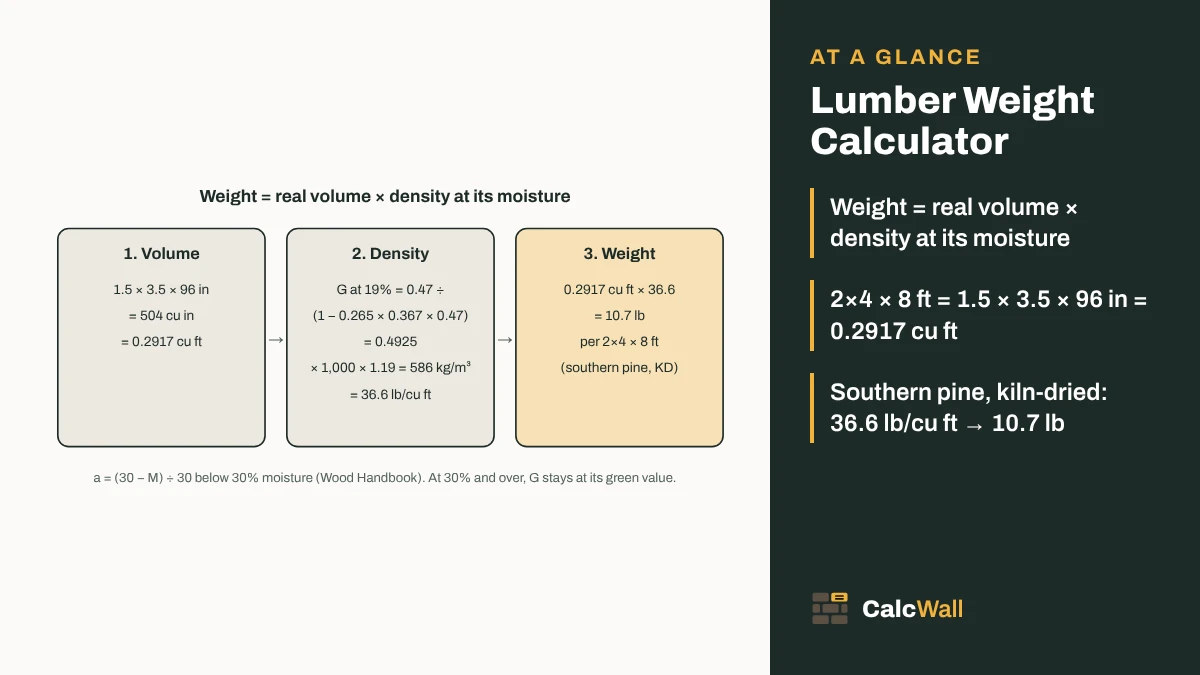
Quick answer: lumber weight = real volume × density at the wood’s moisture. A kiln-dried southern pine 2×4 × 8 ft is 0.2917 cu ft × 36.6 lb per cu ft = about 10.7 lb. Wet from the treating plant it is about 15 lb. Spruce (SPF) is about 7.4 lb.
How to calculate lumber weight
Weight is volume times density. That part is easy. The catch is that both numbers move. The volume depends on the real size, not the name on the tag. The density depends on the species and on how much water is in the wood. Get those two right and the rest is arithmetic.
- Find the real size. A 2×4 is 1½ × 3½ in when dry. Multiply thickness × width × length, all in inches, and divide by 1,728 for cubic feet. An 8 ft 2×4 is 1.5 × 3.5 × 96 = 504 cu in = 0.2917 cu ft.
- Find the specific gravity at your moisture. The USDA Wood Handbook lists a “green” specific gravity for each species. Below 30% moisture the wood shrinks, so the specific gravity goes up a little: G = Gb ÷ (1 − 0.265 × a × Gb), where a = (30 − M) ÷ 30.
- Turn it into density. Density = 1,000 × G × (1 + M/100) kg/m³. Multiply by 0.06243 for pounds per cubic foot.
- Multiply. Volume × density = weight. Then times the number of pieces.
G(M) = Gb ÷ (1 − 0.265 · a · Gb), a = (30 − M) ÷ 30, for M under 30%
Density = 1,000 · G(M) · (1 + M/100) kg/m³ · Weight = real volume × density
Those two equations are the Wood Handbook’s (Equations 3–5 and 3–6a in the 1999 edition, the same method as Equations 4–9 to 4–12 in the 2010 edition).
We checked our code against the Handbook’s own examples. Sugar maple with a green specific gravity of 0.56 comes out at 0.59 and about 707 kg/m³ at 20% moisture; the Handbook says 0.59 and 708. At 50% it gives 840 kg/m³, the same as the Handbook. White ash at 12% gives 675 kg/m³ against the 678 the Handbook reads off its chart.
At 30% moisture and above, the cell walls are full and only the empty spaces hold more water. The wood stops swelling, so G stays at its green value and only the (1 + M/100) part grows.
Using the calculator
- Weigh by. “Lumber size” for 2×4, 2×6, 4×4 and the rest. “Measured size” if you have rough, metric or odd stock. “Board feet” for hardwood bought by the board foot.
- Species. Eight softwoods and ten hardwoods from the Wood Handbook. Southern pine is the usual treated lumber. SPF and hem-fir are groups of species; we use Engelmann spruce and western hemlock as stand-ins. Pick “Other” to type any specific gravity.
- Moisture. Kiln-dried (19%), seasoned (12%), wet treated (75%), KDAT (19%), green, or your own meter reading.
- Pieces and payload. Enter how many, and if you are hauling, your truck or trailer payload. You get the percentage and the number of loads.
The answer is the total weight. Under it you get each piece, the density, the volume, the weight per foot and per nominal board foot, and the total in tons. It works in pounds or kilograms, and the link in your address bar reopens the same numbers.
Nominal vs actual sizes
Lumber is named by its size before it was dried and planed. The finished board is smaller.
PS 20, the American Softwood Lumber Standard, sets the minimum dressed sizes. For dry lumber (19% moisture or less), 2 to 6 in sizes are ½ in under, 8 in and wider are ¾ in under, and a 1 in board is ¾ in thick. Green lumber is planed a little bigger so it ends up close to the dry size once it shrinks.
| Nominal | Dry size (in) | Green size (in) | Real area vs name |
|---|---|---|---|
| 1×4 | ¾ × 3½ | 25⁄32 × 3 9⁄16 | 66% |
| 1×6 | ¾ × 5½ | 25⁄32 × 5⅝ | 69% |
| 2×4 | 1½ × 3½ | 1 9⁄16 × 3 9⁄16 | 66% |
| 2×6 | 1½ × 5½ | 1 9⁄16 × 5⅝ | 69% |
| 2×8 | 1½ × 7¼ | 1 9⁄16 × 7½ | 68% |
| 2×10 | 1½ × 9¼ | 1 9⁄16 × 9½ | 69% |
| 2×12 | 1½ × 11¼ | 1 9⁄16 × 11½ | 70% |
| 4×4 | 3½ × 3½ | 3 9⁄16 × 3 9⁄16 | 77% |
| 6×6 | 5½ × 5½ | 5½ × 5½ | 84% |
Minimum dressed sizes from PS 20-20, Table 3. A 6×6 is a timber: ½ in off, dry or green. The area column is plain arithmetic on the dry size.
Hardwood is different. It is sold rough, by the quarter-inch (4/4 is 1 in thick), and priced by the board foot on its real size. For hardwood, use “Measured size” or “Board feet”.
Wood density by species and moisture
Specific gravity is the weight of the wood substance compared with water. The Wood Handbook measures it on ovendry weight, with the volume taken green or at 12% moisture. A higher number means a heavier, usually stronger wood. Douglas-fir and southern pine sit near 0.45 to 0.47 green. Spruce and cedar are near 0.31 to 0.33. Oaks are 0.56 to 0.60.
| Species | Specific gravity, green | at 12% | lb/cu ft at 12% | at 19% | Green MC (heart / sap) | lb/cu ft green |
|---|---|---|---|---|---|---|
| Southern pine (loblolly) | 0.47 | 0.51 | 35.5 | 36.6 | 33% / 110% | 50.3 |
| Douglas-fir, Coast | 0.45 | 0.48 | 33.9 | 35.0 | 37% / 115% | 49.4 |
| Hemlock, western (Hem-fir) | 0.42 | 0.45 | 31.5 | 32.5 | 85% / 170% | 59.6 |
| Spruce, Engelmann (SPF) | 0.33 | 0.35 | 24.4 | 25.3 | 51% / 173% | 43.7 |
| Pine, ponderosa | 0.38 | 0.40 | 28.3 | 29.3 | 40% / 148% | 46.0 |
| Larch, western | 0.48 | 0.52 | 36.3 | 37.4 | 54% / 119% | 55.9 |
| Redcedar, western | 0.31 | 0.32 | 22.8 | 23.7 | 58% / 249% | 49.1 |
| Redwood (old-growth) | 0.38 | 0.40 | 28.3 | 29.3 | 86% / 210% | 58.8 |
| Oak, northern red | 0.56 | 0.63 | 43.0 | 44.0 | 80% / 69% | 61.0 |
| Oak, white | 0.60 | 0.68 | 46.4 | 47.3 | 64% / 78% | 64.1 |
| Maple, sugar (hard maple) | 0.56 | 0.63 | 43.0 | 44.0 | 65% / 72% | 58.9 |
| Ash, white | 0.55 | 0.60 | 42.1 | 43.2 | 46% / 44% | 49.8 |
| Birch, yellow | 0.55 | 0.62 | 42.1 | 43.2 | 74% / 72% | 59.4 |
| Walnut, black | 0.51 | 0.55 | 38.8 | 39.9 | 90% / 73% | 57.8 |
| Cherry, black | 0.47 | 0.50 | 35.5 | 36.6 | 58% / — | 46.4 |
| Yellow-poplar | 0.40 | 0.42 | 29.9 | 30.9 | 83% / 106% | 48.6 |
| Aspen, quaking | 0.35 | 0.38 | 25.9 | 26.9 | 95% / 113% | 44.6 |
| Basswood, American | 0.32 | 0.37 | 23.6 | 24.5 | 81% / 133% | 41.4 |
Specific gravity: Wood Handbook (2010) Table 5–3b. Green moisture: Table 4–1 averages for heartwood and sapwood. Densities are worked from the green specific gravity with the Handbook equations above; “green” uses the middle of the heartwood and sapwood figures. Hemlock’s 4–1 row is western hemlock; redwood’s is “redwood”; aspen’s is “aspen”.
The “at 12%” column is the Handbook’s own measured value. Our equation, starting from the green value, lands within 0.035 of it for every species here; basswood shows the biggest gap. We start from the green value for every moisture so the curve is smooth. That is also why the table can show weights at any moisture you type.
Moisture content is water weight divided by dry wood weight. So a board at 100% holds its own weight in water. Green softwood sapwood often sits well above 100%, which is why a fresh-sawn load can be half again as heavy as a kiln-dried one. The green numbers in the table are averages and real trees vary a lot, so for green wood a moisture meter reading beats any table.
Weight per linear foot chart
Pounds per foot of length, kiln-dried at 19%, dry dressed sizes. Multiply by the length in feet for one board.
| Size | Southern pine | Douglas-fir | Hem-fir (W. hemlock) | SPF (Engelmann spruce) |
|---|---|---|---|---|
| 1×4 | 0.67 lb/ft | 0.64 lb/ft | 0.59 lb/ft | 0.46 lb/ft |
| 1×6 | 1.05 lb/ft | 1.00 lb/ft | 0.93 lb/ft | 0.73 lb/ft |
| 1×8 | 1.38 lb/ft | 1.32 lb/ft | 1.23 lb/ft | 0.96 lb/ft |
| 1×12 | 2.14 lb/ft | 2.05 lb/ft | 1.91 lb/ft | 1.48 lb/ft |
| 2×4 | 1.33 lb/ft | 1.27 lb/ft | 1.19 lb/ft | 0.92 lb/ft |
| 2×6 | 2.10 lb/ft | 2.00 lb/ft | 1.86 lb/ft | 1.45 lb/ft |
| 2×8 | 2.76 lb/ft | 2.64 lb/ft | 2.46 lb/ft | 1.91 lb/ft |
| 2×10 | 3.53 lb/ft | 3.37 lb/ft | 3.13 lb/ft | 2.44 lb/ft |
| 2×12 | 4.29 lb/ft | 4.10 lb/ft | 3.81 lb/ft | 2.97 lb/ft |
| 4×4 | 3.11 lb/ft | 2.97 lb/ft | 2.77 lb/ft | 2.15 lb/ft |
| 4×6 | 4.89 lb/ft | 4.67 lb/ft | 4.35 lb/ft | 3.39 lb/ft |
| 6×6 | 7.69 lb/ft | 7.34 lb/ft | 6.83 lb/ft | 5.32 lb/ft |
Worked with the calculator’s engine: PS 20 dry sizes × Wood Handbook density at 19%. For kilograms per meter, multiply by 1.488.
Some handy readings: a kiln-dried southern pine 2×10 × 12 ft is 3.53 × 12 = 42.4 lb. A Douglas-fir 2×12 × 16 ft is 4.10 × 16 = 65.6 lb. An SPF 2×4 × 10 ft stud is 0.92 × 10 = 9.2 lb.
Pressure-treated lumber weight
Treated lumber is heavier because it is wet. The preservative goes in as a water solution under pressure, and the wood leaves the plant soaked. We could not find a current published average for modern treatments, so the calculator uses the one figure we could read: a 1997 extension answer that freshly treated wood is at “75% or higher”. Treat 75% as a floor, not a ceiling.
- Wet treated, 75%: southern pine weighs about 51.3 lb per cu ft. A 2×4 × 8 is about 15.0 lb, a 4×4 × 8 about 34.9 lb, a 2×6 × 16 about 47.1 lb.
- KDAT (kiln-dried after treatment): dried back to 19% for dimension lumber. It weighs about the same as plain kiln-dried lumber, 10.7 lb for a southern pine 2×4 × 8.
- Treated wood that has sat out: it dries over weeks. If you have a moisture meter, choose “My own moisture reading” and type it in.
The chemical retained in the wood is small next to the water, so the calculator does not add any weight for it.
Worked examples
One 2×4 × 8 ft, kiln-dried southern pine
Volume 1.5 × 3.5 × 96 ÷ 1,728 = 0.2917 cu ft. a = (30 − 19) ÷ 30 = 0.3667. G = 0.47 ÷ (1 − 0.265 × 0.3667 × 0.47) = 0.4925. Density = 1,000 × 0.4925 × 1.19 = 586.1 kg/m³ = 36.59 lb/cu ft. Weight = 0.2917 × 36.59 = 10.67 lb.
Worked example: a bundle of 2x4s
Fifty kiln-dried southern pine 2×4 × 8 ft: 50 × 10.67 = 534 lb, 0.27 US tons. With a 1,500 lb trailer payload that is 36% of it, one load. If they are wet treated: 50 × 14.98 = 749 lb.
Wet treated 4×4 posts
Ten 4×4 × 8 ft, southern pine at 75%: volume 3.5 × 3.5 × 96 ÷ 1,728 = 0.6806 cu ft each. G stays 0.47 (over 30%). Density = 1,000 × 0.47 × 1.75 = 822.5 kg/m³ = 51.35 lb/cu ft. Each post 34.94 lb, ten posts 349 lb.
Green lumber
A fresh-sawn southern pine 2×4 × 8 at the species’ middle green moisture of 71.5%, green size 1 9⁄16 × 3 9⁄16 in: 0.3092 cu ft × 50.32 lb/cu ft = 15.6 lb, about 46% more than kiln-dried.
Hardwood by the board foot
100 board feet of northern red oak at 8% moisture: G = 0.56 ÷ (1 − 0.265 × 0.7333 × 0.56) = 0.6284. Density = 1,000 × 0.6284 × 1.08 = 678.7 kg/m³ = 42.37 lb/cu ft. 100 board feet is 8.333 cu ft, so 353 lb.
Metric
A 38 × 89 mm stud, 2.4 m long, kiln-dried southern pine: 0.038 × 0.089 × 2.4 = 0.008117 m³ × 586.1 kg/m³ = 4.76 kg.
Plywood and OSB sheet weights
Sheet goods are not worked out from species here; they are glued products with their own make-up. These are published planning weights for wood structural panels, plywood or OSB.
| Panel thickness | lb per sq ft | 4 × 8 sheet (32 sq ft) | kg per m² |
|---|---|---|---|
| 11/32 or 3/8 in | 1.0 – 1.2 | 32 – 38 lb | 4.9 – 5.9 |
| 15/32 or 1/2 in | 1.4 – 1.7 | 45 – 54 lb | 6.8 – 8.3 |
| 19/32 or 5/8 in | 1.8 – 2.1 | 58 – 67 lb | 8.8 – 10.3 |
| 23/32 or 3/4 in | 2.2 – 2.5 | 70 – 80 lb | 10.7 – 12.2 |
| 7/8 in | 2.6 – 2.9 | 83 – 93 lb | 12.7 – 14.2 |
| 1 1/8 in | 3.3 – 3.6 | 106 – 115 lb | 16.1 – 17.6 |
Boise Cascade Technical Note GE-1 (2020), citing APA EWS TT-019 (1998). Sheet weight and kg/m² are unit conversions. Wet panels weigh more.
To count the sheets first, use the plywood calculator, then multiply by the sheet weight.
Notes for pros
Weigh one. For a load you must not overload, weigh a typical piece and multiply. The calculator gets you within the right range, not to the pound.
Payload is not GVWR. Your payload is what is left after the truck, fuel and people. Check the door-jamb sticker.
Roof loading. Spread bundles over walls or girders, not mid-span. The weight here is the dead load of the stack, not a structural check.
Mixed loads. Run each size and species separately and add them up with the share list.
- Species groups (SPF, hem-fir, southern pine) mix several species of different weights. We show one representative species each and name it.
- No rule of thumb here for bundle or unit counts: mills package differently. Count the pieces and enter them.
- Need the board feet or the cut list first? Use the board foot calculator or the lumber calculator. Framing a wall? The framing calculator counts studs and plates, and a deck calculator list can be weighed here size by size.
Sources
Where the numbers on this page come from. Everything else is plain geometry and unit conversion, which the calculator does with exact factors.
- Wood Handbook: Wood as an Engineering Material (Centennial Edition), General Technical Report FPL-GTR-190, USDA Forest Service, Forest Products Laboratory (copy hosted by the California Air Resources Board), April 2010; read 17 November 2026. Used for: Chapter 5, Table 5–3b (pages 5–9 to 5–13): specific gravity of each species, green and at 12% moisture, on ovendry weight. Chapter 4, Table 4–1 (page 4–2): average moisture content of green heartwood and sapwood. Chapter 4: fiber saturation point about 30%, the density methods of Equations (4–9) to (4–12) and the white ash check (basic specific gravity 0.55 gives about 678 kg/m³ at 12%)
- Wood Handbook: Wood as an Engineering Material, General Technical Report FPL-GTR-113, Chapter 3 “Physical Properties and Moisture Relations of Wood”, USDA Forest Service, Forest Products Laboratory (copy hosted by WOODWEB), 1999; read 17 November 2026. Used for: Equation (3–5), Gm = Gb ÷ (1 − 0.265 a Gb) with a = (30 − M) ÷ 30 for M under 30, and Equation (3–6a), density = 1,000 Gm (1 + M/100) kg/m³; its sugar maple example (0.56 → 0.59 and about 708 kg/m³ at 20%; 840 kg/m³ at 50%). We quote these numbers because the 2010 PDF we could open did not show the equation text
- Voluntary Product Standard PS 20-20, American Softwood Lumber Standard, National Institute of Standards and Technology, January 2020; read 17 November 2026. Used for: Table 3, nominal and minimum dressed sizes of boards, dimension and timbers, dry and green; section 2.7, dry lumber is 19% moisture content or less
- Technical Note GE-1: Weights of Building Materials, Boise Cascade Wood Products, Rev. 06.20 / 07.20 (2020); read 17 November 2026. Used for: plywood and OSB weights in pounds per square foot by thickness; the note cites APA EWS TT-019 (1998), “Approximate Engineering Dead Load Weight of Wood Structural Panels”
- Q&A: Treated Lumber’s Moisture Content, Journal of Light Construction (answer by a University of Wisconsin–Madison wood processing extension specialist), 1 July 1997; read 17 November 2026. Used for: “After pressure-treating with chromated copper arsenate (CCA), the moisture content will be 75% or higher”: the 75% wet-treated setting
- Kiln Dried After Treatment (KDAT), Technical Note, Culpeper Wood Preservers, undated PDF; read 17 November 2026. Used for: wet treated wood is above the fiber saturation point; KDAT is dried to 19% for dimensional lumber (18% for plywood) and is lighter to handle
Frequently asked questions
How much does a 2x4 weigh?
A kiln-dried 2×4 × 8 ft weighs about 10.7 lb in southern pine, 10.2 lb in Douglas-fir and 7.4 lb in Engelmann spruce (an SPF species). Those are Wood Handbook averages at 19% moisture on the real 1½ × 3½ in size. A wet pressure-treated southern pine 2×4 × 8 is about 15 lb. Real boards can be 10% or more either side.
How much does a 4x4 post weigh?
A kiln-dried southern pine 4×4 is about 3.1 lb per foot, so 24.9 lb for 8 ft and 18.7 lb for 6 ft. Most 4×4 posts are pressure-treated, and wet from the plant (75% moisture) the same 8 ft post is about 34.9 lb. The real size is 3½ × 3½ in.
Is pressure-treated lumber heavier?
Yes, mostly because of water. Treating forces a water-based solution into the wood, and a 1997 extension answer puts freshly treated wood at 75% moisture or higher. At 75% a southern pine 2×4 × 8 is about 15.0 lb against 10.7 lb kiln-dried, 40% more. Kiln-dried after treatment (KDAT) lumber is dried back to 19% and weighs close to untreated dry lumber.
Does wet wood weigh more?
Yes. Moisture content is the weight of water as a percentage of the dry wood, so wood at 100% holds as much water as wood. Below about 30% moisture the wood also swells as it takes on water, which the Wood Handbook equation allows for. Green lumber of the same size can weigh half again as much as kiln-dried.
How much does a bundle of 2x4s weigh?
Multiply the piece weight by the count. Fifty kiln-dried southern pine 2×4 × 8 ft weigh about 50 × 10.67 = 534 lb. Wet treated, the same 50 are about 749 lb. Enter the number of pieces and your trailer payload and the calculator tells you how many loads it is.
How much does a sheet of plywood weigh?
Boise Cascade’s building-materials note (2020, citing APA TT-019) lists 23/32 or ¾ in plywood or OSB at 2.2 to 2.5 lb per sq ft, so a 4 × 8 sheet is about 70 to 80 lb. A ½ in (15/32) sheet is 1.4 to 1.7 lb per sq ft, about 45 to 54 lb. See the panel table on this page.
Do I use the nominal or actual size for weight?
The actual size. A 2×4 is 1½ × 3½ in when dry under PS 20, which is 66% of a true 2 × 4 in. Using the nominal size would overstate its weight by about half. The calculator turns the name into the real size for you.
How much does lumber weigh per board foot?
It depends on species and moisture. A kiln-dried southern pine 2×4 weighs about 2.0 lb per nominal board foot, because a nominal board foot of 2×4 holds only 0.66 board feet of real wood. Rough hardwood sold by real board feet weighs density ÷ 12: red oak at 8% moisture is about 42.4 lb per cu ft, or 3.5 lb per board foot.
How accurate is a lumber weight calculator?
It is an estimate. The Wood Handbook figures are species averages, and real boards vary with growth rate, heartwood, knots and how wet they are. For a load you must not exceed, weigh one typical piece on a bathroom scale and multiply, or use the calculator with your own moisture meter reading.
Is this lumber weight calculator free to use online?
Yes. The CalcWall Lumber Weight Calculator is completely free and works online in any browser, on a phone, tablet or computer. There is nothing to download and no account to create, and the math runs right in your browser, so results appear as you type.