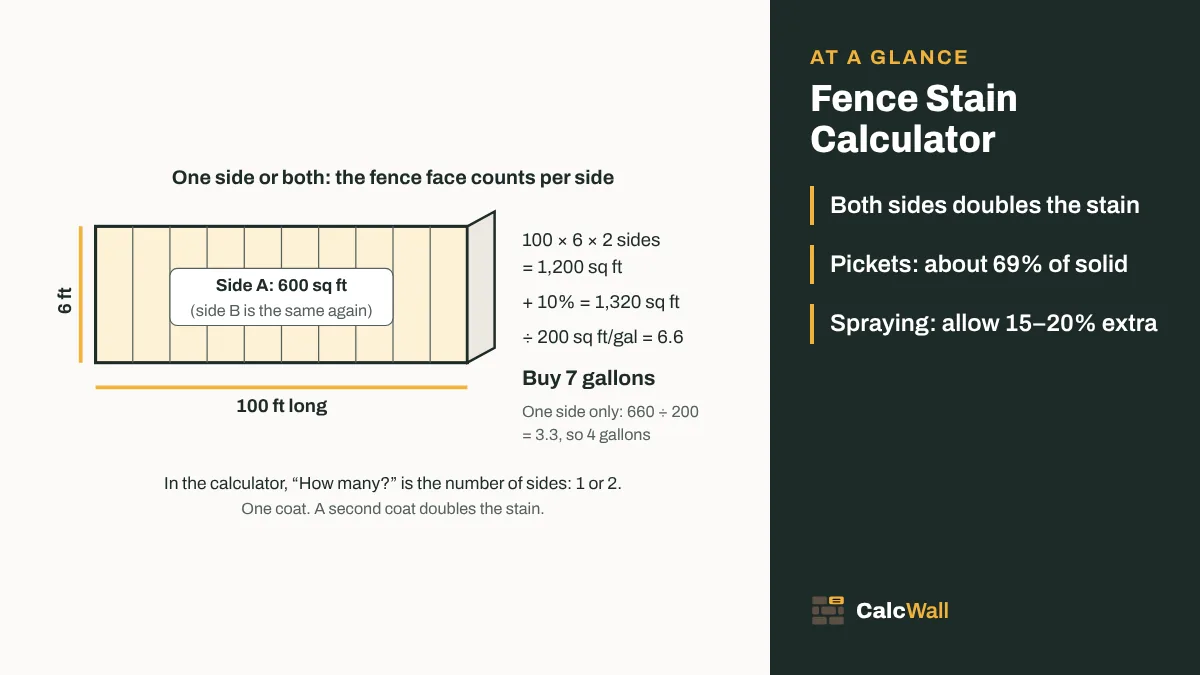
Quick answer: gallons = length × height × sides × 1.10 × coats ÷ coverage per gallon, rounded up. A 100 ft fence, 6 ft high, both sides, one coat at 200 sq ft per gallon is 1,320 ÷ 200 = 6.6, so 7 gallons of fence stain.
How to calculate fence stain
- Measure the fence length along the ground, and the height from the ground to the top of the boards. Enter each run with a different height as its own row.
- Set “How many?” to the number of sides you will stain: 1 or 2.
- Subtract anything you won’t stain, like a metal gate, under “Areas not stained”.
- Add about 10% for posts, rails, edges and the end grain at the top of each board. Use 15–20% if you spray.
- Multiply by the coats and divide by the coverage per gallon (or per litre) from the can. Round up.
Gallons = length × height × sides × (1 + waste) × coats ÷ coverage per gallon
The calculator rounds up to the next whole gallon, or the next whole litre in metric countries, and shows the exact figure before rounding. The defaults (200 sq ft per gallon, 5 m² per litre) are examples only. 200 sq ft per gallon is 4.91 m² per litre, so the two are close.
Metric example: a 30 m fence, 1.8 m high, both sides is 108 m², plus 10% = 118.8 m². At 5 m² per litre that is 23.76, so 24 litres.
One side or both sides
A fence has two faces, and each one counts. Most people stain their own side and leave the neighbor’s side alone, or agree to split the work. If you stain both, the fence stain doubles.
- The good side (the flat board face) is usually the one facing out. It is quick to stain.
- The back side has the rails and the posts. It takes longer and a bit more stain, which is one reason to keep the 10% allowance.
- The neighbor’s side is their call as much as yours. Agree before you stain it, and before you spray near it.
Fence stain by length and height
Solid fence, one coat with 10% extra at the calculator’s example rate of 200 sq ft per gallon. Gallons are rounded up; the exact figure is in brackets.
| Fence length | 4 ft high, one side | 4 ft high, both sides | 6 ft high, one side | 6 ft high, both sides |
|---|---|---|---|---|
| 50 ft | 2 (1.1) | 3 (2.2) | 2 (1.65) | 4 (3.3) |
| 100 ft | 3 (2.2) | 5 (4.4) | 4 (3.3) | 7 (6.6) |
| 150 ft | 4 (3.3) | 7 (6.6) | 5 (4.95) | 10 (9.9) |
| 200 ft | 5 (4.4) | 9 (8.8) | 7 (6.6) | 14 (13.2) |
| 300 ft | 7 (6.6) | 14 (13.2) | 10 (9.9) | 20 (19.8) |
For two coats, double the exact figure and round up again. For rough cedar at 125 sq ft per gallon, multiply the exact figure by 1.6 (200 ÷ 125).
Picket fences and gaps
The calculator treats the fence as a solid face. For a privacy fence with boards butted tight, that is right. For a picket fence it overstates the stain, but by less than you might think. The gaps are empty, yet you still stain the edge of every picket and the rails behind them.
To allow for gaps, shorten the length you enter:
Length to enter = fence length × (picket width + picket thickness) ÷ (picket width + gap)
Each picket has two edges. When you stain both sides, each side picks up about one edge, so add one thickness. Staining one side only? You will still catch both edges, so add the thickness twice. Then enter the rails as their own row: length × about 0.5 ft (a 2×4 rail shows 3½ in of face and two 1½ in edges) × the number of rails. Posts are covered by the 10%.
How much of a solid fence a picket fence works out at, per side, for 3½ in pickets ⅝ in thick:
| Gap between pickets | Face only | Face + one edge | Length to enter for 100 ft |
|---|---|---|---|
| 1 in | 78% | 92% | 91.7 ft |
| 1½ in | 70% | 83% | 82.5 ft |
| 2 in | 64% | 75% | 75 ft |
| 2½ in | 58% | 69% | 68.75 ft |
| 3½ in (gap = picket) | 50% | 59% | 58.9 ft |
A sprayer cancels some of that saving. A lot of what you spray at a picket fence goes straight through the gaps. That is why the spray section below suggests more waste.
Board-on-board, shadowbox and panels
- Board-on-board: two layers of boards that overlap. From each side you see a full face plus the edges of the second layer. Count it as solid on each side you stain and raise the waste to 15%. This is a rule of thumb; some calculators add 50% for box-style fences, which is safe but usually more than you need.
- Shadowbox: boards on alternate sides of the rails with gaps between. From each side you see one layer of boards and the backs of the other layer through the gaps, and the inside faces are hard to reach without a sprayer. Count it as solid, both sides, at 15–20% waste.
- Lattice tops: with two crossing layers of strips and their edges, lattice has close to the surface of a solid panel. Count its height in full; it is a safe figure.
- Panel fences (UK, Australia, New Zealand): enter one panel’s width × height and put the number of panels × sides in “How many?”. Ten 1.83 × 1.83 m panels, both sides, is How many = 20: 66.98 m² plus 10% = 73.68 m², at 5 m² per litre 14.74, so 15 litres. Rough-sawn overlap and feather-edge boards drink far more than planed wood, so check the tin’s figure for rough timber.
Spray, roller or brush
How you put the stain on changes how much you buy. A sprayer is several times faster on a long fence, but some of the stain never lands on the wood: it drifts in the wind, goes over the top and through the gaps, and lands on the ground or the neighbor’s side. Brushing loses very little and works stain into rough wood. Purdue’s extension guide says brushing gives semitransparent stain better penetration.
| Method | Speed | Waste setting to use | Notes |
|---|---|---|---|
| Brush or stain pad | Slowest | +10% | Best penetration on rough wood. Good for the posts and rails. |
| Roller (long nap) | Medium | +10% | Fast on flat privacy boards; follow with a brush in the gaps. |
| Pump-up garden sprayer | Fast | +15% | Low pressure, little drift; works with thin, oil-based stains. |
| Airless sprayer | Fastest | +20% | Most overspray. Back-brush or back-roll straight after. |
The waste settings are rule-of-thumb figures from how much ends up off target, not product ratings. Several makers allow spraying but ask you to back-brush or back-roll straight away so the color is even and the stain soaks in. A sprayer maker’s own advice: hold the gun about 12 in from the boards, overlap each pass by half, tape cardboard behind gaps to catch overspray and brush out any drips. Don’t spray on a windy day.
Coverage and the wood
Most fence boards are rough-sawn on at least one face, and rough wood takes about twice as much stain as smooth. Purdue’s extension guide gives semitransparent stain about 300–400 sq ft per gallon on smooth wood and 150–200 on rough. One current data sheet gives 300–400 smooth and 100–200 rough. One maker’s fence chart gives about 125 sq ft per gallon for cedar fences and 150 for pine and spruce.
- New, dry, rough cedar: very thirsty. Expect the low end, around 125–150 sq ft per gallon.
- Old, gray fence: clean it first; even then, use the low end of the range.
- Previously stained, sound boards: the high end, and often one coat is enough.
- Pressure-treated pine: it has to dry out after treatment before stain will soak in. Wet treated wood takes little stain and the stain sits on top.
For the number of coats, follow the label. Semitransparent stains are often a single coat; on rough wood some are applied as two coats, wet-on-wet. Solid stains are usually two. The Coats box multiplies the whole area, so two coats need twice the stain.
Worked examples
Each of these matches what the calculator shows with the same inputs.
The default fence, both sides
100 ft long, 6 ft high, both sides (How many = 2), one coat at 200 sq ft per gallon, 10% extra: 100 × 6 × 2 = 1,200 sq ft × 1.10 = 1,320 ÷ 200 = 6.6, so 7 gallons. Sprayed with 20% extra: 1,440 ÷ 200 = 7.2, so 8 gallons.
A 4 ft picket fence
150 ft of 4 ft fence, 3½ in pickets ⅝ in thick with 2½ in gaps, two rails, both sides, one coat at 200 sq ft per gallon. Length to enter: 150 × 4.125 ÷ 6 = 103.125 ft. Rows: pickets 103.125 × 4 × 2 = 825 sq ft; rails 150 × 0.5 × 2 = 150 sq ft. Total 975 × 1.10 = 1,072.5 ÷ 200 = 5.36, so 6 gallons. Counted as solid it would be 7.
Rough cedar privacy fence, one side
80 ft of 6 ft rough-sawn cedar, your side only, at 125 sq ft per gallon: 80 × 6 × 1 = 480 × 1.10 = 528 ÷ 125 = 4.22, so 5 gallons for one coat. If the label calls for two coats wet-on-wet, 1,056 ÷ 125 = 8.45, so 9 gallons.
Metric fence, one side
25 m of 1.8 m fence, one side, at 5 m² per litre: 25 × 1.8 × 1 = 45 m² × 1.10 = 49.5 ÷ 5 = 9.9, so 10 litres. In tins, two 5 L.
Prep and timing
- Let a new fence dry. One maker suggests at least 4–6 weeks of weathering, or a moisture reading of 12% or less. Sprinkle some water on a board: if it soaks in, stain will too.
- Clean it first. Wash off dirt and mildew and let the wood dry for at least 48 hours before staining. If you use a pressure washer, keep it gentle so you don’t fur up the grain.
- Cover what you don’t want stained. Plants, the house wall and the neighbor’s car. With a sprayer, add a drop cloth along the bottom.
- Pick your weather. Dry, mild and calm, with no rain due for a day. Hot sun makes stain dry before it soaks in.
- Plan for upkeep. Semitransparent stain on a fence usually needs a fresh coat every 2–3 years, and the second time takes less.
Still building it? The wood fence calculator works out posts, rails and pickets, and the privacy fence calculator handles board-on-board. For any fence type, try the fence calculator. Staining the deck as well? The deck stain calculator adds railings and stairs.
Notes for fence contractors
Price the back side separately. The rail side takes longer and more stain than the board face. Quote one side and both sides as two lines so the customer sees the split.
Spray, then back-brush. Spraying gets the stain on; a brush right behind works it into the rough grain and picks up runs. Budget 15–20% extra for the sprayer.
Measure the real coverage. On rough cedar, note how many gallons the first 50 ft took and adjust the order before the next delivery. Labels give a range for a reason.
Mind the neighbor. Overspray on a car or siding next door costs more than the stain. Get agreement before you touch the far side and shield it if you spray.
Sources
Where the numbers on this page come from. Everything else is plain geometry and unit conversion, which the calculator does with exact factors.
- Selection and Application of Exterior Finishes for Wood (NCR-135), Purdue University Cooperative Extension Service (D. L. Cassens, W. C. Feist), rev. 3/86. Used for: semitransparent stain covering about 300–400 sq ft per gallon on smooth wood and 150–200 sq ft on rough wood; two coats wet-on-wet on rough-sawn or weathered lumber; brushing giving better penetration than other methods
- READY SEAL Initial Application Instructions 2026, Ready Seal. Used for: an example of coverage by fence wood: about 125 sq ft per gallon on cedar fences and 150 on spruce, pine and treated pine; brush, roller, pump-up and airless sprayer all allowed; no spraying on windy days; moisture content of 12% or less
- Step by step: how to properly stain a fence, Ready Seal. Used for: letting a new fence weather at least 4–6 weeks; at least 48 hours of drying after washing; restaining every 2–3 years
- ZAR Deck and Siding Semi-Transparent product data sheet, Sika USA, September 2026, version 01.02. Used for: an example of label coverage: 300–400 sq ft per gallon smooth and 100–200 rough; spraying allowed if followed by dry-brushing or back-rolling for even color
- BEHR Oil-Latex Redwood Stain product page, Behr. Used for: a second example of label coverage (200–400 sq ft per gallon); a long-nap roller or airless sprayer for rough surfaces, followed straight away by back-brushing or back-rolling
- How to stain a fence with a sprayer, Wagner SprayTech. Used for: holding the spray gun about 12 in from the surface with 50% overlap, taping cardboard behind gaps to catch overspray, and brushing out drips
Frequently asked questions
How much stain do I need for a fence?
Multiply the length by the height and by the number of sides, add about 10%, multiply by the coats and divide by the coverage per gallon. A 100 ft × 6 ft fence stained on both sides is 1,200 sq ft; plus 10% is 1,320 sq ft. At 200 sq ft per gallon that is 6.6, so 7 gallons.
How much fence does a gallon of stain cover?
Labels typically give a range per coat, often around 300–400 sq ft on smooth wood and 100–200 on rough-sawn wood. Most fence boards are rough-sawn, so use the lower figure. One maker lists about 125 sq ft per gallon for cedar fences and 150 for pine.
Should I count both sides?
Only if you are staining both sides. Set “How many?” to 1 for one side or 2 for both. Both sides doubles the stain.
Does a picket fence need less stain?
Yes, but less than the gaps suggest, because you also stain the picket edges and the rails. Multiply the length by (picket width + thickness) ÷ (picket width + gap) and add the rails as their own row. A 3½ in picket with 2½ in gaps uses about 69% of a solid fence, per side.
How many coats of fence stain?
Follow the label. Many semitransparent stains are one coat; some go on as two coats wet-on-wet on rough wood. Solid stains are usually two. Set the Coats box to match.
Is it better to spray or brush fence stain?
Spraying is much faster, but some stain drifts away, so allow 15–20% extra instead of 10%. Brushing works stain into rough wood better. Many labels ask you to back-brush or back-roll straight after spraying, which gives you the speed and the penetration.
How much stain for 100 feet of 6 ft fence?
One side is 600 sq ft; with 10% extra, 660 sq ft, which at 200 sq ft per gallon is 3.3, so 4 gallons. Both sides is 6.6, so 7 gallons, for one coat.
How much stain for a 4 ft fence?
A 4 ft fence is 4 sq ft per running foot per side. 150 ft of 4 ft solid fence on one side is 600 sq ft; with 10% extra and 200 sq ft per gallon, 3.3, so 4 gallons. Both sides, 7 gallons.
How long should a new fence wait before staining?
Long enough for the wood to dry. One maker suggests at least 4–6 weeks for new wood, or a moisture reading of 12% or less. A quick check: sprinkle water on a board. If it soaks in, the wood is ready; if it beads, wait.
How many litres of fence stain do I need?
In metric the method is the same: a 30 m fence 1.8 m high, stained on both sides, is 108 m², plus 10% is 118.8 m². At 5 m² per litre that is 23.76, so 24 litres.
Is this fence stain calculator free to use online?
Yes. The CalcWall Fence Stain Calculator is completely free and works online in any browser, on a phone, tablet or computer. There is nothing to download and no account to create, and the math runs right in your browser, so results appear as you type.