Quick answer: gallons = deck area × 1.10 × coats ÷ coverage per gallon, rounded up. A 16 × 12 ft deck (192 sq ft) with two coats at 250 sq ft per gallon is 422.4 ÷ 250 = 1.69, so 2 gallons of deck stain.
When can I stain? Check the next 7 days
Type your US ZIP code to see the next 7 days from the US National Weather Service, with a badge for each day: Good, Risky or No for deck stain. It is a planning guide, not a guarantee: check the forecast again the evening before.
The forecast check covers US ZIP codes only (it uses the US National Weather Service). Wherever you are, the rules below still apply: hold them against your own national weather service’s forecast.
How each day is rated
- Good The high is between 50 and 90 °F (10 and 32 °C) and rain is no more than a slight chance (20%) in the day and the night after, so the stain gets about 24 dry hours.
- Risky A chance of rain (30–50%) in the day or night, a high above 90 °F (32 °C), or the night not in the forecast yet.
- No A high below 50 °F (10 °C), or rain likely (60% or more) in the day or the night after.
These are typical label figures (Cabot’s guide gives 50–90 °F and no rain for 12–24 hours). Your product’s label comes first: some stains allow 40 °F, others need 48 dry hours. The wood should be dry too.
Rain words follow the National Weather Service: 20% is a “slight chance”, 30–50% a “chance”, 60–70% “likely”. The forecast is for the ZIP’s center point, so a hilltop or a valley can be a few degrees off.
Where these rules come from
- How to stain an exterior deck, Cabot, web guide, read 16 November 2026. Used for: apply when air and wood are 50–90 °F; no rain in the next 12–24 hours; avoid direct sunlight. Your product’s label comes first.
- API Web Service, US National Weather Service, api.weather.gov documentation, read 16 November 2026. Used for: the 7-day forecast in 12-hour periods; free open data, no key
- Forecast terms (probability of precipitation), NWS Binghamton, NY, web page, read 16 November 2026. Used for: 20% slight chance, 30–50% chance, 60–70% likely
- ZCTA Gazetteer file, US Census Bureau, 2025 Gazetteer (2025_Gaz_zcta_national). Used for: the point each ZIP code is looked up at (ZCTA internal point)
How to calculate deck stain
- Measure the deck floor. Length × width of the boards. Split an L-shaped deck into rectangles and enter each as its own row.
- Add the railings and stairs as extra rows (see below). Together they often take as much stain as the floor.
- Subtract anything you won’t stain, like a hot tub cut-out or a tiled planter top, under “Areas not stained”.
- Add about 10% for board edges, the gaps between boards, end grain and what stays in the tray.
- Multiply by the coats and divide by the coverage per gallon (or per litre) printed on the can. Round up to whole gallons.
Gallons = (deck + railings + stairs − not stained) × (1 + waste) × coats ÷ coverage per gallon
The calculator rounds the answer up to the next whole gallon, or the next whole litre in metric countries. It also shows the exact figure before rounding, so you can see when a quart would do instead of a full extra gallon.
Metric example: a 5 × 4 m deck is 20 m², plus 10% = 22 m²; two coats = 44 m². At 6 m² per litre that is 7.33, so 8 litres. The two defaults (250 sq ft per gallon, 6 m² per litre) are example figures and close to each other: 250 sq ft per gallon is 6.14 m² per litre.
Coverage per gallon and the wood
The coverage you type in matters more than anything else on this page. Two decks of the same size can need twice as much stain because of the wood, not the product.
Extension and manufacturer data show a clear pattern. Purdue’s extension guide puts semitransparent stain at about 300–400 sq ft per gallon on smooth wood and 150–200 sq ft on rough wood. One current oil-based deck stain data sheet gives 300–400 smooth and 100–200 rough. Another maker lists about 150 sq ft per gallon for treated pine and cedar decks. Rough, gray, weathered or freshly sanded softwood is thirsty; smooth boards that were stained a couple of years ago take much less.
How much deck stain a 16 × 12 ft deck needs at different coverage rates, with 10% extra:
| Coverage per gallon | Per litre (approx.) | Typical wood | 1 coat | 2 coats |
|---|---|---|---|---|
| 100 sq ft | 2.5 m² | Very rough or badly weathered | 3 gal (2.11) | 5 gal (4.22) |
| 150 sq ft | 3.7 m² | Rough-sawn, gray or new softwood | 2 gal (1.41) | 3 gal (2.82) |
| 200 sq ft | 4.9 m² | Weathered but sound | 2 gal (1.06) | 3 gal (2.11) |
| 250 sq ft | 6.1 m² | Calculator default | 1 gal (0.84) | 2 gal (1.69) |
| 300 sq ft | 7.4 m² | Smooth, previously stained | 1 gal (0.70) | 2 gal (1.41) |
| 400 sq ft | 9.8 m² | Smooth boards, light maintenance coat | 1 gal (0.53) | 2 gal (1.06) |
Numbers in brackets are the exact gallons before rounding up. “Typical wood” is a guide, not a rating. If the can gives a range, use the low end for an old deck and the high end for smooth, sound boards.
Not sure what your boards will take? Test them. A quarter cup is 1/64 of a gallon. Brush it onto a 2 × 2 ft square of deck (4 sq ft): if it just covers, your wood takes about 4 × 64 = 256 sq ft per gallon. If it runs out at half the square, you are nearer 128. Easier still on a big job: stain one section, note how much went in, and work out the coverage before you buy the rest.
Railings, stairs and extras
This is where most estimates go wrong. A calculator that only asks for length and width misses the railing, the stairs and the fascia, and those parts have a lot of surface. Add each as its own row.
Railings
A baluster railing has far more wood than its outline suggests. Each 2×2 baluster is 1½ in square, so it has four faces and 6 in of girth. With 4 in gaps they sit 5½ in on center, about 2.2 per foot, which is 13 in of baluster surface for every 12 in of railing. Add the top cap, the bottom rail and the posts, and the stain area is about twice the flat face of the railing.
- Baluster railing: enter railing length × height and set How many to 2.
- Solid board railing: length × height, How many = 2 if you stain both sides.
- Glass or cable infill: count only the posts and rails. A 4×4 post has 4 faces of 3½ in, 14 in of girth, so a 3 ft post is about 3.5 sq ft.
Stairs
For each step, add the tread depth and the riser height, then multiply by the step width. A step 4 ft wide with an 11¼ in tread and a 7½ in riser is 4 × (18¾ ÷ 12) = 4 × 1.5625 = 6.25 sq ft. Enter it as width 4, length 1.5625, How many = the number of steps. Open risers? Leave the riser out. Stringers add a little more; on a short flight the 10% usually covers them.
Other parts
- Fascia and rim boards: the exposed perimeter × board height.
- Built-in benches and planters: each face is a rectangle.
- Pergola posts and beams: worth a separate run, as they are often a different product or color.
Deck stain for common deck sizes
Floor only, two coats with 10% extra, at the calculator’s example rate of 250 sq ft per gallon. Add railings and stairs on top.
| Deck size | Floor area | Staining area (2 coats + 10%) | Gallons at 250 sq ft/gal |
|---|---|---|---|
| 10 × 10 ft | 100 sq ft | 220 sq ft | 1 (0.88) |
| 12 × 12 ft | 144 sq ft | 316.8 sq ft | 2 (1.27) |
| 16 × 12 ft | 192 sq ft | 422.4 sq ft | 2 (1.69) |
| 12 × 20 ft | 240 sq ft | 528 sq ft | 3 (2.11) |
| 16 × 16 ft | 256 sq ft | 563.2 sq ft | 3 (2.25) |
| 20 × 20 ft | 400 sq ft | 880 sq ft | 4 (3.52) |
| 20 × 24 ft | 480 sq ft | 1,056 sq ft | 5 (4.22) |
Metric decks, two coats with 10% extra at 6 m² per litre:
| Deck size | Floor area | Staining area | Litres at 6 m²/L |
|---|---|---|---|
| 3 × 3 m | 9 m² | 19.8 m² | 4 (3.30) |
| 4 × 3 m | 12 m² | 26.4 m² | 5 (4.40) |
| 5 × 4 m | 20 m² | 44 m² | 8 (7.33) |
| 6 × 4 m | 24 m² | 52.8 m² | 9 (8.80) |
| 6 × 5 m | 30 m² | 66 m² | 11 (11.00) |
Stain in metric countries is often sold in 1, 2.5 and 5 litre tins (sizes vary by brand), so turn the litres into tins at the end. 8 litres is a 5 L tin plus a 2.5 L and a 1 L, or two 5 L tins if the price per litre is better.
Coats, wet-on-wet and stain type
The Coats box multiplies the whole area. Take it from the label, not from habit.
- Transparent and semitransparent oil stains: often one coat. Some labels say plainly that more is not better: stain that cannot soak in sits on top, stays tacky and wears off unevenly.
- Wet-on-wet: on rough or weathered wood, some stains go on as two coats, the second before the first dries, and the excess is wiped off later. Count that as 2 coats.
- Solid stains: usually two coats. They behave like thin paint, and the Forest Products Laboratory advises against film-forming finishes on deck floors because they trap moisture and peel. They do better on railings.
- Maintenance coats: a deck stained two years ago with the same product often takes one light coat at the high end of the coverage range.
Not sure if the wood will take a second coat? One maker’s test: an hour after the first coat, put a few drops of stain on the boards and wipe them after 30–45 minutes. If color wipes off, the wood is full and a second coat will not soak in.
Worked examples
Each of these matches what the calculator shows with the same inputs.
The default deck, floor only
16 × 12 ft, two coats at 250 sq ft per gallon, 10% extra: 192 × 1.10 = 211.2 × 2 = 422.4 sq ft ÷ 250 = 1.69, so 2 gallons.
The same deck with railing and stairs
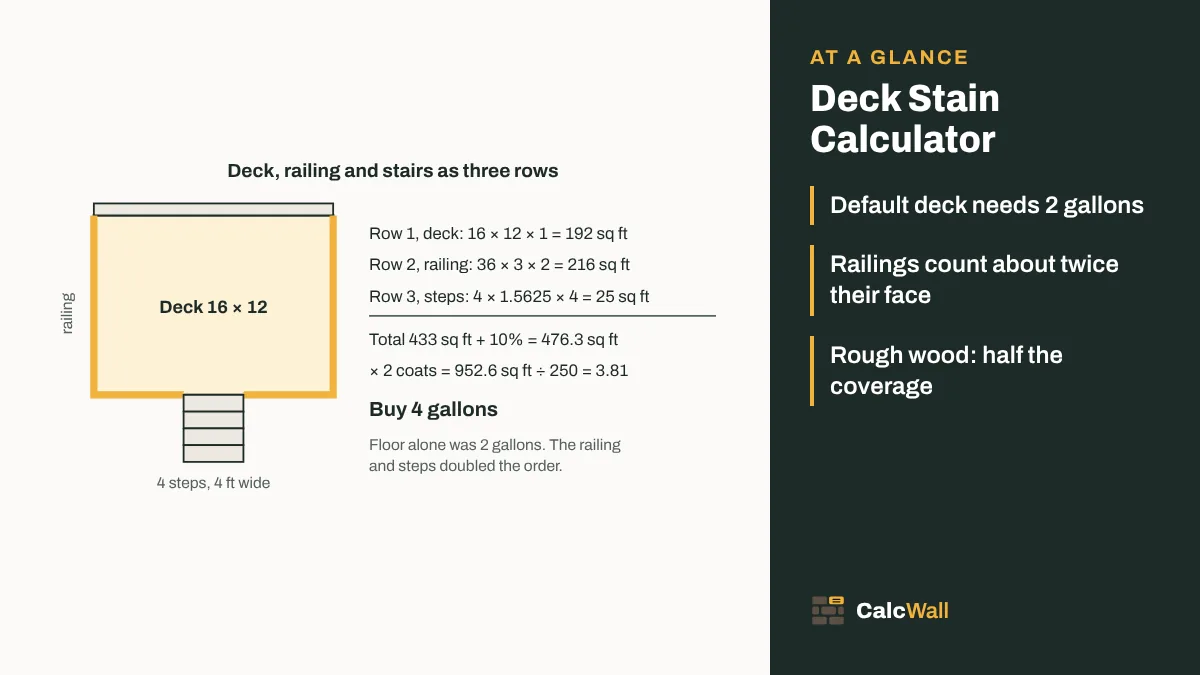
The deck sits against the house, so the railing runs 12 + 16 + 12 = 40 ft, less a 4 ft stair opening: 36 ft at 3 ft high. Rows: deck 16 × 12 × 1 = 192; railing 36 × 3 × 2 = 216; four steps 4 × 1.5625 × 4 = 25. Total 433 sq ft × 1.10 = 476.3 × 2 coats = 952.6 ÷ 250 = 3.81, so 4 gallons.
An old, gray 20 × 20 deck
400 sq ft of rough, weathered boards, two coats wet-on-wet at 150 sq ft per gallon: 400 × 1.10 × 2 = 880 ÷ 150 = 5.87, so 6 gallons. The same deck smooth and sound at 300 sq ft per gallon: 880 ÷ 300 = 2.93, so 3 gallons.
Metric deck with railing and steps
A 5 × 4 m deck against the house, 11.8 m of 0.9 m railing (4 + 5 + 4 less a 1.2 m stair opening) and three steps 1.2 m wide with a 280 mm tread and 170 mm riser. Rows: 5 × 4 × 1 = 20 m²; 11.8 × 0.9 × 2 = 21.24 m²; 1.2 × 0.45 × 3 = 1.62 m². Total 42.86 m² × 1.10 = 47.15 × 2 coats = 94.29 m² ÷ 6 m² per litre = 15.72, so 16 litres.
Prep that changes how much you use
- Let new wood dry out. The Forest Products Laboratory suggests letting new wood weather 2 to 3 months before a semitransparent stain. Makers often give a moisture limit instead, from 12% to 20% depending on the product, or a simple test: if a few drops of water soak in, the wood is ready.
- Clean old decks. Gray, sun-damaged fibers on the surface soak up stain and then flake off with it. Wash or lightly sand them off first; the wood underneath takes stain more evenly.
- Strip incompatible finishes. Many penetrating stains will not soak in over a clear film finish or a silicone sealer. Stripping costs a day but saves stain that would otherwise sit on top and peel.
- Hit the end grain. Board ends drink stain. Give them an extra pass; that is part of the 10% allowance.
- Watch the weather. Labels set a minimum temperature and a dry period after application. Stain on a hot deck in full sun dries too fast and shows lap marks.
Building a new deck? The deck calculator works out the boards, joists and screws. For the fence around the yard, use the fence stain calculator, which handles one or both sides. Sealing a concrete patio next to the deck? The sealant calculator does the same job for concrete sealer, and the square yards calculator converts any area between units.
Notes for deck contractors
Quote from a test board. On a weathered deck, stain one section first and measure what it took. Real coverage on old boards can be half the label’s best case, and that is the difference between 3 and 6 gallons.
Railings eat the hours. Balusters take as long as the floor and about as much stain. Price them as their own line, at roughly twice the railing face area for material.
Box the batch. Mix all the gallons of one color together before you start, so a new can halfway across the deck does not show as a stripe.
Keep a wet edge. Stain two or three boards end to end at a time. Stopping mid-board leaves lap marks that read as stripes of two coats.
Tips before you buy
- Check the exact figure. If the calculator says 3.81, four gallons is right. If it says 4.05, four gallons and a quart may do instead of five.
- Price per square foot. Divide the can price by the coverage you will really get on your boards to compare products fairly.
- Keep a little back. A labelled quart from the same batch is handy for touch-ups after a board replacement.
Sources
Where the numbers on this page come from. Everything else is plain geometry and unit conversion, which the calculator does with exact factors.
- Finishes for Wood Decks, USDA Forest Service, Forest Products Laboratory (M. Knaebe), revised July 2013. Used for: penetrating finishes rather than film-forming finishes on deck floors (solid stain and paint tend to peel there but can suit railings); letting new wood weather 2 to 3 months before a semitransparent stain; lap marks from staining over already-finished areas
- Selection and Application of Exterior Finishes for Wood (NCR-135), Purdue University Cooperative Extension Service (D. L. Cassens, W. C. Feist), rev. 3/86. Used for: semitransparent stain covering about 300–400 sq ft per gallon on smooth wood and 150–200 sq ft on rough wood; the two-coat wet-on-wet method for rough or weathered wood
- ZAR Deck and Siding Semi-Transparent product data sheet, Sika USA, September 2026, version 01.02. Used for: an example of label coverage: 300–400 sq ft per gallon smooth, 100–200 rough, one coat (“more is not better”); wood at 20% moisture or less and the water-drop test; not applying over clear finishes or silicone
- READY SEAL Initial Application Instructions 2026, Ready Seal. Used for: an example of coverage by wood: about 150 sq ft per gallon on treated pine and cedar decks; the drop test (wait 1 hour, wipe after 30–45 minutes) for whether a second coat will soak in; moisture content of 12% or less
Frequently asked questions
How much deck stain do I need?
Multiply the deck area by the number of coats, add about 10% and divide by the coverage per gallon. A 16 × 12 ft deck is 192 sq ft; plus 10% that is 211.2 sq ft, and two coats make 422.4 sq ft. At 250 sq ft per gallon that is 1.69, so 2 gallons.
How much does a gallon of deck stain cover?
It depends on the product and the wood. Semitransparent stains are often rated around 300–400 sq ft per gallon on smooth wood and 100–200 on rough wood, per coat. Use the figure on your can, and the lower end for rough, weathered or new softwood boards.
How many coats of deck stain?
Follow the label. Many semitransparent oil stains are one coat, or two applied wet-on-wet on rough wood. Solid stains are usually two. Set the Coats box to match, and only count a second coat if the wood will take it.
How much stain for a 12 × 12 deck?
A 12 × 12 ft deck is 144 sq ft. With 10% extra and two coats that is 316.8 sq ft; at 250 sq ft per gallon it is 1.27, so 2 gallons. With one coat it is 0.63, so 1 gallon.
How much stain for a 20 × 20 deck?
400 sq ft. With 10% extra and two coats, 880 sq ft of staining. At 250 sq ft per gallon that is 3.52, so 4 gallons; on rough, weathered boards at 150 sq ft per gallon it is 5.87, so 6 gallons.
How do I include railings and stairs?
Add them as extra rows. For a baluster railing, enter the railing length × height and set How many to 2, because balusters, rails and posts have about twice the surface of the flat railing face. For stairs, enter the step width × (tread + riser) and the number of steps.
Does old or weathered wood need more stain?
Yes. Gray, weathered and rough-sawn boards soak up more, often half the coverage of smooth wood. Clean the deck first, then use the low end of the label range, or stain a test section and measure what it takes.
How long should new wood wait before staining?
The USDA Forest Products Laboratory suggests letting new wood weather 2 to 3 months before a semitransparent stain. Some makers use a moisture limit or a water-drop test instead: if the drops soak in, the wood is ready.
Can I use the same stain on the railings and the floor?
You can, but they wear differently. Penetrating stains suit deck floors; solid stain and paint tend to peel on floors but can last well on railings, which take no foot traffic. If you use two products, run the calculator for each.
How many litres of deck stain do I need?
In metric the method is the same: a 5 × 4 m deck is 20 m², plus 10% is 22 m², and two coats make 44 m². At 6 m² per litre that is 7.33, so 8 litres.
Is this deck stain calculator free to use online?
Yes. The CalcWall Deck Stain Calculator is completely free and works online in any browser, on a phone, tablet or computer. There is nothing to download and no account to create, and the math runs right in your browser, so results appear as you type.