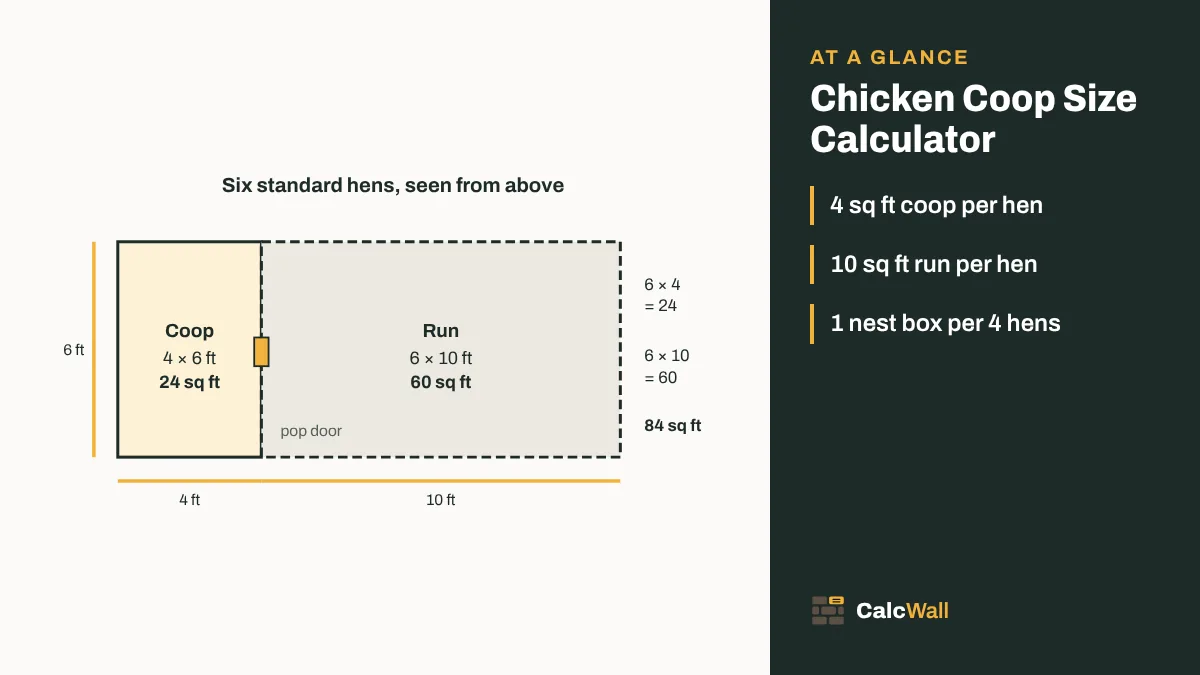
Quick answer: coop = chickens × 4 sq ft, run = chickens × 10 sq ft (standard birds). Six hens: 24 sq ft of coop, 60 sq ft of run, 4 ft of perch and 2 nest boxes.
How to calculate coop size
A chicken coop size comes from four numbers, each one a per-bird figure multiplied by the flock. The calculator does the multiplication; the work is choosing figures that suit your birds and how they will live.
- Count the birds you plan to keep, not the ones you have now. Most keepers add a few hens within a year or two, so build for that number.
- Pick the bird size. Standard (large fowl) breeds such as Rhode Island Reds, Orpingtons or Australorps get the standard figures. Bantams are much smaller birds and get roughly half the space.
- Multiply by the floor space per bird inside the coop: 4 sq ft for standard birds, 2 sq ft for bantams by default.
- Multiply by the run space per bird outside: 10 sq ft standard, 5 sq ft bantam.
- Multiply by perch per bird (8 in standard, 6 in bantam) for the total length of roosting bar.
- Divide the hens by hens per nest box (4 by default) and round up.
Coop = birds × coop per bird · Run = birds × run per bird · Perch = birds × perch per bird · Nest boxes = birds ÷ hens per box, rounded up
Metric example: six standard hens at 0.371612 m² each need about 2.23 m² of coop and 5.57 m² of run, with 121.9 cm (1.22 m) of perch. Those are the US figures converted exactly (1 sq ft = 0.09290304 m², 1 in = 2.54 cm), which is what the calculator loads when your region uses metric.
Floor area is the floor the birds can actually use. Nest boxes mounted on the outside wall don’t take any of it; a feeder and waterer on the floor do. If you plan to keep them inside, add a few square feet.
Space per bird by breed size
No two sources give quite the same figure, because space depends on how much time the birds spend inside. The calculator’s defaults sit at the generous end of university extension guidance for birds that have a run. These are guidance for backyard keepers, not legal minimums.
| Bird | Coop floor per bird | Run per bird | Perch per bird | Where from |
|---|---|---|---|---|
| Standard hen (calculator default) | 4 sq ft (0.37 m²) | 10 sq ft (0.93 m²) | 8 in (20.3 cm) | Rule of thumb, top of the Virginia Tech range |
| Bantam (calculator default) | 2 sq ft (0.19 m²) | 5 sq ft (0.46 m²) | 6 in (15.2 cm) | Rule of thumb |
| Laying hens | 3–4 sq ft | 10 sq ft | 8–10 in | Virginia Tech Extension |
| Bantam chickens | 2–3 sq ft | 5–8 sq ft | 8–10 in | Virginia Tech Extension |
| Any chicken with outdoor access | at least 3 sq ft | not given | 5–10 in | Oregon State Extension |
| Any chicken kept inside full time | 8–10 sq ft | none | 5–10 in | Oregon State Extension |
| Large breeds (Brahma, Jersey Giant) | 5 sq ft or more | 12 sq ft or more | 10 in | Rule of thumb; enter your own |
Some online calculators flip these figures and put more space in the coop than the run, because they assume the birds live mostly indoors. That is the Oregon State “no outdoor access” case. Decide which describes your flock: if the birds are only inside to sleep and lay, 4 sq ft per hen plus a decent run is plenty. If they will be shut in for long stretches of winter or bad weather, raise the coop figure toward 8–10 sq ft.
Crowding shows up as feather pecking, bullying at the feeder and a dirty, damp floor. If you see those, space is the first thing to check. More room is never a problem; too little always is.
Coop and run sizes by flock
Straight from the calculator’s defaults: 4 / 10 sq ft and 8 in per standard bird, 2 / 5 sq ft and 6 in per bantam, one nest box per 4 hens.
| Birds | Standard: coop / run | Standard: perch | Bantam: coop / run | Bantam: perch | Nest boxes |
|---|---|---|---|---|---|
| 3 | 12 / 30 sq ft | 24 in (2 ft) | 6 / 15 sq ft | 18 in | 1 |
| 4 | 16 / 40 sq ft | 32 in (2.67 ft) | 8 / 20 sq ft | 24 in | 1 |
| 6 | 24 / 60 sq ft | 48 in (4 ft) | 12 / 30 sq ft | 36 in | 2 |
| 8 | 32 / 80 sq ft | 64 in (5.33 ft) | 16 / 40 sq ft | 48 in | 2 |
| 10 | 40 / 100 sq ft | 80 in (6.67 ft) | 20 / 50 sq ft | 60 in | 3 |
| 12 | 48 / 120 sq ft | 96 in (8 ft) | 24 / 60 sq ft | 72 in | 3 |
| 20 | 80 / 200 sq ft | 160 in (13.33 ft) | 40 / 100 sq ft | 120 in | 5 |
Turn the area into a building that suits sheet goods and lumber. Plywood and siding come in 4 × 8 ft sheets, so a 4 × 6, 4 × 8 or 6 × 8 ft coop wastes little. For a 24 sq ft coop, 4 × 6 ft works; for 40 sq ft, 5 × 8 ft does. Runs are easier to build long and narrow, in multiples of the panel or roll width of your wire. Once you have the plan, the lumber calculator turns the frame into a cut list, and the fence calculator works out posts for a larger run. For the walls and roof, the plywood calculator turns the area into whole sheets.
Keep the coop small enough to clean. You, not the hens, will be scraping that floor every week. A people door or a wall that lifts away matters more on a small coop than a few extra inches of floor.
Roosting bars
Chickens sleep perched, shoulder to shoulder. The calculator gives the total length of bar; how you split it is up to you.
- Length: 8 in per standard bird by default. Virginia Tech gives 8–10 in, Oregon State 5–10 in. Birds huddle closer in winter and spread out in summer, so the upper figure suits hot climates.
- Height: Oregon State suggests about 2 ft off the floor. Heavy breeds and Silkies, which can’t fly up well, do better at about 1 ft.
- Spacing: if you fit more than one bar, keep them about 10 in apart. Stepped bars like a ladder lead to squabbles over the top rung and droppings on the birds below, so many keepers set them at one height.
- Shape: 1 to 2 in square lumber with the top edges rounded, or a 2 × 4 laid flat, gives the feet something to grip and lets the birds cover their toes in cold weather.
- Droppings: most droppings land under the roost overnight. A droppings board or tray under the bar makes daily cleaning a two-minute job.
Nest boxes
Hens share nest boxes and tend to queue for the favorite. One box per 4 hens is the calculator’s default; Virginia Tech says at least one per 4–5 hens, and Oregon State one per about four birds. A part box always rounds up.
- Size: about 12 × 12 × 12 in for standard hens (Oregon State). A little larger for big breeds, smaller for bantams.
- Height: lower than the roosting bar, so the birds don’t sleep in the nests and soil them. A dark, quiet corner suits them best.
- Top: slope the top of the boxes, Oregon State suggests 45°, so birds can’t roost on it.
- Access: a lid from outside lets you collect eggs without going in. Seal the lid well; a nest box lid is a favorite way in for rats and raccoons.
Roosters don’t need nest boxes. If you keep one, count only the hens in the nest box calculation; for floor, run and perch, count every bird.
Ventilation, light and cleaning
Floor area gets the attention, but a damp, stuffy coop causes more trouble than a slightly small one. Chickens breathe out a lot of moisture, and droppings give off ammonia. Both need to leave the building.
- Vent high, not at roost level. Warm, moist air rises. Openings under the eaves or along the ridge let it out without blowing across the birds at night. Oregon State’s guide says to give as much ventilation as you can without drafts or gaps for predators. Virginia Tech notes that windows or vents on one side usually give enough for a small coop.
- How much? Neither guide gives a single number. A rule of thumb often repeated by hobby keepers is about 1 sq ft of vent per 10 sq ft of floor, so about 2.4 sq ft for the 24 sq ft example. In hot climates, more is better; in cold ones, keep the vents but close the low openings.
- Cover every opening with welded wire. Use 1/2 in welded hardware cloth on vents and windows, not chicken wire, which keeps chickens in but doesn’t keep predators out.
- Light. A window lets daylight in, which hens respond to. Face it away from the prevailing wind where you can.
- Floor and bedding. A dry, solid floor with wood shavings or straw is easy to clean. A coop raised off the ground stays drier and gives the birds shade underneath.
For the run, a well-drained base matters as much as size. A bare run turns to mud fast. Spread wood chips or sand: the mulch calculator gives the cubic yards for a 60 sq ft run at 4 in deep. A concrete pad for a permanent coop is a job for the concrete calculator.
Guidance, not welfare law
Everything the calculator loads by default is a rule of thumb for small backyard flocks, drawn from university extension guidance. It is not a welfare standard and doesn’t make a coop legal or illegal anywhere.
Rules do exist, but mostly for farms. In Scotland, for example, the Welfare of Farmed Animals (Scotland) Regulations 2010 set conditions for laying hens kept in non-cage systems: no more than 9 hens per square metre of usable area (about 1.2 sq ft per hen), at least 15 cm of perch per hen and at least one nest per 7 hens. Those are minimums for commercial housing with very different management, not a target for a garden coop; the backyard figures above give far more room. Other countries, the EU, organic and free-range labels and welfare schemes all set their own figures.
Closer to home, check your town or council rules before you build. Many limit the number of hens, ban roosters, or set how far a coop must be from a property line or a neighbor’s house. A homeowners’ association may have its own rules, and some countries ask poultry keepers to register their flock.
Worked examples
Six standard hens (the calculator’s default)
6 birds, 4 sq ft coop, 10 sq ft run, 8 in perch, 4 hens per box. Coop = 6 × 4 = 24 sq ft (2.23 m²). Run = 6 × 10 = 60 sq ft. Perch = 6 × 8 = 48 in (4 ft). Nest boxes = 6 ÷ 4 = 1.5, so 2. Coop plus run 84 sq ft.
Ten bantams in metric
10 bantams with the metric defaults: 0.185806 m² coop, 0.464515 m² run, 15.24 cm perch, 4 hens per box. Coop = 1.86 m². Run = 4.65 m². Perch = 152.4 cm (1.52 m). Nest boxes = 10 ÷ 4 = 2.5, so 3. Coop plus run 6.5 m².
Five large-breed hens
5 Brahmas with figures raised for their size: 5 sq ft coop, 12 sq ft run, 10 in perch, 4 hens per box. Coop = 5 × 5 = 25 sq ft. Run = 60 sq ft. Perch = 50 in (4.17 ft). Nest boxes = 5 ÷ 4 = 1.25, so 2.
Twelve hens with no run
12 standard hens kept inside full time, following Oregon State’s 8–10 sq ft: coop 10 sq ft, run 0, perch 8 in, 4 hens per box. Coop = 12 × 10 = 120 sq ft, for example 10 × 12 ft. Perch = 96 in (8 ft). Nest boxes = 3.
Notes for coop builders
Build to the sheet. Size the coop in 2 ft steps so 4 × 8 sheets cut without waste: 4 × 6, 4 × 8, 6 × 8, 8 × 8 ft.
Predators dig. Bury the run wire 12 in or run an apron of hardware cloth 18–24 in out on the ground around the base.
Clean from standing height. A full-height door, or a floor at waist height on a raised coop, sells better than extra square feet.
Ask about local rules first. Setbacks, hen limits and permits for sheds vary by town. Check before you quote a size.
Sources
Where the numbers on this page come from. Everything else is plain geometry and unit conversion, which the calculator does with exact factors.
- Small-scale Poultry Housing (2902-1092, APSC-186NP), Virginia Cooperative Extension, Virginia Tech. Used for: space per bird (Table 1): laying hens 3–4 sq ft inside and 10 sq ft outside, bantams 2–3 sq ft inside and 5–8 sq ft outside; 8–10 in of perch per bird; at least one nest per 4–5 hens; vents on one side usually enough for small coops
- Living on the Land: Backyard Chicken Coop Design (EC 1644), Oregon State University Extension Service. Used for: at least 3 sq ft per bird inside with outdoor access, 8–10 sq ft per bird without; 5–10 in of roost per bird, roosts about 2 ft up and 10 in apart (Silkies 1 ft); one nest box per about four birds, about 12 × 12 × 12 in; as much ventilation as possible without drafts or predator access
- The Welfare of Farmed Animals (Scotland) Regulations 2010, Schedule 3, legislation.gov.uk, SSI 2010/388, as made. Used for: an example of farm rules for laying hens in non-cage systems: no more than 9 hens per square metre of usable area, at least 15 cm of perch per hen, at least one nest per 7 hens
Frequently asked questions
How big should a chicken coop be?
A common rule of thumb is about 4 sq ft of coop floor per standard-size chicken and 2 sq ft per bantam, plus about 10 sq ft (bantams 5 sq ft) of outdoor run per bird. Six standard hens would need about 24 sq ft of coop and 60 sq ft of run.
How many nest boxes do I need?
Usually one nest box for every 4 to 5 hens, because hens take turns. Six hens need 2 boxes at 4 hens per box.
How much perch space does a chicken need?
About 8 in (20 cm) of perch per standard bird and 6 in (15 cm) per bantam is the calculator’s default. Virginia Tech suggests 8–10 in per bird and Oregon State 5–10 in, so give large breeds the top of that range.
Are these legal minimums?
No. They are rules of thumb for backyard flocks. Some countries, local rules and welfare or organic schemes set their own minimum space; check the ones that apply to you, and give more space if you can.
Can I change the figures?
Yes. Every per-bird figure is editable, so you can enter the guidance you follow. The calculator multiplies by the number of birds.
How big a coop do I need for 10 chickens?
At 4 sq ft per bird, 40 sq ft of coop floor, for example 5 × 8 ft, plus 100 sq ft of run, 80 in (about 6 ft 8 in) of roost and 3 nest boxes. Ten bantams need half the floor: 20 sq ft of coop and 50 sq ft of run.
How much space do chickens need if they never go outside?
Much more. Oregon State University Extension suggests 8 to 10 sq ft per bird inside a coop with no outdoor access, compared with at least 3 sq ft when the birds have a run. Set the coop figure to 10 and the run to 0.
How high should a roosting bar be?
Oregon State suggests about 2 ft off the floor, with 10 in between bars if you use more than one. Heavy or flightless breeds such as Silkies do better with a bar about 1 ft up. Keep the bar higher than the nest boxes so hens sleep on the bar, not in the nests.
How big should a nest box be?
About 12 in wide, 12 in deep and 12 in tall suits most standard hens. Large breeds can use a slightly bigger box, bantams a smaller one. A sloped top stops birds roosting on it.
How much ventilation does a chicken coop need?
The extension guides give no single number: they say to give as much ventilation as you can without drafts on the roost or gaps a predator can get through. A rule of thumb often repeated by hobby keepers is about 1 sq ft of vent per 10 sq ft of floor, placed high up.
Is this chicken coop size calculator free to use online?
Yes. The CalcWall Chicken Coop Size Calculator is completely free and works online in any browser, on a phone, tablet or computer. There is nothing to download and no account to create, and the math runs right in your browser, so results appear as you type.