Quick answer: tons = length × width (ft) × compacted depth (in) ÷ 12 × 121 ÷ 2,000. A 50 × 12 ft driveway with 4 in of compacted crushed concrete is 200 cu ft, or 12.10 tons. Don’t add a compaction allowance on top; the 121 lb figure already includes it.
How to calculate crushed concrete
Crushed concrete is sold by the ton but placed by depth, so the job is to turn a size and a depth into a weight. Yards also call it recycled concrete aggregate (RCA), crushed concrete base or recycled base. The math is the same for all of them.
- Measure the area in feet. For a rectangle, length × width. A 50 × 12 ft driveway is 600 sq ft.
- Decide the compacted depth in inches: the finished thickness after rolling, not the loose pile.
- Find the volume: square feet × depth ÷ 12 gives cubic feet. Divide by 27 for cubic yards.
- Convert to weight: cubic feet × 121 lb per cu ft gives pounds. Divide by 2,000 for US tons.
- Round up to the half ton or the load size your yard sells. Add waste only for things the math can’t see, such as soft spots or uneven ground.
Tons = L (ft) × W (ft) × compacted depth (in) ÷ 12 × 121 ÷ 2,000
The calculator above does exactly this. Its default is 121 lb per cu ft for compacted depth, the middle of the 119–123 lb per cu ft that Wisconsin DOT researchers measured in place on compacted recycled concrete base. For cubic yards alone, the cubic yards calculator handles any shape.
In metric countries the calculator works in metres and centimetres and gives tonnes and cubic metres. The density box stays in pounds per cubic foot, so if your supplier quotes kg per m³, divide by 16.02 before entering it. 121 lb per cu ft is about 1,938 kg per m³.
Crushed concrete weight per yard: loose vs compacted
This is where most crushed concrete estimates go wrong. The same ton of material takes up a lot more room loose in a truck than it does rolled flat in a driveway. You have to match the density to the depth you measured.
Wisconsin DOT’s 2023 study (WHRP 0092-22-05) tested 1¼ in recycled concrete base three ways. Loose in a unit box it weighed 81–89 lb per cu ft. Compacted in place on site it measured 119–123 lb per cu ft dry. In the lab’s Proctor test, the densest it could be packed was 122–129 lb per cu ft. FHWA’s guidelines give a mean dry density of 129.0 lb per cu ft from 143 tests on Long Island.
| State of the material | lb per cu ft | Tons per cu yd | kg per m³ | Source |
|---|---|---|---|---|
| Loose (truck, pile, unit box) | 81–89 (calculator 85) | 1.09–1.20 (1.15) | ≈ 1,362 at 85 | WisDOT 2023 |
| Compacted in place, dry | 119–123 (calculator 121) | 1.61–1.66 (1.63) | ≈ 1,938 at 121 | WisDOT 2023 |
| WisDOT conversion factor | ≈ 122–130 | 1.65–1.75 | ≈ 1,958–2,076 | WisDOT 2023 |
| Densest (max dry density) | 122–129; FHWA mean 129.0 (calculator 129) | 1.65–1.74 (1.74) | ≈ 2,066 at 129 | WisDOT 2023, FHWA-RD-97-148 |
Tons per cubic yard = lb per cu ft × 27 ÷ 2,000. For kg per m³, multiply lb per cu ft by 16.0185.
Is the 1.65–1.75 tons per yard figure loose or compacted?
Compacted. The Wisconsin report describes its conversion factors as weight-to-volume factors that are “essentially compacted unit weights (tons/cubic yard)”. Its expansion factor for recycled concrete base, from compacted to loose, is 37–60%. So 1.65–1.75 tons is what a cubic yard of finished base weighs, not a cubic yard in the truck.
That range works out to about 122–130 lb per cu ft, a little above the 119–123 lb dry density measured in place. The report doesn’t say whether its factors include moisture. If you want the cautious end for ordering, pick the 129 lb option in the calculator; it gives 1.74 tons per yard, near the top of WisDOT’s range.
Why we don’t double-count compaction
Some crushed concrete calculators use a compacted density and then add 10% “for compaction” by default. That counts the shrink twice. A compacted density already describes material that has been packed down, so it already accounts for the extra loose material you’ll need.
Our calculator starts with the compaction allowance set to None for that reason. Use the allowance only if you’ve entered a lighter custom density, such as a loose figure from your yard, with a finished depth, and you want a rough top-up. For a loose figure the honest top-up is closer to 40% (121 ÷ 85 = 1.42), more than the allowance list offers, so the compacted option is the better route.
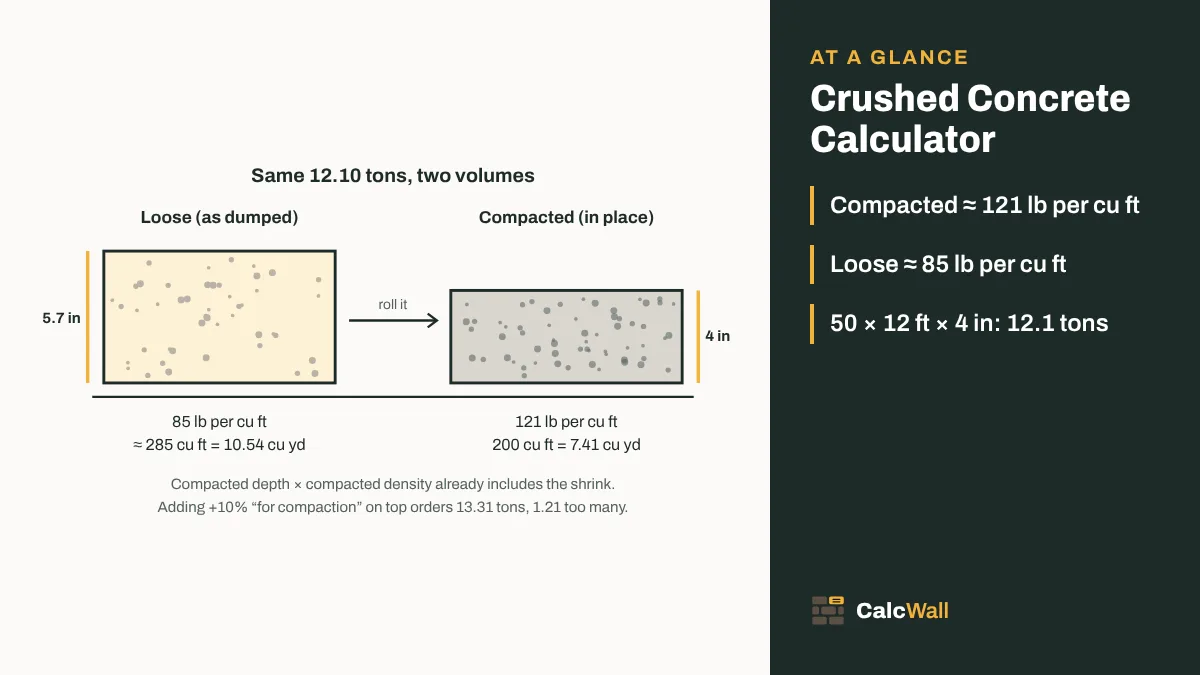
The loose option has one proper use: when the depth you enter is the loose depth you’ll spread. 4 in compacted is about 5.7 in loose (4 × 121 ÷ 85), and either route gives about 12.1 tons on a 600 sq ft driveway. Picking “loose” and then entering a compacted depth would undercount by about 30%.
How deep crushed concrete should be
Depth matters more than anything else in the order. Tonnage scales directly with it, so going from 4 to 6 in adds half again. The table gives common compacted depths by use. These are general trade practice, not code figures; your local rules, your plans or an engineer decide.
| Use | Common compacted depth | Tons per 100 sq ft at 121 lb | Notes |
|---|---|---|---|
| Garden path or walkway | 3–4 in | 1.51–2.02 | Firm, well-drained ground |
| Shed or patio pad | 4–6 in | 2.02–3.03 | Run the base a little past the edge of the shed or slab |
| Base under a concrete slab | Per plans (often about 4 in) | 2.02 at 4 in | Check that your local code accepts recycled concrete |
| Car driveway base | 4–8 in total | 2.02–4.03 | Deeper on clay or soft ground, or for heavy trucks |
| Pipe bedding or trench backfill | Per pipe maker or engineer | n/a | Read the drain rules below before using it around drains |
| UK sub-base (Type 1) | Per design | n/a | Up to 225 mm in one layer under SHW Series 800 |
Our gravel driveway calculator uses the same 4–8 in compacted range for home driveways and covers the top layer and crown. Crushed concrete works as the base under a stone top course, or on its own for a farm lane or work yard.
On a crushed concrete driveway, the base has to shed water. The FHWA gravel roads guide recommends a crown of about ½ in per foot, roughly 4%. On a 12 ft wide driveway that puts the centre about 3 in above the edges.
Crushed concrete tons for common sizes
These figures come straight from the formula at 121 lb per cu ft, the calculator default. The column on the right uses 129 lb per cu ft, the densest figure, for anyone who wants the cautious order. Round up to your yard’s minimum load.
| Area | Sq ft | 4 in: cu yd | 4 in: tons | 6 in: cu yd | 6 in: tons | 6 in at 129 lb |
|---|---|---|---|---|---|---|
| 10 × 10 ft pad | 100 | 1.23 | 2.02 | 1.85 | 3.03 | 3.23 |
| 10 × 20 ft path | 200 | 2.47 | 4.03 | 3.70 | 6.05 | 6.45 |
| 12 × 20 ft shed pad | 240 | 2.96 | 4.84 | 4.44 | 7.26 | 7.74 |
| 20 × 20 ft parking pad | 400 | 4.94 | 8.07 | 7.41 | 12.10 | 12.90 |
| 24 × 24 ft two-car pad | 576 | 7.11 | 11.62 | 10.67 | 17.42 | 18.58 |
| 12 × 50 ft driveway | 600 | 7.41 | 12.10 | 11.11 | 18.15 | 19.35 |
| 20 × 40 ft yard | 800 | 9.88 | 16.13 | 14.81 | 24.20 | 25.80 |
| 12 × 100 ft driveway | 1,200 | 14.81 | 24.20 | 22.22 | 36.30 | 38.70 |
The chart below gives the same thing per 100 sq ft, which is handy for odd shapes. Work out your area, divide by 100 and multiply by the bar for your depth.
Going the other way, a ton is 2,000 ÷ 121 = 16.5 cu ft compacted. That covers about 99 sq ft at 2 in, 66 at 3 in, 50 at 4 in, 33 at 6 in and 25 at 8 in. The calculator’s “what will my load cover?” box does the same sum for any amount you already have.
Crushed concrete vs gravel vs crusher run
Crushed concrete does the same job as crusher run or road base: an angular, dense-graded mix that locks together when rolled. The big difference for ordering is weight. Recycled concrete is lighter than virgin stone, so the same compacted volume takes fewer tons.
FHWA puts it plainly: the lower compacted unit weight of recycled concrete “results in higher yield”. Its specific gravity runs 2.2–2.5 for coarse particles, and FHWA’s technical advisory puts it 5–10% below comparable virgin aggregate, with higher water absorption.
| Material | Loose, lb per cu ft | Compacted, tons per cu yd | Tons for 50 × 12 ft at 4 in | Source |
|---|---|---|---|---|
| Crushed concrete (RCA base) | 81–89 | 1.63 (121 lb); WisDOT 1.65–1.75 | 12.10 | WisDOT 2023 |
| Virgin dense-graded base, 1¼ in | 90–104 | 1.79–1.98 | 13.26–14.67 | WisDOT 2023 |
| Crusher run / road base | ≈ 107 (1.45 tons per cu yd) | 2.03 | 15.04 | TDOT 2019, our road base calculator |
| Aggregate base, FHWA estimate | n/a | 1.88 (139 lb) | 13.90 | FHWA Federal Lands 2009 |
| No. 57 stone (clean gravel) | ≈ 97 (2,619 lb per cu yd) | Compacts little | ≈ 9.7 loose | TDOT 2015, our gravel calculator |
The tonnage column is 7.41 cu yd × the compacted factor. For No. 57 stone it is 200 cu ft × 97 lb ÷ 2,000, a loose figure, since clean stone packs down only a little. Our road base calculator and gravel calculator use those same factors.
So a price per ton is not a fair comparison on its own. If crushed concrete and crusher run cost the same per ton, the crushed concrete base costs about 20% less (12.10 ÷ 15.04 = 0.80) because you buy fewer tons. Multiply each quote by its own tonnage before you choose.
On performance, FHWA reports that crushed concrete base has California Bearing Ratio values from 90 to more than 140, is nonplastic and is not frost susceptible. It is more permeable than conventional granular material because it has fewer fines. It is graded to the same AASHTO M147 and ASTM D2940 requirements as stone base, so ask your yard which grading its product meets.
Where it falls short: quality varies more from pile to pile. A pile from a clean highway slab is not the same as one with brick, asphalt or wood mixed in, which is why Michigan DOT caps building rubble and asphalt at 5% in its crushed concrete base. Look at the pile before you order, and ask what the source was.
Compaction and lifts
A crushed concrete base is only as good as its compaction. Spread it in layers (lifts), wet it, and compact each one before the next goes on. A single thick layer can look fine on top and stay loose at the bottom.
Ohio DOT’s Item 304 for aggregate base is a useful yardstick. It limits a compacted lift to 8 in with a vibratory roller over 12 tons, 6 in with a 10–12 ton roller, and 4 in otherwise. For a homeowner with a plate compactor or small roller, that means 4 in lifts. Item 304 points to a separate materials section (703.17) for which aggregates qualify, so treat it as a guide to method here, not as approval of recycled concrete.
Moisture is the other half. Ohio wants base within 2% of its optimum moisture before compacting, and accepts the work at 98% of the test section’s maximum dry density. Recycled concrete absorbs more water than stone: FHWA gives 2–6% for coarse particles and 4–8% for fines. A dry pile needs a good soaking before you roll it, or it won’t reach density.
Compacting in lifts doesn’t change the order. The calculator works on the finished depth. If the finished base is 8 in, enter 8 in, and the tonnage is the same whether you built it in two lifts or four.
Michigan 21AA and other spec names
21AA is a dense-graded aggregate class in the Michigan DOT 2020 Standard Specifications for Construction, Section 902. Section 902.05 allows it to be made from natural aggregate, iron blast-furnace slag, reverberatory furnace slag or crushed concrete. So “21AA crushed concrete” is recycled concrete crushed and screened to the 21AA grading.
Table 902-1 sets that grading: 100% passing the 1½ in sieve, 85–100% passing 1 in, 50–75% passing ½ in and 20–45% passing the No. 8 sieve, plus a limit on fines. MDOT also caps building rubble or asphalt at 5.0% by particle count in crushed concrete aggregate. If you’re ordering in Michigan, ask for 21AA by name, and ask whether it is virgin or recycled.
The spec sets no density, so use the calculator’s crushed concrete figures, or ask the yard for its own weight per yard. Other states have their own names for dense-graded base, and our road base page lists several. The class number tells you the grading; it doesn’t tell you whether the stone is virgin or recycled.
Ordering in the UK (recycled Type 1)
In the UK, the equivalent product is recycled Type 1 sub-base. The Specification for Highway Works, Series 800, Clause 803 allows Type 1 to be made from crushed rock, crushed slag, crushed concrete, recycled aggregates, manufactured aggregates or well-burnt non-plastic shale. Recycled material has to pass the testing in Clause 710 and stay within the limits in Table 8/3 for asphalt, glass and other contents.
Clause 802 covers laying. Up to 225 mm compacted thickness can go down in one layer. Anything thicker goes in two or more layers, each at least 110 mm compacted.
We haven’t found a published bulk density for recycled Type 1 that we can cite, so we give none. Ask your supplier for theirs in kg per m³, divide by 16.02 and enter it as a custom density. In the UK the calculator gives tonnes and cubic metres. Don’t assume the US crushed concrete figures match recycled Type 1, because gradings and source material differ.
Drains, water and steel
Crushed concrete is not chemically inert. FHWA notes that stockpiles may need to be kept away from water courses because of the alkaline nature of the leachate, and its 2022 brief lists high-pH runoff from stockpiles as a concern to manage.
The practical problem is drains. FHWA reports cases where a chalky precipitate (tufa) from recycled concrete base “clogged subdrains and blinded geotextile filters”, and traces it to free lime and unhydrated cement in the material. It also notes many pavements work without any such problem.
Michigan DOT handles the risk with a rule. Crushed concrete 21AA, 21A or 22A may not be used as a base that drains to an underdrain unless there are at least 12 in of granular Class I, II, IIA or IIAA material, or a geotextile leachate barrier, between them. Michigan also bans crushed concrete on its jobs within 100 ft of any water course or lake.
Those are state highway rules, not rules for your yard, but they show how seriously one DOT takes runoff. Keep recycled concrete out of French drains and away from streams and ponds. Where a bank next to water needs protecting, the rip rap calculator works out the stone.
What we couldn’t source: firm guidance on metal pipes or on plants. FHWA’s advisory discusses corrosion only for chloride-laden concrete around steel in new pavement, not buried pipe. For metal pipe near the base, ask the pipe maker. For planting beds next to it, ask your local extension office. Leftover rebar is a separate issue: Michigan allows steel only in pieces small enough to pass the top sieve, so pick out anything bigger.
Cost per ton
We looked for a dated, published price per ton of crushed concrete from a source we’d trust, and didn’t find one. So this page quotes no price. Local prices depend on how much demolition concrete the yard takes in, whether it’s screened, and how far the truck has to run.
Call your local recycling yard or quarry and ask three things: the price per ton, the delivery charge, and the minimum load. Enter the price in the calculator, per ton or per cubic yard, and it multiplies it by the tonnage or volume for you.
If the yard prices per cubic yard, ask whether that means a loose yard in the truck or a compacted yard. A loose yard of crushed concrete at 85 lb per cu ft weighs about 1.15 tons, so you’d need about 1.42 loose yards for each compacted yard (121 ÷ 85). The calculator’s per-yard price uses compacted cubic yards.
For a poured driveway instead of a stone one, the concrete driveway cost calculator prices the concrete. The base underneath it is still worked out here.
Worked examples
The default driveway
A driveway 50 × 12 ft with 4 in of compacted crushed concrete: 50 × 12 × 4 ÷ 12 = 200 cu ft = 7.41 cu yd. At 121 lb per cu ft that is 24,200 lb, or 12.10 US tons (10.98 tonnes). Order 12.5 tons. This is what the calculator shows when you open it.
Same driveway, densest figure
Choose “densest (129 lb/cu ft, FHWA)” with the same 50 × 12 ft at 4 in: 200 cu ft × 129 = 25,800 lb = 12.90 tons. That is 0.8 tons more than the default, a cautious order if your yard’s product is heavy or wet.
The double-count mistake
Leave the density at 121 lb and set “Allow for compaction” to +10%: 200 × 1.10 = 220 cu ft × 121 = 26,620 lb = 13.31 tons. That is 1.21 tons more than you need, because 121 lb is already a compacted figure.
An 8 in driveway base in two lifts
A 10 × 40 ft driveway with 8 in compacted, placed as two 4 in lifts: 400 sq ft × 8 ÷ 12 = 266.67 cu ft = 9.88 cu yd. × 121 = 32,267 lb = 16.13 tons. Order 16.5 tons, about 8 tons per lift.
A round turnaround
A circle 20 ft across at 4 in compacted: 3.1416 × 10² × 4 ÷ 12 = 104.72 cu ft. × 121 = 12,671 lb = 6.34 tons. Use the cylinder shape in the calculator.
Loose yards from the same order
To see how big the 12.10-ton pile will look, divide the weight by the loose density: 24,200 lb ÷ 85 = 284.7 cu ft ÷ 27 = 10.54 loose cu yd. This is a hand check; the calculator’s cubic yards are compacted.
For several areas, such as a driveway plus a parking pad, work each one out and press “Add this area to a project total”. Each part keeps its own depth and density.
Notes for site work
One allowance only. Compacted density with compacted depth needs no compaction allowance. Add waste for soft spots, not for shrink.
Soak it. Coarse recycled concrete absorbs 2–6% water (FHWA). Bring it near optimum moisture before rolling, or it won’t reach density.
4 in lifts. Without a vibratory roller of 10 tons or more, keep compacted lifts to 4 in (Ohio DOT Item 304).
Mind the drains. Keep crushed concrete out of French drains and away from water. Michigan wants 12 in of clean granular material or a barrier between it and an underdrain.
- Look at the pile. Ask what the source concrete was and whether it is screened to a grading such as 21AA or Type 1.
- Keep the weight ticket. Bulk material is sold by weight. Compare the ticket with the calculator’s tonnage.
- Plan the drop. Ask the yard how many tons each truck carries, and clear a spot to tip close to the work.
Sources
Where the numbers on this page come from. Everything else is plain geometry and unit conversion, which the calculator does with exact factors.
- Weight-Volume Relationships and Conversion Factors for Soils and Aggregates of Wisconsin (WHRP 0092-22-05), final report, Wisconsin Department of Transportation / Wisconsin Highway Research Program, December 2023. Used for: recycled concrete base (1¼ in): loose unit weight 81–89 lb/cu ft, compacted in place 119–123 lb/cu ft dry, corrected Proctor maximum 122–129 lb/cu ft, conversion factor 1.65–1.75 tons per compacted cu yd, expansion 37–60% compacted to loose; virgin dense-graded base 1.79–1.98 tons per cu yd and 90–104 lb/cu ft loose
- User Guidelines for Waste and Byproduct Materials in Pavement Construction: Reclaimed Concrete Material (FHWA-RD-97-148), Federal Highway Administration, 1997 report; archive page last modified 03/08/2016. Used for: dry density 129.0 lb/cu ft (mean of 143 tests), specific gravity 2.2–2.5 coarse, absorption 2–6% coarse and 4–8% fine, typical uses
- Reclaimed Concrete Material: Granular Base (FHWA-RD-97-148), Federal Highway Administration, 1997 report; archive page. Used for: AASHTO M147 and ASTM D2940 gradation, CBR 90 to over 140, nonplastic and not frost susceptible, more permeable, higher yield, alkaline leachate, tufa clogging subdrains and geotextiles
- Use of Recycled Concrete Aggregate in Concrete Paving Mixtures (FHWA-HIF-22-020), Federal Highway Administration, February 2022. Used for: unbound base is the predominant use of RCA; high-pH runoff from stockpiles
- Technical Advisory T 5040.37: Use of Recycled Concrete Pavement as Aggregate in Hydraulic-Cement Concrete Pavement, Federal Highway Administration, July 3, 2007. Used for: RCA density slightly below the original aggregate, specific gravity 5–10% lower, higher absorption, corrosion discussed only for steel in pavements
- Construction and Material Specifications, Item 304 Aggregate Base, Ohio Department of Transportation, 2013 CMS. Used for: maximum compacted lifts of 4, 6 and 8 in by roller weight, moisture within 2% of optimum, acceptance at 98% of test-section maximum dry density
- 2020 Standard Specifications for Construction, Section 902.05 and Table 902-1 (dense-graded aggregate), Michigan Department of Transportation, 2020 edition. Used for: Class 21AA may be made with crushed concrete; 21AA grading; no crushed concrete within 100 ft of a water course or lake; underdrain separation; 5.0% limit on building rubble or HMA; steel allowed only in pieces that pass the top sieve
- Manual of Contract Documents for Highway Works, Volume 1, Specification for Highway Works, Series 800, National Highways (Standards for Highways), Amendment November 2021 (check for later amendments). Used for: Type 1 unbound mixture may use crushed concrete and recycled aggregates (Clause 803); recycled material tested under Clause 710 with limits in Table 8/3; up to 225 mm compacted in one layer, thicker in layers of at least 110 mm (Clause 802)
- Roadway Design Guidelines, Chapter 4: Pavement and Roadway Materials, Tennessee Department of Transportation, Revised 08/01/2019. Used for: mineral aggregate base (crusher run) 2.03 tons per compacted cu yd and 2,900 lb per cu yd loose, as used on our road base calculator
- Roadway Design Guidelines, Section 4-303.00: Computations for Mineral Aggregate Base, Tennessee Department of Transportation, revised 27 Oct 2015. Used for: No. 57 stone 2,619 lb per cu yd loose, as used on our gravel calculator
- Application Rates and Weights for Estimating Purposes, Federal Highway Administration, Federal Lands Highway, 2009. Used for: cross-check: aggregate base about 139 lb per cu ft in place
- Gravel Roads Construction & Maintenance Guide, Federal Highway Administration and South Dakota LTAP, August 2015. Used for: crown of about ½ in per foot (about 4%) and drainage as the first priority
- NIST Handbook 44, Appendix C: General Tables of Units of Measurement, National Institute of Standards and Technology, 2026 edition. Used for: 1 cu yd = 27 cu ft, 1 short ton = 2,000 lb, 1 lb = 0.45359237 kg, and lb per cu ft to kg per m³ (× 16.0185)
Frequently asked questions
How many tons of crushed concrete are in a yard?
About 1.63 tons per cubic yard once it is compacted in place (121 lb per cu ft × 27 ÷ 2,000), and about 1.15 tons per cubic yard loose in the truck (85 lb per cu ft). Wisconsin DOT’s conversion factor for recycled concrete base is 1.65–1.75 tons per compacted cubic yard, so 1.6–1.75 is a fair working range.
How much crushed concrete do I need for a driveway?
Multiply length × width in feet × compacted depth in inches ÷ 12 to get cubic feet, then × 121 ÷ 2,000 for tons. A 50 × 12 ft driveway with 4 in of compacted base is 200 cu ft, or 12.10 tons. A 6 in base on the same driveway is 18.15 tons.
Is crushed concrete cheaper than gravel?
Compare it per job, not just per ton. Crushed concrete is lighter than virgin stone base, so the same compacted driveway takes fewer tons: 12.10 tons of crushed concrete against about 15.04 tons of road base at 2.03 tons per cubic yard for a 50 × 12 ft, 4 in base. Multiply each quote by its own tonnage before you choose.
How much does crushed concrete cost per ton?
We could not find a dated, published price per ton from a reliable source, so we don’t quote one. Prices depend on the yard, the local supply of demolition concrete and the delivery distance. Ask your local recycling yard or quarry for a price per ton delivered and enter it in the calculator.
How deep should crushed concrete be for a driveway?
Residential driveway bases are commonly 4–8 in of compacted material in total, deeper on soft or clay soil or where heavy trucks will run. Place it in compacted lifts: Ohio DOT limits a lift to 4 in unless a vibratory roller of 10 tons or more is used. Your local rules or an engineer decide anything beyond a home driveway.
Does crushed concrete compact well?
Yes. FHWA says it can be placed and compacted with the same methods and equipment as conventional aggregate, and reports California Bearing Ratio values from 90 to more than 140. It absorbs more water than natural stone, so wet it toward its optimum moisture before rolling.
Is crushed concrete safe near pipes or plants?
Water that drains through it is alkaline. FHWA reports cases where a chalky precipitate from recycled concrete clogged subdrains and filter fabric, and Michigan DOT bans crushed concrete within 100 ft of a water course or lake on its jobs. The sources we checked do not cover metal pipe corrosion or plants, so ask the pipe maker or your local extension office.
What is 21AA crushed concrete?
21AA is a dense-graded aggregate class in the Michigan DOT Standard Specifications. It can be made from natural aggregate, slag or crushed concrete, and it must meet grading limits such as 100% through the 1½ in sieve and 85–100% through the 1 in sieve. Crushed concrete 21AA is recycled concrete crushed to that grading.
How many square feet does a ton of crushed concrete cover?
At 121 lb per cu ft, a ton is 16.5 cu ft compacted. That covers about 99 sq ft at 2 in, 66 sq ft at 3 in, 50 sq ft at 4 in, 33 sq ft at 6 in and 25 sq ft at 8 in.
What is recycled Type 1 in the UK?
Type 1 is the standard unbound sub-base in the Specification for Highway Works, Series 800. Clause 803 allows it to be made from crushed rock, crushed concrete or recycled aggregates, among others, and recycled material must meet the testing and content limits in the specification. Recycled Type 1 is crushed concrete or other recycled aggregate made to that standard.
How much does a ton of crushed concrete cover at 4 inches?
About 50 sq ft (49.6) when the 4 in is the compacted depth and the material weighs 121 lb per cu ft. At the denser 129 lb per cu ft figure, a ton covers about 46.5 sq ft.
Loose or compacted: which number do I order by?
If you measured the finished, compacted depth, use the compacted density and add no compaction allowance. Use the loose density only if the depth you enter is the loose depth you will spread before rolling. Both routes give the same tonnage; mixing them is what makes an order come out short or long.
Can crushed concrete be used under a slab?
FHWA lists granular base, subbase and engineered fill among its normal uses, and DOT base specifications such as Michigan 21AA accept it. For a house or garage slab, the base course is set by your building code and plans, so check that your local code accepts recycled concrete before you order.
Does crushed concrete get muddy?
The crushed concrete itself is nonplastic, and FHWA describes it as more permeable than conventional granular material. Mud in a driveway usually comes from a wet subgrade working up through a thin base. A crown of about ½ in per foot, a firm subgrade and enough compacted depth keep it clean.
Is this crushed concrete calculator free to use online?
Yes. The CalcWall Crushed Concrete Calculator is completely free and works online in any browser, on a phone, tablet or computer. There is nothing to download and no account to create, and the math runs right in your browser, so results appear as you type.