Quick answer: a concrete driveway costs about $4–10 per sq ft installed in the US, by published estimates. A 20 × 20 ft two-car driveway, 4 in thick on a gravel base, comes to $3,194.07 with this calculator’s default prices, or $7.99 per sq ft. Stamped finishes run $12–18 per sq ft.
When can I pour? Check the next 7 days
Type your US ZIP code to see the next 7 days from the US National Weather Service, with a badge for each day: Good, Risky or No for a concrete driveway. It is a planning guide, not a guarantee: check the forecast again the evening before.
The forecast check covers US ZIP codes only (it uses the US National Weather Service). Wherever you are, the rules below still apply: hold them against your own national weather service’s forecast.
How each day is rated
- Good The day’s high and the night after stay at 40 °F (5 °C) or warmer, rain is no more than a slight chance (20%), and the high is 90 °F (32 °C) or less.
- Risky The night drops to 33–39 °F (1–4 °C), a chance of rain (30–50%) in the day, rain likely the night after, or a high above 90 °F (32 °C). Pour only with insulated blankets, plastic sheeting or hot-weather care ready.
- No A high below 40 °F (5 °C), a freezing night (32 °F, 0 °C, or colder) or rain likely (60% or more) in the day.
Fresh concrete must not freeze until it reaches about 500 psi (3.5 MPa), which NRMCA says takes about two days. So a cold night two days after the pour matters too: look at the next day’s badge as well.
Rain words follow the National Weather Service: 20% is a “slight chance”, 30–50% a “chance”, 60–70% “likely”. The forecast is for the ZIP’s center point, so a hilltop or a valley can be a few degrees off.
Where these rules come from
- CIP 27: Cold Weather Concreting, NRMCA, Concrete in Practice series, footer years 1998 and 2014. Used for: cold weather tied to 40 °F (5 °C); fresh concrete must be protected from freezing until it reaches 500 psi (3.5 MPa), about two days
- FM 5-428 Concrete and Masonry, Headquarters, Department of the Army, 18 June 1998. Used for: protect concrete from freezing at 40 °F or lower
- CIP 12: Hot Weather Concreting, NRMCA (citing ACI 305R), Concrete in Practice series, footer years 1982, 1989, 2000, 2014. Used for: hot weather as heat, wind, low humidity and sun together; avoid the hottest part of the day; cure at once
- FAQ: maximum concrete temperature in hot weather, American Concrete Institute, web FAQ citing ACI 301-20 and ACI 305.1-14. Used for: ACI 301-20 and 305.1-14 limit concrete to 95 °F (35 °C) at discharge; the 90 °F (32 °C) air warning here is CalcWall’s own planning margin, not a standard
- API Web Service, US National Weather Service, api.weather.gov documentation, read 16 November 2026. Used for: the 7-day forecast in 12-hour periods; free open data, no key
- Forecast terms (probability of precipitation), NWS Binghamton, NY, web page, read 16 November 2026. Used for: 20% slight chance, 30–50% chance, 60–70% likely
- ZCTA Gazetteer file, US Census Bureau, 2025 Gazetteer (2025_Gaz_zcta_national). Used for: the point each ZIP code is looked up at (ZCTA internal point)
Concrete driveway cost per square foot
Most people price a driveway per square foot, because that is how contractors quote it. The trouble is that the published figures don’t agree, and they don’t all include the same work. HomeGuide puts a concrete driveway at $4–8 per sq ft installed. Fixr says $4–10. Angi’s headline range is wider, at $4–15, because it takes in decorative work.
The finish is the biggest single swing. Angi breaks its prices down by finish, and that breakdown is the most useful way to set a budget. All figures below are published estimates for the US, before sales tax, and each is shown with the date on its source page.
| Finish | Low | Typical | High | Source, date shown |
|---|---|---|---|---|
| Plain | $6 | $7 | $8 | Angi, updated Aug 4, 2022 |
| Broom, textured, colored, exposed aggregate | $8 | $10 | $12 | Angi, updated Aug 4, 2022 |
| Stamped, slate, imprinted | $12 | $15 | $18 | Angi, updated Aug 4, 2022 |
| Saw cut, stained | $18 | $19 | $20 | Angi, updated Aug 4, 2022 |
| Any concrete driveway | $4 | not given | $8 | HomeGuide, undated |
| Any concrete driveway | $4 | $4.99 (600 sq ft example) | $10 | Fixr, undated |
| Stamped | $12 | not given | $18 | HomeGuide, undated |
Prices are per square foot, installed. “Undated” means the page showed no publication or update date when we read it in November 2026.
Treat these as a sanity check, not a quote. The calculator above builds the price from its parts instead. It shows the matching published range under the result, so you can see straight away if your numbers are out of line. Pick your finish in the “Finish” box to change which range it shows.
How the calculator works it out
This concrete driveway cost calculator adds up five kinds of cost. Here is exactly what it does with your numbers.
- Area = length × width, in square feet (or m² if you measure in meters).
- Volume = area × thickness in inches ÷ 12, in cubic feet, then ÷ 27 for cubic yards.
- Order = volume × (1 + waste). The default is 10% extra.
- Concrete = order × ready-mix price per cubic yard. If the order is below the supplier’s minimum load, it adds a short-load fee on every yard.
- Labor and extras = price per sq ft × area, for labor, gravel base, reinforcement, excavation and removal. Each extra counts only if you tick it.
- Flat charges such as delivery or a pump are added once.
Total = yd³ with waste × (price + short-load fee) + area × (labor + base + rebar + excavation + removal) + delivery + pump
The default US prices are published figures, and you can change any of them. The table shows what each one is and where it comes from.
| Line in the calculator | US default | Published range | Source |
|---|---|---|---|
| Ready-mix concrete | $130 per cu yd | $110–150; HomeGuide $119–147 delivered | Angi (Sep 2022), HomeGuide |
| Short-load fee | $53 per cu yd under 10 cu yd | a full truck holds about 10 cu yd | HomeGuide |
| Labor (place and finish) | $3.50 per sq ft | $3–5 (slab); $2–4 (driveway) | HomeGuide |
| Gravel base (ticked by default) | $2 per sq ft | $1–3 | HomeGuide |
| Reinforcement | $2 per sq ft | rebar $1–3 installed; mesh and barrier $0.30–2 | HomeGuide, Forbes Home |
| Excavation and grading | $3 per sq ft | $1–5 | HomeGuide |
| Remove old concrete | $4 per sq ft | $2–6; HomeGuide $1–3 for a driveway | Angi (Sep 2022), HomeGuide |
One thing the calculator does not do is change the price when you change the finish. The finish box only picks which published range you compare against. To price a stamped or exposed-aggregate job, raise the labor figure to match your contractor’s quote.
Concrete driveway cost by size (1-car, 2-car, long)
Size changes the price per square foot, too. Small pours pay the short-load fee on every yard, so the price per square foot falls once an order passes a full truck. The calculator column uses the US defaults at 4 in, with 10% waste and a gravel base.
| Size (ft) | Sq ft | Concrete to order | Calculator default | HomeGuide range | Angi range (average) |
|---|---|---|---|---|---|
| 10 × 20 (1-car) | 200 | 2.72 cu yd | $1,597.04 | $800–1,600 | $800–3,000 ($1,900) |
| 12 × 24 (1-car) | 288 | 3.91 cu yd | $2,299.73 | $1,200–2,300 | $1,200–4,300 ($2,800) |
| 20 × 20 (2-car) | 400 | 5.43 cu yd | $3,194.07 | $1,600–3,200 | $1,600–6,000 ($3,800) |
| 24 × 24 (2-car) | 576 | 7.82 cu yd | $4,599.47 | $2,300–4,600 | $2,300–8,600 ($5,400) |
| 12 × 50 (long single) | 600 | 8.15 cu yd | $4,791.11 | not listed | not listed |
| 24 × 36 (3-car) | 864 | 11.73 cu yd | $6,277.33 | $3,400–6,900 | $3,500–13,000 ($8,200) |
HomeGuide is undated; Angi’s page shows “updated Aug 4, 2022”. Neither range includes removal of an old driveway unless the quote says so.
Every row up to 12 × 50 works out at the same $7.99 per sq ft, because every one is under 10 cu yd and pays the fee. The 24 × 36 driveway needs 11.73 cu yd, so it skips the fee and drops to $7.27 per sq ft.
Two-car widths vary. HomeGuide lists both 20 × 20 and 24 × 24 as two-car sizes. If you park two wide trucks, measure your cars with the doors open before you settle on 20 ft.
How much concrete for a driveway
Before you can price a driveway you need to know how much concrete it takes. The calculator above works it out from your length, width and thickness, and shows the cubic yards to order in its results. Here is the same sum by hand, so you can check a quote.
cubic yards = length (ft) × width (ft) × thickness (in) ÷ 12 ÷ 27
For a 20 × 20 ft driveway at 4 in: 20 × 20 = 400 sq ft; 400 × 4 ÷ 12 = 133.3 cu ft; 133.3 ÷ 27 = 4.94 cu yd. Add 10% for spillage, uneven subgrade and the thickened edges, and you order 5.43 cu yd. The 27 is exact: a cubic yard is 3 × 3 × 3 ft (NIST Handbook 44).
Cubic yards by driveway size and thickness
The first figure is the exact volume, the second the amount to order with 10% extra. The last column turns the 4 in order into 80 lb bags at about 0.60 cu ft each, the yield on QUIKRETE’s data sheet.
| Size (ft) | 4 in | 5 in | 6 in | 80 lb bags at 4 in |
|---|---|---|---|---|
| 10 × 20 (1-car) | 2.47 / 2.72 cu yd | 3.09 / 3.40 | 3.70 / 4.07 | 123 |
| 12 × 24 (1-car) | 3.56 / 3.91 | 4.44 / 4.89 | 5.33 / 5.87 | 176 |
| 20 × 20 (2-car) | 4.94 / 5.43 | 6.17 / 6.79 | 7.41 / 8.15 | 245 |
| 24 × 24 (2-car) | 7.11 / 7.82 | 8.89 / 9.78 | 10.67 / 11.73 | 352 |
| 12 × 50 (long single) | 7.41 / 8.15 | 9.26 / 10.19 | 11.11 / 12.22 | 367 |
| 24 × 36 (3-car) | 10.67 / 11.73 | 13.33 / 14.67 | 16.00 / 17.60 | 528 |
Which thickness to use
ConcreteNetwork (August 2023) says 4 in is enough for a driveway carrying ordinary cars and SUVs of 3,000–6,000 lb, and that heavier vehicles, such as an RV of 12,000 lb or more, may need 5 or 6 in. A driveway FAQ published by County Materials gives the same 4 in minimum and 5 in or more where garbage trucks or other heavy vehicles drive on it. Many towns also want the apron at the street at 5 or 6 in. Your local building department has the final word; see driveway thickness for what each inch does to the price.
Base, joints and truckloads
- Base: the County Materials FAQ suggests 6–12 in of compacted gravel or crushed stone; HomeGuide and the Shaker Heights rules ask for at least 4 in. That is a separate order of stone, not concrete. See base and gravel.
- Joints: no more than 10 ft apart on a 4–5 in slab, cut a quarter of the thickness deep. See control joints.
- Trucks: HomeGuide puts a full truck at about 10 cu yd. Most one- and two-car driveways fit in one truck; a 24 × 24 ft driveway at 6 in (11.73 cu yd) or any 3-car driveway needs two. Under a full load, many plants charge a short-load fee, which the calculator adds.
- Bags or ready-mix: even a small 10 × 20 ft driveway is 123 bags of 80 lb, about 4.9 tons to lift and mix. Bags make sense for a patch or a small apron repair; for a whole driveway, ready-mix is the usual choice.
A flared apron is easy to add by hand: treat each flare as a triangle (½ × base × depth), add it to the rectangle, and multiply by the apron thickness. Two 4 ft × 4 ft flares at 6 in add 2 × 8 sq ft × 0.5 ft = 8 cu ft, or 0.30 cu yd.
Material vs labor
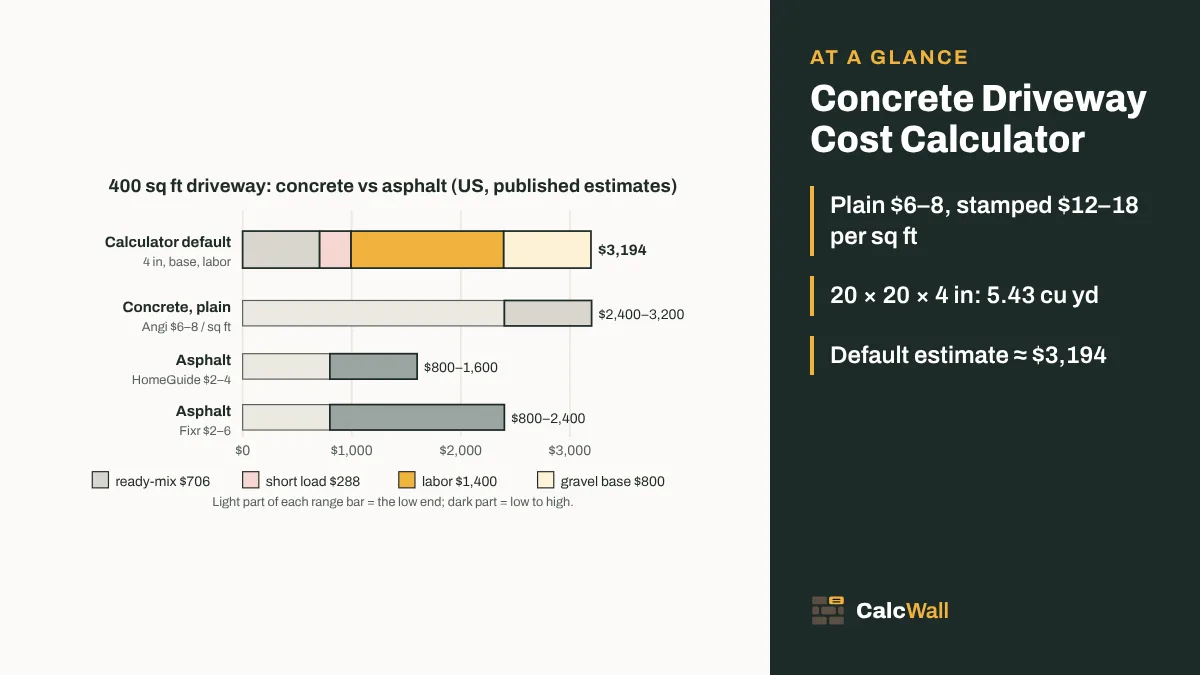
Angi says labor makes up about half the cost of a new driveway. The calculator’s default 20 × 20 estimate is close: $1,400 of the $3,194.07 is labor, which is 44%. Ready-mix and the short-load fee are $994.07, or 31%. The gravel base is $800, or 25%.
Labor is also where quotes vary most. Angi gives basic pour labor at $1.50–2 per sq ft, but specialty finishes at $3–18. HomeGuide gives $2–4 per sq ft to install a driveway. The calculator uses $3.50, from HomeGuide’s $3–5 for slab labor, which sits near the top of the driveway range.
Material cost is easier to pin down. Ask the plant for its price per yard, its minimum load and its short-load fee, and type them in. Those three numbers decide most of the material line. If the job also has a new curb along the street, work out how much concrete the curb needs separately and add it to the order.
Base and gravel
The base is the part you never see and the part that decides whether the slab cracks. HomeGuide says to spread at least 4 in of gravel and tamp it down. The Shaker Heights, Ohio driveway rules ask for the same: a minimum of 4 in of compacted stone, gravel or limestone screenings.
On expansive clay you may need more. ConcreteNetwork suggests 2–8 in of crushed rock, depending on how much the soil moves, and says to dig out soft spots and replace them with good material.
The calculator prices the base per square foot. HomeGuide gives $1–3 for a gravel pad base, and the default is $2. On a 20 × 20 driveway that is $800. To buy the stone yourself, work out the volume first: 400 sq ft × 4 in ÷ 12 = 133.3 cu ft, or 4.94 cu yd before compaction. The gravel driveway calculator turns that into tons. Recycled material is cheaper in some areas, and the crushed concrete calculator covers it.
In Canada, HomeStars says an upgraded base can add $5–15 per sq ft. That is far more than the US figure, so if a Canadian quote has a big base line, ask what depth and material it covers.
Driveway thickness: 4, 5 or 6 in
For passenger cars, 4 in is the usual minimum. HomeGuide says a residential driveway “should be 4 inches thick to hold standard passenger cars”, and ConcreteNetwork says to place concrete at a minimum of 4 in. City rules often say the same. Shaker Heights sets a 4 in minimum for the driveway and 6 in for the apron and sidewalk crossing.
Five or six inches is for heavier loads. HomeGuide says 5 to 6 in raises load capacity by 50%. ConcreteNetwork, citing the Tennessee Concrete Association, says going from 4 to 5 in adds about 20% to the cost but nearly 50% to the load the slab can carry. Angi suggests 6 in for heavier vehicles.
Here is what the extra inch does in the calculator, for a 20 × 20 driveway with the defaults:
- 4 in: 5.43 cu yd with waste, $3,194.07 ($7.99 per sq ft)
- 5 in: 6.79 cu yd, $3,442.59 ($8.61 per sq ft)
- 6 in: 8.15 cu yd, $3,691.11 ($9.23 per sq ft)
Each inch adds 25% of the 4 in volume, so 6 in is 50% more concrete than 4 in (6 ÷ 4 = 1.5). Some guides say 6 in raises material cost by only 25%, but the arithmetic says 50%. The total rises less, about 8% per inch here, because labor and base don’t change with thickness.
For a driveway that takes a delivery van, an RV or a loaded trailer, ask the contractor or your local building department what they require. These figures are a guide; local rules decide.
Control joints and drainage
Concrete shrinks as it dries, and it will crack. Control joints are grooves that make it crack in a straight line where you want it to. The National Ready Mixed Concrete Association (NRMCA), following ACI PRC-330-21, gives these maximum spacings for a subgrade of typical stiffness:
- 4 to 5 in thick: 10 ft
- over 5 to 6 in: 12.5 ft
- 6 in and thicker: 15 ft
ConcreteNetwork and the Shaker Heights rules give the same 10 ft for a 4 in driveway. Both say to cut the joint a quarter of the slab thickness deep, which is 1 in on a 4 in slab. NRMCA says conventional saw cuts are usually made 4 to 12 hours after the pour, depending on the weather.
NRMCA also describes isolation joints, which separate the driveway from fixed things like the garage slab, so each can move on its own. Shaker Heights asks for ½ in felt or fiberboard expansion joints every 30 ft, and where the driveway meets other concrete, posts or brick.
Water is the other enemy. ConcreteNetwork says to slope the driveway away from buildings at a minimum of 1/8 in per foot. Over a 20 ft driveway that is 20 × 1/8 = 2.5 in of fall. Shaker Heights also says the driveway must not sit higher than the garage floor.
Mesh or rebar
Reinforcement doesn’t stop a slab cracking. It holds the cracks tight so the panels don’t drift apart or drop. Joints still decide where the cracks form.
ConcreteNetwork suggests wire mesh for driveways 4 to 5 in thick and rebar for those 5 in or more, with bars about 12 in apart. Some cities accept fiber instead. Shaker Heights allows either 6 × 6 W1.4 × W1.4 welded wire mesh, placed in the middle of the slab, or synthetic fibers added at the plant.
Prices, all published estimates:
- Rebar, installed: $1–3 per sq ft (HomeGuide, undated). The calculator default is $2.
- Rebar, material only: $1.40 per linear foot on average, $0.70–2.55 (Angi, updated Aug 4, 2022).
- Mesh, vapor barrier or foam: $0.30–2 per sq ft added (Forbes Home, Feb 2025).
Tick “Reinforcement” in the calculator to add it. At the $2 default, a 20 × 20 driveway adds $800. If your quote is for mesh, enter a lower figure.
Finishes: broom, colored, exposed aggregate, stamped
A broom finish is the plain, grippy texture most driveways get. Color, exposed aggregate and stamping all cost more, mainly in labor and time.
- Plain: $6–8 per sq ft (Angi).
- Colored, textured or exposed aggregate: $8–12 (Angi). HomeGuide says exposed aggregate or a seeded pebble finish adds $1–3 per sq ft.
- Stained: $8–12 per sq ft (HomeGuide).
- Stamped: $12–18 per sq ft (Angi and HomeGuide agree).
Against Angi’s plain range, stamped concrete adds about $6–10 per sq ft. On 400 sq ft that takes the job from $2,400–3,200 to $4,800–7,200.
To use this as a stamped concrete cost calculator, set the finish to Stamped and the published range under the result moves to $4,800–7,200 for 400 sq ft. Then raise the labor line until your total matches the contractor’s price. That tells you how much of the quote is the stamping.
Decorative finishes often need sealing. HomeGuide gives $1–2 per sq ft for professional sealing and about $0.10–0.50 per sq ft for DIY sealer. Fixr says sealing concrete isn’t required but recommends it every few years.
Removing an old driveway
Replacing a driveway costs more than pouring a new one, because the old one has to be broken out and hauled away. HomeGuide gives $1–3 per sq ft to remove an old driveway, including demolition and hauling. Angi gives $2–6 per sq ft for professional concrete removal. HomeGuide’s slab guide gives $3–8 including disposal.
The calculator’s default is $4 per sq ft, the middle of Angi’s range. On a 20 × 20 driveway, ticking “Remove old concrete” adds $1,600.
New ground often needs excavation and grading too. HomeGuide gives $1–5 per sq ft, and the calculator default is $3. A replacement over a sound, compacted base may not need much digging, so ask whether the quote includes it.
Concrete vs asphalt driveway cost
Asphalt is cheaper to lay almost everywhere we found a price. The calculator shows the asphalt range for your area under the result, so it also works as an asphalt vs concrete driveway cost calculator.
| Market | Concrete driveway | Asphalt / tarmac | Source, date shown |
|---|---|---|---|
| US | $4–8 per sq ft | $2–4 per sq ft | HomeGuide, undated |
| US | $4–10 per sq ft | $2–6 per sq ft | Fixr, undated |
| Canada | $12–20 per sq ft (broom) | $4–10 per sq ft | HomeStars, undated |
| UK | about £95 per m² | tarmac about £90; asphalt £80–100 per m² | Checkatrade, Apr 2026 |
| Australia | $110–130 per m² (Yellow Pages, May 2026); about $65 (Oneflare) | $25–40 per m² | Oneflare, undated |
| Germany | no published price found | €80–100 per m² | sanier.de, Dec 2025 |
Each price is in the source’s own currency and unit. We don’t convert between currencies.
Fixr’s 600 sq ft example puts the gap in dollars: $2,994 for concrete against $1,230 for asphalt. In the UK the gap almost closes, with Checkatrade putting concrete at about £95 per m² and tarmac at about £90.
The cheaper price comes with more upkeep. Fixr says asphalt must be sealed six to twelve months after it goes down and then every three to five years. For tonnage and depth, use the asphalt calculator.
How long a concrete driveway lasts
The sources agree on decades, but not on exactly how many:
- HomeGuide: concrete lasts 30 to 40 years with proper maintenance; asphalt 15 to 30.
- Fixr: concrete can last 50 years or more; asphalt about 30 with proper maintenance.
- American Cement Association: concrete pavements have an average service life of 30 to 50 years.
Spread over its life, a concrete driveway costs about the same per year as asphalt, even though it costs more on day one. Take the HomeGuide low ends on 400 sq ft: $1,600 for concrete over 30 years is about $53 a year, and $800 for asphalt over 15 years is also about $53 a year. That is before asphalt resealing, which tips the sum toward concrete.
What shortens a driveway’s life is mostly under the surface: a soft or thin base, joints too far apart, and water sitting against the slab. ConcreteNetwork also says to keep the driveway curing for at least a week before you drive on it. The concrete curing time calculator adjusts that wait for the weather.
Driveway prices by country
The calculator switches to each country’s published prices when you change the country at the top of the site. Where there is no reliable figure, it says so and asks for your quote. Prices are as each source publishes them, in its own currency.
| Country | Plain concrete driveway | Decorative or stamped | Source, date shown |
|---|---|---|---|
| United States | $6–8 per sq ft; $4–8 (HomeGuide); $4–10 (Fixr) | decorative $8–12; stamped $12–18 | Angi, updated Aug 4, 2022 |
| United Kingdom | about £95 per m² (£50 materials, £45 installation) | printed £80–110 per m² | Checkatrade, Apr 2026 |
| Canada | $12–20 per sq ft, broom (HomeStars blog, undated); $4–8 basic in Calgary | Calgary: exposed aggregate $8–12; stamped $12–18 | HomeStars Calgary guide, Aug 21, 2026 |
| Australia | $110–130 per m² (Yellow Pages); about $65 (Oneflare, undated) | coloured $120–180; exposed aggregate $120–200; stamped $110–150 | Yellow Pages Australia, May 2026 |
| New Zealand | $135–185 per m² (Airtasker NZ); $120–160 (ArchiPro, second reference) | $150–250 (ArchiPro) | Airtasker NZ, Oct 31, 2026; ArchiPro, Jul 8, 2026 |
| Germany | no published concrete driveway price found | none found | asphalt only: sanier.de, Dec 2025 |
UK. Checkatrade (April 2026) gives about £95 per m² for a concrete driveway, split into £50 materials and £45 installation. Printed concrete is £80–110 per m², tarmac around £90 and asphalt £80–100. Groundworks add £20–100 per m², which explains a lot of the spread between quotes.
Canada. HomeStars’ two pages disagree. Its driveway guide (undated) says a basic broom-finish driveway costs $12–20 per sq ft. Its Calgary guide (August 21, 2026) gives $4–8 per sq ft for basic concrete. That is a gap of up to five times from the same publisher, so get local quotes. The calculator’s range check uses the $12–20 figure and notes the Calgary one.
Australia. Yellow Pages (May 2026) gives $110–130 per m² for a plain driveway, and about $10 per m² more on a sloping block. Oneflare (undated) gives about $65 per m² for plain concrete with materials and labour, about half the Yellow Pages figure. Most Australian figures in the calculator are ex GST.
New Zealand. Airtasker NZ (last updated October 31, 2026) gives $135–185 per m². As a second reference, ArchiPro published an article by Superior Renovations, an Auckland contractor, in July 2026. It quotes $120–160 per m² supplied and laid, and $150–250 for decorative work. A contractor’s own article is a useful check, but not an independent survey.
Germany. We found no reliable published price for a concrete driveway (Betoneinfahrt) in Germany. For asphalt, sanier.de (December 2025) gives €80–100 per m² for smaller areas. It also gives €25–30 per m² for a gravel sub-base and about €10 per m² for excavation including soil disposal. The calculator uses these, and asks for your quote for labor.
Worked examples
Each example uses the calculator’s default prices for its country, and the totals match what the calculator shows to the cent.
Default: a 20 × 20 ft two-car driveway
20 × 20 ft = 400 sq ft. At 4 in: 400 × 4 ÷ 12 = 133.33 cu ft ÷ 27 = 4.94 cu yd. With 10% waste: 4.94 × 1.1 = 5.43 cu yd.
Ready-mix: 5.4321 × $130 = $706.17. That is under 10 cu yd, so the short-load fee applies: 5.4321 × $53 = $287.90.
Labor: 400 × $3.50 = $1,400. Gravel base: 400 × $2 = $800.
Total: $706.17 + $287.90 + $1,400 + $800 = $3,194.07, or $3,194.07 ÷ 400 = $7.99 per sq ft. Under it, the calculator shows Angi’s plain range of $2,400–3,200, and asphalt at $800–1,600.
Replacing a long single driveway at 5 in, with rebar
12 × 50 ft = 600 sq ft. At 5 in: 600 × 5 ÷ 12 = 250 cu ft = 9.26 cu yd, or 10.19 cu yd with waste. That is over 10 cu yd, so there is no short-load fee.
Ready-mix: 10.1852 × $130 = $1,324.07. Labor: 600 × $3.50 = $2,100. Base, rebar and removal at $2, $2 and $4 per sq ft: $1,200 + $1,200 + $2,400.
Total: $8,224.07, or $13.71 per sq ft. Removal alone is $2,400, which is why a replacement costs far more than the per-square-foot figures for a new driveway.
UK: a 6 × 6 m driveway at 10 cm
With the country set to the UK, the calculator opens in meters with a 6 × 6 m, 10 cm driveway. 6 × 6 m = 36 m², × 0.10 m = 3.6 m³, or 3.96 m³ with 10% waste.
Ready-mix at £120 per m³: £475.20. The order is under 4 m³, so the part-load charge of £45 per m³ applies: £178.20. Labor at £20 per m²: £720. Sub-base at £11 per m²: £396.
Total: £1,769.40, or £49.15 per m². Checkatrade’s £95 per m² gives £3,420 for the same area. The default UK labor figure comes from a slab guide, and digging out is not ticked. Tick excavation (£50 per m² default) if your site needs it, and compare against a driveway contractor’s quote.
Doing it yourself
Same 20 × 20 driveway, labor set to 0: $706.17 + $287.90 + $800 = $1,794.07. Switch “Concrete from” to bags and the 146.67 cu ft with waste becomes 146.67 ÷ 0.60 = 244.4, so 245 bags of 80 lb. That is why almost everyone orders ready-mix for a driveway.
Notes for contractors
Watch the short-load line. At $130 plus $53, a short load costs $183 a yard. A full 10 yd truck at $130 costs $1,300, the same as 1,300 ÷ 183 = 7.1 yd on a short load. Above about 7.1 yd, ask the plant to price a full truck.
Price the apron separately. Some cities require 6 in at the apron and sidewalk crossing. HomeGuide puts aprons at $4–10 per sq ft. Run it as a second line at 6 in.
Lay out joints before the pour. 10 ft max on 4–5 in slabs, 12.5 ft over 5–6 in (NRMCA, from ACI 330). Cut a quarter of the depth, within about 4–12 hours.
Quote in lines. Removal, excavation, base, rebar and finish as separate lines make quotes comparable, and they match the calculator so clients can check them.
- Patios, slabs and pads: the concrete cost calculator uses the same engine without the driveway extras.
- Just the volume? The concrete calculator handles slabs, footings and odd shapes.
- Permits: HomeGuide puts a driveway permit at $50–200. Some cities, such as Shaker Heights, also want a pre-pour inspection. These figures are a guide; local rules decide.
Sources
Where the numbers on this page come from. Everything else is plain geometry and unit conversion, which the calculator does with exact factors.
- How Thick Should a Concrete Driveway Be?, ConcreteNetwork (Anne Balogh), published August 17, 2023; read 20 Nov 2026. Used for: 4 in minimum for cars and SUVs of 3,000–6,000 lb; 5 or 6 in for heavier vehicles such as RVs (12,000 lb or more); aprons at 5 or 6 in in many municipalities; thickened edges 1–2 in deeper for 4–8 in
- Frequently Asked Questions (FAQ's) about Concrete Driveways, County Materials (PDF referring readers to the Wisconsin Ready Mixed Concrete Association), no date shown; read 20 Nov 2026. Used for: 4 in minimum, 5 in or more for garbage trucks and other heavy vehicles, 6–12 in of compacted gravel or crushed stone base, joints at least 1/4 of the depth
- Concrete Mix No. 1101 product data sheet, QUIKRETE, revised October 2022. Used for: bag yields: 80 lb ≈ 0.60 cu ft, 60 lb ≈ 0.45 cu ft (the same yields as the Concrete Calculator)
- How Much Will It Cost to Install a Concrete Driveway?, Angi, page shows “Updated August 4, 2022”, read Nov 2026. Used for: installed price by finish (plain $6–8, decorative $8–12, stamped $12–18, saw cut or stained $18–20 per sq ft), the $4–15 headline range, costs by size, labor about half the cost, basic and specialty labor rates, DIY savings of $2–3 per sq ft, rebar $0.70–2.55 per linear foot, 6 in for heavier vehicles
- How Much Does a Concrete Driveway Cost?, HomeGuide, page undated, read Nov 2026. Used for: $4–8 per sq ft installed, costs by size, asphalt $2–4, lifespans (concrete 30–40 years, asphalt 15–30), removal $1–3, excavation $1–5, install labor $2–4, rebar $1–3 per sq ft, stamped, stained and exposed-aggregate prices, apron $4–10 per sq ft, permit $50–200, sealing, 4 in base and slab, 5–6 in for heavier loads
- How Much Does a Concrete Slab Cost?, HomeGuide, page undated, read Nov 2026. Used for: gravel pad base $1–3 per sq ft, slab labor $3–5 per sq ft, removal $3–8 per sq ft including disposal
- Concrete Prices, HomeGuide, page undated, read Nov 2026. Used for: short-load fee of $53 per cu yd below a full truck, a full truck of about 10 cu yd, ready-mix $119–147 per cu yd delivered
- Concrete Cost Per Yard, Angi, updated Sep 2022. Used for: ready-mix $110–150 per cu yd (calculator default $130) and professional removal $2–6 per sq ft (default $4)
- Asphalt vs Concrete Driveway: Pros, Cons, Comparisons and Costs, Fixr, page undated, read Nov 2026. Used for: concrete $4–10 and asphalt $2–6 per sq ft installed, the 600 sq ft example ($2,994 vs $1,230), lifespans and sealing intervals
- How Much Does A Concrete Slab Cost?, Forbes Home, updated Feb 2025. Used for: wire mesh, vapor barrier and foam adding $0.30–2 per sq ft
- 8 Concrete Driveway Construction Essentials for a Problem-Free Pour, ConcreteNetwork.com, updated March 12, 2026. Used for: 4 in minimum, 4 to 5 in adding about 20% to cost for nearly 50% more load capacity (citing the Tennessee Concrete Association), thickened edges, 2–8 in of crushed rock on expansive soil, 1/8 in per ft fall, 10 ft joints on a 4 in slab, mesh vs rebar, a week of curing before driving
- Jointing Concrete (Design Assistance Program sheet, based on ACI PRC-330-21), National Ready Mixed Concrete Association (NRMCA), hosted by the Pennsylvania Aggregates and Concrete Association, undated, read Nov 2026. Used for: maximum joint spacing by thickness (10, 12.5 and 15 ft), joint depth of 1/4 the thickness, sawing within 4–12 hours, isolation joints
- Asphalt and Concrete Driveway Requirements, City of Shaker Heights (Ohio) Building and Housing Department, effective June 6, 2019. Used for: an example city rule: 4 in minimum driveway, 6 in apron and sidewalk, 4 in compacted aggregate base, mesh or fiber, joints at 10 ft on 4 in concrete, 1/4 depth, expansion joints every 30 ft, pre-pour inspection
- Applications of Cement (paving), American Cement Association (formerly the Portland Cement Association), last modified June 2, 2025. Used for: concrete pavements have an average service life of 30 to 50 years
- Concrete Mix No. 1101 product data sheet, QUIKRETE, revised October 2022. Used for: an 80 lb bag yields about 0.60 cu ft
- Driveway Costs in the UK, Checkatrade, April 2026. Used for: UK concrete driveway about £95 per m² (£50 materials, £45 installation), printed concrete £80–110, tarmac about £90, asphalt £80–100, groundworks £20–100 per m²
- Ready Mix Concrete Cost, Checkatrade, updated Jul 2024. Used for: UK default ready-mix price of £120 per m³
- Ready Mix Concrete Cost, MyBuilder, page undated, read Nov 2026. Used for: UK part-load charge used as the default: £45 per m³ on orders under 4 m³
- Concrete Slab Cost Guide, MyBuilder, page undated, read Nov 2026. Used for: UK default labor £15–25 per m² (£20 used) and 100 mm sub-base £6–16 per m² (£11 used)
- How Much Does Concrete Cost? (UK price update), MyJobQuote, Sep 2026. Used for: UK default excavation of £50 per m² (dig out, level and compact, £30–70)
- Everything You Need to Know About Concrete Driveway Costs, HomeStars, page undated, read Nov 2026. Used for: Canada: basic broom driveway $12–20 per sq ft, asphalt $4–10, upgraded base $5–15 per sq ft (currency not named on the page)
- Concrete Contractor Costs in Calgary, HomeStars, Aug 21, 2026. Used for: Calgary: basic concrete $4–8, exposed aggregate $8–12, stamped driveway $12–18 per sq ft
- How much does a concrete driveway cost?, Yellow Pages Australia, May 2026. Used for: Australia: plain $110–130, coloured $120–180, exposed aggregate $120–200, stamped $110–150 per m², sloping block about $10 per m² more
- Concrete driveway cost guide, Oneflare, page undated, read Nov 2026. Used for: Australia: plain about $65 per m² with materials and labour, asphalt $25–40 per m²
- Concreting cost guide (NZ), Airtasker NZ, last updated Oct 31, 2026. Used for: New Zealand: concrete driveway $135–185 per m²
- Concrete Driveways NZ: Costs, Options & What to Know, ArchiPro (article written by Superior Renovations, an Auckland contractor), Jul 8, 2026. Used for: second New Zealand reference: plain $120–160 per m² supplied and laid, decorative $150–250
- Flächen asphaltieren lassen: wie viel kostet das?, sanier.de, updated Dec 1, 2025. Used for: Germany: asphalt €80–100 per m² for smaller areas, gravel sub-base €25–30 per m², excavation about €10 per m²
Frequently asked questions
How much concrete do I need for a driveway?
Multiply length × width in feet by the thickness in inches, divide by 12 for cubic feet and by 27 for cubic yards, then add about 10% for waste and uneven ground. A 20 × 20 ft driveway at 4 in is 4.94 cu yd, or 5.43 cu yd to order. At 6 in it is 7.41 cu yd, or 8.15 cu yd to order.
How many bags of concrete for a driveway?
An 80 lb bag makes about 0.60 cu ft (QUIKRETE data sheet), so one cubic yard takes 45 bags. A 10 × 20 ft driveway at 4 in with 10% waste needs 123 bags of 80 lb; a 20 × 20 ft driveway needs 245. Above about 1 cu yd, ready-mix is usually the practical choice for a driveway.
How many yards of concrete for a 20 × 20 driveway?
4.94 cu yd at 4 in, 6.17 at 5 in and 7.41 at 6 in, before waste. With 10% extra, order 5.43, 6.79 or 8.15 cu yd. All three fit in one truck of about 10 cu yd.
How many concrete trucks do I need for a driveway?
Divide the yards to order by the truck size; HomeGuide gives about 10 cu yd for a full truck. A 24 × 24 ft driveway at 6 in needs 11.73 cu yd with waste, which is two trucks. Ask the plant for its truck size and its minimum load, and order the second truck before the first runs out.
How much does a concrete driveway cost per square foot?
Published US estimates put a concrete driveway at $4–8 per sq ft installed (HomeGuide), $4–10 (Fixr) or $6–8 for a plain finish (Angi). Decorative finishes run $8–12 and stamped $12–18 per sq ft (Angi). With its default prices, this calculator gives $7.99 per sq ft for a 20 × 20 ft, 4 in driveway with a gravel base.
How much is a 2-car (20×20) concrete driveway?
HomeGuide lists a 20 × 20 ft (400 sq ft) two-car driveway at $1,600–3,200, and Angi at $1,600–6,000 with a $3,800 average. The calculator’s default estimate is $3,194.07: 5.43 cu yd of ready-mix with a short-load fee, labor at $3.50 per sq ft and a gravel base at $2 per sq ft.
Is concrete or asphalt cheaper?
Asphalt costs less to put in. HomeGuide gives $2–4 per sq ft for asphalt against $4–8 for concrete, and Fixr gives $2–6 against $4–10. Concrete usually lasts longer: HomeGuide says 30–40 years for concrete and 15–30 for asphalt, and Fixr says asphalt needs resealing every three to five years.
How thick should a concrete driveway be?
Four inches is the usual minimum for passenger cars, according to HomeGuide and ConcreteNetwork, and it is the minimum in the Shaker Heights, Ohio rules, for example. Five to six inches carries heavier loads. Some cities ask for 6 in at the apron where the driveway crosses the sidewalk. Your local rules decide.
Does a driveway need rebar?
Not always. ConcreteNetwork suggests wire mesh for 4–5 in driveways and rebar at about 12 in spacing for 5 in and thicker. Some cities, such as Shaker Heights, Ohio, accept mesh or synthetic fiber. Reinforcement holds cracks tight; control joints decide where cracks form. HomeGuide puts rebar at $1–3 per sq ft installed.
How much does stamped concrete add?
Angi lists plain concrete at $6–8 and stamped at $12–18 per sq ft, so stamping adds roughly $6–10 per sq ft. On a 400 sq ft driveway that is $4,800–7,200 stamped against $2,400–3,200 plain. In the calculator, pick Stamped to see the published range, and raise the labor figure to match your quote.
How much does it cost to remove an old driveway?
HomeGuide gives $1–3 per sq ft for removing an old driveway, including demolition and hauling. Angi gives $2–6 per sq ft for professional concrete removal, which is where the calculator’s $4 default comes from. HomeGuide’s slab guide gives $3–8 including disposal.
How long does a concrete driveway last?
HomeGuide says 30–40 years with proper maintenance, and Fixr says 50 years or more. The American Cement Association gives concrete pavements an average service life of 30 to 50 years. A good base, joints at the right spacing and drainage away from the slab matter more than the finish.
How much gravel goes under a driveway?
HomeGuide and the Shaker Heights rules both call for at least 4 in of compacted gravel. On a 20 × 20 ft driveway, 4 in of base is 400 × 4 ÷ 12 = 133.3 cu ft, or 4.94 cu yd before compaction. ConcreteNetwork suggests 2–8 in of crushed rock on expansive soils. HomeGuide prices a gravel base at $1–3 per sq ft.
Can I pour a driveway myself?
You can, but it is a big pour. A 20 × 20 ft slab at 4 in needs 5.43 cu yd with waste, which would be 245 bags of 80 lb premix. Angi says doing it yourself might save $2–3 per sq ft but recommends a pro. Set labor to 0 in the calculator and the default estimate drops from $3,194.07 to $1,794.07.
How much is a concrete driveway in the UK or Australia?
Checkatrade (April 2026) puts a UK concrete driveway at around £95 per m², and printed concrete at £80–110. In Australia, Yellow Pages (May 2026) gives $110–130 per m² for plain concrete and up to $200 for exposed aggregate. Oneflare gives a much lower $65 per m², so get local quotes.
Why are quotes so different?
Published ranges differ because they bundle different things: removal, excavation, base, reinforcement, finish and the short-load fee on small orders. Angi’s headline range is $4–15 per sq ft; HomeGuide’s is $4–8. Ask each contractor for a line-item quote and enter those lines in the calculator.
How often does a driveway need control joints?
NRMCA, following ACI PRC-330-21, gives a maximum of 10 ft between joints for 4–5 in slabs, 12.5 ft for over 5–6 in and 15 ft for 6 in and thicker. Cut them a quarter of the slab thickness deep, so 1 in on a 4 in driveway, usually within about 4–12 hours of the pour.
Do I need a permit for a driveway?
Often, yes, especially where the driveway meets the street or sidewalk. HomeGuide puts a concrete driveway permit at $50–200, depending on location. Some cities, such as Shaker Heights, Ohio, also require a pre-pour inspection. Check with your local building or public works department before you book the truck.
How much does a concrete driveway apron cost?
HomeGuide puts concrete driveway aprons at $4–10 per sq ft, or $1,000–1,600 on average, and lists a 10 × 10 ft apron at $400–1,000. Some cities require the apron and sidewalk crossing to be thicker; Shaker Heights asks for 6 in. Price it as a separate 6 in line in the calculator.
Is this concrete driveway cost calculator free to use online?
Yes. The CalcWall Concrete Driveway Cost Calculator is completely free and works online in any browser, on a phone, tablet or computer. There is nothing to download and no account to create, and the math runs right in your browser, so results appear as you type.