Box / room
Also: rectangular prism, bed, trench, room
V = L × W × H
L = length, W = width, H = height or depth.
Example: A patio base 20 × 10 ft, 4 in deep in #57: 20 × 10 × 4 ÷ 12 = 66.7 cu ft = 2.47 cu yd, about 3.23 tons before any extra.
This crushed stone calculator works out how many tons and cubic yards of #57, #3, crusher run or screenings you need for a base, path or drain. Pick the grade, say whether your depth is loose or compacted, and get the order, the bags and the cost. This free online crushed stone calculator works on any phone or computer, with no sign-up or download.
Jump to:How much stoneGradesWeight per yardLoose vs compactedExamplesFAQ
Crushed stone needed
— tons
Quick answer: crushed stone tons = length × width (ft) × depth (in) ÷ 12 × weight (lb per cu ft) ÷ 2,000. Loose #57 weighs about 97 lb per cu ft: 1.31 tons a cubic yard. A 10 × 20 ft base 4 in deep takes about 3.2 tons.
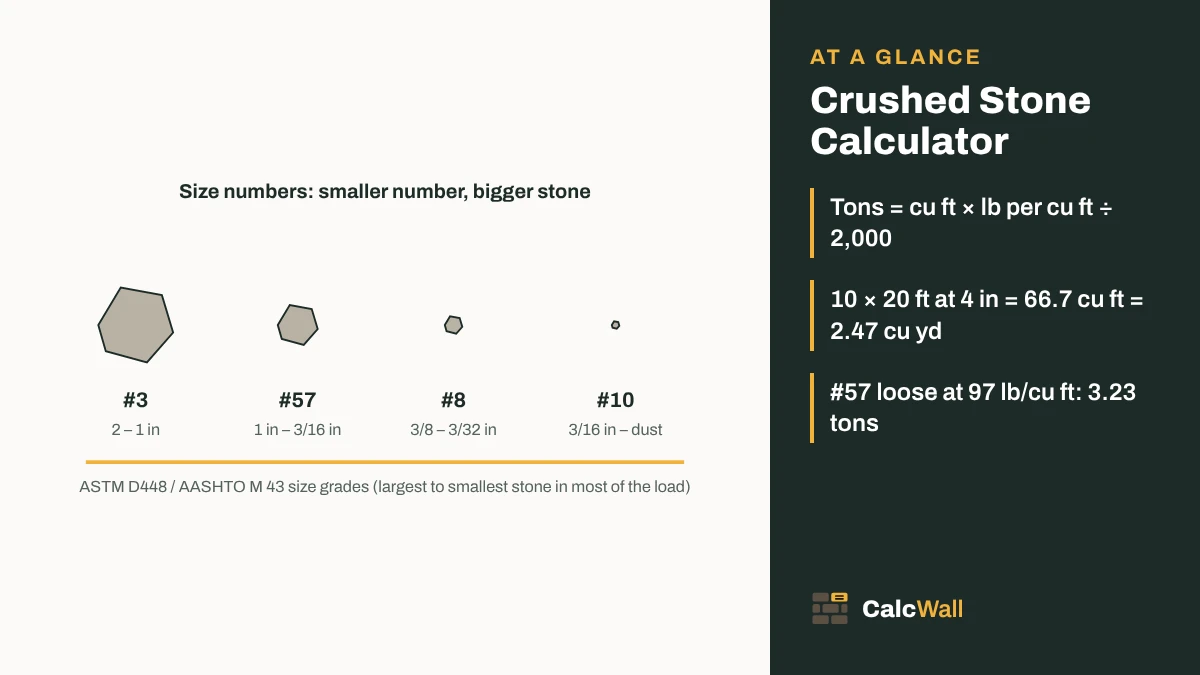
Every crushed stone order comes down to the same three numbers: the area, the depth and the weight of the stone you are buying. The calculator does the arithmetic, but it helps to see it once so you can sanity-check the delivery ticket.
Tons = L (ft) × W (ft) × depth (in) ÷ 12 × density (lb/ft³) ÷ 2,000
A 10 × 20 ft patio base, 4 in deep, in loose #57 stone:
10 × 20 × 4 ÷ 12 = 66.7 cu ft = 2.47 cu yd. 66.7 × 97 ÷ 2,000 = 3.23 tons. With 5% extra: 3.40 tons, so order 3½ tons.
In a metric country, type meters and centimeters. The calculator gives cubic meters and metric tonnes (1,000 kg), as well as US tons for comparison. One US ton is 2,000 lb; a metric tonne is about 2,205 lb, so the same pile is a slightly smaller number in tonnes.
Quarries sell crushed stone by size number. The numbers come from ASTM D448, the same sizes as AASHTO M 43, and they describe the largest and smallest stone in most of the load. The rule to remember: the smaller the number, the bigger the stone.
| Grade | Stone size | What it is used for |
|---|---|---|
| #3 | 2–1 in | Sub-base on soft ground, construction entrances, large drains |
| #4 | 1½–¾ in | Drainage, sub-base |
| #57 | 1 in to about 3/16 in | French drains, pipe beds, under slabs, driveway top layer, concrete aggregate |
| #8 | ⅜ in to about 3/32 in | Paver bedding, pipe bedding |
| #10 (screenings) | about 3/16 in to dust | Leveling under pavers and stepping stones |
| Crusher run / dense grade | about ¾ in down to dust | Driveway and patio base that compacts hard |
Crusher run is not an ASTM size number. It is a blend of stone and fines, sold under local names such as road base, ¾ in minus, dense-graded aggregate or CR-6. Blends such as #411 (#4 stone mixed with stone dust) are also local products, so their weight depends on the quarry. For any of these, ask the quarry for its weight and type it in the calculator as a custom density.
Weight is what turns a volume into tons, and it is where most online calculators hide a single number. These are the figures this calculator uses, with where each one comes from.
| Stone | lb per cu ft | lb per cu yd | Tons per cu yd | Basis |
|---|---|---|---|---|
| #57, loose | 97 | 2,619 | 1.31 | Tennessee DOT estimating figure |
| #3 / #4, loose | 97 | 2,619 | 1.31 | Estimate: clean single-size stone has gaps similar to #57 |
| Crusher run, loose | 107 | 2,900 | 1.45 | Tennessee DOT loose weight for mineral aggregate base |
| Crusher run, compacted in place | 150 | 4,060 | 2.03 | Tennessee DOT compacted mineral aggregate base |
| Screenings (#10), loose | 109 | 2,943 | 1.47 | Estimate from limestone’s specific gravity and typical voids |
The Tennessee DOT figures are from its Roadway Design Guidelines, Chapter 4. Real stone varies with the rock (granite, limestone and trap rock all differ) and with moisture: wet stone straight from a washed pile weighs more than dry. If you are buying by the ton, the quarry’s own figure makes your order match their scale.
Crusher run is full of fines. When a plate compactor runs over it, the fines pack into the gaps between the stones and the layer gets thinner and much heavier. If you want 4 in of finished, compacted base, you need to spread more than 4 in of loose stone.
The calculator handles this two ways. The cleanest is to pick Crusher run, compacted depth and type the finished depth: it then uses 2.03 tons per compacted cubic yard, so the tons come out right for the finished layer. The other way is to pick the loose crusher run and add a compaction allowance. The Tennessee DOT figures imply about 40% (2.03 ÷ 1.45 = 1.40) between loose and fully compacted; suppliers often quote a smaller number, because a load is never perfectly loose. If your supplier gives you a figure, use theirs.
Clean stone such as #57 has no fines to fill the gaps, so it settles far less. A 0–10% allowance is usually enough.
A good driveway or heavy-use pad is usually more than one stone. A coarse sub-base gives strength and drainage on soft ground, a compacted crusher run base gives a hard, flat layer, and a thin top layer of #57 or crusher run gives the surface.
To do this in the calculator, enter the first layer, pick its stone and press Add this layer to a project total. Change the depth and the stone for the next layer and add it too. The total at the bottom adds up the tons and yards and lists each layer separately for your order. The gravel driveway calculator is set up for exactly this, and the road base calculator covers a single compacted base.
Sometimes you have it the other way round: a quarry sells by the ton, and you want to know how far a ton goes. Area per ton = 2,000 ÷ (lb per cu ft × depth in inches ÷ 12).
| Depth | 1 ton of #57 (loose) | 1 ton of crusher run (loose) | 1 ton of crusher run (compacted) |
|---|---|---|---|
| 2 in | 124 sq ft | 112 sq ft | 80 sq ft |
| 3 in | 82 sq ft | 74 sq ft | 53 sq ft |
| 4 in | 62 sq ft | 56 sq ft | 40 sq ft |
| 6 in | 41 sq ft | 37 sq ft | 27 sq ft |
The result panel also shows coverage for your own depth and stone, so you can check a quote quickly.
Also: rectangular prism, bed, trench, room
V = L × W × H
L = length, W = width, H = height or depth.
Example: A patio base 20 × 10 ft, 4 in deep in #57: 20 × 10 × 4 ÷ 12 = 66.7 cu ft = 2.47 cu yd, about 3.23 tons before any extra.
Also: square feet to cubic feet
V = A × d
A = area, d = depth or thickness.
Example: A 200 sq ft shed and path base, 4 in deep: 200 × 4 ÷ 12 = 66.7 cu ft, the same 3.23 tons of #57.
Also: round hole, post hole, tank, planter
V = π × r² × h
r = radius (half the diameter), h = height.
Example: A round fire-pit pad 10 ft across, 4 in deep: π × 5² × 4 ÷ 12 = 26.2 cu ft, about 1.27 tons of #57.
Also: ditch, berm, swale, trapezoidal prism
V = (a + b) ÷ 2 × h × L
a = top width, b = bottom width, h = depth, L = length.
Example: A drain trench 18 in wide, 18 in deep and 40 ft long: 1.5 × 1.5 × 40 = 90 cu ft = 3.33 cu yd, about 4.37 tons of #57 before taking out the pipe.
Also: ramp, uneven depth, tapered bed
V = L × W × (h₁ + h₂) ÷ 2
L = length, W = width, h₁ and h₂ = depth at each end.
Example: A parking pad 40 × 12 ft that runs from 6 in deep at one end to 4 in at the other: 40 × 12 × (0.5 + 0.333) ÷ 2 = 200 cu ft, about 10.7 tons of loose crusher run.
Also: around a tree, donut bed, circle with a hole
V = π × (R² − r²) × d
R = outer radius, r = inner radius (the part left bare), d = depth.
Example: A stone ring 12 ft across around an 8 ft pit, 4 in deep: π × (6² − 4²) × 4 ÷ 12 = 20.9 cu ft, about 1.02 tons of #57.
#57 loose: 10 × 20 × 4 ÷ 12 = 66.7 cu ft = 2.47 cu yd × 1.31 = 3.23 tons. In crusher run, compacted to 4 in: 2.47 × 2.03 = 5.01 tons. The difference is the fines and the compaction, and it is why the grade matters as much as the size.
40 × 12 × 6 ÷ 12 = 240 cu ft = 8.89 compacted cu yd × 2.03 = 18.0 tons of crusher run. If the yard sells by the loose yard: 8.89 × 1.40 = about 12.4 loose cu yd.
18 in wide by 18 in deep: 1.5 × 1.5 × 40 = 90 cu ft = 3.33 cu yd of #57, about 4.4 tons. A 4 in pipe takes out π × (2 ÷ 12)² × 40 = 3.5 cu ft, so you can trim the order a little.
A 4 × 6 ft landing pad 3 in deep is 6 cu ft, which is 12 bags of 0.5 cu ft, or about 0.29 tons of #57. Below about half a ton, bags are often simpler; above it, bulk is usually cheaper even with a delivery fee.
Spec the grade and the name. Write the size number and the local name on the order. “Gravel” or “base” alone can mean anything from pea gravel to crusher run.
Lifts. Compact dense-graded base in 3–4 in lifts rather than one thick layer, or the bottom stays soft and settles later.
Separation. On soft clay, a geotextile under the stone stops it working down into the soil over the years.
Check the ticket. Tons on the ticket ÷ tons per yard gives the loose yards delivered. If it is well short of your order, ask before you spread.
Depths on this page are common residential practice, not code requirements. Commercial work, public roads and anything carrying heavy trucks follows the project specification or an engineer’s design.
Where the numbers on this page come from. Everything else is plain geometry and unit conversion, which the calculator does with exact factors.
Loose #57 crushed stone weighs about 2,619 lb, or 1.31 US tons, per cubic yard: that is the Tennessee DOT estimating figure. Loose crusher run is heavier, about 2,900 lb (1.45 tons), because the fines fill the gaps. Compacted in place, crusher run is about 2.03 tons per cubic yard. Your quarry’s stone can weigh a little more or less, so ask for their figure.
A ton of loose #57 is about 20.6 cu ft. That covers about 124 sq ft at 2 in deep, 82 sq ft at 3 in, 62 sq ft at 4 in and 41 sq ft at 6 in. Crusher run is heavier, so a ton covers a little less: about 56 sq ft at 4 in.
#57 is clean crushed stone from 1 in down to about 3/16 in. It drains well and does not pack into a solid layer, so it is used in French drains, around pipes, under concrete slabs and as a driveway top layer. It is also a common coarse aggregate in concrete.
Common residential practice is 4–6 in of compacted base under a patio or walkway and 8–12 in under a driveway, laid and compacted in 3–4 in layers (Unilock’s base guide). Soft clay or heavy trucks need more. These are rules of thumb, not code: follow your local requirements or an engineer’s design.
For crusher run, yes. Pick “Crusher run, compacted depth” and type the finished depth; the calculator then uses 2.03 tons per compacted yard, which is about 1.4 loose yards for each compacted yard. For clean #57, a small allowance (0–10%) is usually enough because it settles much less.
Both. Quarries and many yards sell by the ton because they weigh the truck; some landscape yards sell by the loose cubic yard. The calculator shows both, so you can order either way and compare prices.
#411 is a local name for a blend of #4 stone and stone dust that some quarries sell. It is not one of the ASTM D448 size numbers, so its weight depends on the quarry. Ask for their weight per ton and type it as a custom density.
Crushed stone is quarried rock broken by machine, so the pieces are angular and lock together. Gravel is often rounded by water. For a base that stays put, use crushed stone; round gravel and river rock suit paths and beds.
Yes. The CalcWall Crushed Stone Calculator is completely free and works online in any browser, on a phone, tablet or computer. There is nothing to download and no account to create, and the math runs right in your browser, so results appear as you type.