Box / room
Also: rectangular prism, bed, trench, room
V = L × W × H
L = length, W = width, H = height or depth.
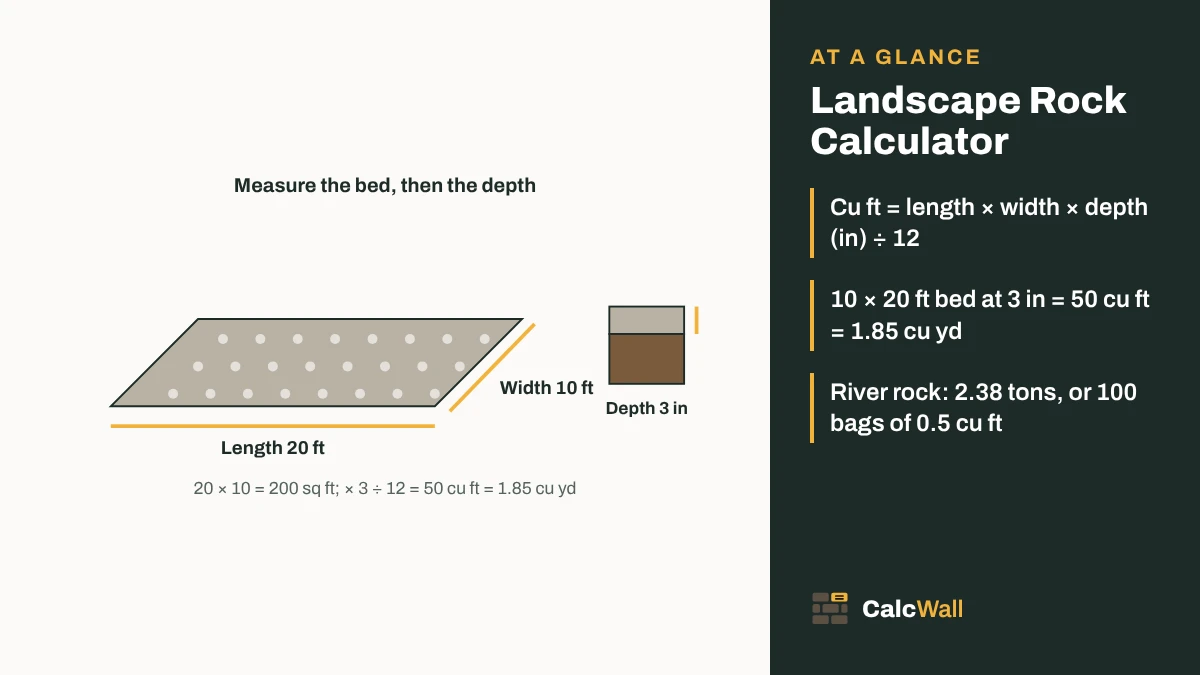
Example: A front bed 20 × 10 ft, 3 in deep: 20 × 10 × 3 ÷ 12 = 50 cu ft = 1.85 cu yd, about 2.38 tons of river rock.
This landscape rock calculator tells you how much decorative rock to order for beds, borders, tree rings and dry creek beds: tons, cubic yards and bags, with what it covers per ton and what it will cost. This free online landscape rock calculator works on any phone or computer, with no sign-up or download.
Jump to:How much rockDepthTons, yards, bagsWeightExamplesFAQ
Landscape rock needed
— tons
Quick answer: landscape rock tons = length × width (ft) × depth (in) ÷ 12 × about 95 lb per cu ft ÷ 2,000 for river rock. A 10 × 20 ft bed 3 in deep needs 1.85 cubic yards: about 2.4 tons, or 100 bags of 0.5 cu ft.
Rock is heavy and it is sold by weight or by the yard, so a few minutes with a tape before you call the yard saves a second delivery fee or a pile of leftover stone by the drive.
Tons = L (ft) × W (ft) × depth (in) ÷ 12 × density (lb/ft³) ÷ 2,000
A 10 × 20 ft bed, 3 in deep, in river rock:
10 × 20 × 3 ÷ 12 = 50 cu ft = 1.85 cu yd. 50 × 95 ÷ 2,000 = 2.38 tons. With the 5% extra the calculator adds by default: 2.49 tons, or 105 bags of 0.5 cu ft.
Got several beds? Work out the first one, press Add this bed to a project total, then do the next. The total adds them up and lists each bed for your order. In a metric country, type meters and centimeters and the result comes out in cubic meters and tonnes.
Too thin and the soil or fabric shows through; too thick and you have paid for rock nobody sees. A common rule of thumb is a layer about twice as deep as the stones are wide.
| Use | Rock size | Typical depth |
|---|---|---|
| Beds and borders | ¾–1½ in | 2 in |
| Beds with bigger stone | 1–3 in | 3–4 in |
| Paths you walk on | ⅜–¾ in | 2–3 in, with edging |
| Dry creek beds | mixed, 1 in to small boulders | fill the channel, larger stones on the sides |
| Drainage around a downspout | clean crushed stone (#57) or larger | 4–6 in |
These depths are common practice, not rules. A bed on a slope needs edging or larger stone so the rock does not creep downhill.
Landscape yards sell rock three ways, and the calculator shows all three so you can compare prices.
One cubic yard is 27 cu ft, so it is 54 bags of 0.5 cu ft. At about 95 lb per cu ft, a cubic yard of river rock is about 2,565 lb (1.28 tons), and a ton is about 21 cu ft, or 42 bags.
The weight per cubic foot is what turns a volume into tons, and it is the number that varies most from one yard to the next.
| Rock | lb per cu ft | Tons per cu yd | Basis |
|---|---|---|---|
| River rock | 95 | 1.28 | Estimate, the same as our River Rock calculator; no primary source found |
| Crushed stone, #57 size | 97 | 1.31 | Tennessee DOT estimating figure, 2,619 lb per cu yd |
| Larger crushed stone, #3 / #4 | 97 | 1.31 | Estimate: clean single-size stone has gaps similar to #57 |
| Lava rock | ask the supplier | ask the supplier | Much lighter (porous); no published figure we can cite |
If your yard tells you its weight, pick Custom density in the calculator and type it in lb per cu ft. A figure in lb per cubic yard divided by 27 gives lb per cu ft; a figure in tons per yard times 2,000 ÷ 27 does the same.
| Depth | 1 ton of river rock covers | 1 ton of #57 covers | 1 cu yd covers |
|---|---|---|---|
| 2 in | 126 sq ft | 124 sq ft | 162 sq ft |
| 3 in | 84 sq ft | 82 sq ft | 108 sq ft |
| 4 in | 63 sq ft | 62 sq ft | 81 sq ft |
Square feet per ton = 2,000 ÷ (lb per cu ft × depth in inches ÷ 12). Square feet per cubic yard = 324 ÷ depth in inches, whatever the rock.
Also: rectangular prism, bed, trench, room
V = L × W × H
L = length, W = width, H = height or depth.
Example: A front bed 20 × 10 ft, 3 in deep: 20 × 10 × 3 ÷ 12 = 50 cu ft = 1.85 cu yd, about 2.38 tons of river rock.
Also: square feet to cubic feet
V = A × d
A = area, d = depth or thickness.
Example: Side-yard beds adding up to 300 sq ft, 2 in deep: 300 × 2 ÷ 12 = 50 cu ft, also about 2.38 tons.
Also: round hole, post hole, tank, planter
V = π × r² × h
r = radius (half the diameter), h = height.
Example: A round bed 8 ft across, 3 in deep: π × 4² × 3 ÷ 12 = 12.6 cu ft, about 0.60 tons (1,190 lb).
Also: around a tree, donut bed, circle with a hole
V = π × (R² − r²) × d
R = outer radius, r = inner radius (the part left bare), d = depth.
Example: A tree ring 8 ft across, with 2 ft round the trunk left bare, 3 in deep: π × (4² − 1²) × 3 ÷ 12 = 11.8 cu ft, about 0.56 tons.
Also: ditch, berm, swale, trapezoidal prism
V = (a + b) ÷ 2 × h × L
a = top width, b = bottom width, h = depth, L = length.
Example: A dry creek bed 30 ft long, 3 ft wide at the top and 1.5 ft at the bottom, 12 in deep: (3 + 1.5) ÷ 2 × 1 × 30 = 67.5 cu ft = 2.5 cu yd, about 3.2 tons.
Also: ramp, uneven depth, tapered bed
V = L × W × (h₁ + h₂) ÷ 2
L = length, W = width, h₁ and h₂ = depth at each end.
Example: A bank bed 20 × 6 ft, 4 in deep at the bottom thinning to 2 in at the top: 20 × 6 × (4 + 2) ÷ 2 ÷ 12 = 30 cu ft, about 1.43 tons.
50 cu ft = 1.85 cu yd. River rock: 50 × 95 ÷ 2,000 = 2.38 tons. #57 crushed stone: 50 × 97 ÷ 2,000 = 2.43 tons. In bags: 50 ÷ 0.5 = 100 bags.
40 × 3 × 2 ÷ 12 = 20 cu ft = 0.74 cu yd, about 0.95 tons of river rock, or 40 bags. Edging along the open side: 40 ft plus the two 3 ft ends = 46 ft.
π × (4² − 1²) × 3 ÷ 12 = 11.8 cu ft, about 0.56 tons or 24 bags. Keep the rock a hand’s width back from the trunk.
For the same 10 × 20 ft bed at 3 in, order 1.85 cu yd; the weight does not matter when the yard sells by volume. If it sells by the ton, ask its weight per yard first and type it as a custom density.
Fabric. University of Nevada, Reno Extension recommends landscape fabric under a 2 in layer of rock for weed control. Washington State University Spokane County Extension does not recommend fabric or plastic under rock for weeds, because soil and leaves settle on top of the fabric and weeds grow there anyway. Fabric does stop the rock sinking into soft soil. If you use it, buy the bed area plus your seam overlaps, overlap the seams and pin them. Never use plastic sheeting: it stops water reaching the soil.
Edging. Measure the sides of the bed that are not against a wall, path or fence. Rock beside a lawn needs edging, or it ends up in the mower.
Heat. Both extension guides note that rock heats up in the sun and warms the soil and air around it. Keep rock back from plant stems and choose plants that like heat for a bed in afternoon sun.
Weigh, then measure. If a yard sells by the ton, get its weight per yard and type it in; it makes the order match the scale.
Order once. The default 5% extra covers uneven ground. Delivery fees usually cost more than a few extra bags.
Same batch. Rock color varies between loads. Order a whole job at once so the beds match.
Drainage first. Clean crushed stone drains; rounded rock with fines does not. Use #57 or larger around downspouts.
Where the numbers on this page come from. Everything else is plain geometry and unit conversion, which the calculator does with exact factors.
Multiply length × width in feet by the depth in inches ÷ 12 for cubic feet, divide by 27 for cubic yards, and multiply cubic feet by the rock’s weight (about 95 lb per cu ft for river rock) ÷ 2,000 for tons. A 20 × 10 ft bed 3 in deep is 50 cu ft, 1.85 cu yd or about 2.4 tons.
A common rule of thumb is a layer about twice as deep as the stones are wide: about 2 in for ¾–1½ in rock and 3–4 in for 1–3 in rock. That is enough to hide fabric or soil. Paths that people walk on are often a little deeper so the rock does not scatter.
A ton of river rock at about 95 lb per cu ft is about 21 cu ft. That covers about 126 sq ft at 2 in deep, 84 sq ft at 3 in and 63 sq ft at 4 in. Heavier crushed stone covers a little less.
A cubic yard is 27 cu ft, so it takes 54 bags of 0.5 cu ft. Some bags are sold by weight instead (for example 40 or 50 lb); for those, divide the pounds you need by the bag weight.
Yes, much lighter, because lava rock is full of air pockets. That means a ton of lava rock covers far more ground than a ton of river rock. We have not found a published weight we can cite, so the calculator has no lava rock preset: ask your supplier for its weight per cubic yard, pick Custom density and type it in (lb per cu yd ÷ 27 = lb per cu ft). If the yard sells lava rock by the cubic yard, just use the cubic yards result.
Extension services differ. University of Nevada, Reno Extension recommends fabric under a 2 in layer of rock for weed control; Washington State University Spokane County Extension does not recommend fabric or plastic under rock for weeds. Fabric does keep rock from sinking into soft soil. Never use plastic sheeting, which stops water reaching the soil.
For anything more than a few hundred pounds, bulk by the ton or by the yard is usually much cheaper than bags. A ton of river rock is about 42 bags of 0.5 cu ft. Type both prices in the calculator to compare on your job.
Edging runs around the open sides of the bed: add up the lengths of the sides that are not against a wall, path or fence. For a 20 × 10 ft bed against a house wall, that is 20 + 10 + 10 = 40 ft. Buy a little extra for joints and corners.
Yes. The CalcWall Landscape Rock Calculator is completely free and works online in any browser, on a phone, tablet or computer. There is nothing to download and no account to create, and the math runs right in your browser, so results appear as you type.