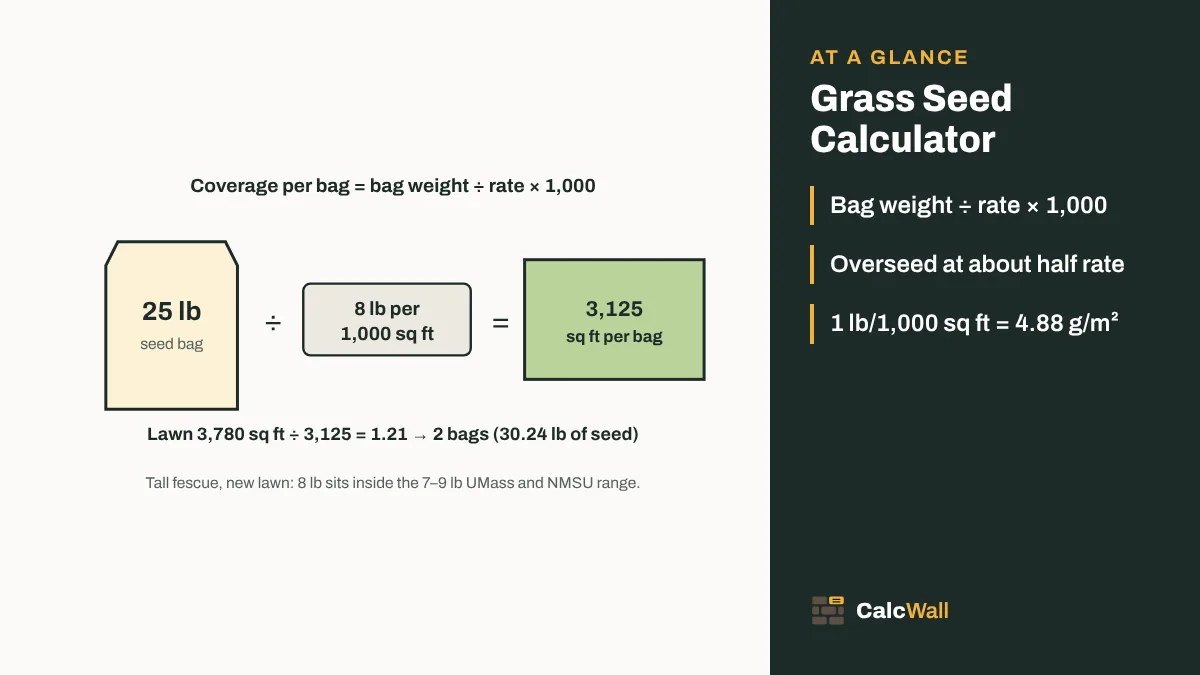
Quick answer: area one bag covers = bag weight ÷ rate per 1,000 sq ft × 1,000; bags = lawn area ÷ that area, rounded up. A 25 lb bag of tall fescue at 8 lb per 1,000 sq ft covers 3,125 sq ft, so a 3,780 sq ft lawn needs 2 bags.
How to calculate grass seed
Seed is sold by weight but sown by area. The bridge between the two is the seeding rate: pounds per 1,000 sq ft in the US, grams per square metre almost everywhere else. Once you know the rate and the bag weight, the area one bag covers follows.
- Measure the lawn as one or more rectangles and subtract patios, paths and beds.
- Find the rate for your job on the bag: new lawn on bare soil, or overseeding into existing grass. They are different numbers.
- Work out what one bag covers: bag weight ÷ rate × 1,000 sq ft. Many bags print this for you.
- Divide the lawn area by that coverage and round up to whole bags.
Bags = (lawn area − areas not seeded) × (1 + extra) ÷ (bag weight ÷ rate × 1,000)
The grass seed calculator above takes the coverage per bag directly, because that is the number printed on most bags. If yours only gives a rate, use the formula in step 3 first. The calculator then shows the net area, the bags as an exact figure and the whole bags to buy. With the defaults, a 50 × 30 ft lawn (1,500 sq ft) and bags that cover 1,000 sq ft gives 1.5, so 2 bags.
Metric example: a 15 × 10 m lawn is 150 m². With boxes that cover 50 m² at the packet rate, that is exactly 3, so 3 boxes. Outside the US the calculator switches to metres and m² and you enter the coverage per bag in m².
The “Extra for waste” option starts at none for seed, because the label rate is already the full amount. Use it when you know you will lose seed: a windy site, a slope, or heavy bird pressure. Leftover seed keeps for patching if you store it cool and dry, so a part bag spare is not wasted.
Seeding rates by grass type
Grass seeds differ hugely in size. A pound of bentgrass or centipedegrass holds far more seeds than a pound of tall fescue or ryegrass, which is why their rates are a fraction of a pound per 1,000 sq ft while fescue and rye need several pounds. Here are the new-lawn rates from university extension tables, with the metric equivalent.
| Grass (seeded alone) | lb per 1,000 sq ft | g/m² | Source |
|---|---|---|---|
| Kentucky bluegrass | 1–2 | 4.9–9.8 | UMass, NMSU |
| Rough bluegrass | 1–2 | 4.9–9.8 | UMass |
| Bentgrass (colonial, creeping) | 0.5–1 | 2.4–4.9 | UMass |
| Red (fine) fescue | 4–6 | 19.5–29.3 | UMass |
| Tall fescue | 7–9 | 34.2–43.9 | UMass, NMSU |
| Perennial ryegrass | 7–9 | 34.2–43.9 | UMass, NMSU |
| Annual ryegrass | 7–9 | 34.2–43.9 | UMass |
| Bermudagrass, hulled | 1–1.5 | 4.9–7.3 | NMSU |
| Bermudagrass, coated | 1.5–2 | 7.3–9.8 | NMSU |
| Zoysiagrass | 1–2 | 4.9–9.8 | NMSU |
| Buffalograss (burrs) | 3–3.5 | 14.6–17.1 | NMSU |
| Centipedegrass | 0.25–1 | 1.2–4.9 | Univ. of Florida |
| Bahiagrass | 5–10 | 24.4–48.8 | Univ. of Florida |
Florida’s table gives a wider bermudagrass range, 1–4 lb, and lists no seed rate for zoysiagrass. None of these tables gives a seeding rate for St. Augustinegrass; if that is your lawn, look at sod instead with the sod calculator.
Why the ranges? Seed quality, soil, how fast you want cover and the region all move the number, and different universities set their tables for their own climate. Use the low end on a well-prepared seedbed with good watering, the high end where conditions are tougher, and always check the bag label: it is written for that exact seed.
Rates for seed mixtures
Most bags sold for home lawns are blends or mixtures. A mix with ryegrass or fine fescue in it is sown heavier than straight bluegrass, because the larger seeds of those grasses weigh more. Purdue and the University of Illinois give these new-lawn rates:
| Mixture | lb per 1,000 sq ft | g/m² | lb per acre |
|---|---|---|---|
| 100% Kentucky bluegrass | 1.5–2.0 | 7.3–9.8 | 65–87 |
| 85–90% bluegrass + 10–15% perennial rye | 3.0–4.0 | 14.6–19.5 | 130–175 |
| 50–70% bluegrass + 30–50% fine fescue | 4.0–5.0 | 19.5–24.4 | 175–220 |
| 100% tall fescue | 6.0–9.0 | 29.3–43.9 | 261–348 |
Converting: 1 lb per 1,000 sq ft = 4.88 g/m² (453.59 g ÷ 92.90 m²), or 0.49 kg per 100 m². Going the other way, 10 g/m² is about 2.05 lb per 1,000 sq ft. For a whole acre, multiply the rate per 1,000 sq ft by 43.56.
Overseeding vs a new lawn
Bare soil needs the full rate to make a lawn from nothing. Overseeding drops seed into grass that is already there, to thicken it, so it takes less. Nebraska Extension puts the overseeding rate at up to about half the bare-soil rate:
- Kentucky bluegrass: 3–4 lb per 1,000 sq ft on bare soil (14.6–19.5 g/m²); 1–2 lb for overseeding (4.9–9.8 g/m²).
- Tall fescue: 8–10 lb per 1,000 sq ft on bare soil (39.1–48.8 g/m²); 4–6 lb for overseeding (19.5–29.3 g/m²).
Nebraska’s bare-soil bluegrass rate is higher than the UMass and NMSU figures in the table above. That is normal: extension services set rates for their own conditions. Most seed bags print both a new-lawn and an overseeding coverage, and those are the numbers to enter.
Patchy lawn? Measure only the bare and thin patches for the full rate, and the rest of the lawn for the overseeding rate. Run the calculator once for each and add the bags. Overseeding only works if the seed reaches the soil, so mow short and rake or dethatch first.
What one bag covers
Area per bag = bag weight ÷ rate × 1,000. Enter the figure from this table as the coverage per bag. For a range, the higher rate (smaller coverage) is the safe side on bare soil.
| Bag | At 1.5 lb per 1,000 sq ft | At 2 lb | At 4 lb | At 8 lb |
|---|---|---|---|---|
| 3 lb | 2,000 sq ft | 1,500 sq ft | 750 sq ft | 375 sq ft |
| 5 lb | 3,333 sq ft | 2,500 sq ft | 1,250 sq ft | 625 sq ft |
| 7 lb | 4,667 sq ft | 3,500 sq ft | 1,750 sq ft | 875 sq ft |
| 10 lb | 6,667 sq ft | 5,000 sq ft | 2,500 sq ft | 1,250 sq ft |
| 25 lb | 16,667 sq ft | 12,500 sq ft | 6,250 sq ft | 3,125 sq ft |
| 50 lb | 33,333 sq ft | 25,000 sq ft | 12,500 sq ft | 6,250 sq ft |
In metric, area per bag = bag weight in grams ÷ rate in g/m². A 1 kg box at 9.8 g/m² (2 lb per 1,000 sq ft) covers about 102 m²; at 19.5 g/m² (4 lb), about 51 m²; at 39.1 g/m² (8 lb), about 26 m². A 2 kg bag at 39.06 g/m² covers 51.2 m², and a 10 kg bag at the same rate 256 m². Some UK and Australian packs simply say “covers 50 m²”: that figure goes straight into the calculator.
Measuring the lawn
- Split it into rectangles. Each part of an L or T shape is its own row in the calculator.
- Subtract beds, patios and paths under “Areas not seeded”. A circle is 3.1416 × radius²; enter it as its area by 1.
- Measure slopes along the ground, not on a level line.
- Seed a little past the edges of a new lawn rather than stopping short. Edges are where the lawn thins first.
The sod calculator’s guide to irregular lawns has a worked L-shaped example with a bed and a tree ring. If the soil needs building up before you sow, work out the volume with the topsoil calculator; for an area in another unit, try the square meters calculator.
Worked examples
Each one is what the calculator shows when you enter the same areas and coverage per bag.
Small lawn, coverage printed on the bag
A 50 × 30 ft lawn is 1,500 sq ft. The bag says it covers 1,000 sq ft for a new lawn: 1,500 ÷ 1,000 = 1.5, so 2 bags.
New tall fescue lawn, front and back
Front 60 × 40 ft and back 50 × 30 ft, minus a 12 × 10 ft patio: 2,400 + 1,500 − 120 = 3,780 sq ft. Seed at 8 lb per 1,000 sq ft from 25 lb bags: 25 ÷ 8 × 1,000 = 3,125 sq ft per bag. 3,780 ÷ 3,125 = 1.21, so 2 bags. The lawn needs 30.24 lb, so a 25 lb bag plus a smaller one also works.
Overseeding the same lawn with bluegrass
The same 3,780 sq ft, overseeded at 2 lb per 1,000 sq ft (the top of Nebraska’s 1–2 lb range) from 5 lb bags: 5 ÷ 2 × 1,000 = 2,500 sq ft per bag. 3,780 ÷ 2,500 = 1.51, so 2 bags (7.56 lb of seed).
Metric: tall fescue in 2 kg bags
A 15 × 10 m lawn is 150 m². Tall fescue at 8 lb per 1,000 sq ft is 39.06 g/m², so a 2 kg bag covers 2,000 ÷ 39.06 = 51.2 m². Enter 51.2 as the coverage: 150 ÷ 51.2 = 2.93, so 3 bags (about 5.86 kg of seed used).
Allowing for birds
For the RHS’s 50% extra on a new sowing, divide the bag’s coverage by 1.5. The 25 lb bag above becomes 3,125 ÷ 1.5 = 2,083 sq ft; 3,780 ÷ 2,083 = 1.81, so still 2 bags.
Sowing it
- Timing: cool-season lawns do best sown in early autumn, with spring second. In the UK the RHS gives September to November or March to April. Warm-season grasses go in when the soil is warm; your local extension office gives the dates for your area.
- Split the seed in two. Spread half walking one way and half at right angles, so a miss in one pass is covered by the other.
- Set the spreader to the bag’s setting and check it on a measured patch before doing the lawn.
- Rake it in lightly and keep it moist. The RHS says seedlings show in about 7 to 10 days; the top of the soil should not dry out until they do, and the young grass needs steady water until it has been mown a few times.
- Keep off it. Foot traffic on a new seedbed leaves bare footprints. Rope it off if children or dogs use the garden.
- Want a lawn now? Sod costs more but is a lawn the day it goes down, and it suits slopes where seed can wash off in heavy rain. Seed costs far less, gives you the widest choice of grass, and is the only practical way to thicken an existing lawn.
Notes for lawn care pros
Price by rate, not by bag. Compare products on cost per 1,000 sq ft at the label rate. A cheap mix with a high rate can cost more per lawn than a dearer one.
Check pure live seed. The label’s purity and germination figures tell you how much of the bag will grow. Pure live seed = purity × germination: 95% × 85% is about 81%. Compare products on that, not on the bag weight.
Split the job. Bare patches at the new-lawn rate, the rest at the overseeding rate. Two calculator runs, one order.
Slit seeders. Calibrate the machine for the seed you are using; drop rates for a small-seeded bluegrass and a large-seeded fescue at the same setting are far apart.
Sources
Where the numbers on this page come from. Everything else is plain geometry and unit conversion, which the calculator does with exact factors.
- Seeding Rate Considerations, UMass Amherst Center for Agriculture, Food, and the Environment (Turf Program). Used for: seeding rates in lb per 1,000 sq ft: colonial and creeping bentgrass 0.5–1.0, Kentucky bluegrass 1.0–2.0, rough bluegrass 1.0–2.0, red fescue 4.0–6.0, tall fescue 7.0–9.0, annual and perennial ryegrass 7.0–9.0
- Establishing Turfgrass Areas From Seed (AY-3-W), Purdue University and University of Illinois Extension (Reicher, Bigelow, Patton, Voigt), rev. 5/2006. Used for: new-lawn rates for mixtures in lb per 1,000 sq ft (lb per acre): 100% Kentucky bluegrass 1.5–2.0 (65–87); 85–90% bluegrass + 10–15% perennial rye 3.0–4.0 (130–175); 50–70% bluegrass + 30–50% fine fescue 4.0–5.0 (175–220); 100% tall fescue 6.0–9.0 (261–348)
- Spring Lawn Overseeding, Nebraska Extension in Lancaster County (Sarah Browning), April 25, 2023. Used for: full bare-soil rates (Kentucky bluegrass 3–4 lb, tall fescue 8–10 lb per 1,000 sq ft) against overseeding rates (bluegrass 1–2 lb, tall fescue 4–6 lb), and overseeding at up to about half the full rate
- Turfgrass Establishment (Guide H-509), New Mexico State University, Cooperative Extension Service (Leinauer and White), revised December 2016. Used for: rates in lb per 1,000 sq ft: bermudagrass 1–1.5 hulled and 1.5–2.0 coated, buffalograss 3–3.5 (burrs), zoysiagrass 1–2, Kentucky bluegrass 1–2, tall fescue 7–9, perennial ryegrass 7–9
- Establishing Your Florida Lawn (LH013), University of Florida IFAS Extension (Lindsey, Schiavon, Unruh). Used for: warm-season rates in lb per 1,000 sq ft: bahiagrass 5–10, bermudagrass 1–4, centipedegrass 0.25–1; no seeding rate listed for zoysiagrass
- Starting a lawn from seed, Royal Horticultural Society. Used for: UK practice: the sowing rate per square metre is on the packet and varies by mix; raise it by 50% to allow for losses such as birds; sow in autumn (Sept–Nov) or mid-spring (March–April), early autumn being better; germination in about 7–10 days
Frequently asked questions
How much grass seed do I need?
Work out what one bag covers at your sowing rate, then divide the lawn area by it and round up. A 1,500 sq ft lawn with bags that cover 1,000 sq ft needs 2 bags.
How much grass seed per 1,000 sq ft?
It depends on the grass. University extension tables give about 1–2 lb for Kentucky bluegrass, 4–6 lb for red fescue, 7–9 lb for tall fescue and perennial ryegrass, and well under 1 lb for centipedegrass, for a new lawn. Follow the rate on your bag.
Overseeding or a new lawn?
Overseeding an existing lawn uses less seed. Nebraska Extension gives 3–4 lb of Kentucky bluegrass per 1,000 sq ft on bare soil but 1–2 lb for overseeding, and 8–10 lb of tall fescue on bare soil but 4–6 lb for overseeding.
What if the label gives pounds per 1,000 sq ft?
Divide the bag weight by that rate and multiply by 1,000 to get the area one bag covers. A 5 lb bag at 5 lb per 1,000 sq ft covers 1,000 sq ft; a 25 lb bag at 8 lb covers 3,125 sq ft.
How much grass seed for an acre?
An acre is 43,560 sq ft, so multiply the rate per 1,000 sq ft by 43.56. Purdue’s tables give 261–348 lb per acre for tall fescue and 65–87 lb for straight Kentucky bluegrass.
How much seed for a 5,000 sq ft lawn?
Multiply the rate by 5. Tall fescue at 8 lb per 1,000 sq ft is 40 lb; Kentucky bluegrass at 2 lb is 10 lb. Divide by the bag weight and round up for the bags.
Should I add extra seed?
The label rate already allows for normal losses. The RHS suggests raising a new sowing by 50% where birds take a lot of seed. The calculator’s extra goes up to 20%; for 50% more, divide the bag’s coverage by 1.5 before you enter it.
How many grams per square metre is 1 lb per 1,000 sq ft?
4.88 g/m². 1 lb is 453.6 g and 1,000 sq ft is 92.9 m², so 453.6 ÷ 92.9 = 4.88. A rate of 8 lb per 1,000 sq ft is about 39 g/m².
Does it work in square metres?
Yes. Outside the US the calculator works in metres and m²; enter the area one bag or box covers in m², as printed on the pack or worked out from the g/m² rate.
When is the best time to sow grass seed?
For cool-season lawns, early autumn is best and spring is second choice. The RHS gives September to November or March to April in the UK, with early autumn the better of the two. Seedlings appear in about 7 to 10 days.
Is this grass seed calculator free to use online?
Yes. The CalcWall Grass Seed Calculator is completely free and works online in any browser, on a phone, tablet or computer. There is nothing to download and no account to create, and the math runs right in your browser, so results appear as you type.