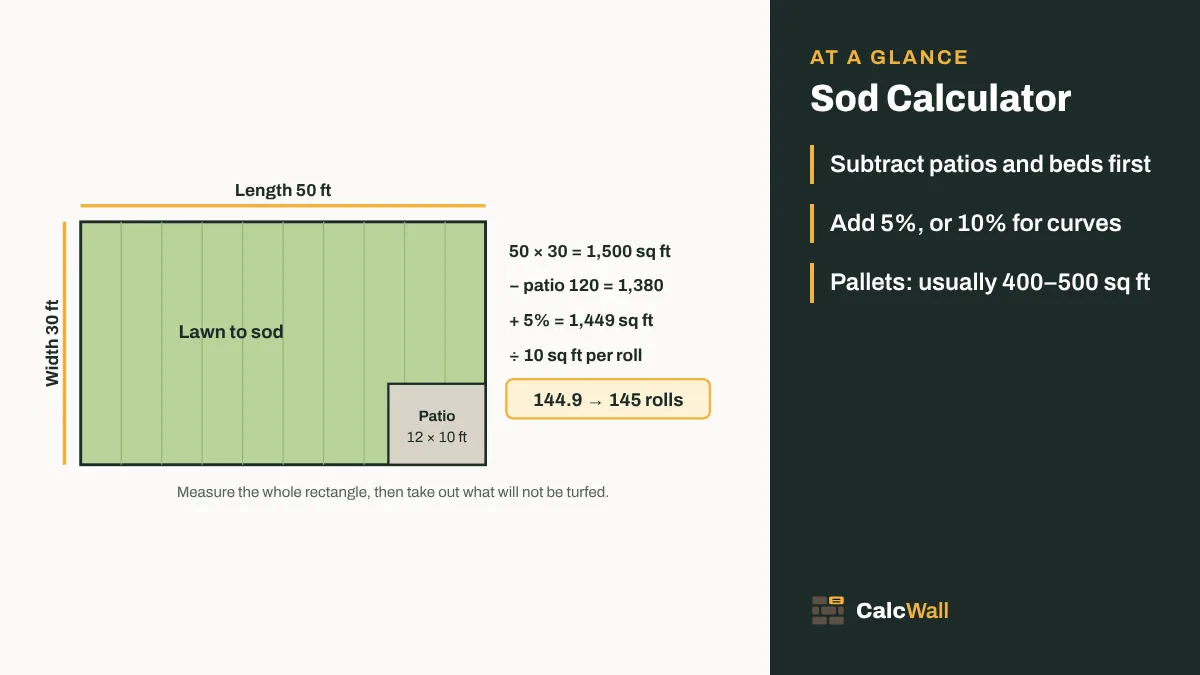
Quick answer: rolls = (lawn area − patios and beds) × 1.05 ÷ area per roll, rounded up. A 50 × 30 ft lawn with a 12 × 10 ft patio, at 10 sq ft per roll, needs 145 rolls (1,449 sq ft, or 4 pallets of 450 sq ft).
How to calculate sod
Working out how much sod to order is area arithmetic. The only number you can’t measure yourself is the size of one piece, and that changes from farm to farm.
- Measure each part of the lawn as a rectangle: length × width, in feet (or metres).
- Subtract what won’t be turfed: patios, paths, beds, a shed base, tree rings.
- Add extra for cutting: about 5% for a plain rectangle, about 10% where there are curves and lots of edges.
- Divide by the area of one roll, slab or piece from your supplier and round up to a whole piece.
- For pallets, divide the same area by the square feet one pallet covers and round up.
Pieces = (lawn area − areas not turfed) × (1 + waste) ÷ area of one piece
The sod calculator above does exactly that. Add a row for each part of the lawn and a row under “Areas not turfed” for each thing you cut out. It shows the net area, the area with waste, the exact number of pieces before rounding, and the whole pieces to order. Choose a different “Extra for waste” to see how much the allowance changes the order.
Metric example: a 15 × 10 m lawn with a 4 × 3 m patio is 150 − 12 = 138 m². Plus 5% is 144.9 m², and with 1 m² rolls that is 145 rolls of turf. Outside the US the calculator switches to metres and square metres; you enter the area of one roll in m².
Rolls, slabs and pallets
Sod is cut on the farm by a harvester set to a width and length, so “a roll” is not one size. Southern farms that grow Bermuda, zoysia, St. Augustine and centipede often cut small flat slabs. Northern farms growing bluegrass and fescue tend to cut rolls. In the UK, turf is sold by the square metre in rolls of about 1 m². Before you use any number on this page, ask the farm or garden centre what one piece covers.
| Piece | Typical size | Area each | Per pallet (typical) |
|---|---|---|---|
| Slab (southern US) | 16 × 24 in | 2.67 sq ft (0.25 m²) | 399, 452 or 503 sq ft, about 150–189 slabs |
| Mini hand roll | 18 × 40 in | 5 sq ft (0.46 m²) | 80, 90 or 100 rolls (400, 450 or 500 sq ft) |
| Large roll | 24 × 60 in or 18 × 80 in | 10 sq ft (0.93 m²) | 500, 600 or 700 sq ft (50, 60 or 70 rolls) |
| UK turf roll | about 610 × 1640 mm | 1 m² (10.76 sq ft) | varies by supplier |
Area of a piece in square feet is width × length in inches ÷ 144. A 16 × 24 in slab is 384 ÷ 144 = 2.67 sq ft; some farms round it to 2.66. In metric, width × length in metres gives m². Australian and New Zealand suppliers also sell by the square metre, and piece sizes vary, so check the docket.
Pallets. Most farms sell by the pallet, and a pallet of slabs or mini rolls usually covers 400 to 500 sq ft. Pallets = area with waste ÷ sq ft per pallet, rounded up. The 1,449 sq ft lawn above is 3.22 pallets of 450 sq ft: either 4 pallets, or 3 pallets plus about 100 sq ft of loose pieces if the farm sells part pallets. Some do, some charge a cut-pallet fee, some won’t split at all. Ask.
Weight. A pallet weighs roughly 1,500 to 3,000 lb, depending on grass and moisture, and wet sod is a lot heavier than dry. A single slab is about 15 to 20 lb. A full pallet is beyond the rated payload of many pickups, so if you plan to collect it, check the door-jamb sticker first, or pay for delivery with a forklift.
Sod for common lawn sizes
Pieces to order for a net lawn area with 5% added, worked out with the calculator’s rounding (always up to a whole piece). Pallets assume 450 sq ft each.
| Net lawn area | With 5% | Rolls of 10 sq ft | Mini rolls of 5 sq ft | Slabs of 2.67 sq ft | Pallets of 450 sq ft |
|---|---|---|---|---|---|
| 500 sq ft | 525 sq ft | 53 | 105 | 197 | 2 (1.17) |
| 1,000 sq ft | 1,050 sq ft | 105 | 210 | 394 | 3 (2.33) |
| 1,500 sq ft | 1,575 sq ft | 158 | 315 | 590 | 4 (3.50) |
| 2,000 sq ft | 2,100 sq ft | 210 | 420 | 787 | 5 (4.67) |
| 3,000 sq ft | 3,150 sq ft | 315 | 630 | 1,180 | 7 (7.00) |
| 5,000 sq ft | 5,250 sq ft | 525 | 1,050 | 1,967 | 12 (11.67) |
In metric, 1 m² rolls with 5% extra: 25 m² needs 27 rolls, 50 m² needs 53, 100 m² needs 105, 150 m² needs 158, 200 m² needs 210 and 300 m² needs 315. For a quick check on any area in either system, the square yards calculator and the square meters calculator convert between sq ft, sq yd and m².
Measuring an irregular lawn
Few lawns are one rectangle. The method that works for every shape is the one turf growers in the UK and Australia give their customers: sketch the lawn, split it into simple shapes, measure each one and add them up.
- L and T shapes: split them into rectangles along a straight line, as in the diagram. Each rectangle is a row in the calculator.
- Circles: area = 3.1416 × radius². A circle 10 ft across is 3.1416 × 5 × 5 = 78.54 sq ft. The calculator takes rectangles, so enter a circle as its area by 1 (78.54 × 1).
- Triangles: half the base × the height. Enter it as base by half the height.
- Long curved edges: measure the lawn as the rectangle that just contains it, then subtract the bed or path as its own rough shape. Being a foot generous on a curve is cheaper than being a foot short.
- Very odd shapes: draw the lawn on graph paper at one square per square foot (or square metre), count full squares, estimate the part squares and round up.
- Slopes: measure along the ground, not across the top on a level line. A tape laid on a bank reads longer than the plan, and the sod has to cover the longer length.
Measure twice, in the same direction each time, and write the numbers on the sketch. If you are also bringing in soil, the same sketch gives the area for the topsoil calculator.
Cutting in around beds, paths and trees
The waste allowance is mostly cutting. Every curved bed, path edge and tree ring means pieces laid past the line and trimmed back. How much you lose depends on how much edge there is, not on how big the lawn is.
- Start along the longest straight edge, such as a drive or path, so the first row is straight and every row after follows it.
- Stagger the joints by half a piece, like brickwork, and butt every piece tight without stretching it. Stretched sod shrinks back as it dries and leaves gaps.
- Lay through the curve, then cut. Run full pieces over the bed edge and trim back to a hose or string line with a sharp knife or a half-moon edger. Use the offcuts to fill gaps in the middle of the lawn.
- Avoid slivers at the edge. A thin strip on its own at a border dries out first. Put a full piece at the edge and do the small fill one row in.
- Trees and posts: lay over them, cut a cross where the trunk is, fold back and trim the ring. Leave a mulched circle around young trees rather than sod right up to the bark; the mulch calculator works out the bags for the ring.
As a rule of thumb from turf suppliers (not a standard), allow 5% on a plain rectangle and 10% once there are curves, several beds or a narrow side strip. The calculator offers 0, 5, 10, 15 and 20%; on a small lawn with lots of edge, 15% is not too much.
Worked examples
Each example is what the calculator shows for the same inputs.
Back lawn with a patio, large rolls
A 50 × 30 ft lawn with a 12 × 10 ft patio, 5% extra, 10 sq ft rolls: 1,500 − 120 = 1,380 sq ft; × 1.05 = 1,449 sq ft; ÷ 10 = 144.9, so 145 rolls. On 450 sq ft pallets that is 1,449 ÷ 450 = 3.22, so 4 pallets (or 3 plus loose rolls).
The same lawn in southern slabs
Same 1,449 sq ft, but the farm cuts 16 × 24 in slabs. Enter 2.67 as the coverage per piece: 1,449 ÷ 2.67 = 542.70, so 543 slabs. Three pallets of 452 sq ft cover 1,356 sq ft, so this lawn still needs a fourth pallet or about 35 loose slabs.
L-shaped front lawn with a bed and a tree
Areas 40 × 25 ft and 30 × 8 ft; take out a 12 × 4 ft bed and a 6 ft tree ring (entered as 28.27 × 1). 1,240 − 48 − 28.27 = 1,163.73 sq ft; with 10% for the curves, 1,280.1 sq ft; ÷ 10 = 128.01, so 129 rolls. The rounding works on the exact figure, so a hair over 128 still means 129.
UK garden in metric
A 15 × 10 m lawn with a 4 × 3 m patio, 5% extra, 1 m² turf rolls: 150 − 12 = 138 m²; × 1.05 = 144.9 m²; so 145 rolls.
Australian backyard with a side strip
A 12 × 8 m yard and a 5 × 3 m side strip, minus a 3 × 2 m garden bed, with 10% extra for a curved edge, at 1 m² per piece: 96 + 15 − 6 = 105 m²; × 1.10 = 115.5 m²; so 116 m² of turf.
Delivery day and laying
Sod is alive, and it starts to suffer from the moment it is cut. Getting the quantity right matters most because you want to lay it all on the day it comes, without a second trip.
- Have the ground ready first. The soil should be graded, firm and level before the truck arrives. Soft soil takes footprints and tyre ruts that stay as hollows under the new lawn.
- Keep pallets out of the sun and lay them the same day. A pallet left in heat cooks from the middle.
- Fill cracks with soil, roll and water straight away. Water each section as soon as it is down rather than waiting for the whole lawn, and keep it moist for the first several days.
- Hold off on fertiliser and weedkiller until the grass is rooted and you are mowing it regularly.
- Seed instead? Seed is cheaper but slower and needs watching for weeks. The grass seed calculator works out the bags for the same lawn.
Notes for landscapers
Quote by area, order by pallet. Price the job on net square feet plus your waste, then round the order to the farm’s pallet size. The leftover belongs in the quote, not in your margin.
Confirm the piece size on the docket. Farms change harvester settings and pallet counts by grass and season. A 2.66 vs 2.67 sq ft slab is nothing; a 400 vs 500 sq ft pallet is a whole pallet on a big job.
Weight on site. At up to 3,000 lb a pallet, plan where the truck can set them down without crossing a finished grade, a septic field or soft ground.
Edge-heavy jobs. Narrow side yards and island beds waste more than open lawns. Measure the perimeter: a lot of edge on a small area is your cue for 10–15% extra.
Tips before you order
- Ask three questions: what one piece covers, what one pallet covers, and whether they sell part pallets.
- Order the whole lawn in one delivery. Sod from a different field or week can differ in colour and thickness, and the seam can show for a while.
- Book delivery for the morning you will lay it, not the day before.
Sources
Where the numbers on this page come from. Everything else is plain geometry and unit conversion, which the calculator does with exact factors.
- How Many Square Feet in a Pallet of Sod?, Sod Solutions (Sod University). Used for: piece sizes and pallet coverage: 16 × 24 in slabs (2.66 sq ft) on 399, 452 or 503 sq ft pallets; 40 × 18 in mini rolls (5 sq ft), 80, 90 or 100 per 400, 450 or 500 sq ft pallet; 60 × 24 or 80 × 18 in large rolls (10 sq ft) on 500, 600 or 700 sq ft pallets; pallets weigh about 1,500 to 3,000 lb
- How Big Is a Pallet of Sod?, The Grass Outlet. Used for: a supplier’s figures: slabs for Bermuda, zoysia, St. Augustine and centipede in the South, rolls for bluegrass and fescue in the North; a single slab weighs about 15 to 20 lb; sizes vary by farm
- How to measure your lawn for turf, Rolawn. Used for: UK turf rolls of about 1 m² (roughly 610 × 1640 mm when harvested), splitting irregular lawns into rectangles or counting squares on graph paper, and ordering at least 5% extra (5–10% for cutting and shaping)
- How to Lay Turf, Part 1: Accurate Measuring, Lawn Solutions Australia. Used for: breaking a lawn into squares, rectangles, triangles and circles, and ordering about 5% extra for simple areas and about 10% for complex ones
- Turfgrass Establishment (Guide H-509), New Mexico State University, Cooperative Extension Service, revised December 2016. Used for: laying practice: firm, level soil, pieces tight to edges, rows staggered by half a piece like brickwork, cracks filled with soil, roll and water at once, no fertiliser until mowing, and not leaving sod in the sun
- Establishing Your Florida Lawn (LH013), University of Florida IFAS Extension. Used for: lay sod in a staggered brick pattern and fit pieces tightly without stretching them
Frequently asked questions
How much sod do I need?
Measure the lawn area, subtract patios and beds, add about 5% and divide by the area of one roll. A 50 × 30 ft lawn with a 12 × 10 ft patio is 1,380 sq ft; plus 5% is 1,449 sq ft, so at 10 sq ft per roll you need 145 rolls.
How big is a roll of sod?
It depends on the farm. Common US sizes are 16 × 24 in slabs (about 2.67 sq ft), 18 × 40 in mini rolls (5 sq ft) and large rolls of 10 sq ft. UK turf rolls are about 1 m². Use the area your supplier states per piece.
How many pallets of sod do I need?
Divide the area including waste by the square feet one pallet covers and round up. 1,449 sq ft on 450 sq ft pallets is 3.22, so 4 pallets, or 3 pallets plus about 100 sq ft of loose pieces if the farm sells them.
How much does a pallet of sod cover?
Usually 400 to 500 sq ft for slabs and mini rolls, and 500 to 700 sq ft for pallets of large rolls. Some farms load other amounts, so ask before you order.
How many square feet in a roll of sod?
A 24 × 60 in or 18 × 80 in roll is 10 sq ft. A mini roll of 18 × 40 in is 5 sq ft. A slab of 16 × 24 in is 2.67 sq ft (some farms quote 2.66). Width × length in inches ÷ 144 gives square feet.
How much extra sod should I order?
About 5% for a simple rectangle and about 10% for curved beds, trees and odd shapes. Running short means a second delivery and a visible patch where the new sod meets the old.
How much does a pallet of sod weigh?
Roughly 1,500 to 3,000 lb, depending on the grass and how wet it is. That is more than many pickup trucks are rated to carry, so check the payload before you collect it yourself.
How many rolls of turf do I need for 50 m²?
50 m² plus 5% is 52.5 m², so 53 rolls of 1 m² turf. Add 10% instead (55 rolls) if the lawn has curves or a lot of edges.
How do I work out sod for a round or curved lawn?
Split it into rectangles and circles. A circle is 3.1416 × radius × radius: a 6 ft tree ring is 3.1416 × 3 × 3 = 28.27 sq ft. In the calculator, enter that area as 28.27 by 1.
Is sod the same as turf?
Yes. “Sod” is the usual word in the US and Canada; “turf” in the UK, Australia and New Zealand.
Is this sod calculator free to use online?
Yes. The CalcWall Sod Calculator is completely free and works online in any browser, on a phone, tablet or computer. There is nothing to download and no account to create, and the math runs right in your browser, so results appear as you type.