Quick answer: square feet = linear feet × width (in) ÷ 12. 120 linear feet of 5.5-inch boards is 55 sq ft. Going back, linear feet = square feet × 12 ÷ width (in).
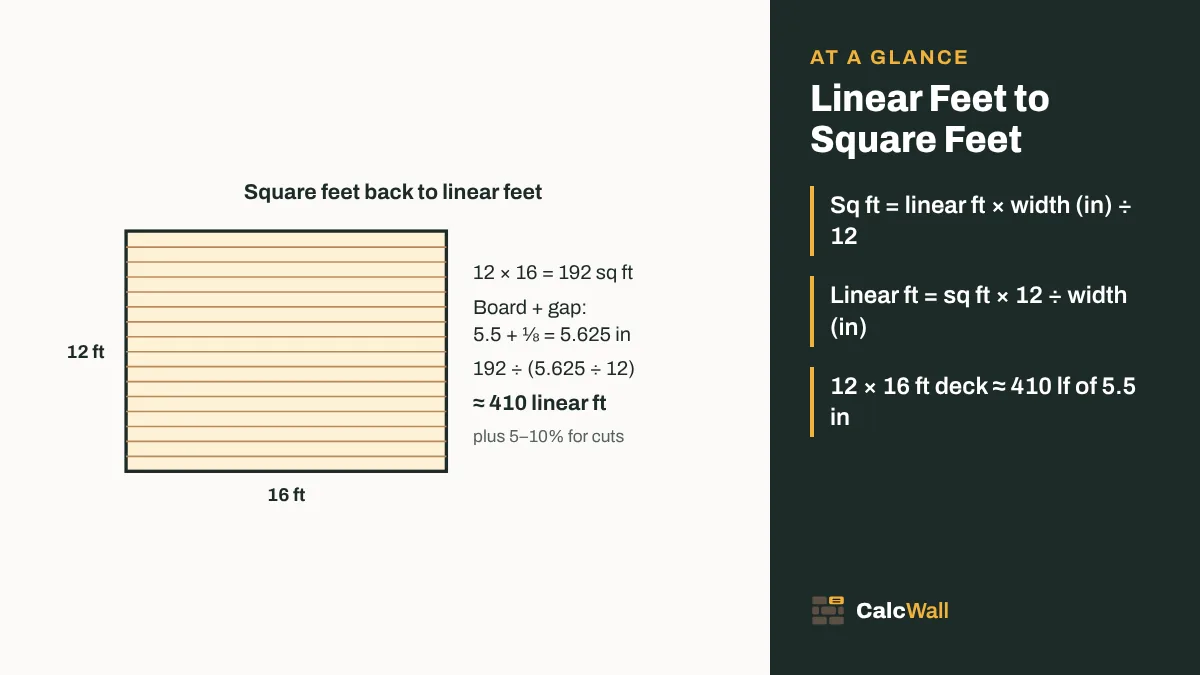
How to calculate
- Add up the total length of the boards or strip, in feet.
- Measure the width that actually covers the surface, in inches.
- Multiply the length by the width and divide by 12 to get square feet.
- Going the other way, divide the square feet by (width ÷ 12) to get linear feet. Add extra for cuts if you need it.
Square feet = linear feet × width (in) ÷ 12
The divide-by-12 is there because the width is in inches and the length is in feet. Turning the width into feet first gives the same answer: 5.5 in is 0.4583 ft, and 12 × 0.4583 = 5.5 sq ft. Forgetting the 12 is the usual mistake. It makes the area twelve times too big, so a 120 ft run of decking would show 660 sq ft instead of 55.
The question you can't answer without a width is “how many square feet is 100 linear feet?”. A linear foot has no width of its own, so 100 linear feet of narrow trim and 100 linear feet of wide shiplap cover very different areas. Always pin the width down first.
Which width to use
Lumber is sold by its nominal size, which is not what you can measure. Under the American Softwood Lumber Standard, a dry 1 × 6 board or 2 × 6 is dressed to 5½ in wide, a 1 × 4 to 3½ in and a 1 × 8 to 7¼ in. Use those real widths, not the names.
- Square-edge boards butted tight (most siding battens, plain cladding): use the actual width.
- Deck boards with a gap: add the gap to the width. A 5.5 in board with a ⅛ in gap covers 5.625 in per row.
- Tongue-and-groove and shiplap: the tongue or lap hides under the next board, so the covering width (also called face or exposure) is less than the full width. Check the product label.
- Overlapping siding: use the exposure, the part left showing, not the board width.
Coverage tables by board width
Linear feet needed to cover 100 square feet, before waste. The widths are the actual or covering widths, not nominal sizes.
| Covering width | Typical use | Linear ft per 100 sq ft | Linear ft per sq ft |
|---|---|---|---|
| 2¼ in | Strip flooring | 533.3 | 5.333 |
| 3½ in | 1 × 4 boards | 342.9 | 3.429 |
| 5⅛ in | 1 × 6 tongue-and-groove (typical) | 234.1 | 2.341 |
| 5½ in | 1 × 6 or 2 × 6, tight | 218.2 | 2.182 |
| 5⅝ in | 5½ in deck board + ⅛ in gap | 213.3 | 2.133 |
| 7¼ in | 1 × 8 boards | 165.5 | 1.655 |
And the other way: the area 100 linear feet covers at each width.
| Covering width | Sq ft from 100 linear ft |
|---|---|
| 2¼ in | 18.75 |
| 3½ in | 29.17 |
| 5⅛ in | 42.71 |
| 5½ in | 45.83 |
| 5⅝ in | 46.88 |
| 7¼ in | 60.42 |
Worked examples
Decking for a 12 × 16 ft deck
The deck is 192 sq ft. Each 5.5 in board plus a ⅛ in gap covers 5.625 in, so you need 192 ÷ (5.625 ÷ 12) = 409.6 linear feet. In practice, count rows: boards run the 16 ft way, and 144 in ÷ 5.625 in = 25.6, so 26 boards of 16 ft (416 linear feet), plus a couple of spares for bad boards. The deck calculator adds joists and screws.
Tongue-and-groove wainscot
A wall 14 ft long gets panelling 3 ft high: 42 sq ft. The boards cover 5⅛ in each, so 42 ÷ (5.125 ÷ 12) = 98.3 linear feet. With 10% for cuts, that is about 108 linear feet. For a whole room with a cap and base rail, the wainscoting calculator does the full list.
When you only need linear feet
Some jobs never need square feet at all. Baseboard, crown molding, chair rail, edging and fence rails are bought by length, so the number you want is the perimeter or the run, not an area.
For baseboard in a 12 × 14 ft room, the perimeter is 12 + 14 + 12 + 14 = 52 ft. Take off a 3 ft doorway and you have 49 linear feet. Add 10% for miters and offcuts and it comes to about 54 linear feet, which is 4 lengths of 16 ft (64 ft). Buying 16 ft lengths also means most walls can be done in one piece, with no joints.
The calculator still helps when a product is sold by length but you know the area, or the other way round: a stack of shiplap priced per linear foot, a flooring quote in square feet, or a roll of fabric of a set width. Enter the width once and switch between the two.
Working in meters
Metric is simpler, because the width is usually given in millimeters and there is no 12 to remember. Convert the width to meters and multiply.
Metric example: 30 m of 140 mm boards is 30 × 0.14 = 4.2 m². To cover 20 m² with 140 mm boards you need 20 ÷ 0.14 = 142.86 m.
The conversions are exact: 1 in = 2.54 cm and 1 ft = 0.3048 m by definition. A 140 mm board is about 5.51 in, almost the same as a dressed 1 × 6.
If you are buying by volume instead of length, the board foot calculator handles hardwood sold by the board foot, and the lumber calculator counts pieces and cost.
Notes for carpenters and installers
Count rows, not just area. The formula gives a total length. Boards come in set lengths, so divide the run into rows and round each row up.
Covering width wins. A ⅜ in difference in width on a 6 in board is about 7% more material. Measure a real board from the stack.
Waste depends on the job. Around 5–10% for straight runs; more for diagonals, short walls or boards with knots you will cut out.
Check how it is priced. Trim and decking are often priced per linear foot, flooring per square foot. Convert before comparing quotes.
Sources
Where the numbers on this page come from. Everything else is plain geometry and unit conversion, which the calculator does with exact factors.
- Voluntary Product Standard PS 20-25: American Softwood Lumber Standard, National Institute of Standards and Technology, January 2025. Used for: Minimum dressed dry widths: 1 × 4 = 3½ in, 1 × 6 and 2 × 6 = 5½ in, 1 × 8 = 7¼ in
- NIST Handbook 44, Appendix C: General Tables of Units of Measurement, National Institute of Standards and Technology, 2026 edition. Used for: 12 inches per foot, 144 square inches per square foot, and the metric equivalents
Frequently asked questions
How do I convert linear feet to square feet?
Multiply the linear feet by the width in inches and divide by 12. 120 linear feet of 5.5-inch decking is 120 × 5.5 ÷ 12 = 55 square feet.
How do I convert square feet to linear feet?
Divide the square feet by the width in feet (width in inches ÷ 12). To cover 200 sq ft with 5.5-inch boards you need 200 ÷ (5.5 ÷ 12) = 436.36 linear feet.
Is a linear foot the same as a foot?
Yes. A linear foot is simply a length of one foot, used for boards, trim or fabric sold by length regardless of width.
Should I use the nominal or actual width?
Use the width that actually covers the surface. A “1 × 6” deck board is about 5.5 in wide, and tongue-and-groove boards cover less than their full width.
Does it work in meters?
Yes. Outside the US the calculator starts in meters with the width in millimeters, and shows m², square feet and square yards.
How many square feet does one linear foot of a 2 × 6 cover?
A 2 × 6 is 5.5 in wide when dressed, so one linear foot covers 5.5 ÷ 12 = 0.458 sq ft. Laid with a ⅛ in gap, it covers 5.625 ÷ 12 = 0.469 sq ft.
What is the difference between linear feet and board feet?
Linear feet measure length only. Board feet measure volume: one board foot is 12 × 12 × 1 in. Hardwood is usually sold by the board foot, while trim, decking and many softwood boards are sold by the linear foot.
How much extra should I buy?
Allow around 5–10% for straight runs and more for diagonal layouts, many short walls or boards with defects. Round up to whole boards of the length you are buying.
How many linear feet are in a 12 ft board?
12. Length is the only thing a linear foot counts, so a 12 ft board is 12 linear feet whether it is 3.5 in or 7.25 in wide.
Is this linear feet to square feet calculator free to use online?
Yes. The CalcWall Linear Feet to Square Feet Calculator is completely free and works online in any browser, on a phone, tablet or computer. There is nothing to download and no account to create, and the math runs right in your browser, so results appear as you type.