Quick answer: pavers = area × 1.10 ÷ area of one paver with its joint, rounded up. A 12 × 10 ft patio with 8 × 4 in pavers and a 1/8 in joint is 132 sq ft ÷ 0.2327 sq ft = 568 pavers.
How to calculate pavers
- Measure the area as one or more rectangles and multiply length by width for each.
- Subtract what you won’t pave, such as a planting bed, a tree ring or a fixed grill pad.
- Add extra for cuts: about 5–10% for a straight pattern on a rectangle, more for herringbone and curves (see the pattern section).
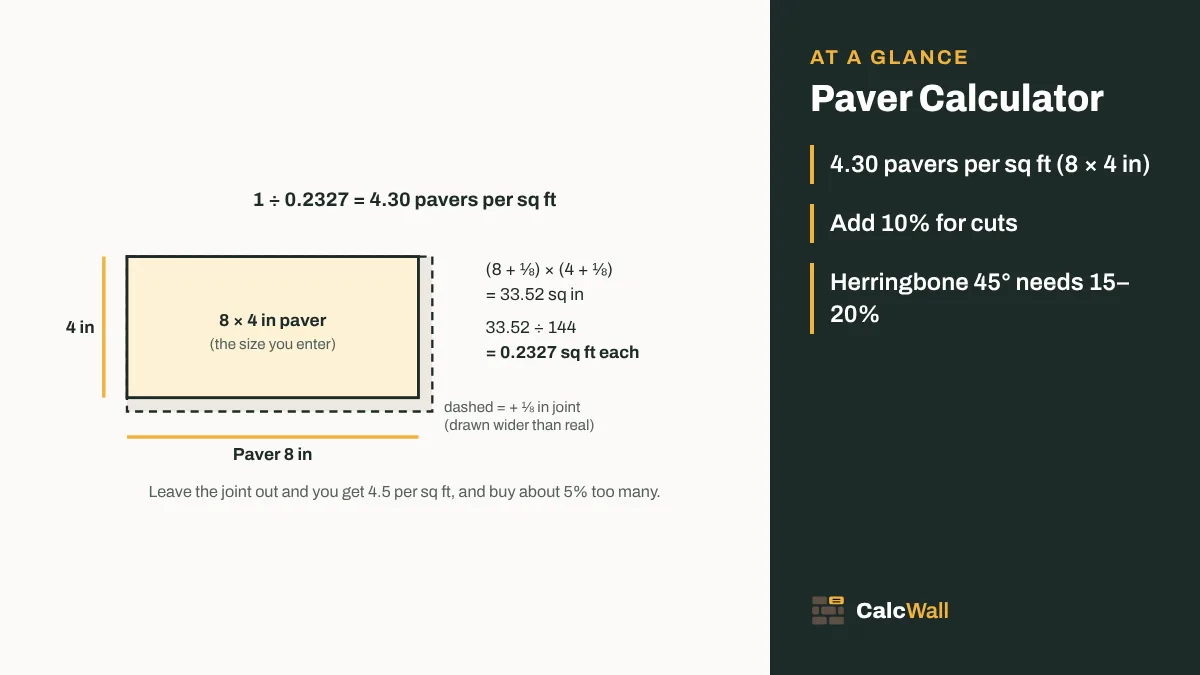
- Work out the space one paver takes, joint included: (length + joint) × (width + joint). For an 8 × 4 in paver with a 1/8 in joint that is 8⅛ × 4⅛ = 33.52 sq in, and 33.52 ÷ 144 = 0.2327 sq ft.
- Divide the area by that figure and round up to a whole paver.
Pavers = area × (1 + waste) ÷ ((L + j) × (W + j) ÷ 144)
L and W are the paver length and width in inches, j is the joint in inches, and the area is in square feet. The calculator does exactly this. Under the result it shows the space each paver covers with its joint (0.233 sq ft for the default 8 × 4 in paver) and the exact count before rounding, so you can check it against your own figures.
Metric example: a 4 × 3 m patio is 12 m², plus 10% = 13.2 m². A 20 × 10 cm paver with a 3 mm joint covers 20.3 × 10.3 cm = 0.0209 m², so 13.2 ÷ 0.020909 = 631.3: 632 pavers. In metric mode the calculator takes the paver size in centimetres and offers joints in millimetres.
Why bother with the joint? Pavers are not laid tight together. The joints, usually 1/16 to 3/16 in, are filled with sand so the pavers lock together and can move a little without chipping. On 8 × 4 in pavers a 1/8 in joint changes the count from 4.5 to 4.30 per square foot. On a 300 sq ft patio, ignoring it means buying about 60 pavers too many. That is not a disaster, but it is money and a pallet corner you didn’t need.
Common paver sizes and pavers per square foot
Paver sizes are nominal. A “4 × 8” concrete paver may measure a little under that, with spacer nubs on the sides that set the joint. Use the size and joint the maker lists if you have them. For a quick estimate the nominal size with a 1/8 in joint is close enough, because the nubs make up the difference.
| Paver size | Pavers per sq ft, no joint | Pavers per sq ft, ⅛ in joint | Pavers per sq ft, 3/16 in joint | Per 100 sq ft (⅛ in joint) |
|---|---|---|---|---|
| 4 × 8 in (brick size) | 4.50 | 4.30 | 4.20 | 430 |
| 6 × 6 in | 4.00 | 3.84 | 3.76 | 384 |
| 6 × 9 in | 2.67 | 2.58 | 2.53 | 258 |
| 8 × 8 in | 2.25 | 2.18 | 2.15 | 219 |
| 6 × 12 in | 2.00 | 1.94 | 1.91 | 194 |
| 12 × 12 in | 1.00 | 0.98 | 0.97 | 98 |
| 12 × 18 in | 0.67 | 0.66 | 0.65 | 66 |
| 16 × 16 in | 0.56 | 0.55 | 0.55 | 56 |
| 12 × 24 in | 0.50 | 0.49 | 0.49 | 50 |
| 24 × 24 in (slab) | 0.25 | 0.25 | 0.25 | 25 |
The last column is rounded up to whole pavers and has no waste added. Notice how little the joint matters on big slabs and how much it matters on small pavers: there are more joints per square foot when the pieces are small.
In the UK, Europe, Australia and New Zealand pavers are sold in millimetres. Block paving of 200 × 100 mm is the metric cousin of the 4 × 8. With a 3 mm joint:
| Paver size | Pavers per m², no joint | Pavers per m², 3 mm joint | Each paver with joint |
|---|---|---|---|
| 200 × 100 mm (block paving) | 50.00 | 47.83 | 0.0209 m² |
| 200 × 200 mm | 25.00 | 24.27 | 0.0412 m² |
| 300 × 150 mm | 22.22 | 21.57 | 0.0464 m² |
| 300 × 300 mm | 11.11 | 10.89 | 0.0918 m² |
| 400 × 400 mm | 6.25 | 6.16 | 0.1624 m² |
| 600 × 300 mm | 5.56 | 5.47 | 0.1827 m² |
| 600 × 600 mm (slab) | 2.78 | 2.75 | 0.3636 m² |
Thickness does not change the count, but it matters for the job. Patio and walkway pavers are commonly 2⅜ in (60 mm) thick; pavers for driveways are often thicker, around 3⅛ in (80 mm). Check that the paver you pick is rated for cars if anything will drive on it.
Laying patterns and the waste they need
The pattern does not change how many pavers fit in a square foot. It changes how many you cut at the edges, and every cut leaves an offcut you usually can’t use. That is where the extra goes.
| Pattern | What it looks like | Extra to order (rule of thumb) | Good for |
|---|---|---|---|
| Running bond | Rows offset by half a paver, like a brick wall | 5–10% | Paths and patios; easiest to lay. Run rows across a path, not along it, for a stiffer surface. |
| Stack bond | Straight rows and columns, joints lined up | 5% | Large square slabs; looks clean but has the least interlock |
| Basket weave | Pairs of pavers alternating flat and upright | 5–10% | Patios with a traditional look; needs a 2:1 paver like 4 × 8 |
| Herringbone 90° | Pavers in a zigzag square to the edges | 10–15% | Patios and driveways |
| Herringbone 45° | The same zigzag turned 45° to the edges | 15–20% | Driveways and showpiece patios |
| Circles, fans and curves | Kits or cut pavers on a radius | 15–20% or more | Features; follow the kit’s count |
These ranges are a tradesman’s rule of thumb, not a standard. A rectangle with long straight edges sits at the low end; an L-shaped patio with a curved bed and a few corners sits at the high end. If you lay a soldier course (a border row of pavers set side by side around the edge), the field cuts land against the border and you can stay nearer the low end, but count the border pavers in the same total.
Herringbone is not only for looks. Belgard’s technical guide says herringbone gives the most effective horizontal interlock and recommends it for roadways. If cars will turn on your driveway, it is the pattern to choose, and its extra cuts are worth it.
The calculator’s waste choices are 0, 5, 10, 15 and 20%. With the default 12 × 10 ft patio and 8 × 4 in pavers they give 516, 542, 568, 593 and 619 pavers.
Measuring a patio, path or driveway
- Measure the finished paved area, not the dig. The base runs past the edge, but the pavers don’t.
- Break odd shapes into rectangles. An L-shaped patio is two rectangles; add each as its own row with “+ Add another area”.
- Circles: area = 3.1416 × radius × radius. Enter that number as one side and 1 as the other.
- Curved edges: measure the rectangle that contains the curve and use the higher waste figure, or measure a few offsets and treat it as several strips.
- Subtract beds, pools and pads under “Areas not paved”. A 4 × 4 ft bed in the middle takes 16 sq ft off.
- Square up the layout. Before you lay, check the corners with a 3-4-5 triangle: 3 ft along one side, 4 ft along the other, and the diagonal between those marks should be 5 ft.
Feet, inches, metres or centimetres all work in the “Measured in” box. If you measured in feet and inches, 10 ft 6 in is 10.5 ft. For a quick area check in any unit, the square yards calculator converts between square feet, square yards and m².
Pavers for common patio sizes
Counts for 8 × 4 in pavers with a 1/8 in joint, worked out with the calculator’s own formula and rounded up.
| Area | Square feet | Pavers at +10% | Pavers at +15% |
|---|---|---|---|
| 3 × 30 ft path | 90 | 426 | 445 |
| 10 × 10 ft patio | 100 | 473 | 495 |
| 12 × 10 ft patio (default) | 120 | 568 | 593 |
| 12 × 12 ft patio | 144 | 681 | 712 |
| 12 × 16 ft patio | 192 | 908 | 949 |
| 16 × 20 ft patio | 320 | 1,513 | 1,582 |
| 20 × 20 ft patio or parking pad | 400 | 1,891 | 1,977 |
Worked examples
Backyard patio, running bond
A 12 × 10 ft patio with 8 × 4 in pavers and a 1/8 in joint, 10% extra: 120 × 1.10 = 132 sq ft. Each paver covers 8.125 × 4.125 ÷ 144 = 0.2327 sq ft. 132 ÷ 0.2327 = 567.14, so 568 pavers. The calculator shows 568, with 567.14 as the exact figure.
Larger patio with a planting bed, 45° herringbone
A 20 × 16 ft patio (320 sq ft) with a 4 × 4 ft bed left open: 320 − 16 = 304 sq ft. With 15% extra for the angled cuts that is 349.6 sq ft. A 6 × 9 in paver with a 1/8 in joint covers 6.125 × 9.125 ÷ 144 = 0.3881 sq ft, so 349.6 ÷ 0.3881 = 900.73: 901 pavers. Enter 20 × 16 as the area, 4 × 4 under “Areas not paved”, paver 9 × 6 in, joint 1/8 in and +15%.
Block paving drive in metric
A 4 × 3 m area with 200 × 100 mm block pavers (enter 20 × 10 cm) and a 3 mm joint, 10% extra: 12 × 1.10 = 13.2 m². Each block with its joint covers 0.203 × 0.103 = 0.020909 m². 13.2 ÷ 0.020909 = 631.31, so 632 pavers. Laid in herringbone at +15% the same area is 13.8 m² ÷ 0.020909 = 660.003. That is a hair over 660, so the calculator rounds up to 661.
Large slabs on a square patio
A 14 × 14 ft patio (196 sq ft) in 24 × 24 in slabs with a 1/4 in joint, stack bond, 5% extra: 196 × 1.05 = 205.8 sq ft. Each slab covers 24.25 × 24.25 ÷ 144 = 4.0838 sq ft. 205.8 ÷ 4.0838 = 50.39, so 51 slabs. With big slabs, lay out the rows on paper first: if the patio is not a whole number of slabs wide, you will cut a strip along one or two edges, and 5% may not cover it.
Edge restraint and the layers under the pavers
A paver patio is a system of layers. The calculator counts the top layer. Everything under it, and the edge that holds it together, is a separate order.
- Base: compacted crushed stone. Belgard’s guide gives a minimum of 4 in compacted for patios and walkways and 6 in for residential driveways; Rochester Concrete Products gives 4–6 in for foot traffic and 8–12 in for vehicles, compacted in layers of no more than 4 in. Soft or wet soil needs more. Work it out with the paver base calculator.
- Bedding sand: a 1 in screeded layer of coarse sand. Don’t use it to fix low spots in the base. The paver sand calculator gives the cubic feet and bags.
- Joint sand: swept in after the pavers are laid and compacted. Polymeric sand hardens and resists weeds and washout; the polymeric sand calculator turns your area into bags.
- Edge restraint: any edge that is not held by a wall, a curb or a building needs one. Without it, the outside rows creep outward, the joints open and the whole field loosens.
Edge restraints come as plastic, aluminum or steel edging, cut stone, precast concrete or a poured concrete edge. They sit on the compacted base, not on the bedding sand. Plastic edging is fixed with steel spikes driven into the base; the edging maker gives the spike spacing. Order edging by length: the perimeter of the paved area minus any side against the house. Plastic edging bends to follow a curve, which saves forming a concrete edge. If you would rather pour one, the concrete curb calculator works out landscape curbing by the foot.
Belgard’s guide gives joints of 1/16 in up to 3/16 in, with 1/8 in for most standard products. That is why the calculator starts at 1/8 in. Choose “None” only for pavers with built-in spacers when you enter their overall size, and choose 3/8 or 1/2 in only for tumbled or natural stone set with wide joints.
Ordering: pallets, batches and spares
- Pallets: pavers are usually sold by the pallet or by the square foot. Ask the yard how many pieces are on a pallet of your paver and enter it in “Pavers per pallet”. The calculator then rounds up to whole pallets. If a pallet holds 520 pavers, the 568-paver patio is 2 pallets; ask whether the yard will sell part of one.
- Price: enter the price per pallet and the result shows the cost. With the default of 1 per pallet you can enter a price per paver instead.
- One batch: buy everything at once from the same production run. Colour varies between batches, and the difference shows on a big patio.
- Mix as you lay: pull pavers from three or four pallets at a time so the colour blends across the patio instead of changing in patches.
- Keep spares: leave a dozen or so in the garage. A paver stained by oil or cracked by a dropped grill is easy to swap if you have a matching one.
- Check the delivery: a full pallet of concrete pavers is heavy. Make sure the truck can reach where you want it dropped and that it won’t sit on your lawn or a thin driveway for long.
Notes for hardscape installers
Count from the maker’s data. Many product sheets give pieces per sq ft and sq ft per pallet for each paver and pattern. Use those over nominal sizes, especially for multi-piece random patterns.
No slivers. Plan the layout so edge cuts are not thin strips. Small pieces break out and loosen; shift the field or add a soldier course to keep cuts larger.
Waste by job, not habit. Price 45° herringbone and curved beds at the high waste figure. A plain running bond rectangle rarely needs more than 5–10%.
String lines. Pull lines every few feet to hold joint lines straight. Joints drift on a big field, and the pavers will not close up a crooked line later.
Tips before you buy
- Lay a dry test row on the driveway: ten pavers with their joints tell you the real module better than the label.
- Price the whole system, not just the pavers: base, sand, joint sand, edging and the plate compactor rental all add up.
- Plan the drainage first. A patio should slope away from the house; set the slope in the base, not in the bedding sand.
Sources
Where the numbers on this page come from. Everything else is plain geometry and unit conversion, which the calculator does with exact factors.
- Technical Resource Guide, Belgard, BEL25 edition. Used for: paver joint width of 1/16 in to a maximum of 3/16 in, with uniform 1/8 in joints for most standard products; herringbone gives the most effective horizontal interlock and is recommended on roadways; edge restraint types (precast concrete, plastic, cut stone, aluminum, steel, poured concrete) and plastic edging anchored into the compacted base with steel spikes at the maker’s spacing; a minimum 4 in compacted base for patios and walkways, 6 in for residential driveways, and a 1 in nominal bedding layer
- Interlocking Segmental Paver Installation and Care Guide, Rochester Concrete Products, 2025 guide. Used for: 4–6 in of compacted gravel base for foot traffic and 8–12 in for vehicles, a 1 in screeded sand layer, base compacted in layers of no more than 4 in, edge restraints on the compacted base along every edge that would otherwise be unrestrained, squaring the layout with 3-4-5 measurements, and compacting the pavers in two directions with a protective pad
- Alliance Gator Reference Guide, Alliance Designer Products, 2025 edition (March 2026 file). Used for: the 2⅜ in (60 mm) paver height its joint sand coverage chart is based on, and joint sand filled to the full paver depth minus 1/8 in
Frequently asked questions
How many pavers do I need?
Divide the area, plus about 10%, by the area one paver covers with its joint. A 12 × 10 ft patio is 120 sq ft, plus 10% = 132 sq ft. An 8 × 4 in paver with a 1/8 in joint covers 8.125 × 4.125 = 33.52 sq in, or 0.2327 sq ft, so 132 ÷ 0.2327 = 567.1: buy 568 pavers.
How many pavers are in a square foot?
144 ÷ ((length + joint) × (width + joint)), with sizes in inches. For 8 × 4 in pavers with a 1/8 in joint that is 4.30 pavers per sq ft; without the joint it is 4.5. A 6 × 6 in paver gives 3.84 per sq ft and a 12 × 12 in paver 0.98 per sq ft with a 1/8 in joint.
How many pavers do I need for a 10 × 10 patio?
A 10 × 10 ft patio is 100 sq ft. With 8 × 4 in pavers, a 1/8 in joint and 10% extra that is 110 ÷ 0.2327 = 472.6, so 473 pavers. For a 45° herringbone with 15% extra it is 495.
How many pavers for a 12 × 12 patio?
144 sq ft plus 10% is 158.4 sq ft. With 8 × 4 in pavers and a 1/8 in joint that is 680.6, so 681 pavers. With 12 × 12 in pavers and a 1/8 in joint each one covers 1.0209 sq ft, so 158.4 ÷ 1.0209 = 155.2: 156 pavers.
How much extra should I order?
As a rule of thumb: 5–10% for running bond or basket weave on a plain rectangle, 10–15% for 90° herringbone and 15–20% for 45° herringbone, curves and lots of corners. These are not fixed rules; your installer may want more for a complicated layout.
Should I count the joint when working out pavers?
Yes. Pavers are laid with a small gap, typically 1/16 to 3/16 in, and each joint makes every paver take up a little more room. With 8 × 4 in pavers a 1/8 in joint means about 4.5% fewer pavers than the bare size suggests. Many concrete pavers have spacer nubs that set the joint for you.
How do I work out pavers for a round patio?
Area = 3.1416 × radius². A 12 ft circle has a 6 ft radius: 3.1416 × 36 = 113.1 sq ft. Enter 113.1 × 1 as the area, pick 15% extra for the curved cuts, and with 8 × 4 in pavers you get 559.
What about base, sand and joint sand?
This page counts the pavers only. Use the paver base calculator for the compacted base, the paver sand calculator for the 1 in bedding layer and the polymeric sand calculator for the joints.
Does it count edge restraint?
No. Edging is sold by length: measure the open edges of the patio, usually the perimeter minus any side against the house or a wall. A 12 × 10 ft patio against the house needs 10 + 12 + 10 = 32 ft.
How many pavers are on a pallet?
It depends on the paver, its thickness and the supplier, so ask for the count or the square feet per pallet. Put the pieces per pallet in the calculator and it rounds up to whole pallets: 568 pavers at 520 per pallet is 2 pallets.
Is this paver calculator free to use online?
Yes. The CalcWall Paver Calculator is completely free and works online in any browser, on a phone, tablet or computer. There is nothing to download and no account to create, and the math runs right in your browser, so results appear as you type.