Quick answer: section area (sq ft) = curb width × (curb height + gutter thickness) + gutter width × gutter thickness. A 6 in curb with a 24 in gutter 8 in thick is 1.917 sq ft, so 100 ft takes 7.10 cu yd, or 7.81 cu yd with 10% waste.
How to calculate concrete for a curb
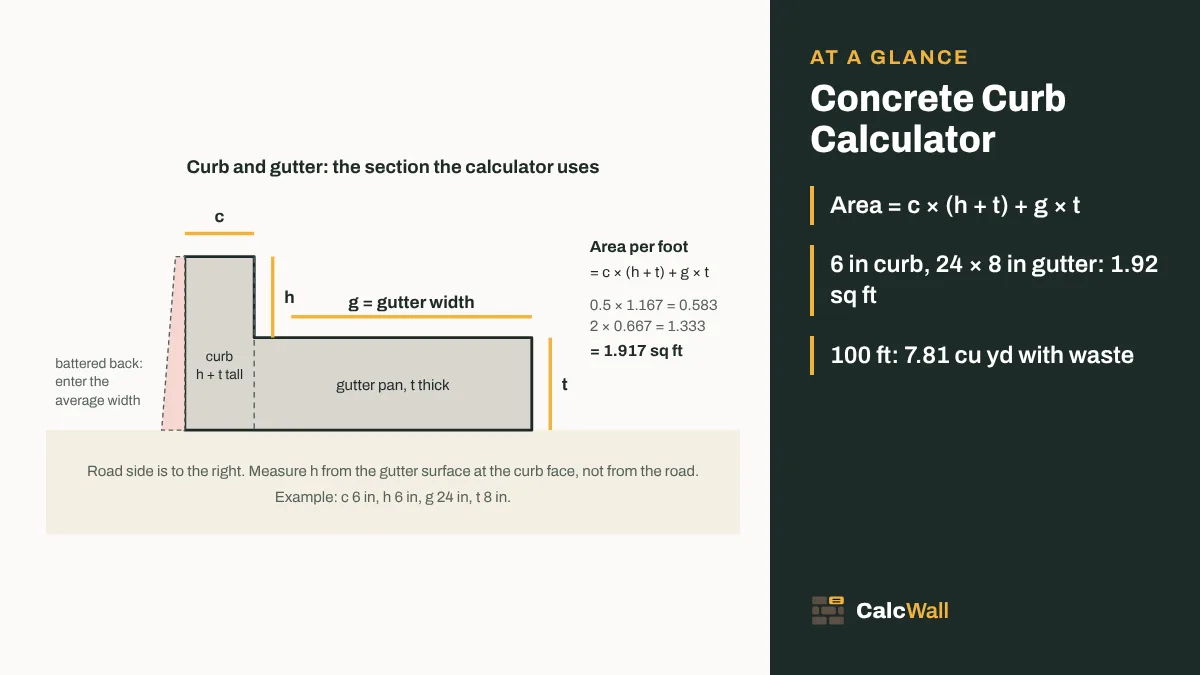
A curb is a long prism. Its volume is the area of its cross-section times its length, so the whole job is getting the section right. The calculator treats curb and gutter as two rectangles: the curb block, which runs from its top down to the bottom of the gutter, and the gutter pan in front of it.
- Curb width (c): the width of the curb block, back to face. The calculator calls this "curb depth (width)". If the back or face slopes, use the average of the top and bottom widths.
- Curb height (h): the height of the curb above the gutter surface at the face.
- Gutter width (g): the pan in front of the curb face, not counting the curb itself.
- Gutter thickness (t): the pan thickness. If it varies, use the average.
- Area = c × (h + t) + g × t, with everything in feet. Volume = area × length. Divide cubic feet by 27 for cubic yards and add waste.
V = L × [c × (h + t) + g × t]
For the default section, c = 0.5 ft, h = 0.5 ft, g = 2 ft and t = 0.667 ft. The curb block is 0.5 × 1.167 = 0.583 sq ft and the pan is 2 × 0.667 = 1.333 sq ft. Together that is 1.917 sq ft, which is the concrete curb calculator formula at work. Times 100 ft gives 191.7 cu ft.
That area is also the answer if you searched for a concrete curb calculator in square feet. A curb's square feet are its section, not its footprint. Multiply by length to get cubic feet.
Cubic yards per foot and per 100 feet
Most crews think in yards per foot, because the run length changes but the section doesn't. Here are common sections worked with the same formula the curb and gutter concrete calculator uses. Widths are in inches.
| Section (curb c × h, gutter g × t) | Area, sq ft | Cu yd per ft | Cu yd per 100 ft | With 10% waste |
|---|---|---|---|---|
| 6 × 6 curb, 24 × 8 gutter (calculator default) | 1.917 | 0.0710 | 7.10 | 7.81 |
| 6 × 8 curb, 24 × 8 gutter | 2.000 | 0.0741 | 7.41 | 8.15 |
| 6 × 6 curb, 24 × 6 gutter | 1.500 | 0.0556 | 5.56 | 6.11 |
| Menomonie, WI section (5.5 × 5.5, 24 × 6.5) | 1.542 | 0.0571 | 5.71 | 6.28 |
| 6 × 6 curb, 12 × 6 gutter | 1.000 | 0.0370 | 3.70 | 4.07 |
| Curb only, 6 wide × 18 deep (Box) | 0.750 | 0.0278 | 2.78 | 3.06 |
| Curb only, 6 top, 8 bottom, 12 deep (Trapezoid) | 0.583 | 0.0216 | 2.16 | 2.38 |
| Landscape curb, 6 wide × 4 tall (Box) | 0.167 | 0.0062 | 0.62 | 0.68 |
| SDDOT Plate 650.01, Type B range (published) | – | 0.057–0.106 | 5.7–10.6 | – |
The South Dakota figures are a useful sanity check. Their smallest section comes out at 0.057 cu yd per foot, the same as the Menomonie section worked by hand. If your own number for street curb and gutter is far outside that range, recheck the units before you order.
For slabs, footings and other shapes, the concrete calculator covers the rest of the job. If you only need to turn cubic feet into yards, use the cubic yards calculator.
Standard concrete curb and gutter dimensions
There's no single US curb size. Each state DOT and most cities publish their own standard drawings, and the numbers differ. These are the published figures we could read from the source documents.
| Source | Curb height | Curb width | Gutter | Gutter thickness |
|---|---|---|---|---|
| City of Menomonie, WI code | 6 in rise (12 in at the back) | 6 in at base, 5 in at top | 24 in | 7 in at front edge |
| NYC Street Design Manual, integral curb | 7 in reveal, 18 in deep | 6 in on top | typically 6–12 in | not stated |
| Colorado DOT M-609-1 (2019) | 6 in barrier or mountable | – | 1 ft or 2 ft | not legible in our copy |
| Wisconsin DOT SDD 8D1 (2025) | – | face 6 in from back | types named 18, 30, 36 in | 6 in min, 8 in by a truck apron |
| Oregon DOT RD700 | 6–9 in, 7 in standard | – | 24 or 30 in noted | – |
| Los Angeles street manual | 8 in standard; 5–9 in range | – | – | – |
| Seattle Streets Illustrated | 6 in standard | – | – | – |
Watch how the gutter width is given. Some drawings name a section by its overall width, back of curb to edge of gutter, while others give the pan alone. The calculator wants the pan alone, so if your drawing gives the overall width, subtract the curb width first. A 30 in overall section with a 6 in curb is a 24 in gutter.
Here is the Menomonie section entered by hand. The curb is 6 in wide at the base and 5 in at the top, so c = 5.5 in. The pan is 6 to 7 in thick, so t = 6.5 in. The back is 12 in tall, so h = 12 − 6.5 = 5.5 in, which keeps h + t at the full 12 in.
That averaging matters. Entering 6 in for c instead would add 0.04 sq ft per foot, or 0.15 cu yd per 100 ft.
If the drawing's 24 in gutter is measured from the back of the curb, enter 24 − 5.5 = 18.5 in instead. That drops the section to 1.293 sq ft.
Curb profiles: barrier, mountable, landscape
The shape of the face changes how you enter the curb, but the idea stays the same: break the section into rectangles and use average dimensions where it slopes.
- Barrier curb has a near-vertical face to keep wheels on the road. It fits the curb and gutter shape almost exactly.
- Mountable or roll curb slopes so cars can drive over it. Iowa's standard plan shows 6 in and 4 in sloped types. Enter the full width of the sloped face plus the top as c, and the average height across that width as h.
- Curb only, with no gutter, is a Box or a Trapezoid: top width, bottom width and depth.
- Landscape curbing is a small extruded or hand-formed edge around beds. Use the Box shape, or the Trapezoid if it has a slant face.
One quirk to know: in the Box and Trapezoid shapes, the widths use the main "Measured in" unit, which is feet by default. Enter 6 in as 0.5 and 8 in as 0.667. The depth box stays in inches.
The gutter pan and its slope
The gutter pan carries water to the inlets, so it slopes across its width. Colorado DOT's M-609-1 shows 1/2 in per foot where the gutter drains away from the curb and 1 in per foot toward it. Wisconsin uses a 4% gutter cross slope unless the plans say otherwise.
That slope means the pan is thicker at one edge than the other. Menomonie's code calls for a 7 in front edge with a 1 in slope, so the pan runs from about 6 to 7 in thick. Enter the average, 6.5 in. FDOT's Index 300 sets a 6 in lip thickness unless the plans show otherwise.
Gutters next to heavy traffic get thicker. Wisconsin raises the minimum from 6 in to 8 in where the gutter sits next to a concrete truck apron. If your drawing thickens the gutter at driveways, work those lengths as a separate run and add them to the project total.
Radius returns and curves
At street corners and driveway returns the curb follows an arc. Work out the arc length and add it to the straight runs.
Arc length = π × r × angle ÷ 180
A 90° corner is a quarter circle, so a 10 ft radius gives 15.71 ft and a 15 ft radius gives 23.56 ft. Use the radius to the middle of the section if you can. The face of the curb has a shorter arc than the back of the gutter, and the middle is the true average. On tight returns the difference is a few percent.
Pay items may be measured another way. Ohio DOT measures curb and gutter along the front face of the curb, so a takeoff for payment and a takeoff for ordering concrete can differ slightly. Ohio also allows flexible forms for cast-in-place curbs with radii of 200 ft or less.
Contraction and expansion joints
Concrete shrinks as it cures. Contraction joints give it a straight place to crack. Expansion or isolation joints give it room to move against structures and pavement. Spacing differs by agency.
| Agency | Contraction joints | Expansion or isolation joints |
|---|---|---|
| Ohio DOT Item 609 (2013) | every 10 ft, 1/4 in wide, at least 2 in deep in curb and gutter | 1 in filler where abutting pavement has expansion joints |
| FDOT Index 300 | 10 ft centers max; match pavement joints | between curb and concrete pavement only |
| Iowa DOT / SUDAS PV-102 (2025) | "C" joints at 15 ft normal | "E" joints where the pavement has expansion joints |
| Montana DOT 609 (2022) | about 10 ft | through the curb every 100 ft (± 30 ft) |
| Oregon DOT RD700 | 15 ft max | 200 ft max |
| Oakdale, MN spec 2531 (2021) | 10 ft | isolation joints every 60 ft on tangents |
To count contraction joints in a run, divide the length by the spacing, round up and subtract one. A 100 ft run at 10 ft needs 9 joints between its ends. At Iowa's 15 ft spacing it needs 6. The calculator doesn't count joints for you, but this takes seconds.
Where curb and gutter sits beside concrete pavement, Ohio, Florida and Iowa all tie curb joints to the pavement joints. That can override the round-number spacing.
Landscape curbing around beds
Concrete landscape curbing is the small continuous edge you see around lawns and beds. It's often made with a curbing machine that extrudes a stiff mix, but many owners hand-form it. Either way the volume is small, and bags are usually the right buy. If you are reseeding the lawn along a new edge, count the bags of grass seed for the patch.
Sizes vary by machine and profile, so measure your mold or ask your installer. This table shows bags for a range of sizes, worked at the QUIKRETE yields of 0.60 cu ft per 80 lb bag and 0.45 cu ft per 60 lb bag.
| Curb size (width × height) | Cu ft per 10 ft | 80 lb bags per 10 ft | 60 lb bags per 10 ft | 80 lb bags per 100 ft, +10% |
|---|---|---|---|---|
| 4 × 4 in | 1.11 | 2 | 3 | 21 |
| 6 × 4 in | 1.67 | 3 | 4 | 31 |
| 6 × 6 in | 2.50 | 5 | 6 | 46 |
| 8 × 6 in | 3.33 | 6 | 8 | 62 |
| 8 × 8 in | 4.44 | 8 | 10 | 82 |
| Slant, 6 in top, 8 in base, 6 in tall | 2.92 | 5 | 7 | 54 |
Per-10-ft counts are rounded up for that 10 ft on its own. For a whole job, enter the full length so the calculator rounds once. Bed edges curve, so lay a garden hose along the line and measure the hose, rather than the straight sides of the bed.
Bags or ready-mix for curb and gutter
The calculator shows both, and the numbers make the choice for you. The default 100 ft of curb and gutter takes 210.8 cu ft with waste. That's 352 bags of 80 lb, or 28,160 lb of bags to lift and mix. As ready-mix it's 7.81 cu yd, one truck.
- Bags suit landscape curbing, patching a section or two of street curb, and short runs where a truck can't get close.
- Ready-mix suits anything over about a yard. Curb and gutter is usually formed or slip-formed, and both need a steady supply of the same mix.
- Short loads cost extra. HomeGuide (no date shown) lists a short-load fee of $53 per cu yd for less than a full truck.
The calculator rounds bulk orders up to the next half yard and counts trucks at 10 cu yd each. For a combined job with a new drive, the concrete driveway cost calculator prices the slab.
Concrete curb cost per linear foot
Published installed prices exist for landscape curbing, but not reliably for street curb and gutter. These are published estimates, with the date each page shows.
- HomeGuide (no date shown): landscape curbing $5–$18 per linear ft installed; poured concrete edging $3.50–$17.00; mow strip $3–$8; stamped $5.00–$18.50.
- Bob Vila (April 29, 2024): concrete curbing $15–$20 per linear ft, $18 on average, labor and materials.
For street curb and gutter, we found no installed price per foot from a source we'd trust. You can still price the concrete itself. Cleveland Metroparks' 2026 contract lists 4000 PSI air-entrained ready-mix at $156–$175 per cu yd. At 0.071 cu yd per foot for the default section, that's 0.071 × $156 = $11.07 to 0.071 × $175 = $12.42 per foot for concrete alone. Forms, labor, base, joints and delivery fees come on top.
For a full project estimate, use the concrete cost calculator. If the curb edges a new asphalt drive, the asphalt calculator works out the paving.
Metric curbs and UK kerbs
The calculator works in metres and centimetres too. Set "Measured in" to meters and "Depth in" to centimeters. In metric countries it starts that way and shows cubic metres.
A 30 m run with a 15 cm curb, 15 cm high, and a 60 cm gutter 20 cm thick has a section of 0.15 × (0.15 + 0.20) + 0.60 × 0.20 = 0.1725 m². That's 5.18 m³ for 30 m, or 5.69 m³ with 10% waste.
In the UK and Ireland the word is kerb. Most UK kerbs are precast units rather than poured in place. Marshalls' 125 × 255 mm half-battered kerb weighs about 66 kg per unit, is made to BS EN 1340 and is laid to BS 7533-102. The concrete you buy is for the bed and haunch, so work that with the Box shape using the bed size from your specification.
Worked examples
100 ft of curb and gutter (the default)
Curb 6 in wide and 6 in high, gutter 24 in wide and 8 in thick. Area = 0.5 × (0.5 + 0.667) + 2 × 0.667 = 1.917 sq ft. Volume = 1.917 × 100 = 191.7 cu ft = 7.10 cu yd. With 10% waste: 210.8 cu ft = 7.81 cu yd, ordered as 8.0 cu yd, one truck. It weighs about 31,625 lb at 150 lb per cu ft. Joints at 10 ft: 9.
A corner with a radius return
Same section, 60 ft straight, a 90° return on a 25 ft radius, then 40 ft straight. Arc = 3.1416 × 25 × 90 ÷ 180 = 39.27 ft. Total = 139.27 ft. Volume = 1.917 × 139.27 = 266.9 cu ft. With 10% waste: 293.6 cu ft = 10.88 cu yd. The calculator orders 11.0 cu yd, two trucks. Joints at 10 ft: 13.9 rounds up to 14, minus 1 = 13.
A battered curb only, no gutter
100 ft of curb 6 in wide at the top, 8 in at the bottom and 12 in deep. Use the Trapezoid shape with top width 0.5 ft, bottom width 0.667 ft and depth 12 in. Area = (0.5 + 0.667) ÷ 2 × 1 = 0.583 sq ft. Volume = 58.3 cu ft = 2.16 cu yd. With 10% waste: 64.2 cu ft = 2.38 cu yd.
Landscape curbing around beds
120 ft of mower edge, 6 in wide and 4 in tall. Box shape: length 120, width 0.5, height 4 in. Volume = 120 × 0.5 × 0.333 = 20 cu ft. With 10% waste: 22 cu ft = 0.81 cu yd, or 37 bags of 80 lb (49 bags of 60 lb).
Notes for site crews
Read the drawing's widths. If the gutter is named by overall width, subtract the curb before you enter it. A 30 in section with a 6 in curb is a 24 in pan.
Check against a table. SDDOT publishes 0.057–0.106 cu yd per foot for its Type B sections. A result far outside that deserves a second look.
Match the pavement joints. Ohio, Florida and Iowa line curb joints up with the pavement, which beats a strict 10 or 15 ft count.
Count returns at mid-section. Arc length at the middle of the section is the true average. Pay length may be measured along the face instead.
- This page gives quantities, not a design. Curb sizes, joints and mixes come from your local standard drawings and specifications.
- Dimensions in the tables are published figures from the agencies named. Local code decides what you build.
Sources
Where the numbers on this page come from. Everything else is plain geometry and unit conversion, which the calculator does with exact factors.
- Standard Plate 650.01, Type B Concrete Curb and Gutter, South Dakota Department of Transportation, plate dated January 22, 2023. Used for: published concrete quantities of 0.057 to 0.106 cu yd per linear foot (17.7 to 9.4 linear feet per cu yd) across its Type B curb and gutter sections
- M-Standard Plan M-609-1, Curb, Gutters, and Sidewalks, Colorado Department of Transportation, 2019 M-Standards, issued July 31, 2019. Used for: 6 in barrier and mountable curb types with 1 ft or 2 ft gutters, and gutter cross slopes of 1/2 in per ft draining away from the curb and 1 in per ft toward it
- Standard Detail Drawing 8D1, Concrete Curb, Concrete Curb & Gutter and Ties, Wisconsin Department of Transportation, 08D01-24a/b, February 2025. Used for: curb and gutter types named by width (18, 30 and 36 in), 6 in minimum gutter thickness (8 in next to a concrete truck apron), 4% gutter cross slope, 2 in per ft face batter and the note that the face of curb is 6 in from the back of curb
- Curb and gutter cross section and specifications (municipal code), City of Menomonie, Wisconsin (American Legal Publishing), from the 1975 code, amended 2009. Used for: a fully dimensioned section: 24 in gutter, 7 in front edge, 6 in rise, 12 in at the back, curb 6 in at the base and 5 in at the top, 1 in gutter slope; expansion joints every 50 ft and groove joints about every 10 ft
- Street Design Manual: Integral Curb and Gutter, New York City Department of Transportation, undated web page. Used for: integral curb 6 in wide on top, 18 in deep, 7 in reveal, gutter typically 6 to 12 in
- Complete Street Design Manual, E 633 Miscellaneous Curb Design Details, City of Los Angeles, Bureau of Engineering, undated web page. Used for: 8 in standard curb height, 6 in on some residential streets and in medians, 5 in desirable minimum and 9 in maximum
- Streets Illustrated: Curbs, City of Seattle, last updated June 9, 2017. Used for: 6 in standard curb height
- Oregon Standard Drawing RD700, Curbs, Oregon Department of Transportation, 2024 standard drawings (sheet dated July 20, 2020). Used for: curb exposure of 6 to 9 in (7 in standard), 24 or 30 in gutter pans, contraction joints at 15 ft maximum and expansion joints at 200 ft maximum
- Construction and Material Specifications, Item 609 Curbing, Concrete Medians, and Traffic Islands, Ohio Department of Transportation, 2013 CMS. Used for: 1/4 in contraction joints at 10 ft, at least 2 in deep in curb and gutter; 1 in expansion filler where the pavement has expansion joints; tie bars and dowel bars; flexible forms for radii of 200 ft or less; measurement along the front face
- Design Standards Index 300, Curb & Curb and Gutter, Florida Department of Transportation, FY 2017-18 Design Standards. Used for: contraction joints at 10 ft centers maximum, matching pavement joints, expansion joints between curb and concrete pavement only, and a 6 in gutter lip unless the plans show otherwise
- Standard Road Plan PV-102 / SUDAS Figure 7010.102, PCC Curb Details, Iowa DOT and Iowa SUDAS, revision 6, October 21, 2025. Used for: 6 in standard, 6 in sloped and 4 in sloped curb types; C joints at 15 ft normal spacing; E joints where the pavement has expansion joints
- Detailed Drawings 609, Curb and Gutter, Montana Department of Transportation, 2022 detailed drawings. Used for: contraction joints about every 10 ft and an expansion joint through the curb every 100 ft (plus or minus 30 ft)
- Engineering Specification 2531, Concrete Curbing, City of Oakdale, Minnesota, revised June 14, 2021. Used for: contraction joints at 10 ft, isolation joints at 60 ft on tangents, and curing for at least 72 hours
- Supplemental Specification 353, Concrete Curb and Gutter Systems, City of Greater Sudbury, Ontario, version March 2025 (page header June 2026). Used for: no vehicles on new curb and gutter for at least 3 days or until the concrete reaches 20 MPa
- 125 x 255 Half Battered Kerb datasheet, Marshalls, created May 29, 2025. Used for: UK precast kerb size (125 × 255 mm), about 66 kg per unit, made to BS EN 1340 and laid to BS 7533-102
- Concrete Mix No. 1101 product data sheet, QUIKRETE, revised October 2022. Used for: bag yields: 80 lb ≈ 0.60 cu ft, 60 lb ≈ 0.45 cu ft, 40 lb ≈ 0.30 cu ft
- How much does landscape curbing and edging cost?, HomeGuide, no date shown on the page. Used for: published estimates: poured concrete edging $3.50–$17.00 per linear ft installed, mow strip $3–$8, stamped $5.00–$18.50, landscape curbing overall $5–$18
- How Much Does Landscape Curbing Cost?, Bob Vila, published April 29, 2024. Used for: published estimate: concrete curbing $15 to $20 per linear ft, $18 average, labor and materials
- Concrete Pricing 2026 (Bid 6966), Cleveland Metroparks, contract period January 1 to December 31, 2026. Used for: public contract price for 4000 PSI air-entrained ready-mix, $156–$175 per cu yd
- How Much Does Concrete Cost Per Yard? (2026), HomeGuide, no date shown (title says 2026). Used for: published estimate: short-load fee of $53 per cu yd for less than a full truck
- NIST Handbook 44, Appendix C: General Tables of Units of Measurement, National Institute of Standards and Technology, 2026 edition. Used for: 1 cubic yard = 27 cubic feet and the metric conversions
Frequently asked questions
How much concrete per foot of curb and gutter?
Multiply the section area in square feet by 1 ft, then divide by 27. A 6 in curb with a 24 in gutter 8 in thick has a section of 1.917 sq ft, so it takes 0.071 cu yd per foot. South Dakota DOT publishes 0.057 to 0.106 cu yd per foot for its own Type B sections.
How many yards for 100 feet of curb?
For a 6 in curb with a 24 in gutter 8 in thick, 100 ft is 191.7 cu ft, or 7.10 cu yd before waste and 7.81 cu yd with 10% extra. Smaller sections take less: a 6 in curb with a 12 in gutter 6 in thick is 3.70 cu yd per 100 ft.
What is the difference between barrier and mountable curb?
A barrier curb has a steep, nearly vertical face meant to keep wheels in the road. A mountable or roll curb has a long sloped face so cars can drive over it, which is common in subdivisions. Colorado DOT, for example, lists both in 6 in heights with 1 ft or 2 ft gutters.
How often do curbs need joints?
Contraction joints are typically every 10 ft (Ohio DOT, FDOT, Oakdale MN) or 15 ft (Iowa SUDAS, Oregon DOT maximum). Expansion or isolation joints are set much farther apart, for example about every 100 ft in Montana, and where the curb meets pavement that has expansion joints.
How do I calculate a curved curb?
Find the arc length with π × radius × angle ÷ 180 and add it to the straight runs. A 90° return with a 25 ft radius is 39.27 ft. Then treat the whole length as one run in the calculator. Measure the radius to the middle of the section if you can.
Can I use bagged concrete for curbing?
Yes for short runs and small landscape curbs. 120 ft of 6 × 4 in mower edge needs 37 bags of 80 lb with 10% extra. For street curb and gutter it is rarely practical: 100 ft of a 6 in curb with a 24 in gutter takes 352 bags, so order ready-mix.
How deep should a curb be?
It depends on the standard you are building to. The New York City integral curb is 18 in deep, while Menomonie, Wisconsin, asks for 12 in from the top of the curb to the bottom of the gutter. Wisconsin DOT sets a 6 in minimum gutter thickness. Use your local drawing.
How much does concrete curbing cost per foot?
For landscape curbing, HomeGuide (no date shown) publishes $5 to $18 per linear foot installed, and Bob Vila (April 29, 2024) publishes $15 to $20, averaging $18. We found no reliable published installed price for street curb and gutter, so get local quotes.
What size is a standard curb and gutter?
There is no single national size. Common published sections have a 6 to 8 in curb face and a 12 to 24 in gutter. Seattle uses a 6 in curb, Los Angeles 8 in, and Menomonie, Wisconsin, a 24 in gutter with a 7 in front edge.
How much concrete for landscape curbing?
Width × height × length. A 6 in wide, 4 in tall curb is 0.167 sq ft in section, so 10 ft takes 1.67 cu ft, about 3 bags of 80 lb. Enter it with the Box shape, with the width in feet (0.5 ft) and the height in inches.
What is a battered curb?
A curb whose face or back slopes rather than standing vertical, so it is wider at the bottom than at the top. Wisconsin DOT shows a 2 in per foot face batter. For volume, enter the average of the top and bottom widths as the curb width.
Do curbs need rebar?
Many standard curb sections are plain concrete with joints, but specs often call for tie bars or dowels where curb meets pavement. Ohio DOT Item 609 lists epoxy-coated tie bars and dowel bars. Follow your drawing; local specs decide.
How long before a new curb can take traffic?
Specs vary. Greater Sudbury, Ontario, keeps vehicles off new curb and gutter for at least 3 days or until the concrete reaches 20 MPa, and Oakdale, Minnesota, asks for at least 72 hours of curing. Check your own spec before opening driveways.
What is a kerb in the UK?
Kerb is the British spelling of curb. In the UK most kerbs are precast concrete units, such as a 125 × 255 mm half-battered kerb of about 66 kg, set on a concrete bed and haunch. Use the Box shape to work out the bed and haunch concrete.
Is this free concrete curb calculator accurate enough for bidding?
It does exact geometry for the section you enter, plus your waste allowance. For bid quantities, use the section from your project drawing, check it against any published per-foot quantity, and measure length the way your spec does.