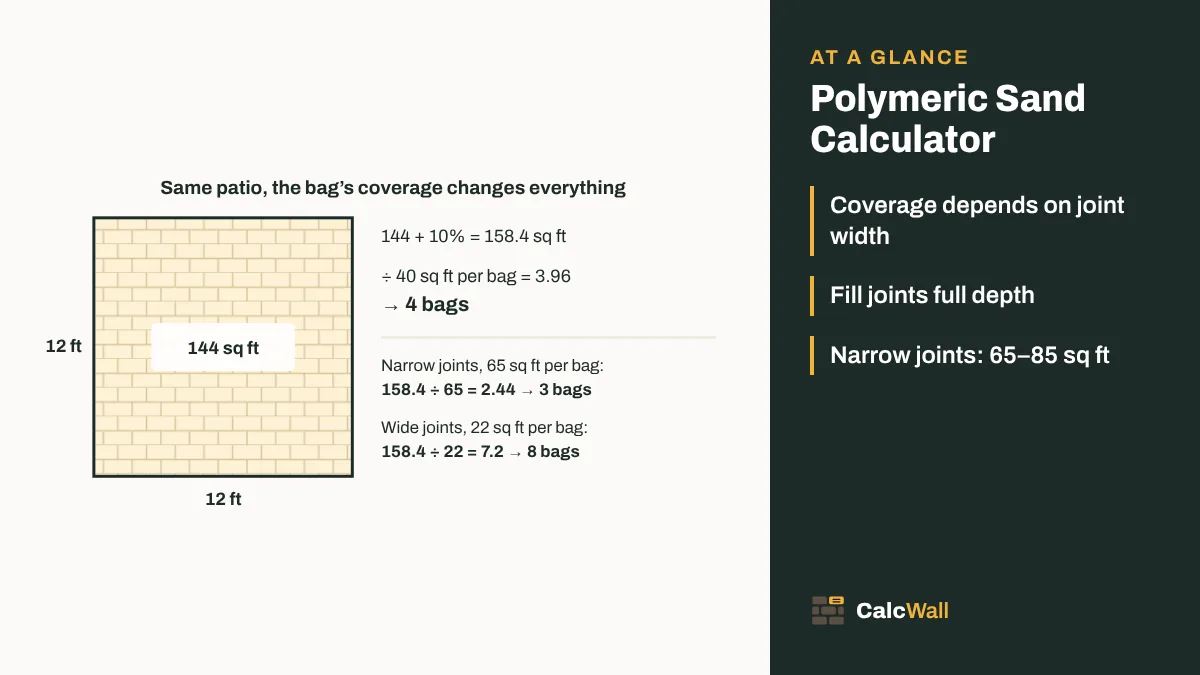
Quick answer: bags = paved area × 1.10 ÷ coverage per bag for your joint width, rounded up. A 12 × 12 ft patio at 40 sq ft per bag is 158.4 ÷ 40 = 3.96, so 4 bags.
How to calculate polymeric sand
- Measure the paved area as rectangles: length × width for each.
- Subtract anything not paved, like a planting bed or a fire pit with a solid cap.
- Add about 10% for spillage, sweeping off and topping up after compaction.
- Find the coverage per bag on the bag’s chart for your paver size and joint width.
- Divide and round up to whole bags.
Bags = (area − not paved) × (1 + waste) ÷ coverage per bag
Metric example: a 4 × 4 m patio is 16 m², plus 10% = 17.6 m². At 4 m² per bag that is 4.4, so 5 bags.
The calculator’s defaults, 40 sq ft per bag in the US and 4 m² per bag elsewhere, are there so the page shows a working example. They are not a product’s rating. Replace them with the figure from your bag. If the bag gives a range, use the low end unless your joints are tight and your pavers are large. Running short halfway through watering in is worse than having a bag left over, because the next bag may be a different batch and a slightly different colour.
The calculator counts the pavers’ surface area, not the joints themselves. That is how manufacturers write their charts: square feet of paving per bag. Don’t try to measure the total length of joints; the chart has already done that for you.
What a bag covers: manufacturer charts
Every brand prints its own chart, and they do not agree, because their sands, bag weights and test pavers differ. Here is what the makers say, as published:
| Product | Bag | Narrow joints | Wide joints | Joint width allowed |
|---|---|---|---|---|
| Alliance Gator Supersand G2 | 50 lb (22.7 kg) | 65–85 sq ft (6–7.4 m²) at 1/8–3/8 in | 22–42 sq ft (2–3.9 m²) at 3/4–1¼ in | Up to 2 in |
| Alliance Gator Maxx G2 | 50 lb (22.7 kg) | 65–85 sq ft (6–7.4 m²) at 1/8–3/8 in | 22–42 sq ft (2–3.9 m²) at 3/4–1¼ in | Up to 4 in (drainage) |
| Alliance Gator Supersand Bond | 50 lb (22.7 kg) | 65–85 sq ft (6–7.4 m²) at 1/8–3/8 in | 22–42 sq ft (2–3.9 m²) at 3/4–1 in | 1/8 in to 1 in |
| Techniseal SmartSand | 50 lb (22.7 kg) | 60–120 sq ft (6–11 m²) | 25–40 sq ft (2.3–4 m²) | 1/16 in to 1 in |
| Sakrete PermaSand | 40 lb pail | 30–45 sq ft (2.8–4.2 m²) for 2 in pavers with 1/4 in joints | 1/4 in to 1½ in | |
The Gator figures are for a paver 2⅜ in (60 mm) high. The Black Diamond colour of Gator Maxx G2 is listed lower, at 58–76 sq ft for narrow joints and 20–38 sq ft for wide joints. Techniseal’s guide does not tie its ranges to a joint width; it says coverage depends on the paver shape and size and the joint width and depth.
How wide can the spread be? A product data guide from the paver maker Permacon, for Techniseal sands in 50 lb bags, lists coverage paver by paver. It runs from 33 sq ft per bag for the Vendome 80 paver to 412 sq ft per bag for the Mega Melville slab. Same bag, more than twelve times the area. That is why the calculator asks you for the coverage rather than guessing it.
Why joint width, depth and paver size change coverage
A bag of polymeric sand fills a volume. The area it covers depends on how much joint volume there is in each square foot of paving, and three things set that: how wide the joints are, how deep they are, and how many joints there are per square foot, which comes down to paver size.
Here is that volume for some common cases, worked out with plain geometry: joint area per square foot × 2¼ in of depth. It ignores chamfers and spacer nubs, so treat it as a comparison, not a bag rating.
| Paver | Joint | Joint area per sq ft | Sand per sq ft (2¼ in deep) | Compared with 4 × 8, ⅛ in |
|---|---|---|---|---|
| 24 × 24 in slab | ⅛ in | 1.49 sq in | 3.3 cu in | 0.23 × |
| 12 × 12 in | ⅛ in | 2.95 sq in | 6.6 cu in | 0.45 × |
| 6 × 9 in | ⅛ in | 4.87 sq in | 11.0 cu in | 0.75 × |
| 6 × 6 in | ⅛ in | 5.82 sq in | 13.1 cu in | 0.89 × |
| 12 × 12 in | ¼ in | 5.82 sq in | 13.1 cu in | 0.89 × |
| 4 × 8 in | ⅛ in | 6.51 sq in | 14.7 cu in | 1.00 × |
| 4 × 8 in | ¼ in | 12.58 sq in | 28.3 cu in | 1.93 × |
| 4 × 8 in | ⅜ in | 18.24 sq in | 41.0 cu in | 2.80 × |
Three things to take from this:
- Joint width counts almost one for one. Double the joint and you need nearly twice the sand. A ⅜ in joint takes 2.8 times what a ⅛ in joint takes.
- Small pavers have more joints. A 4 × 8 in paver has more than twice the joint length per square foot of a 12 × 12 in paver.
- Depth counts directly. A thicker 3⅛ in driveway paver has 3 in of sand in each joint instead of 2¼ in, a third more. If your bag’s chart is based on 2⅜ in pavers, expect lower coverage on thicker ones.
Tumbled pavers, with their rounded and chipped edges, behave like wide joints even when they are laid tight. So do pavers with deep chamfers. Use the wide-joint figure or the middle of the range for them.
Bags for common patio sizes
Bags for each area with 10% extra, at the calculator’s default and at the ends of the Gator chart for 50 lb bags. Recomputed with the calculator’s own rounding.
| Area | At 40 sq ft/bag (default) | Narrow joints, 85 sq ft/bag | Narrow joints, 65 sq ft/bag | Wide joints, 42 sq ft/bag | Wide joints, 22 sq ft/bag |
|---|---|---|---|---|---|
| 10 × 10 ft (100 sq ft) | 3 | 2 | 2 | 3 | 5 |
| 12 × 12 ft (144 sq ft) | 4 | 2 | 3 | 4 | 8 |
| 12 × 16 ft (192 sq ft) | 6 | 3 | 4 | 6 | 10 |
| 16 × 20 ft (320 sq ft) | 9 | 5 | 6 | 9 | 16 |
| 20 × 20 ft (400 sq ft) | 11 | 6 | 7 | 11 | 20 |
Worked examples
Patio with narrow joints
A 12 × 12 ft patio of 2⅜ in concrete pavers with ⅛ in joints, using a sand rated 65–85 sq ft per 50 lb bag. Plan on the low end: 144 × 1.10 = 158.4 sq ft ÷ 65 = 2.44, so 3 bags. Enter 12 × 12, coverage 65 and +10%. With the default 40 sq ft per bag the same patio shows 4 bags.
Wide joints between tumbled or natural stone
A 15 × 10 ft patio (150 sq ft) with ¾ to 1 in joints, using a wide-joint rating of 22–42 sq ft per bag. At the low end: 150 × 1.10 = 165 sq ft ÷ 22 = 7.5, so 8 bags. At the high end it would be 165 ÷ 42 = 3.93, so 4 bags. Order the 8 and ask the yard whether it takes back unopened bags.
Metric patio with SmartSand
A 5 × 4 m patio (20 m²) with narrow joints, using Techniseal SmartSand at 6–11 m² per 22.7 kg bag. At 6 m²: 20 × 1.10 = 22 m² ÷ 6 = 3.67, so 4 bags. If the joints turn out wide, at 2.3 m² per bag the same patio needs 22 ÷ 2.3 = 9.57, so 10 bags.
Pails instead of bags
The same 12 × 12 ft patio with ¼ in joints, using Sakrete PermaSand in 40 lb pails rated 30–45 sq ft. At 30 sq ft: 158.4 ÷ 30 = 5.28, so 6 pails. The calculator says “bags”, but the count works the same for pails.
Before you finish laying, double-check that the joint width you used matches the pavers you laid. Joints often open up near cuts and curves, and the low end of the range covers that.
Picking a sand for your joints
Polymeric sands are made for a range of joint widths. Too narrow and the sand won’t go in; too wide and a product made for tight joints cracks or washes out.
- Tight concrete paver joints, 1/16 to 3/8 in: most standard polymeric sands. Techniseal SmartSand starts at 1/16 in and Gator Supersand Bond at 1/8 in.
- Joints of 1/4 in and up: Sakrete PermaSand needs at least 1/4 in, so it is not for tight-laid pavers.
- Joints wider than 1 in: SmartSand and Supersand Bond stop at 1 in. Gator Supersand G2 goes to 2 in and Gator Maxx G2 to 4 in in drainage applications.
- Natural stone and flagstone: irregular joints vary from tight to wide on the same patio. Use a wide-joint product and the wide-joint coverage figure.
- Depth: SmartSand and Gator Supersand Bond both need joints at least 1½ in deep. Thin pavers set on a slab are a different job; check the product is rated for overlays.
Pick a colour that suits the pavers: grey, beige or tan, and darker shades on some products. Coverage can differ between colours of the same product, as it does with Gator Maxx G2 Black Diamond.
Sweeping, compacting and watering
Most failures of polymeric sand come from the install, not the sand. The steps are much the same across brands; the details (how many watering passes, how long to wait) are on the bag and differ, so read yours.
- Start dry. The pavers and joints must be completely dry. Sakrete warns that damp pavers leave a polymer stain on the surface.
- Sweep it in. Pour the sand onto the pavers and sweep with a stiff broom, working in short sections, until every joint is full.
- Compact. Run a plate compactor with a protective pad over the surface. Gator says to vibrate in several directions to avoid voids. The sand settles; sweep more in and compact again until the joints stay full. Techniseal’s test: a finger cannot sink into the joint.
- Clean the surface. Sweep with a stiff broom, then a soft one, then use a leaf blower. Leave the sand at least 1/8 in below the top of the paver or below the chamfer. Any dust left on the surface can set into a haze when you water.
- Water. Use a shower setting, starting at the low end. Gator works in sections of about 100 sq ft with three passes a few minutes apart. Techniseal waters 30 seconds at a time until the joints are saturated. Sakrete waters until the joints stop absorbing. Too little water and the bottom of the joint never hardens; too much and polymer floats onto the surface.
- Blow off the water standing on textured pavers so it doesn’t dry into a film.
Weather, rain and curing
- Temperature: Sakrete PermaSand goes down above 40 °F. Techniseal SmartSand wants the temperature above 32 °F for 48 hours after installation.
- Rain: Gator Supersand Bond needs no rain for 1 hour after watering in; Gator Maxx G2 needs 15 minutes dry for drainage applications and 24 hours for overlays. SmartSand can take unexpected rain after 60 minutes but asks for 24 hours dry. PermaSand needs 24 hours of protection and a cover if a downpour comes in the first 72 hours.
- Traffic: SmartSand allows foot traffic straight away and vehicles after 48–72 hours.
- Cleaning and sealing: Techniseal says to wait until the joints have hardened, typically 30 days, before pressure washing or sealing.
Check the forecast before you open a bag. A clear day with a dry night ahead is what you want.
Notes for hardscape installers
Quote from the low end. Bag ranges cover the maker’s best and worst cases. Price the job at the low coverage figure and you won’t be short on site.
Old joints, full depth. On a re-sand, clean the old joint material out to full depth without disturbing the bedding, and let the pavers dry fully before you start.
One batch per job. Colour varies between lots. Bring enough for the whole area and keep the lot numbers together.
Pad the compactor. Use the protective pad on the plate, or the steel scuffs and chips the faces. Leave a layer of sand on top while compacting so it vibrates down into the joints.
Laying a new patio? Count the pavers with the paver calculator, the bedding layer with the paver sand calculator and the crushed stone with the paver base calculator. Sealing the pavers afterwards? The sealant calculator works out the sealer.
Sources
Where the numbers on this page come from. Everything else is plain geometry and unit conversion, which the calculator does with exact factors.
- Alliance Gator Reference Guide, Alliance Designer Products, 2025 edition (March 2026 file). Used for: coverage per 50 lb (22.7 kg) bag for a paver 2⅜ in high: Gator Maxx G2 and Gator Supersand G2 65–85 sq ft (6–7.4 m²) for 1/8–3/8 in joints and 22–42 sq ft (2–3.9 m²) for 3/4–1¼ in joints; Black Diamond colour 58–76 and 20–38 sq ft; maximum joint widths (Gator Maxx G2 up to 4 in, Supersand G2 up to 2 in, Supersand Bond up to 1 in); joint depth of full paver depth minus 1/8 in; Gator Maxx G2 needs 15 minutes of dry weather after activation in drainage applications and 24 hours for overlays
- Gator Supersand Bond product page, Alliance Designer Products. Used for: joint width 1/8 in (3 mm) to 1 in, minimum joint depth 1½ in (38 mm); spreading with a hard broom, compacting with a plate compactor, sand at least 1/8 in below the top, watering in sections of about 100 sq ft starting at the low point, and no rain within 1 hour of activation
- SMARTSAND polymeric sand installation guide, Techniseal (hosted by Van Beek’s). Used for: coverage per 22.7 kg (50 lb) bag of 60–120 sq ft (6–11 m²) for narrow joints and 25–40 sq ft (2.3–4 m²) for wide joints; joints 1/16 in to 1 in wide and at least 1½ in deep; watering 30 seconds at a time; rain-safe after 60 minutes with 24 hours dry recommended; foot traffic straight away and vehicles after 48–72 hours; above 32 °F for 48 hours
- Product data guide, Techniseal polymeric sands (Ontario), Permacon, June 2026. Used for: surface per 22.7 kg (50 lb) bag by paver: from 33 sq ft (3.06 m²) for the Vendome 80 paver to 412 sq ft (38.32 m²) for the Mega Melville slab, showing how much paver size and shape change coverage
- Sakrete PermaSand Polymeric Jointing Sand data sheet, Sakrete (hosted by The Home Depot). Used for: a 40 lb pail covers 30–45 sq ft (2.8–4.2 m²) for 2 in pavers with 1/4 in joints at full depth; joints 1/4 in to 1½ in wide; apply above 40 °F with no rain forecast for 24 hours, on completely dry pavers; fill to within 1/8 in of the top; protect from rain for 24 hours
Frequently asked questions
How much polymeric sand do I need?
Divide the paved area (plus about 10%) by the coverage per bag for your joint width. A 12 × 12 ft patio is 144 sq ft; plus 10% is 158.4 sq ft. At 40 sq ft per bag that is 3.96, so 4 bags.
How much does a 50 lb bag of polymeric sand cover?
Anywhere from about 20 sq ft to well over 100 sq ft, depending on the joint width and depth and the paver size. Alliance Gator lists 65–85 sq ft per 50 lb bag for 1/8–3/8 in joints between 2⅜ in pavers and 22–42 sq ft for 3/4–1¼ in joints. Techniseal lists 60–120 sq ft for narrow joints and 25–40 sq ft for wide joints. Use the chart for the product you buy.
How many bags of polymeric sand for a 10 × 10 patio?
100 sq ft plus 10% is 110 sq ft. At 65 sq ft per bag (narrow joints, low end of the Gator chart) that is 1.69, so 2 bags. With wide joints at 22 sq ft per bag it is 5 bags.
Why does my bag say a range, not one number?
Because the same bag fills different joint volumes. Narrow joints between big square pavers take little sand; wide joints between small tumbled pavers take a lot. Plan on the low end of the range unless your pavers are large and your joints tight.
How deep should polymeric sand go?
The full depth of the paver, down to the bedding sand, stopping about 1/8 in below the top (or below the chamfer). Gator and Techniseal SmartSand both ask for at least 1½ in of depth. Joints filled only near the top crack and wash out.
Is this the same as paver base sand?
No. Polymeric sand fills the joints after the pavers are laid. For the 1 in bedding layer under the pavers use the paver sand calculator, and for the crushed stone below that the paver base calculator.
Why add 10%?
Some sand is lost when sweeping and blowing off, joints are rarely all the same width, and compaction settles the sand so you top up. If you are following a manufacturer’s chart that already gives a range, 10% on top of the low end is plenty.
Can I use polymeric sand for wide joints or flagstone?
Only a product rated for it. Gator Maxx G2 is listed for joints up to 4 in in drainage applications and Gator Supersand G2 up to 2 in; Techniseal SmartSand and Gator Supersand Bond stop at 1 in. Sakrete PermaSand needs joints of at least 1/4 in. Check the bag before you buy.
What happens if it rains after I put down polymeric sand?
It depends on the product and how long since you watered it in. Techniseal SmartSand can take unexpected rain 60 minutes after installation but asks for 24 hours dry; Gator Supersand Bond needs no rain for 1 hour; Sakrete PermaSand needs 24 hours of protection. Heavy rain too early can wash polymer onto the pavers and leave a haze.
Can I put polymeric sand on wet pavers?
No. The pavers and the joints must be completely dry before you sweep it in. Damp pavers hold the dust, the polymer activates on the surface and it can stain. Wait for a dry day and a dry surface.
Is this polymeric sand calculator free to use online?
Yes. The CalcWall Polymeric Sand Calculator is completely free and works online in any browser, on a phone, tablet or computer. There is nothing to download and no account to create, and the math runs right in your browser, so results appear as you type.