Quick answer: gallons = area × 1.05 × coats ÷ coverage per gallon, rounded up. A 20 × 40 ft driveway with two coats at 200 sq ft per gallon needs 9 gallons.
How to calculate
- Measure the length and width of each area.
- Subtract anything not sealed.
- Add about 5% extra.
- Multiply by the coats and divide by the coverage per gallon (or per litre). Round up.
Gallons = (area − not sealed) × 1.05 × coats ÷ coverage per gallon, rounded up
The 5% covers what stays in the roller, the tray and the sprayer, plus the bit you overlap at the edges. It does not cover a slab that turns out thirstier than the label assumed. That is a coverage question, and it is the number to get right.
Metric example: a 6 × 12 m driveway is 72 m², plus 5% = 75.6 m²; two coats = 151.2 m². At 5 m² per litre that is 30.24, so 31 litres.
How far a gallon of sealer goes
Sealer coverage is printed as a range because concrete varies. A dense, steel-troweled garage floor takes little; a broom-finished driveway takes more; exposed aggregate, old weathered concrete and pavers take the most. The two labels checked for this page show how wide the spread is. Indoors, a ground and polished slab is another option: compare what polishing a concrete floor costs.
| Product (example) | Type | Label coverage | Coats |
|---|---|---|---|
| Rust-Oleum SEAL-KRETE Multi-Surface Water Repellent | water-based acrylic repellent | 150–300 sq ft / gal, by porosity | 1 for dustproofing, 2 for a satin finish |
| MASCO Acrylic Sealer | acrylic film sealer | 350–400 sq ft / gal per coat on dry, hardened concrete; less on exposed aggregate | 2, always recommended |
These are examples to show the range, not recommendations. Penetrating silane and siloxane sealers, solvent acrylics, water-based acrylics and epoxies all behave differently. If you are coating a garage floor with epoxy rather than sealing it, use the epoxy calculator instead, since epoxy is sold in kits and laid thicker.
A simple test tells you where your slab sits: sprinkle some water on it. If it darkens and soaks in within a minute, the concrete is porous and you should plan on the low coverage number. If it beads, the slab may already be sealed, and new sealer may not soak in at all; check the label for what it says about recoating.
Gallons of sealer by area
The chart below is two coats with 5% extra, rounded up, at four coverage rates that span the labels above.
| Area | 150 sq ft / gal | 200 sq ft / gal | 300 sq ft / gal | 400 sq ft / gal |
|---|---|---|---|---|
| 200 sq ft | 3 | 3 | 2 | 2 |
| 400 sq ft | 6 | 5 | 3 | 3 |
| 600 sq ft | 9 | 7 | 5 | 4 |
| 800 sq ft | 12 | 9 | 6 | 5 |
| 1,000 sq ft | 14 | 11 | 7 | 6 |
An 800 sq ft driveway needs anything from 5 to 12 gallons depending on the product and the surface. That is why the calculator takes the coverage from your label instead of assuming one. Sealer often comes in 1 and 5 gallon pails, so 9 gallons might be one 5 gallon pail and four singles; check the price per gallon both ways.
One coat or two
Most film-forming sealers are applied in two thin coats. MASCO’s sheet says two coats are always recommended, with the second at 90° to the first once the first has dried overnight. The Seal-Krete repellent sheet says one coat for dustproofing and two for a satin finish. A thick single coat is not the same as two thin ones: it takes longer to dry and can stay soft or look cloudy.
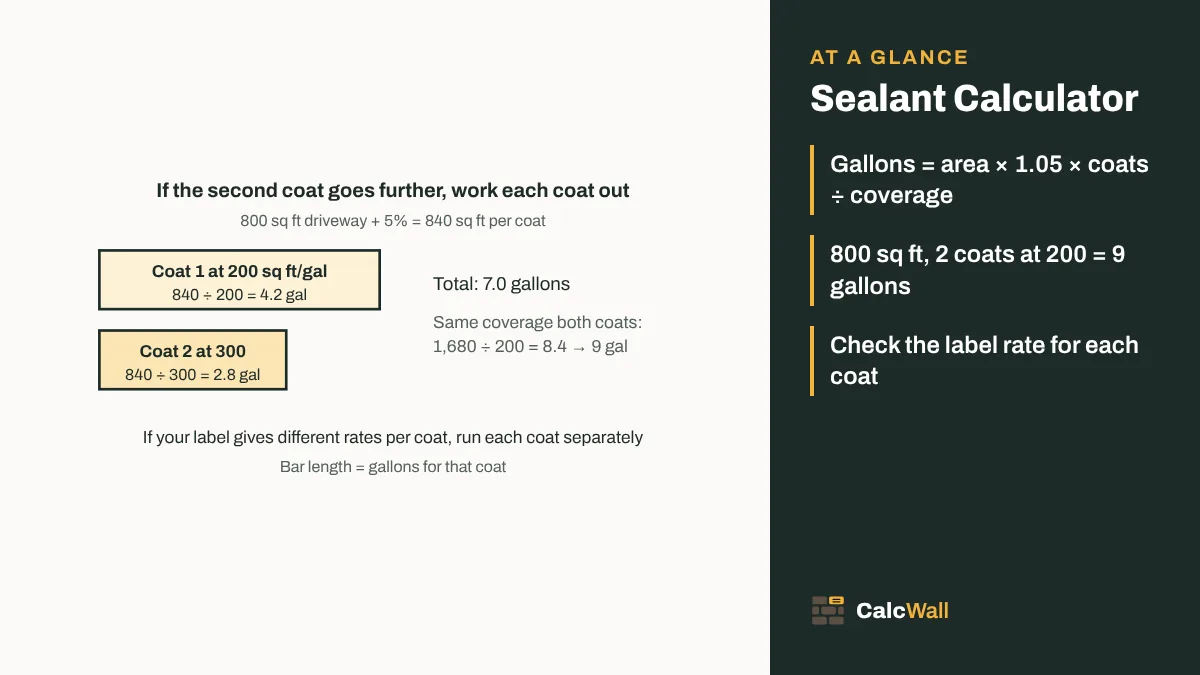
The calculator uses one coverage figure for every coat, which is the safe way to order. Some labels give a higher coverage for the second coat, because the first coat has filled the surface. If yours does, run the calculator twice, one coat each time at its own rate, and add the two answers.
Driveways, walks and patios together
Most jobs are more than one slab. Enter each one as its own row and the calculator adds them before it applies the extra and the coats, so you only round up once. The countertop calculator works the same way for a top cast in several pieces.
Rounding each slab separately would give 9 gallons for the drive and 2 for the walk, 11 in all, one more than you need. For odd shapes, split them into rectangles. If you are still at the pouring stage, the concrete calculator uses the same lengths and widths to work out the yards of concrete, and for paver patios the paver sand calculator covers the sand underneath.
Litres and square meters
Set the calculator to meters and it asks for coverage per litre. To convert a US label, multiply the square feet per gallon by 0.02454: 150 sq ft per gallon is 3.68 m² per litre, 200 is 4.91, 300 is 7.36 and 400 is 9.82. The factor comes from the exact definitions 1 US gallon = 3.785411784 L and 1 sq ft = 0.09290304 m². To go the other way, divide by 0.02454.
Weather and timing
The amount you need doesn’t change with the weather, but whether the sealer works does. The Seal-Krete sheet asks for 50–90 °F and no drop below 50 °F for 24 hours. The MASCO sheet says it works best between 55 and 80 °F, should not go on if the temperature will fall below 40 °F within 4 hours, and should be kept out of direct sun above 90 °F. New concrete has to cure before most sealers go on; the label says how long. Plan for a dry day and a dry night after it. On a new slab, the concrete curing time calculator helps you plan the wait before sealing.
Worked examples
Two common jobs, worked the same way as the calculator.
Broom-finished patio. A 12 × 16 ft patio is 192 sq ft. With 5% extra and two coats of a repellent at the low end of its range, 150 sq ft per gallon: 192 × 1.05 × 2 = 403.2 sq ft, and 403.2 ÷ 150 = 2.69, so 3 gallons.
Smooth garage floor. A 24 × 24 ft two-car garage is 576 sq ft. Two coats of an acrylic at 350 sq ft per gallon per coat: 576 × 1.05 × 2 = 1,209.6 sq ft, and 1,209.6 ÷ 350 = 3.46, so 4 gallons.
The garage is three times the size of the patio but needs only one more gallon, because a smooth floor and a sealer with high coverage stretch every gallon further.
Common mistakes
- Using the top of the range. The high number is for dense, smooth concrete. Driveways rarely are.
- Forgetting the second coat. If the label calls for two, the gallons double.
- Laying it on thick. One heavy coat uses the same sealer as two thin ones but often looks worse and stays tacky.
- Sealing over old sealer. Some sealers won’t bond to a different one. Do the water test and read the recoat section of the label.
- Mixing up sealer and joint sealant. Cracks and control joints are filled with a joint sealant, sold by the tube, not by the gallon.
Notes for applicators
Test patch. Do a small area first and see how far a measured amount goes. It tells you your real coverage before you buy the rest.
Cross the coats. Run the second coat at 90° to the first, as MASCO’s sheet says, so you don’t leave stripes.
Watch puddles. Back-roll any puddles or low spots. Sealer that pools turns white or stays sticky.
Same batch. Buy enough for the whole job at once, so you don’t run out halfway across a slab and leave a lap line.
Sources
Where the numbers on this page come from. Everything else is plain geometry and unit conversion, which the calculator does with exact factors.
- SEAL-KRETE Multi-Surface Water Repellent: technical data sheet, Rust-Oleum, SK201001 / SK201005. Used for: 150–300 sq ft per gallon depending on porosity, one coat for dustproofing and two for a satin finish, and the 50–90 °F application range
- MASCO Acrylic Sealer: product data sheet, MASCO (Mason’s Supply Company), rev. 8/3/2023. Used for: 350–400 sq ft per gallon per coat on dense concrete, lower on exposed aggregate, two coats at 90° to each other, and the temperature limits
- NIST Handbook 44, Appendix C: General Tables of Units of Measurement, National Institute of Standards and Technology, 2026 edition. Used for: 1 US gallon = 3.785411784 L and 1 sq ft = 0.09290304 m², for the sq ft per gallon to m² per litre factor
Frequently asked questions
How much concrete sealer do I need?
Multiply the area by the number of coats, add a little extra and divide by the coverage per gallon. A 20 × 40 ft driveway is 800 sq ft; plus 5% that is 840 sq ft, and two coats make 1,680 sq ft. At 200 sq ft per gallon that is 8.4, so 9 gallons.
How much does a gallon of sealer cover?
It varies a lot. One water-based repellent checked here lists 150–300 sq ft per gallon depending on porosity; one acrylic sealer lists 350–400 sq ft per gallon per coat on dense concrete. Use your label, and the lower figure for porous or broom-finished concrete.
How many coats of sealer should I apply?
Many products recommend two thin coats. Follow the label: some penetrating sealers are one-coat products, and some say one coat for dustproofing and two for a finish.
Does this work for pavers or stone?
Yes, as long as you enter the coverage the manufacturer gives for that surface. Pavers with sand joints usually soak up more.
Is this for caulk or joint sealant?
No. This calculator is for sealers spread over an area. Joint sealant is worked out by the length and size of the joint.
How many gallons of sealer for a two-car driveway?
A typical two-car driveway of about 20 × 40 ft is 800 sq ft. With 5% extra and two coats, that is 6 gallons at 300 sq ft per gallon, 9 at 200 and 12 at 150.
How do I convert sq ft per gallon to m² per litre?
Multiply by 0.02454. 200 sq ft per US gallon is about 4.91 m² per litre and 300 sq ft per gallon about 7.36 m² per litre.
Can I seal concrete in cold weather?
Check the label. One product here asks for 50–90 °F with no drop below 50 °F for 24 hours; another wants no drop below 40 °F within 4 hours. Outside those limits the sealer may not dry or bond properly.
Is this sealant calculator free to use online?
Yes. The CalcWall Sealant Calculator is completely free and works online in any browser, on a phone, tablet or computer. There is nothing to download and no account to create, and the math runs right in your browser, so results appear as you type.