Quick answer: fraction = (decimal × 16, rounded) ÷ 16, reduced. 0.3 in ≈ 5/16 in; 3 5/8 + 1 1/4 = 4 7/8 in.
How to calculate
- Type a measurement as a whole number and fraction (3 5/8), a fraction (5/8) or a decimal (3.625).
- To do a sum, choose add or subtract and type a second measurement, or multiply or divide by a number.
- Pick the smallest mark on your tape (1/16 in on most). The result is rounded to the nearest mark and reduced, with how far rounding moved it.
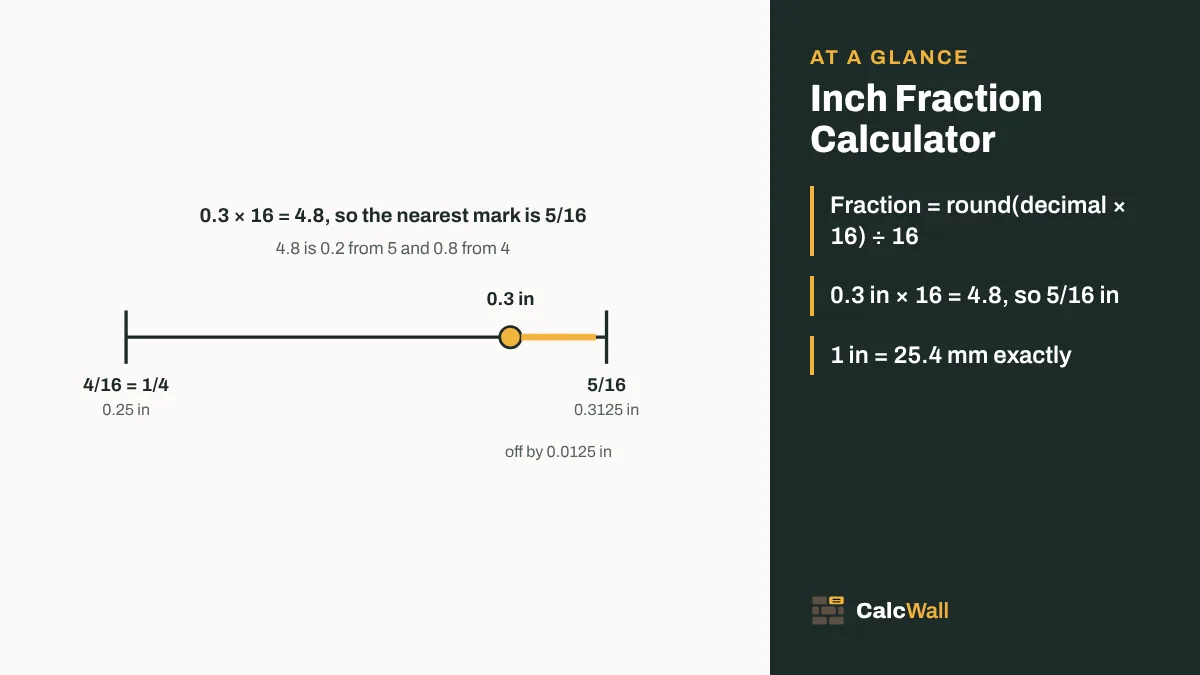
Behind the scenes there is one rule. Multiply the decimal part by the number of marks per inch, round to the nearest whole number, put it over that number and reduce. To the nearest sixteenth, 0.3 in × 16 = 4.8, which rounds to 5, so 0.3 in becomes 5/16 in. If the rounded number is even, it reduces: 0.25 × 16 = 4, and 4/16 is 1/4.
Fraction = round(decimal × 16) ÷ 16, then reduce
Millimeters use the exact definition 1 in = 25.4 mm, so 3 5/8 in = 92.075 mm.
Reading the marks on a tape
A standard tape splits each inch into 16. The marks are different lengths so you can find your place without counting: the half inch is the longest mark between the inch lines, then the quarters, then the eighths, and the shortest marks are the odd sixteenths.
To read 11/16, find the 5/8 mark (10/16) and go one short mark further. Thinking in sixteenths makes it easy: every mark is one more sixteenth, and you reduce at the end. 10/16 is 5/8, 12/16 is 3/4, but 11/16 stays as it is because 11 is odd.
Fine rules and some machinist scales go to 1/32 or 1/64 in. If you set the calculator to a finer mark than your tape shows, you will get a number you can’t find on the blade.
Sixteenths chart
The table below is every sixteenth of an inch as a decimal and in millimeters. The millimeters are exact, because the inch is defined as 25.4 mm.
| Fraction | Decimal (in) | Millimeters |
|---|---|---|
| 1/16 | 0.0625 | 1.5875 |
| 1/8 | 0.125 | 3.175 |
| 3/16 | 0.1875 | 4.7625 |
| 1/4 | 0.25 | 6.35 |
| 5/16 | 0.3125 | 7.9375 |
| 3/8 | 0.375 | 9.525 |
| 7/16 | 0.4375 | 11.1125 |
| 1/2 | 0.5 | 12.7 |
| 9/16 | 0.5625 | 14.2875 |
| 5/8 | 0.625 | 15.875 |
| 11/16 | 0.6875 | 17.4625 |
| 3/4 | 0.75 | 19.05 |
| 13/16 | 0.8125 | 20.6375 |
| 7/8 | 0.875 | 22.225 |
| 15/16 | 0.9375 | 23.8125 |
Decimals to the nearest sixteenth
Plans, spreadsheets and digital calipers often give decimals that don’t land on a tape mark. Rounding to the nearest sixteenth is never more than 1/32 in (0.03125 in, under 0.8 mm) away from the true value. That is fine for framing and most trim; for tight joinery, round to 1/32 instead.
| Decimal (in) | × 16 | Nearest 1/16 | Rounding moved it |
|---|---|---|---|
| 0.1 | 1.6 | 1/8 | +0.025 in |
| 0.2 | 3.2 | 3/16 | −0.0125 in |
| 0.3 | 4.8 | 5/16 | +0.0125 in |
| 0.33 | 5.28 | 5/16 | −0.0175 in |
| 0.4 | 6.4 | 3/8 | −0.025 in |
| 0.6 | 9.6 | 5/8 | +0.025 in |
| 0.7 | 11.2 | 11/16 | −0.0125 in |
| 0.8 | 12.8 | 13/16 | +0.0125 in |
| 0.9 | 14.4 | 7/8 | −0.025 in |
A plus sign means the fraction is a little longer than the decimal; minus means a little shorter. The calculator shows the same figure under the result, in inches and millimeters.
Millimeters to inch fractions
To use a metric size with an imperial tape, divide by 25.4 and enter the decimal inches. The table shows common metric sizes rounded to the nearest sixteenth, and how far off that leaves you.
| Millimeters | Decimal inches | Nearest 1/16 | Off by |
|---|---|---|---|
| 3 mm | 0.1181 | 1/8 in | +0.17 mm |
| 6 mm | 0.2362 | 1/4 in | +0.35 mm |
| 10 mm | 0.3937 | 3/8 in | −0.48 mm |
| 12 mm | 0.4724 | 1/2 in | +0.70 mm |
| 15 mm | 0.5906 | 9/16 in | −0.71 mm |
| 19 mm | 0.7480 | 3/4 in | +0.05 mm |
| 25 mm | 0.9843 | 1 in | +0.40 mm |
Notice that 12 mm and 1/2 in are not the same: a 12 mm bit in a 1/2 in hole leaves 0.7 mm of slop. When a fit matters, buy the size the plan was drawn in.
Fractions back to decimals
Going the other way is plain division: the top number divided by the bottom. 5/8 is 5 ÷ 8 = 0.625, so 3 5/8 in is 3.625 in. That is exact, with no rounding, because every fraction on a tape is a sixteenth, a thirty-second or a sixty-fourth, and they all end in a short decimal.
You need the decimal when you type a measurement into a spreadsheet, a CNC or a laser cutter, or a calculator that only takes decimals. Type the fraction into this calculator with “Just convert” and the decimal inches appear under the result, along with millimeters and centimeters. For a long measurement it also shows feet and inches, so 75 3/8 in reads as 6 ft 3 3/8 in.
One habit worth keeping: write the fraction down the way you read it off the tape, and convert only when you need to. A decimal like 0.4375 is easy to mistype; 7/16 is hard to get wrong.
Inches to decimal feet
Most area and volume calculators, including the lumber calculator and the framing calculator, want lengths in feet. Divide the inches by 12: 1 in = 0.0833 ft, 2 in = 0.1667, 3 in = 0.25, 4 in = 0.3333, 6 in = 0.5, 8 in = 0.6667, 9 in = 0.75, 10 in = 0.8333 and 11 in = 0.9167 ft. So 8 ft 6 in is 8.5 ft, not 8.6. For a small part measured in inches, the square inches calculator keeps everything in inches.
Adding, subtracting and halving
To add or subtract fractions by hand, put them over the same bottom number first. 3 5/8 + 1 1/4 becomes 3 5/8 + 1 2/8 = 4 7/8 in. If the fractions add up to more than one, carry the whole inch: 5/8 + 3/4 = 5/8 + 6/8 = 11/8 = 1 3/8.
Halving is where people slip. To halve a fraction, double the bottom number: half of 5/8 is 5/16. Half of 3 5/8 is 1 13/16, because 3 5/8 is 58/16 and half of that is 29/16. The calculator does this when you choose “Divide by a number” and enter 2.
Worked examples
Both examples below use the calculator the way you would on site: one subtraction, then one division.
Centering a shelf. The space between two walls is 30 3/4 in and the shelf is 17 1/2 in. Subtract: 30 3/4 − 17 1/2 = 13 1/4 in. Divide by 2: 6 5/8 in each side. Mark 6 5/8 in in from each wall and the shelf edges land on the marks.
Three equal pieces from a board. A 96 in board cut into three equal pieces loses two saw kerfs of 1/8 in. Subtract: 96 − 1/4 = 95 3/4 in. Divide by 3: 31.9167 in, which rounds to 31 15/16 in (0.0208 in long). Cut the first two at 31 15/16 and the last piece takes up the difference.
Common mistakes
- Reading 8 ft 6 in as 8.6 ft. Inches are twelfths of a foot, not tenths. 6 in is 0.5 ft.
- Halving the top number. Half of 3/8 is 3/16, not 1.5/8. Double the bottom number instead.
- Forgetting the kerf. Every cut turns about 1/8 in of wood into sawdust. Over several cuts it adds up.
- Rounding at every step. Add and subtract the exact numbers, then round once at the end. Rounding each piece to 1/16 can stack up to an eighth or more.
- Treating metric and imperial sizes as equal. 12 mm is not 1/2 in, and 19 mm is only just 3/4 in.
Notes for carpenters and fabricators
Burn an inch. If the hook on your tape is bent, measure from the 1 in mark and take an inch off. Just remember to take it off.
Strong and shy. Some crews call a hair over a mark “strong” and a hair under “shy”. The plus or minus under the result tells you which way the rounding went.
Same tape, whole job. Two tapes can disagree by 1/16 in over a few feet. Use one tape for the layout and the cutting.
Quick metric. 1/16 in is about 1.6 mm, 1/8 in about 3.2 mm, 1/4 in 6.35 mm, 1 in exactly 25.4 mm.
Sources
Where the numbers on this page come from. Everything else is plain geometry and unit conversion, which the calculator does with exact factors.
- NIST Handbook 44, Appendix C: General Tables of Units of Measurement, National Institute of Standards and Technology, 2026 edition. Used for: 1 inch = 25.4 mm exactly and 1 foot = 12 inches, used for every millimeter and decimal-foot figure on this page
Frequently asked questions
How do I convert a decimal to an inch fraction?
Multiply the decimal part by 16 (or 32, 64), round to a whole number and put it over 16, then reduce. 0.3 in × 16 = 4.8, which rounds to 5, so 0.3 in is about 5/16 in.
How do I add inch fractions?
Give the fractions a common denominator and add. 3 5/8 + 1 1/4 = 3 5/8 + 1 2/8 = 4 7/8 in.
How do I divide a measurement in half?
Choose “Divide by a number” and enter 2. Half of 3 5/8 in is 1 13/16 in.
What do the marks on a tape measure mean?
Most imperial tapes mark 1/16 in; some fine rules go to 1/32 or 1/64. The longest marks are inches, then halves, quarters, eighths and sixteenths.
How many millimeters is 1/16 inch?
1/16 in is 1.5875 mm exactly, because 1 in = 25.4 mm by definition.
How do I convert millimeters to inch fractions?
Divide the millimeters by 25.4 to get decimal inches, then enter that. 10 mm ÷ 25.4 = 0.3937 in, which is 3/8 in to the nearest sixteenth (about half a millimeter short).
How do I convert inches to decimal feet?
Divide the inches by 12. 6 in is 0.5 ft, 9 in is 0.75 ft and 3 5/8 in is 0.302 ft. Many area and volume calculators want feet, so convert before you enter the number.
Should I round to 1/16 or 1/32?
Round to the smallest mark you can actually cut to. For framing and most carpentry that is 1/16 in; cabinet and trim work sometimes uses 1/32 in. Rounding finer than your tape is just false precision.
Is this inch fraction calculator free to use online?
Yes. The CalcWall Inch Fraction Calculator is completely free and works online in any browser, on a phone, tablet or computer. There is nothing to download and no account to create, and the math runs right in your browser, so results appear as you type.