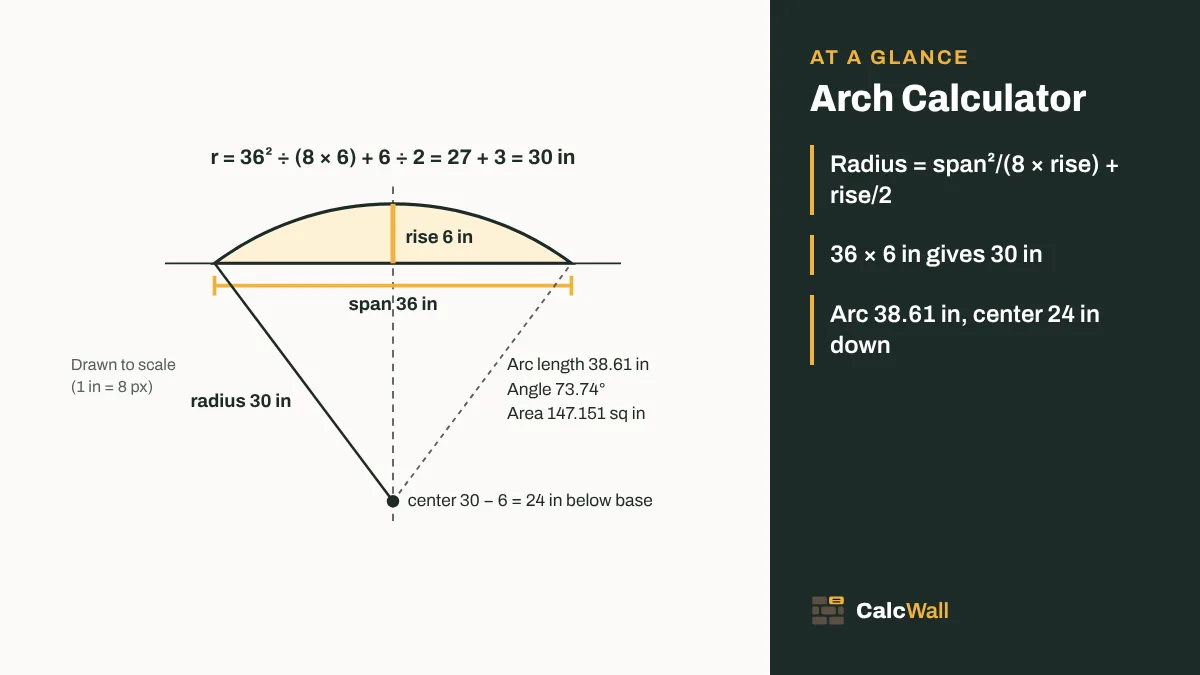
Quick answer: radius = span² ÷ (8 × rise) + rise ÷ 2. A 36 in wide arch that rises 6 in has a radius of 36² ÷ 48 + 3 = 30 in, an angle of 73.74° and an arc length of 38.61 in. The circle’s center is 24 in below the base line.
How to calculate the radius of an arch
A circular arch is a slice of a circle. If you know how wide it is at the base and how high it rises in the middle, there is only one circle it can belong to. The arch radius formula finds it.
- Measure the span: the straight width between the two points where the curve meets the base line (the springing points). On a door or window head that is the opening width.
- Measure the rise: the height of the curve at the center, square up from the base line. Not the height off the floor.
- Radius = span² ÷ (8 × rise) + rise ÷ 2.
- Angle of the arc = 4 × arctan(2 × rise ÷ span). Arc length = radius × angle in radians (degrees × π ÷ 180).
- Area under the arch = radius² × (angle − sin angle) ÷ 2, angle in radians.
Radius = span² ÷ (8 × rise) + rise ÷ 2
You will also see it written as (span² + 4 × rise²) ÷ (8 × rise). Multiply it out and it is the same thing. It comes from the right triangle formed by the radius, half the span and the distance from the center to the base line: r² = (span ÷ 2)² + (r − rise)². Solve that for r and you get the formula above.
Use one unit for both inputs. The calculator accepts inches, feet, centimeters or meters and gives every answer in the same unit, plus the radius in meters. Fractions like 6 3/8 need to go in as decimals (6.375). The inch fraction calculator converts them both ways.
The second number to watch is the center below the base line, which is radius − rise. That is where the pivot of your trammel goes. For flat arches it can be a long way down: a 48 in span with a 4 in rise has a 74 in radius, and the center is 70 in below the opening.
Segmental, half-round and horseshoe arches
The arch calculator handles any circular arch. What changes as the rise grows is where the circle’s center ends up.
- Segmental arch (rise less than half the span): the center is below the base line. This is the usual shape for arched door heads, window heads, garage door headers and garden gates. The flatter the arch, the larger the radius.
- Half-round or Roman arch (rise exactly half the span): the center is on the base line and the radius equals the rise. A 36 in wide half-round window has an 18 in radius and an arc of 56.549 in, which is π × 18.
- Horseshoe arch (rise more than half the span): the center is above the base line and the curve bulges wider than the opening before it closes back in. The calculator says so and gives the widest point. A 36 in span with a 24 in rise has an 18.75 in radius; 5.25 in above the base it is 37.5 in wide, 0.75 in more than the span on each side.
The radius is smallest for a half circle: half the span. Any other rise, flatter or taller, needs a larger radius.
Laying out the curve
There are two ways to put the curve on a board or a sheet of plywood. Swing it from the center, or plot it from heights. Both give a true circle.
With a trammel or a string
- Draw the base line and the center line square to it.
- Measure radius − rise down the center line from the base line and mark the center. On the 36 × 6 in arch that is 24 in down. If the board is not big enough, screw a scrap under it to carry the mark.
- Set a trammel (two points on a stick, or a strip of plywood with a nail and a pencil hole) to the radius: 30 in.
- Swing the arc. It should pass through both springing points and the top. If it misses by more than a pencil line, check the measurements before you cut.
A string works, but cotton string stretches and the pencil angle changes the radius. Use a stiff stick, a thin strip of plywood or a steel tape hooked on a nail for anything that has to fit.
From heights (offsets)
When the center is too far away to reach, plot points instead. The height of the curve at a distance x out from the center line is √(radius² − x²) − (radius − rise). Mark the heights at even steps, then spring a thin batten through the points and draw along it.
| Out from the center line | Height of the curve (36 × 6 in arch) | Nearest 1/16 in |
|---|---|---|
| 0 in (center) | 6.000 in | 6 |
| 3 in | 5.850 in | 5 7/8 |
| 6 in | 5.394 in | 5 3/8 |
| 9 in (quarter span) | 4.618 in | 4 5/8 |
| 12 in | 3.495 in | 3 1/2 |
| 15 in | 1.981 in | 2 |
| 18 in (end) | 0 | 0 |
The calculator shows the quarter-span height (4.618 in here) so you can check a layout quickly. For the other points use the formula, or put it in a spreadsheet with the radius from the calculator.
A horseshoe arch cannot be plotted this way all the way down. Below the circle’s center the curve bulges out past the span, so one x has two heights. The formula only gives the top part. Its widest point is 2 × radius, at the height of the center. Draw it with a trammel set to the radius from the center, which sits above the base line.
Measuring an existing arch
Matching an old window head, replacing a curved casing or building a storm panel for an arched opening? Measure the opening’s span and rise if you can see both springing points. If you can’t, or if the ends are buried in trim, use a stick.
- Cut a straight stick to a round length, like 12 or 24 in, and mark its middle.
- Hold it against the inside of the curve so both ends touch.
- Measure square from the middle mark to the curve.
- Enter the stick length as the span and that measurement as the rise. A 24 in stick and a 3/4 in gap give 24² ÷ 6 + 0.375 = 96 3/8 in.
Do it in two or three places. If the answers agree, the curve is a true circle. If they don’t, it may be an ellipse or a two-centered arch, and you will need a full-size template off the real thing.
Small gaps matter. With a 24 in stick, a gap of 5/8 in instead of 3/4 in gives a radius of 115.5 in. Measure carefully, and use a longer stick on flat curves.
Radius and arc length for common arches
Figures from the calculator, in inches, with the nearest 1/16 in in brackets. “Center below base” is how far below the base line to put the trammel pivot.
| Span × rise | Radius | Angle | Arc length | Center below base | Height at quarter span |
|---|---|---|---|---|---|
| 24 × 3 | 25.5 | 56.145° | 24.988 (25) | 22.5 | 2.284 (2 5/16) |
| 30 × 4 | 30.125 | 59.726° | 31.403 (31 3/8) | 26.125 | 3.051 (3 1/16) |
| 36 × 3 | 55.5 | 37.849° | 36.663 (36 11/16) | 52.5 | 2.265 (2 1/4) |
| 36 × 6 | 30 | 73.74° | 38.61 (38 5/8) | 24 | 4.618 (4 5/8) |
| 36 × 9 | 22.5 | 106.26° | 41.728 (41 3/4) | 13.5 | 7.122 (7 1/8) |
| 36 × 12 | 19.5 | 134.76° | 45.864 (45 7/8) | 7.5 | 9.799 (9 13/16) |
| 36 × 18 (half round) | 18 | 180° | 56.549 (56 9/16) | 0 | 15.588 (15 9/16) |
| 48 × 8 | 40 | 73.74° | 51.48 (51 1/2) | 32 | 6.158 (6 3/16) |
| 60 × 12 | 43.5 | 87.206° | 66.208 (66 3/16) | 31.5 | 9.332 (9 5/16) |
| 72 × 9 | 76.5 | 56.145° | 74.963 (74 15/16) | 67.5 | 6.852 (6 7/8) |
| 96 × 12 | 102 | 56.145° | 99.951 (99 15/16) | 90 | 9.136 (9 1/8) |
Arches with the same rise-to-span ratio have the same angle and the same shape, just bigger or smaller. That makes a ratio table handy for sketching before you have exact sizes:
| Rise ÷ span | Radius ÷ span | Angle of arc | Arc ÷ span | Shape |
|---|---|---|---|---|
| 1/12 | 1.542 | 37.85° | 1.018 | Very flat segmental |
| 1/8 | 1.063 | 56.14° | 1.041 | Flat segmental (garage header) |
| 1/6 | 0.833 | 73.74° | 1.073 | Segmental (door or window head) |
| 1/4 | 0.625 | 106.26° | 1.159 | Tall segmental |
| 1/3 | 0.542 | 134.76° | 1.274 | Near half round |
| 1/2 | 0.500 | 180.00° | 1.571 | Half round |
| 2/3 | 0.521 | 212.52° | 1.932 | Horseshoe |
Example: a 1/6 ratio on a 48 in span is an 8 in rise, a 0.833 × 48 = 40 in radius, and an arc of about 1.073 × 48 = 51.5 in.
Worked examples
Arched door head, 36 × 6 in
Span 36 in, rise 6 in (the calculator’s default). Radius = 1,296 ÷ 48 + 3 = 30 in. Angle 73.74°, arc 38.61 in, area 147.151 sq in. The center is 24 in below the base line. At 9 in either side of the center the curve is 4.618 in high. Radius in meters: 0.762 m.
Garage door opening, 96 × 12 in
An 8 ft wide opening with a curve that rises 12 in. Radius = 9,216 ÷ 96 + 6 = 102 in (8 ft 6 in), the same answer Fine Homebuilding gave for this opening in 1997. Angle 56.145°, arc 99.951 in, area 777.516 sq in. The center is 90 in below the base line, so plot this one from offsets: 9.136 in high at 24 in either side of the center, 11.292 in at 12 in out and 5.436 in at 36 in out.
Garden arch in metric, 90 × 15 cm
The calculator’s metric default: span 90 cm, rise 15 cm. Radius = 8,100 ÷ 120 + 7.5 = 75 cm. Angle 73.74°, arc 96.525 cm, area 919.694 cm². The center is 60 cm below the base line. At 22.5 cm either side of the center the curve is 11.545 cm high. Same shape as the 36 × 6 in arch, since the ratio is 1/6 in both.
Horseshoe arch, 36 × 24 in
Rise more than half the span. Radius = 1,296 ÷ 192 + 12 = 18.75 in. Angle 212.52°, arc 69.547 in, area 746.504 sq in. The center is 5.25 in above the base line, and the curve is 37.5 in wide there: 0.75 in wider than the span on each side. The calculator tells you to draw it from the center with a trammel.
Elliptical and pointed arches
This calculator only does circular arches. Two other shapes come up and need different methods.
Elliptical arches are flatter at the top and turn down more sharply at the ends. There is no single radius. The usual way to draw one is with two nails and a loop of string: half the span is a, the rise is b, and the nails go on the base line √(a² − b²) either side of the center. For a 36 × 6 in ellipse that is √(324 − 36) = 16.97 in each side. Tie the string so that, held tight from one nail to the pencil to the other nail, it measures 2a (36 in), and trace the curve. Strings stretch, so check that it passes through the top.
Pointed (Gothic) arches and two-centered arches are drawn from two centers, each side its own arc. You can use this calculator for each half if you know where its arc starts and ends, but the shape as a whole is not one circle.
If an opening was built as an ellipse and you fit a circular piece into it, it will not sit tight. Check with the stick method in more than one place first.
Notes for carpenters and trim installers
Make a template. Draw the arc full size on ¼ in plywood or hardboard, cut and fair it, then trace and router-copy every part from it. One curve, every piece matches.
Inside or outside? Casing, jamb and header each have their own radius. The outside edge of a 3½ in casing on a 30 in radius is 33½ in. Run the calculator, then add or subtract the material width from the radius.
Order trim by arc length. Flexible molding and kerf-bent stock are sold by length. Order the arc length plus several inches for the joints at the springing points.
Check before you glue. On a bent lamination, dry-clamp over the form and check the rise at the center. Laminations spring back a little when they come off the form, so build the form slightly tighter.
Cutting an arched header out of stock lumber? The lumber calculator plans the boards, the board foot calculator prices hardwood blanks, and the miter angle calculator sets the saw where straight casing meets the curve.
Sources
Where the numbers on this page come from. Everything else is plain geometry and unit conversion, which the calculator does with exact factors.
- Calculating the radius of an arch, Fine Homebuilding (Charles W. Davis, issue 112), November 1997. Used for: a field check of the radius formula: a 96 in span with a 12 in rise has a 102 in radius, which the calculator reproduces
- Circular-Based Arches, Part 1, This is Carpentry (Wm. Todd Murdock), January 2012. Used for: the method of finding the radius of an existing curve with a straight stick of known length and the rise from its midpoint, and the note that two-centered arches are not one radius
- Circular Segment Equation and Calculator, Engineers Edge. Used for: the segment formulas: R = h/2 + c²/(8h) and segment area = (R²/2)(θ − sin θ), θ in radians
- Circular Arch Radius Formulas, WOODWEB Knowledge Base. Used for: the same radius formula written as (span² + 4 × rise²) ÷ (8 × rise), as woodworkers use it
Frequently asked questions
How do I find the radius of an arch?
Measure the span (width at the base) and the rise (height at the center). Radius = span² ÷ (8 × rise) + rise ÷ 2. A 36 in span with a 6 in rise has a radius of 1296 ÷ 48 + 3 = 30 in.
How do I draw an arch on a board?
Mark the center line, measure the radius down from the top of the arch along it to find the circle’s center, and swing the radius with a trammel or a string and pencil. For the 36 × 6 in arch the center is 24 in below the base line, so the board or a scrap fixed under it has to reach that far. The calculator also gives the height a quarter of the span either side of the center to check the curve.
How long is the curved edge?
Arc length = radius × angle in radians. For the 36 × 6 in arch: angle 73.74°, 1.287 rad, so the arc is about 38.61 in (38 5/8 in). Use it for trim, flexible molding or a bent lamination, and add some for trimming the ends.
What if the rise is half the span?
Then the arch is a half circle and the radius equals the rise: 36 in wide and 18 in high gives an 18 in radius. A larger rise gives more than a half circle (a horseshoe shape); the formula still works and the calculator tells you how far the curve bulges past the span.
Does this work for elliptical arches?
No. It is for arches that are part of a circle (segmental, half-round and horseshoe), the most common shape for windows, doors and garden arches. An ellipse has no single radius. The page explains the string-and-two-nails method for an ellipse, but the calculator does not compute one.
How do I find the rise if I know the radius and the span?
Rise = radius − √(radius² − (span ÷ 2)²). For a 30 in radius over a 36 in span: 30 − √(900 − 324) = 30 − 24 = 6 in. Enter that rise in the calculator to get the arc length and layout heights.
How do I measure the radius of an existing arch?
Hold a straight stick of known length so both ends touch the curve, and measure square from its midpoint to the curve. Enter the stick length as the span and the gap as the rise. A 24 in stick with a 3/4 in gap gives a radius of 96 3/8 in.
What is a segmental arch?
An arch that is less than a half circle: the rise is less than half the span, so the circle’s center sits below the base line. Most arched door heads, window heads and garage door headers are segmental.
Is the area the same as a pie slice of the circle?
No. The area under an arch is a segment: the pie slice (r² × angle ÷ 2) minus the triangle below it. That is why the formula is r² × (angle − sin angle) ÷ 2. For the 36 × 6 in arch it is 147.151 sq in; the pie slice alone would be 579 sq in.
How accurate is bending a thin batten through three points?
A batten bent through the two ends and the top gives a smooth curve, but not a true circle. On a shallow arch the difference is small. For a curve that has to match a circular window or a radius jamb, swing it from the center or plot several offsets.
Is this arch calculator free to use online?
Yes. The CalcWall Arch Calculator is completely free and works online in any browser, on a phone, tablet or computer. There is nothing to download and no account to create, and the math runs right in your browser, so results appear as you type.