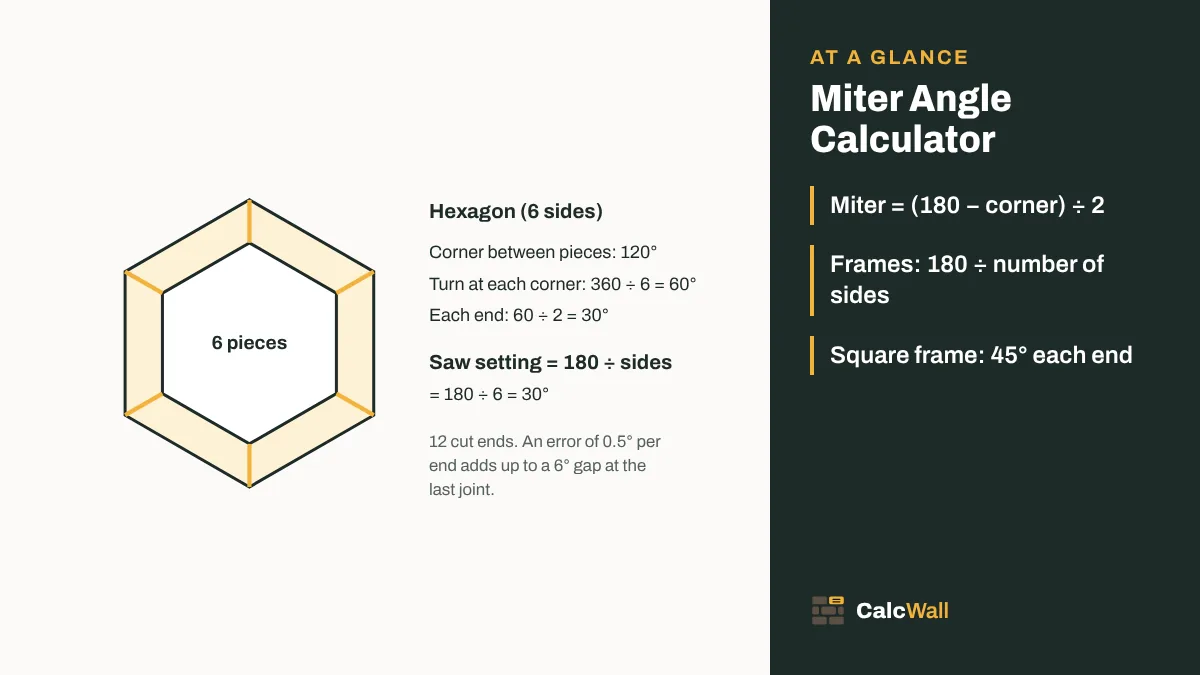
Quick answer: miter angle = (180° − corner angle) ÷ 2, or 180° ÷ number of sides for a regular frame. A square picture frame has 90° corners, so (180 − 90) ÷ 2 = 45° on each end of every piece. A hexagon is 30° and an octagon 22.5°.
How to calculate a miter angle
A miter joint hides the end grain by splitting the corner between two pieces. If the pieces meet at 90°, the line of the trim turns 90° at the corner, and each piece takes half of that turn. That half is the miter angle you set on the saw.
- Find the corner angle between the two pieces where they meet. A picture frame is 90°. For walls, measure it.
- Subtract it from 180°. That is how far the line turns at the corner.
- Halve it. Each piece takes half the turn. That is the saw setting, measured from a square (0°) cut.
Miter saw setting = (180° − corner angle) ÷ 2
For a closed frame with equal sides, you don’t need to measure anything. The turns at all the corners add up to one full turn, 360°. Divide by the number of corners and halve it:
Miter saw setting = 360° ÷ sides ÷ 2 = 180° ÷ sides
The calculator has both modes. Pick Number of sides for a frame, box or planter with equal sides, or Corner angle for trim around a room, a bay window or any one-off corner. It shows the saw setting, the angle of the cut against the board’s edge (what a protractor reads) and the total turn at the corner. It assumes both pieces are the same width, which is true for almost all trim and frame work.
Miter angles for frames and polygons
Frames, shadow boxes, planters, hexagon shelves and octagon tables all follow the same rule. With the sides equal, every corner is the same and every cut end gets the same setting.
| Sides | Shape | Corner between pieces | Miter saw setting | Cut to the board edge |
|---|---|---|---|---|
| 3 | Triangle | 60° | 60° | 30° |
| 4 | Square or rectangle | 90° | 45° | 45° |
| 5 | Pentagon | 108° | 36° | 54° |
| 6 | Hexagon | 120° | 30° | 60° |
| 7 | Heptagon | 128.57° | 25.71° | 64.29° |
| 8 | Octagon | 135° | 22.5° | 67.5° |
| 9 | Nonagon | 140° | 20° | 70° |
| 10 | Decagon | 144° | 18° | 72° |
| 12 | Dodecagon | 150° | 15° | 75° |
| 16 | 16 sides | 157.5° | 11.25° | 78.75° |
| 24 | 24 sides | 165° | 7.5° | 82.5° |
A rectangle is still 45°: the sides don’t have to be the same length, only the corners the same angle. The more sides a frame has, the smaller the angle and the more cuts there are, so small errors matter more. A 12-sided frame has 24 cut ends. If each one is 0.25° off, the last joint is open by 6°.
Odd angles such as 25.71° on a seven-sided frame fall between the marks on most saw scales. Set the saw as close as the scale allows, cut a full set from scrap and check the last joint before cutting the good stock.
Corners that are not 90°
Rooms are rarely square. Drywall corners build up with mud and tape, and a corner that should be 90° can measure 88° or 92°. Bay windows, angled walls and hexagonal rooms are not meant to be 90° at all. In each case, measure the corner and put the real number in corner mode.
- Use a digital angle finder or a sliding bevel. Press the arms flat against both surfaces at the height the trim will sit, not at the very top or bottom where the wall flares.
- Enter the angle between the pieces, less than 180°. An inside corner reads around 90°. For an outside corner, measure around the outside of the corner, which also reads around 90° on a square wall.
- Watch for “divide by 2” shortcuts. Half the corner angle is the angle of the cut to the board’s edge, not the saw setting. For a 90.5° corner, half is 45.25°, but the saw goes to (180 − 90.5) ÷ 2 = 44.75°. Near 45° the two are easy to mix up.
| Corner angle (between pieces) | Where you find it | Miter saw setting | Total turn |
|---|---|---|---|
| 60° | Sharp point, triangle frame | 60° | 120° |
| 88° | Tight drywall corner | 46° | 92° |
| 90° | Square corner, frame | 45° | 90° |
| 90.5° | Slightly open corner | 44.75° | 89.5° |
| 100° | Angled wall | 40° | 80° |
| 120° | Hexagon room or column | 30° | 60° |
| 135° | 45° bay window, octagon | 22.5° | 45° |
| 150° | 30° bay window | 15° | 30° |
A bay window with 45° sides has 135° corners, so each trim piece is cut at 22.5°. A bay with 30° sides has 150° corners and 15° cuts. A wall that only opens up by a couple of degrees still matters: on a 92° corner each piece goes to 44°, not 45°.
Saw setting vs the angle on the board
This trips people up more than anything else. A miter saw reads 0° for a square cut and counts up from there. A protractor laid along the board measures the cut against the edge, so it reads the rest of the 90°. The calculator shows both.
Angle to the board edge = 90° − saw setting
- Plans and drawings sometimes give the angle to the edge (60° for a hexagon) rather than the saw setting (30°). If the number on the plan is bigger than 45° for a shape with more than four sides, it is almost certainly the angle to the edge.
- Positive stops (detents) sit at common settings such as 0°, 22.5° and 45°. Which other stops your saw has varies by model, so check the manual. For anything between stops, lock the table firmly; a detent can pull the setting toward it.
- Saw range varies too. Makita’s LS1216 manual gives a miter range of 0–45° left and right; DEWALT lists its DWS780 at 50° left and 60° right. A 60° triangle cut is past the end of many saws. The FAQ below shows the auxiliary-fence trick for steep cuts.
Cutting frame pieces to length
Once the angle is set, the next question is length. Measure frame pieces on the short point (the inside edge) when you know the opening, or on the long point (the outside edge) when you know the overall size. The difference between the two depends on the width of the molding and the miter angle:
Long point = short point + 2 × molding width × tan(miter angle)
- 4 sides, 45°: tan 45° = 1, so the long point is the short point plus twice the molding width. An 8 × 10 in opening in 2 in wide molding needs pieces 12 in and 14 in on the long point.
- 6 sides, 30°: tan 30° = 0.577. A hexagon with 10 in inside edges in 1½ in stock needs pieces 10 + 2 × 1.5 × 0.577 = 11.73 in on the long point, just under 11¾ in.
- Picture frames are measured to the rabbet, the ledge the glass sits on, not to the face. Leave about ⅛ in over the glass size so it drops in.
For a picture frame, cut the two long pieces against one stop block, then the two short ones against another. Equal opposite sides matter as much as the angle. If you work in fractions, the inch fraction calculator converts 11.73 in to the nearest 1/16.
Crown molding and compound miters
Crown is the one job where a flat miter is not the whole story, because crown sits at an angle between the wall and the ceiling. There are two ways to cut it.
Upside down and nested: use this calculator
Stand the crown upside down against the fence, with the ceiling edge on the saw table and the wall edge against the fence, at the same angle it will sit on the wall. Now the cut is a plain miter. A 90° corner is 45°; a 135° corner is 22.5°. The calculator’s number is the saw setting. Mark a line on the saw table, or clamp a strip, so every piece sits at the same angle.
Lying flat: needs a bevel too
Laid flat on the table, crown needs a compound cut: the saw swings to a miter angle and the blade tilts to a bevel. This calculator does not work out compound cuts. For reference, the settings come from the corner angle C and the crown’s spring angle S (38° for 52/38 crown, 45° for 45/45 crown):
Miter = arctan(sin S ÷ tan(C ÷ 2)) · Bevel = arcsin(cos S × cos(C ÷ 2))
| Wall corner | 52/38 crown: miter | 52/38 crown: bevel | 45/45 crown: miter | 45/45 crown: bevel |
|---|---|---|---|---|
| 90° | 31.62° | 33.86° | 35.26° | 30.00° |
| 100° | 27.32° | 30.43° | 30.68° | 27.03° |
| 120° | 19.57° | 23.20° | 22.21° | 20.70° |
| 135° | 14.31° | 17.55° | 16.32° | 15.70° |
The 90° row matches the crown table in Makita’s saw manual (31.6° miter and 33.9° bevel for 52/38 crown; 35.3° and 30° for 45° crown), and the 100° and 120° rows match WOODWEB’s chart to within 0.01° of rounding. Which way to swing and tilt depends on inside or outside corner and left or right piece, so follow your saw’s crown chart for directions and cut a test pair from scrap first.
Worked examples
Picture frame
Four sides: 180 ÷ 4 = 45° on the saw. The calculator shows a 90° corner, 45° to the board’s edge and a 90° turn. For an 8 × 10 in print in 2 in molding, cut the long points at 12 in and 14 in, two of each.
Hexagon planter
Six sides: 180 ÷ 6 = 30° on the saw. The calculator shows a 120° corner, 60° to the board’s edge and a 60° turn. Cut all 12 ends at 30°, flipping the board between cuts so each piece is a trapezoid.
Bay window stool trim
The angle finder reads 135° at both corners. Corner mode: (180 − 135) ÷ 2 = 22.5° on each piece, 67.5° to the edge, 45° turn. If one corner reads 137°, that corner gets (180 − 137) ÷ 2 = 21.5°.
Octagonal mirror frame in metric
Eight sides: 180 ÷ 8 = 22.5°, 67.5° to the edge. Angles don’t change with units. With 250 mm inside edges and 50 mm wide molding, each piece is 250 + 2 × 50 × tan 22.5° = 250 + 41.4 = 291.4 mm on the long point. Cut eight.
Baseboard in a tight corner
The inside corner measures 88°. Corner mode: (180 − 88) ÷ 2 = 46° on each piece, 44° to the edge, 92° turn. Cut at 45°, the backs would meet first and leave a gap at the face.
Getting tight miters
- Check the saw at 0° and 45° with a good square before a frame job. A saw half a degree off at the detent is common, and on a frame the error builds at every joint.
- Make a test pair. Cut two scraps at the setting, put them together and check the corner with a square or the angle finder. Adjust and recut before you touch the good molding.
- Read the gap. Open at the short point (the face of an inside corner, the inside of a frame)? The setting is too small for the corner. Open at the long point? It is too big. Change it by a quarter degree at a time.
- Hold the work still. Molding that creeps along the fence during the cut gives a slightly different angle every time. Clamp it or use a sacrificial fence.
- Glue and pin. End grain soaks up glue, so size the joint with a thin coat first. Frames are clamped with a band or corner clamps; trim is glued and pinned.
Building panels or wainscot around the room? The wainscoting calculator counts the sheets, battens and chair rail. For curved heads over doors and windows, the arch calculator gives the radius and arc length, and the framing calculator handles the studs behind the trim.
Notes for trim carpenters
Split the difference. On an out-of-square corner, measure it and set both pieces to half the turn. Splitting it evenly keeps the profile lined up on both pieces.
Cope inside corners. On baseboard and crown, many carpenters cope inside corners rather than miter them. A coped joint stays tight when the wall moves. Outside corners still need a miter.
Odd-sided frames. For 5, 7 or 9 sides, cut a full set from scrap first. Any error shows up at the last joint, multiplied by the number of cut ends.
Crown nested. Fix a stop strip on the saw table at the crown’s spring angle. Every piece then sits the same, and the flat miter from this calculator is the only setting you need.
Framing a roof rather than trimming a room? The birdsmouth cut calculator lays out the seat and heel cuts where a rafter sits on the wall.
Sources
Where the numbers on this page come from. Everything else is plain geometry and unit conversion, which the calculator does with exact factors.
- LS1216 Slide Compound Saw instruction manual, crown molding cutting (Table A), Makita. Used for: crown cut lying flat on a 90° inside corner: 52/38 crown at 33.9° bevel and 31.6° miter, 45° crown at 30° bevel and 35.3° miter; miter range 0–45° left and right
- Crown Moulding Miter & Bevel Angle Setting Chart, WOODWEB Knowledge Base. Used for: check of the compound formula at other wall angles: 90° (31.61/33.86 and 35.26/30.00), 100° (27.32/30.43 and 30.68/27.03) and 120° (19.56/23.20 and 22.20/20.70)
- DWS780 12 in. Double Bevel Sliding Compound Miter Saw, product page, DEWALT. Used for: an example of saw range: miters 50° left and 60° right, with 10 positive stops
- How to Calculate Miter Angles, Hunker. Used for: measuring corners with a digital protractor, and its corner ÷ 2 figures (90.5° gives 45.25°), which are the angle to the board edge rather than the saw setting
Frequently asked questions
What angle do I cut for a picture frame?
A four-sided frame has 90° corners, so each piece is cut at 45°: (180 − 90) ÷ 2 = 45. Both ends of every piece are cut at 45°, in opposite directions, so each piece is shaped like a trapezoid.
What is the miter angle for a hexagon or octagon?
Divide 180 by the number of sides: a hexagon (6 sides) is 30°, an octagon (8 sides) is 22.5°, a pentagon (5) is 36° and a triangle (3) is 60°.
How do I miter an outside corner that is not 90°?
Measure the corner angle between the two walls (for example 135° on a bay window) and enter it in corner mode: (180 − 135) ÷ 2 = 22.5° for each piece. An angle finder or bevel gauge gives the corner angle.
Why does my protractor show a different number?
Miter saws read 0° for a square cut, so the setting is measured from square. A protractor laid on the board’s edge measures the cut against the edge, which is 90° minus the saw setting: a 45° setting is also 45°, but a 30° setting is 60° to the edge.
Does this work for crown molding?
Not for crown cut lying flat, which needs a bevel as well as a miter (for 52/38 crown on a 90° corner, about 31.6° miter and 33.9° bevel). For crown cut upside down and nested against the fence at its spring angle, the miter is the same as for flat trim, so the calculator works.
What miter angle for a wall corner that is 88° or 92°?
Use the real angle, not 90°. An 88° corner needs (180 − 88) ÷ 2 = 46° on each piece. A 92° corner needs 44°. A degree off at the wall is half a degree on each piece, which is enough to open a visible gap.
How do I measure a corner angle for trim?
Use a digital angle finder or a sliding bevel. Hold the arms flat against both walls at the height the trim will sit and read the angle, then enter it in corner mode. If your gauge shows half the angle, that is the angle to the board edge; the saw setting is 90° minus it.
What is the difference between a miter and a bevel?
A miter is the angle across the face of the board, set by swinging the saw left or right on its table. A bevel is the tilt of the blade, which angles the cut through the thickness. Flat frames and trim need a miter only. Crown cut flat and boxes with sloped sides need both, called a compound cut.
Why do my frame corners have gaps?
Usually the saw is a fraction of a degree off, or opposite pieces are not exactly the same length. On a four-sided frame, an error of a quarter degree on each of the 8 cut ends adds up to 2° at the last joint. Make test cuts, check them with a square, and cut opposite pieces against the same stop block.
How do I cut a miter steeper than my saw allows?
Many saws stop at 45° or 50° on one side. For a 60° cut, clamp the board against an auxiliary fence set at exactly 90° to the saw fence and set the saw to 30°: the board is turned a quarter turn, so the cut comes out at 90 − 30 = 60° from square. Clamp the work and keep your hands clear.
Is this miter angle calculator free to use online?
Yes. The CalcWall Miter Angle Calculator is completely free and works online in any browser, on a phone, tablet or computer. There is nothing to download and no account to create, and the math runs right in your browser, so results appear as you type.