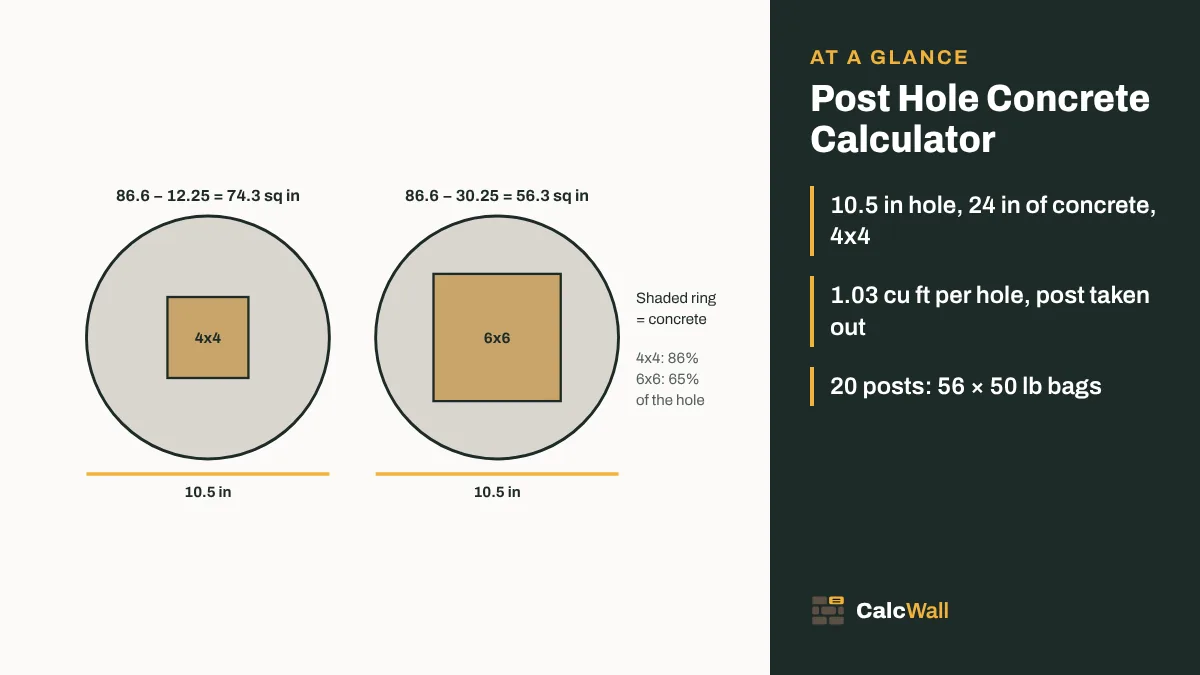
Quick answer: concrete = (π × (hole ÷ 2)² − post²) × depth. A 4x4 (3.5 in actual) in a 10.5 in hole with 24 in of concrete takes 1.03 cu ft: 2.75 bags of 50 lb fast-setting mix. For 20 posts, buy 56 bags, not 60.
How to use the post hole concrete calculator
Pick the shape first. Post hole (square post) is for 4x4, 6x6 and other square timber. Post hole (round post) is for steel tube, poles and round rails. Cylinder is a plain round hole with nothing in it, such as a pier or a footing that a post base sits on later.
All sizes are typed in inches. If your country is set to the UK, Canada, Australia, New Zealand or Germany, the fields switch to centimeters. You can change the unit with the “Measured in” box at any time, and the numbers you typed are converted, not re-read.
- Hole diameter: the width of the auger or of the hole you dug, not the post.
- Concrete depth: the depth that gets concrete. Leave out any gravel at the bottom and any soil you plan to put back on top.
- Post width: the actual size. A 4x4 is 3.5 in and a 6x6 is 5.5 in.
- How many? The number of posts of that size.
- Bag size: 50 lb or 60 lb fast-setting, 80 lb or 40 lb standard mix. The result lists every size and ticks the one you picked.
- Extra for waste: none by default. Add 5% or 10% for hand-dug holes with ragged sides.
The result shows cubic feet (cubic meters in metric countries), liters, US gallons and the weight at 150 lb per cu ft. Bags are rounded up once, for the whole quantity. A price per bag, if you type one, gives the cost.
Gate posts or corners in bigger holes? Enter the line posts, press Add these posts to a fence total, then change the sizes and add the next group. The fence total adds the volumes and rounds the bags once at the end. That is how this fence post concrete calculator handles mixed hole sizes in one order.
Post hole concrete formula: hole minus post
A post hole is a cylinder with a post standing in it. The concrete fills the ring between the two. So the volume is the area of the hole, minus the area of the post, times the depth of concrete.
Concrete (cu in) = (3.1416 × (D ÷ 2)² − p²) × h · cu ft = cu in ÷ 1728
D is the hole diameter, p the actual width of a square post and h the concrete depth, all in inches. For a round post, use 3.1416 × (p ÷ 2)² in place of p². Divide cubic inches by 1,728 for cubic feet, and multiply cubic feet by 28.32 for liters.
Here is how to calculate the calculator’s default, a 4x4 in a 10.5 in hole with 24 in of concrete:
- Hole area: 3.1416 × 5.25² = 86.59 sq in.
- Post area: 3.5 × 3.5 = 12.25 sq in.
- Concrete area: 86.59 − 12.25 = 74.34 sq in.
- Volume: 74.34 × 24 = 1,784 cu in, which is 1,784 ÷ 1,728 = 1.03 cu ft.
- Bags: 1.03 ÷ 0.375 = 2.75 bags of 50 lb fast-setting mix, or 1.03 ÷ 0.60 = 1.72 bags of 80 lb mix.
Skip the post and you get 1.20 cu ft, which is 17% more than you need. Some reference tables online make exactly that mistake and still call the result “net”. In our tables, “gross” means the empty hole and “net” means the hole minus the post.
The calculator also checks that the post fits. A square post’s corners reach out to its width × 1.414, so a 4x4 needs a hole of at least 4.95 in just to go in. Below that you get a warning instead of a number.
How many bags of concrete per post
This is the table most people want. It is for a 4x4 (3.5 in actual), with the post taken out. Depth is the depth of concrete, so add your gravel base on top of these figures when you dig. Bags are rounded up per hole. For a whole fence, the calculator’s single rounding usually saves a few bags.
| Hole | Concrete depth | Gross cu ft (no post) | Net cu ft | 50 lb fast-set bags | 80 lb bags |
|---|---|---|---|---|---|
| 6 in | 2 ft | 0.39 | 0.22 | 1 | 1 |
| 6 in | 3 ft | 0.59 | 0.33 | 1 | 1 |
| 8 in | 2 ft | 0.70 | 0.53 | 2 | 1 |
| 8 in | 2.5 ft | 0.87 | 0.66 | 2 | 2 |
| 8 in | 3 ft | 1.05 | 0.79 | 3 | 2 |
| 8 in | 4 ft | 1.40 | 1.06 | 3 | 2 |
| 10 in | 2 ft | 1.09 | 0.92 | 3 | 2 |
| 10 in | 2.5 ft | 1.36 | 1.15 | 4 | 2 |
| 10 in | 3 ft | 1.64 | 1.38 | 4 | 3 |
| 10 in | 4 ft | 2.18 | 1.84 | 5 | 4 |
| 12 in | 2 ft | 1.57 | 1.40 | 4 | 3 |
| 12 in | 2.5 ft | 1.96 | 1.75 | 5 | 3 |
| 12 in | 3 ft | 2.36 | 2.10 | 6 | 4 |
| 12 in | 4 ft | 3.14 | 2.80 | 8 | 5 |
| 16 in | 2 ft | 2.79 | 2.62 | 7 | 5 |
| 16 in | 2.5 ft | 3.49 | 3.28 | 9 | 6 |
| 16 in | 3 ft | 4.19 | 3.93 | 11 | 7 |
| 16 in | 4 ft | 5.59 | 5.24 | 14 | 9 |
Yields used: 0.375 cu ft per 50 lb bag of QUIKRETE Fast-Setting and 0.60 cu ft per 80 lb bag of QUIKRETE Concrete Mix, both from the makers’ data sheets. A 6 in hole is narrower than the three-times rule allows for a 4x4. It is in the table because people dig them, not because it’s a good idea.
Why round once? Take 20 posts at 1.03 cu ft each. Per hole you need 2.75 bags of 50 lb, so 3 bags a hole is 60 bags. The whole job is 20.65 cu ft, and 20.65 ÷ 0.375 = 55.07, so 56 bags.
The four extra bags are the part-bags left over at each hole. If you mix a full bag at a time and move along the line, those leftovers go into the next hole. If every hole is set by a different person on a different day, buy the per-hole count.
Metric post holes: liters and bags
In metric countries post mix is sold in 20 kg and 25 kg bags. The yields differ by brand, so this table gives liters first. It is for a 100 mm square post, the size Tarmac’s Postcrete chart uses, with the post taken out.
| Hole | Concrete depth | Liters (net) | 20 kg bags at 11 L | 25 kg bags at 12 L |
|---|---|---|---|---|
| 200 mm | 600 mm | 12.8 | 2 | 2 |
| 200 mm | 900 mm | 19.3 | 2 | 2 |
| 200 mm | 1200 mm | 25.7 | 3 | 3 |
| 250 mm | 600 mm | 23.5 | 3 | 2 |
| 250 mm | 900 mm | 35.2 | 4 | 3 |
| 250 mm | 1200 mm | 46.9 | 5 | 4 |
| 300 mm | 600 mm | 36.4 | 4 | 4 |
| 300 mm | 900 mm | 54.6 | 5 | 5 |
| 300 mm | 1200 mm | 72.8 | 7 | 7 |
| 400 mm | 600 mm | 69.4 | 7 | 6 |
| 400 mm | 900 mm | 104.1 | 10 | 9 |
| 400 mm | 1200 mm | 138.8 | 13 | 12 |
11 L is Boral’s published yield for its 20 kg Blue Circle Post Hole Concrete in Australia (0.011 m³). 12 L is Dricon’s for its 25 kg RapidSet in New Zealand (0.012 m³). Tarmac publishes no yield for UK Postcrete, and Heidelberg Materials publishes none for PostFix. For those, divide the liters by a yield you have checked, or follow the maker’s chart and keep a spare bag on site.
The calculator gives metric results in cubic meters and liters. Its bag list is in US bag sizes (50, 60, 80 and 40 lb), so in metric countries work out 20 kg or 25 kg bags from the liters, as in the table.
Checking the bag charts on the packet
Most bags carry a small chart of bags per post. They are handy, but they don’t all say what they assume. We recalculated three of them from their own hole sizes.
Sakrete’s table matches a 4x4, once you know that
Sakrete’s Fast Setting data sheet (Rev. 05/18) gives bags for an “average 10 in diameter hole”: 1.25 bags at 12 in deep, 2 at 18 in, 2.5 at 24 in and 3 at 30 in. Its yield is 0.38 cu ft a bag. It names no post size.
An empty 10 × 30 in hole is 1.36 cu ft, which would be 3.59 bags. So at first sight the chart is short. Take out a 4x4 (3.5 in actual) and the hole holds 1.15 cu ft, or 3.03 bags. Every row lines up the same way:
| Depth | Sakrete’s bags | Empty hole, bags | Minus a 4x4, bags |
|---|---|---|---|
| 12 in | 1.25 | 1.44 | 1.21 |
| 18 in | 2 | 2.15 | 1.82 |
| 24 in | 2.5 | 2.87 | 2.42 |
| 30 in | 3 | 3.59 | 3.03 |
So the chart works for a 4x4 in a 10 in hole filled to the top. With a bigger post or a soil cap it runs a little long, and in a wider hole it runs short. That it assumes a 4x4 is our reading of the numbers. Sakrete doesn’t say so.
Sakrete’s web guide also says about two bags per hole for a standard 6 ft fence, with a 12 in hole for a 4 in post. Those two don’t match each other. A 12 in hole 24 in deep, minus a 4x4, is 1.40 cu ft, or 3.7 bags. Two bags fits a 10 in hole with about 18 in of concrete over the gravel (1.82 bags).
QUIKRETE’s two-bag example
QUIKRETE’s Fast-Setting data sheet says two 50 lb bags set a 3 in square post in a 9 in hole 30 in deep. Filled to the top, that hole holds 0.95 cu ft after the post, which is 2.53 bags.
The same sheet tells you to stop the concrete 3–4 in below grade, and QUIKRETE’s guides put 6 in of gravel in the bottom. With 24 in of concrete the hole takes 2.02 bags. So the example works for a hole that has its gravel and soil cap, not for one filled to the brim.
UK Postcrete: copied as published, with a warning
Tarmac’s Blue Circle Postcrete sheet (December 2023, the same table as its October 2018 sheet) gives bags per post for three post sizes. We checked the rows below against the original PDF. Tarmac gives no yield per bag, so we worked backwards: hole volume minus post, divided by Tarmac’s bag count, gives the liters each bag would have to make.
| Post | Hole (width × depth) | Tarmac’s bags | Hole minus post, L | Implied L per bag |
|---|---|---|---|---|
| 5 cm round | 15 × 30 cm | 1/4 | 4.7 | 18.8 |
| 5 cm round | 20 × 60 cm | 1 | 17.7 | 17.7 |
| 7.5 cm square | 15 × 75 cm | 3/4 | 9.0 | 12.0 |
| 7.5 cm square | 20 × 45 cm | 3/4 | 11.6 | 15.5 |
| 7.5 cm square | 20 × 60 cm | 3/4 | 15.5 | 20.6 |
| 7.5 cm square | 30 × 45 cm | 2 | 29.3 | 14.6 |
| 7.5 cm square | 30 × 60 cm | 2 | 39.0 | 19.5 |
| 10 cm square | 20 × 45 cm | 2/3 | 9.6 | 14.5 |
| 10 cm square | 25 × 60 cm | 1 1/3 | 23.5 | 17.6 |
| 10 cm square | 30 × 60 cm | 2 | 36.4 | 18.2 |
| 10 cm square | 30 × 75 cm | 2 1/2 | 45.5 | 18.2 |
Two problems show up. First, some rows don’t go up with depth. For a 7.5 cm post, the 20 × 45 and 20 × 60 cm holes both get 3/4 of a bag, and the 30 × 45 and 30 × 60 cm holes both get 2 bags, though the deeper hole holds a third more.
Second, the implied yield swings from 12 to almost 21 liters a bag. The only 20 kg post mix with a published yield that we found is Boral’s, at 11 liters, and that is a different product.
We can’t tell which rows are right without Tarmac’s yield. Use the chart as a rough guide, work out the liters for your own holes, and buy a bag or two over. If the chart and the liters disagree, trust the liters.
Two smaller notes. The Postcrete sheet’s 10 cm post rows start at a 20 cm hole, which is only twice the post width, though the sheet’s own rule is three times.
New Zealand’s Dricon chart (25 kg, 12 L a bag, 250 mm hole, 100 × 75 mm post) covers only 79–87% of the hole volume in most rows, and 67% in the shallowest. It reads as if the top of each hole gets soil, though the sheet doesn’t say so.
Hole size and depth for fence and deck posts
QUIKRETE, Sakrete, Tarmac and Dricon all give the same width rule: a hole about three times as wide as the post. The trap is the post size. A “4x4” is a nominal name. Under the American Softwood Lumber Standard (PS 20-20), dry 4 in lumber is 3½ in, and 6 in is 5½ in. So the rule gives 10.5 in for a 4x4, not 12.
| Post (nominal) | Actual size | 3 × width | Smallest hole it fits (corners) | What to enter |
|---|---|---|---|---|
| 4x4 | 3.5 × 3.5 in | 10.5 in | 4.95 in | Post width 3.5 |
| 4x6 | 3.5 × 5.5 in | 10.5–16.5 in | 6.52 in | Post width 4.39 (same area) |
| 6x6 | 5.5 × 5.5 in | 16.5 in | 7.78 in | Post width 5.5 |
| 3 in square (QUIKRETE example) | 3 × 3 in | 9 in | 4.24 in | Post width 3 |
| 75 mm square | 7.5 cm | 22.5 cm | 10.6 cm | Post width 7.5 cm |
| 100 mm square | 10 cm | 30 cm | 14.1 cm | Post width 10 cm |
| 50 mm round | 5 cm | 15 cm | 5 cm | Round post, 5 cm |
The makers say “width” without saying which face of a rectangular post. For a 4x6 we show both: 10.5 in from the narrow face, 16.5 in from the wide one. The calculator’s square-post shape uses p², so for a 4x6 enter √(3.5 × 5.5) = 4.39 in. That square has the same area as the 4x6, so the concrete comes out exact.
Augers come in round sizes. A 10 in auger for a 4x4 is a common compromise, 0.5 in under the rule. A 6x6 by the same rule needs 16.5 in, which is more than many people expect. A 12 in hole for a 6x6 leaves only 3.25 in of concrete each side of the post.
How deep: three rules that don’t quite agree
The depth advice comes in three versions, and it is worth knowing which one you are reading.
- One-third of the height above ground. Sakrete’s guide and Tarmac’s Postcrete sheet.
- One-third to one-half of the above-ground length, plus 6 in for gravel. QUIKRETE’s setting-posts web page.
- One-third of the overall post length (plus 6 in of gravel in the project PDF). QUIKRETE’s data sheet and project PDF. If a third of the whole post is buried, the buried part is half of what shows above ground.
| Fence height above ground | 1/3 of height above ground | QUIKRETE web: 1/3–1/2 + 6 in gravel | 1/3 of whole post + 6 in gravel | Post length for that last rule |
|---|---|---|---|---|
| 4 ft (48 in) | 16 in | 22–30 in | 30 in | 6 ft |
| 5 ft (60 in) | 20 in | 26–36 in | 36 in | 7.5 ft |
| 6 ft (72 in) | 24 in | 30–42 in | 42 in | 9 ft |
| 8 ft (96 in) | 32 in | 38–54 in | 54 in | 12 ft |
For a 6 ft fence that is anything from 24 in to 42 in. The deeper figures include 6 in of gravel, so the concrete itself is 24–36 in.
In cold climates, frost is the bigger question. Frost depth is set locally: one Minnesota city, Grand Rapids, sets 60 in for building footings. Those rules are written for buildings, so ask your building department whether they apply to a fence. A post that stops well above the frost line can heave either way. Call your utility locate line before you dig.
Deck posts and piers
A fence post is set in concrete. Many deck posts aren’t: they stand on a concrete pier or footing, held by a metal post base. That changes the math.
The pier has no post in it, so use the Cylinder shape, which this page labels “concrete depth (no post deducted)”. Used as a concrete pier calculator it works the same as our Sonotube calculator. Deck footing size and depth come from your plans and your local code, not from the post-setting rules above. For pads and spread footings, the concrete footing calculator handles the shapes.
Fast-setting or standard mix for post holes
Fast-setting mix is made to go into the hole without a mixer. Standard premix needs mixing in a barrow or a mixer, but gives more concrete per pound and more time to plumb the post. Here is what each bag makes, from the makers’ own sheets.
| Product | Market | Bag | Yield | Source |
|---|---|---|---|---|
| QUIKRETE Fast-Setting Concrete Mix | US | 50 lb | 0.375 cu ft (10.6 L) | Data sheet, Nov 2025 |
| QUIKRETE Fast-Setting Concrete Mix | US | 60 lb | 0.45 cu ft (12.7 L) | Data sheet, Nov 2025 |
| QUIKRETE Concrete Mix | US | 80 lb | 0.60 cu ft | Data sheet, Oct 2022 |
| QUIKRETE Concrete Mix | US | 40 lb | 0.30 cu ft | Data sheet, Oct 2022 |
| Sakrete Fast Setting Concrete Mix | US | 50 lb | 0.38 cu ft | TDS, Rev. 05/18 |
| Blue Circle Postcrete (Tarmac) | UK | 20 kg | Not published | Data sheet, Dec 2023 |
| PostFix (Heidelberg Materials) | UK | Not stated | Not published | TDS, file dated Nov 2024 |
| Blue Circle Post Hole Concrete (Boral) | Australia | 20 kg | about 0.011 m³ (11 L) | Product sheet, Apr 2012 |
| Dricon RapidSet | New Zealand | 25 kg | 0.012 m³ (12 L) | TDS, undated |
We found no reliable published post-mix yield for Canada or Germany. If you are there, read the yield off your bag and divide the calculator’s liters by it. The Boral sheet is from 2012, so check the current bag too.
Water first or mix first?
The brands disagree, so read the bag you bought. QUIKRETE pours the dry fast-setting mix into the hole to 3–4 in below the top, then adds about a gallon of water per 50 lb bag until the powder is saturated. For holes deeper than 30 in it fills in stages. Sakrete fills the hole a third full of water and then adds the mix. Tarmac’s Postcrete also goes water first, to a third of the hole depth.
Standard concrete mix isn’t made for either method. Mix it to a stiff, workable consistency, then shovel it in around the braced post and rod it to remove air pockets.
How long before you can load the post
- QUIKRETE Fast-Setting: final set in 20–40 minutes; wait 4 hours before any strain on the post.
- Sakrete Fast Setting: sets in about half an hour; Sakrete says 30 minutes before any load, and 24 hours for mixed concrete.
- Tarmac Postcrete: sets in 5–10 minutes; panels can go on after the first 10 minutes.
- Heidelberg PostFix: initial set in 5–10 minutes; leave it overnight before fixing panels.
- Dricon RapidSet: initial set in 15 minutes; an hour before light work such as nailing rails.
What it costs
Bag prices move with brand, size and store, so type your own price per bag into the calculator.
As published guides: Angi put US bagged mix at $4.50 to $27 a bag depending on the type (article dated September 7, 2022). MyJobQuote put UK bagged concrete at £6–£14 a bag, weight not stated (updated September 17, 2026). In Australia, Nuway’s list of February 1, 2026 shows Onemix 20 kg premix at A$9.75, which is a general concrete, not a post mix.
We found no reliable published bag price for New Zealand, Canada or Germany.
Gravel base, crown and drainage
A gravel base lets water drain away from the end grain of the post. QUIKRETE puts 6 in of gravel or crushed stone in the hole. Sakrete says 4–6 in. Tarmac’s and Dricon’s sheets don’t call for any. Either way, dig the extra depth and leave it out of the concrete depth you type in.
The gravel itself: a 10.5 in hole 6 in deep holds 3.1416 × 5.25² × 6 ÷ 1,728 = 0.30 cu ft. Twenty holes need 6 cu ft, a little under a quarter of a cubic yard. The gravel calculator converts that to tons or bags.
At the top there are two schools. QUIKRETE’s web guide and Sakrete both say to slope the concrete down and away from the post so rain runs off. QUIKRETE’s fast-setting data sheet stops the concrete 3–4 in below grade and puts soil or sod back over it. Both avoid the same thing: a cup of concrete that holds water against the wood.
If you crown above grade, add the crown to the concrete depth. If you cap with soil, take the cap off.
That cap matters more than it looks. On a 10.5 in hole with a 4x4, every inch of depth is 0.043 cu ft. Leave 4 in for soil and you save 0.17 cu ft a hole, nearly half a 50 lb bag.
Bell-bottom and square holes
A bell-bottom hole flares out at the base. The wider foot resists uplift and spreads the load. It also takes a lot more concrete than you’d guess, because the area grows with the square of the width.
The flared part is a cone with its top cut off, called a frustum. Its volume is:
Frustum = 3.1416 × h ÷ 3 × (R² + R × r + r²)
R is the bottom radius, r the top radius and h the height of the flare. For a 12 in hole flared to 20 in over the bottom 12 in: 3.1416 × 12 ÷ 3 × (10² + 10 × 6 + 6²) = 2,463 cu in = 1.43 cu ft. The straight 24 in above it holds 1.57 cu ft, so the hole holds 3.00 cu ft before the post, against 2.36 for a straight hole.
In the calculator, enter the straight part with the post-hole shape and add it to the fence total. Then open More shapes, pick Conical frustum, enter the top and bottom diameters and the flare height, and add that too. The frustum part doesn’t take out the post. If the post runs down into the flare, subtract it by hand: a 4x4 takes 12.25 × 12 = 147 cu in (0.085 cu ft) over a 12 in flare.
Square holes
A square hole, dug with a spade in stony ground, holds more than a round hole of the same width. A 12 in square hole has 144 sq in of area against 113 sq in for a 12 in round one. The formula is (s² − p²) × h, where s is the side of the hole.
The tool has no square-hole-with-post shape, but there is an exact shortcut.
A circle with a diameter of 1.128 × s has the same area as a square of side s. So for a 12 in square hole, type 13.54 in as the hole diameter in the post-hole shape. A 12 in square hole 24 in deep with a 4x4 then comes out at (144 − 12.25) × 24 ÷ 1,728 = 1.83 cu ft, the same as the hand sum.
Post spacing and how many posts a fence needs
To know how much concrete to buy, you need the post count. On a straight run there is always one more post than there are gaps between posts (bays).
- Divide the run length by the post spacing: 100 ft ÷ 8 ft = 12.5.
- Round up to whole bays: 13.
- Add one for the end post: 14 posts.
- For more than one straight run, do each run separately and count each shared corner post once.
- Count gate posts separately, since they often go in bigger, deeper holes.
Spacing comes from your panels or rails, so measure them. If you are buying a full fence, the fence calculator counts the posts, rails and pickets, and this page works out the concrete for them.
Worked examples
Each example below gives the numbers the calculator shows for the same inputs.
1. A 20-post fence line with 4x4s
Post hole (square post): hole 10.5 in, concrete 24 in (the hole is 30 in deep with 6 in of gravel), post 3.5 in, quantity 20, no waste. Per hole: (3.1416 × 5.25² − 3.5²) × 24 = 1,784 cu in = 1.03 cu ft.
Total: 20.65 cu ft = 0.76 cu yd, about 3,098 lb. Bags: 20.65 ÷ 0.375 = 55.07, so 56 bags of 50 lb fast-setting, or 46 of 60 lb, or 35 of 80 lb. Rounded per hole it would be 3 × 20 = 60 bags of 50 lb.
2. The same line with 10% for ragged holes
Same inputs, waste set to +10%. 20.65 × 1.1 = 22.72 cu ft. Bags: 22.72 ÷ 0.375 = 60.6, so 61 bags of 50 lb, or 38 of 80 lb. If you type a price of $8 per bag (an example; use your store’s price), 61 bags comes to $488.
3. Four 6x6 pergola posts
Post hole (square post): hole 16 in, concrete 36 in, post 5.5 in, quantity 4. Per hole: (3.1416 × 8² − 5.5²) × 36 = 6,149 cu in = 3.56 cu ft.
Total: 14.23 cu ft, about 2,135 lb of concrete. Bags: 14.23 ÷ 0.60 = 23.7, so 24 bags of 80 lb, or 38 of 50 lb fast-setting. In a 16.5 in hole, the strict three-times size, it would be 15.30 cu ft and 26 bags of 80 lb.
4. Mixed sizes: line posts plus gate posts
Group 1: 18 line posts, 4x4 in 10.5 × 24 in holes = 18 × 1.03 = 18.59 cu ft. Press Add these posts to a fence total. Group 2: 2 gate posts, 6x6 in 16 × 36 in holes = 2 × 3.56 = 7.12 cu ft. Add that too. Fence total: 25.70 cu ft. With the 50 lb bag picked, the total shows 69 bags (25.70 ÷ 0.375 = 68.5). Pick 80 lb and it shows 43.
5. New Zealand, metric posts
Country set to New Zealand, so sizes are in cm. Post hole (square post): hole 25 cm, concrete 60 cm, post 10 cm, quantity 10. Per hole: (3.1416 × 12.5² − 10²) × 60 = 23,452 cm³ = 23.5 L. Total: 0.23 m³, or 234.5 liters. At Dricon’s 12 L per 25 kg bag: 234.5 ÷ 12 = 19.5, so 20 bags of 25 kg.
6. Deck piers with no post in them
Cylinder: diameter 12 in, concrete depth 36 in, quantity 6. Each pier: 3.1416 × 6² × 36 = 4,072 cu in = 2.36 cu ft. Six piers: 14.14 cu ft. Bags: 14.14 ÷ 0.60 = 23.6, so 24 bags of 80 lb. For slabs and ready-mix orders, use the concrete calculator.
Notes for pros
Use actual sizes. A 4x4 is 3.5 in. Three times that is 10.5 in, and a 6x6 needs 16.5 in, not the 12 in auger in the truck.
Round once. 20 holes at 2.75 bags is 56 bags, not 60. Buy per hole only if each hole is mixed on its own.
Type concrete depth. Take off the gravel base and any soil cap. A 4 in cap saves nearly half a 50 lb bag per 10.5 in hole.
Read the bag. QUIKRETE puts dry mix in first; Sakrete and Postcrete put water in first. Postcrete’s chart has no stated yield, so check it against liters.
- Counting the posts first? Use the fence calculator.
- Building a deck? The deck calculator counts posts and footings.
- QUIKRETE, Sakrete, Postcrete, PostFix and Dricon are trademarks of their owners. Depths and sizes on this page are a guide; local rules decide.
Sources
Where the numbers on this page come from. Everything else is plain geometry and unit conversion, which the calculator does with exact factors.
- Fast-Setting Concrete Mix data sheet, Product No. 1004-50, -60, -66, -25, The QUIKRETE Companies, revised November 2025. Used for: yields of 0.375 cu ft (10.6 L) per 50 lb bag and 0.45 cu ft (12.7 L) per 60 lb bag; final set in 20 to 40 minutes; wait 4 hours before strain on the post; dry mix poured to 3–4 in below the top, then water, about 1 gal per 50 lb bag; fill holes deeper than 30 in in stages; hole 3 times the post diameter and 1/3 of the overall post height deep; the two-bag example for a 3 in post in a 9 × 30 in hole
- Concrete Mix No. 1101 product data sheet, The QUIKRETE Companies, revised October 2022. Used for: standard premix yields: 80 lb ≈ 0.60 cu ft, 60 lb ≈ 0.45 cu ft, 40 lb ≈ 0.30 cu ft
- Setting Posts in Concrete (how-to), The QUIKRETE Companies, undated web page. Used for: hole 3 times the post width, depth 1/3 to 1/2 of the above-ground post length plus 6 in, a 6 in gravel base, bracing with two 2 × 4s, finishing the top so it slopes away from the post, heavy weight after about 4 hours
- Setting Posts (project PDF), The QUIKRETE Companies, undated. Used for: the other depth wording: 1/3 of the overall post length plus 6 in (150 mm) for the gravel base
- Fast Setting Concrete Mix technical data sheet, Sakrete (Oldcastle APG), Rev. 05/18. Used for: yield of 0.38 cu ft per 50 lb bag, the post-setting table for an average 10 in hole (1.25, 2, 2.5 and 3 bags at 12, 18, 24 and 30 in), water first (fill the hole 1/3 with water), setting in about half an hour
- Pro Tips: How To Set Posts & Poles, Sakrete, undated web page. Used for: hole about 3 times the post width (a 4 in post needs a 12 in hole), depth about 1/3 of the height above ground, 4–6 in of gravel, about two bags per hole for a 6 ft fence, slope the top away from the post, wait 30 minutes (fast-setting) or 24 hours (mixed concrete) before loading the post
- Blue Circle Postcrete product data sheet, Tarmac Trading Limited, December 2023 (same table as the October 2018 sheet). Used for: 20 kg bags, no yield stated, the bags-per-post table for 5 cm round and 7.5 cm and 10 cm square posts, hole three times wider than the post and 1/3 of the above-ground fence height deep, water to 1/3 of the hole first, setting in 5 to 10 minutes
- PostFix technical data sheet, Heidelberg Materials UK, file dated November 2024; no edition shown on the sheet. Used for: its bags-per-post ranges (for example 2 bags for a 100 mm post in a 300 × 600 mm hole), initial set in 5–10 minutes and leaving it overnight before fixing panels; no bag weight or yield stated
- Blue Circle Post Hole Concrete product information, Boral Cement (Australia), revised April 2012. Used for: 20 kg bag yielding about 0.011 m³ (about 108 bags per m³), and its method: hole volume minus post volume
- Dricon RapidSet post hole mix technical data sheet, Dricon (hosted by Firth, New Zealand), no date or version shown. Used for: 25 kg bag making 0.012 m³, hole about 3 times the post diameter, its bags-per-hole table for a 250 mm hole and 100 × 75 mm post, initial set in 15 minutes and an hour before light work
- DOC PS 20-20 American Softwood Lumber Standard, Table 3, NIST / U.S. Department of Commerce, PS 20-20, effective January 2020. Used for: actual dry sizes: nominal 4 in = 3-1/2 in, nominal 6 in = 5-1/2 in, timbers 5 in and up are 1/2 in under nominal
- Design and Control of Concrete Mixtures, Chapter 1 (EB001), reproduced in a PDH course, Portland Cement Association, as reproduced by PDHonline, course C590. Used for: normal-weight concrete at 2200–2400 kg/m³ (137–150 lb/ft³); the calculator uses 150 lb/ft³ for weight
- Footings, Foundations and Slabs (building handout), City of Grand Rapids, Minnesota, undated handout. Used for: an example of a locally set frost depth (60 in) for building footings
- Concrete Cost Per Yard, Angi, article dated September 7, 2022. Used for: US bagged mix at $4.50 to $27 per bag depending on the type
- How Much Does Concrete Cost? (UK price update), MyJobQuote, updated September 17, 2026. Used for: UK bagged concrete at £6–£14 per bag (bag weight not stated)
- Retail price list (Westerns), Nuway, list dated February 1, 2026. Used for: Onemix concrete 20 kg at A$9.75 a bag (a general premix, not a post mix; GST basis not stated)
Frequently asked questions
How many bags of concrete do I need per fence post?
For a 4x4 in a 10.5 in hole with 24 in of concrete (and 6 in of gravel under it), the concrete is 1.03 cu ft after the post is taken out. That is 2.75 bags of 50 lb fast-setting mix (3 bags if you buy per hole) or 1.72 bags of 80 lb mix. Across 20 posts the calculator rounds once: 56 bags of 50 lb, not 60.
How many 50 lb bags of fast-setting concrete per post?
Divide the net hole volume by 0.375 cu ft, QUIKRETE’s yield for a 50 lb bag. Common results for a 4x4: 2 bags for an 8 in hole 2 ft deep, 3 bags for a 10 in hole 2 ft deep, 4 bags for a 12 in hole 2 ft deep. Sakrete rates its 50 lb bag at 0.38 cu ft, which makes almost no difference.
How much concrete for a 4x4 post 2 ft deep?
It depends on the hole. In a 10.5 in hole (three times the 3.5 in actual width) it is 1.03 cu ft, or 29.2 liters, after taking out the post. In a 10 in hole it is 0.92 cu ft and in a 12 in hole 1.40 cu ft.
How much concrete for a 6x6 post?
A 6x6 is 5.5 in square, so the three-times rule gives a 16.5 in hole. At 36 in of concrete that hole takes 3.82 cu ft per post: 7 bags of 80 lb or 11 bags of 50 lb if you round per hole. In a 16 in hole at the same depth it is 3.56 cu ft. A 12 in hole is smaller than the rule and takes 1.73 cu ft.
What size hole should I dig for a 4x4 post?
QUIKRETE and Sakrete both say about three times the post width. A 4x4 is really 3.5 in, so that is 10.5 in. A 10 in auger is a common, slightly smaller compromise. Sakrete’s own example says 12 in for a 4 in post, which is the rule applied to the nominal size.
How deep should a fence post hole be?
The makers give different rules: about one-third of the height above ground (Sakrete, Tarmac Postcrete), one-third to one-half of the above-ground length plus 6 in of gravel (QUIKRETE web guide), or one-third of the overall post length (QUIKRETE data sheet). In cold areas the local frost depth may push it deeper. Local rules decide.
How deep should the hole be for a 6 ft fence post?
For 6 ft (72 in) above ground: one-third of 72 in is 24 in. QUIKRETE’s web guide gives 24–36 in plus 6 in of gravel, so a hole 30–42 in deep. QUIKRETE’s one-third-of-the-whole-post rule puts 36 in in the ground on a 9 ft post, plus 6 in of gravel.
Do I subtract the post from the concrete volume?
Yes. The post takes up space the concrete doesn’t fill. In a 10.5 in hole a 4x4 takes 14% of the volume and a 6x6 takes 35%. The calculator’s two post-hole shapes subtract the post. Use the Cylinder shape only for a hole with no post in it, such as a pier.
Should I put gravel in the bottom of a post hole?
QUIKRETE’s guide calls for 6 in of gravel and Sakrete’s for 4–6 in, to help drainage. Dig the extra depth for it and enter only the concrete depth in the calculator. A 10.5 in hole 6 in deep needs 0.30 cu ft of gravel.
Should concrete be mounded above the ground around a post?
QUIKRETE’s web guide and Sakrete both say to slope the top of the concrete away from the post so water runs off. QUIKRETE’s fast-setting data sheet instead stops the concrete 3–4 in below grade and fills the top with soil or sod. Either way, don’t leave a dish that holds water against the post.
Can I set a fence post with dry concrete mix?
Fast-setting mixes are made for it, but the makers differ on the order. QUIKRETE pours the dry mix in and then adds water until it is saturated. Sakrete and Tarmac Postcrete put the water in first, then the mix. Follow the bag you bought. Standard concrete mix should be mixed first.
Fast-setting or regular concrete for fence posts?
Fast-setting mix saves mixing and lets you move on in minutes. Regular 80 lb premix gives more concrete per bag (0.60 cu ft against 0.375 for a 50 lb fast-set) and more working time to plumb the post. For a long fence line fast-setting saves hours; for a heavy gate or pergola post, standard mix gives you time to get it plumb.
How long does post hole concrete take to set before I hang the fence?
It varies by product. QUIKRETE fast-setting: final set in 20–40 minutes, 4 hours before strain. Sakrete fast-setting: 30 minutes before load. Tarmac Postcrete: 5–10 minutes, panels after 10 minutes. Heidelberg PostFix: leave overnight before panels. Mixed concrete: Sakrete says 24 hours.
How much concrete for a deck post or pier hole?
If the hole is a pier with the post on top, there is no post to take out: use the Cylinder shape. A 12 in pier 36 in deep holds 2.36 cu ft, or 4 bags of 80 lb. If the post is buried in the concrete, use the post-hole shape. Footing size and depth for decks come from your plans and local code.
Why do bags per hole times holes differ from the total bags?
Rounding. A 4x4 in a 10.5 × 24 in hole needs 2.75 bags of 50 lb. Rounded per hole that is 3, so 20 holes is 60 bags. Rounded once, 20 × 2.75 = 55.1, so 56 bags. The calculator rounds once. Buying 60 only makes sense if you mix whole bags per hole and can’t share a bag between holes.
How many posts do I need for a 100 ft fence?
At 8 ft spacing, 100 ÷ 8 = 12.5, which rounds up to 13 bays. A straight run has one more post than bays, so 14 posts. Add a post for each extra corner or gate side.
How many 20 kg bags of postcrete per post?
Tarmac’s Postcrete chart says 2 bags for a 10 cm post in a 30 cm hole 60 cm deep. That hole holds 36.4 liters after the post, and Tarmac publishes no yield per bag, so check it against your own count. Boral’s 20 kg post mix in Australia is rated at about 11 liters a bag, which would make it 4 bags.
Is this post hole concrete calculator free to use online?
Yes. The CalcWall Post Hole Concrete Calculator is completely free and works online in any browser, on a phone, tablet or computer. There is nothing to download and no account to create, and the math runs right in your browser, so results appear as you type.