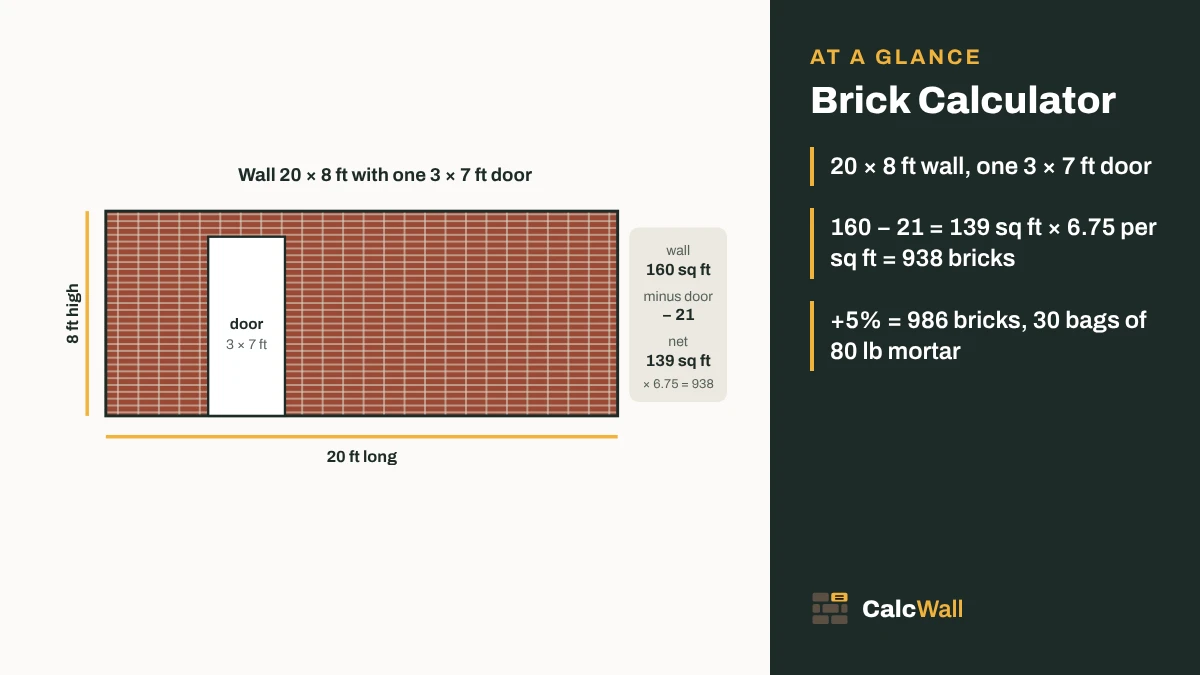
Quick answer: a wall 20 ft long and 8 ft high with one 3 × 7 ft door has 139 sq ft of brick face. At 6.75 modular bricks per sq ft that is 938 bricks, or 986 with 5% extra. The mortar takes about 30 bags of 80 lb mix.
How to use the brick calculator
Pick what you want to know first. There are four modes.
- Bricks for a wall. Enter the length and height. Add each door and window. This is the default.
- Bricks for an area. Enter the square feet or square meters, if you already know them.
- Area a number of bricks covers. Got a pallet left over? Enter the count to see how much wall it builds.
- Bricks a budget buys. Enter your budget and the brick price. You get the count and the area.
Then set the brick. US modular is the default. Choose “My brick size” for anything else and type the length, height and depth. Set the mortar joint, the wall thickness and the extra for waste. Prices are optional.
The answer is the number of bricks to buy. Below it you see the wall area, the bricks per square foot, the mortar in cubic feet and bags, and the cost. The link under the result opens the mortar calculator with your brick count already filled in.
How many bricks per square foot
Bricks are counted by the face of the wall. Each brick takes up its own face plus half a joint on every side. That is the brick length plus one joint, times the brick height plus one joint. Divide a square foot, 144 sq in, by that space.
Bricks per sq ft = 144 ÷ ((length + joint) × (height + joint))
Bricks = (wall area − openings) × bricks per sq ft × (1 + waste)
For US modular brick, BIA Technical Note 10 lists 675 bricks per 100 sq ft with 3/8 in joints. That is 6.75 per square foot. Here is how it works. The brick plus joint is 8 in long. Three courses rise exactly 8 in, so each course takes 2-2/3 in. 144 ÷ (8 × 2-2/3) = 6.75.
Some maker calculators show 6.86 instead. They use the brick height plus a true 3/8 in joint: 2-1/4 + 3/8 = 2-5/8 in. 144 ÷ (8 × 2-5/8) = 6.86. The gap is 1.6%. The calculator uses the BIA coursing for modular brick by default. You can switch to face + joint.
| Brick and layout | Per sq ft | Per 100 sq ft | Mortar per 100 sq ft |
|---|---|---|---|
| Modular, BIA coursing (3 courses = 8 in), one wythe | 6.75 | 675 | 5.4 cu ft |
| Modular, face + 3/8 in joint, one wythe | 6.86 | 686 | 5.5 cu ft |
| Modular brick laid with 1/2 in joints | 6.44 | 644 | 7.0 cu ft |
| Modular, two wythes (solid wall) | 13.5 | 1,350 | 10.9 cu ft |
| Two wythes, header course every 6th | 13.5 (7.875 in the face) | 1,350 | 11.4 cu ft |
| Modular laid flat as paving (8 × 4 in) | 4.5 | 450 | not counted |
| 215 × 65 mm brick, 10 mm joints (example) | 5.51 (59.3 per m²) | 551 | 17.6 liters per m² |
Before waste. Counts from the formula above; BIA TN10 Table 4 gives 675 and 5.5 cu ft for the first row. Mortar is the joint volume, worked out below.
Brick sizes: modular and your own
The modular brick is the common US size. Its face is 7-5/8 in long and 2-1/4 in high, and it is 3-5/8 in deep. Its length and depth are 3/8 in less than the 8 in and 4 in module, so a brick plus a joint fills it. Three courses rise 8 in.
Queen, king, Norman, utility and many other sizes are sold too. Their exact sizes vary by maker and by plant. So the calculator does not guess. Choose “My brick size” and type the size from the maker’s sheet or the pallet tag. The formula then works for any brick.
In metric countries, type the size in millimeters. The calculator starts with 215 × 65 × 102.5 mm and 10 mm joints as an example. Check your own brick before you order. A few millimeters on each brick add up over a wall.
Always measure what the brick is, not what it is called. Bricks have a nominal size (with the joint) and a specified size (the brick itself). The calculator wants the specified size and the joint, kept apart.
Mortar joint width and its effect
Most US brickwork uses 3/8 in joints. Some work uses 1/2 in joints. A wider joint means fewer bricks but more mortar.
Take the modular brick. With 3/8 in joints it is 6.86 per sq ft by face + joint. With 1/2 in joints it drops to 6.44. That is 6% fewer bricks. But the mortar per 100 sq ft goes up from 5.5 to 7.0 cu ft, about 27% more.
So set the joint you will really lay. The mortar bag count from the calculator follows the brick count. The cubic feet of mortar follow the joint.
Bricks for a wall with doors and windows
Take off openings in four steps. The calculator shows each number, so you can check them.
- Gross wall = length × height. 20 × 8 ft = 160 sq ft.
- Openings = width × height × how many, for each door and window. One 3 × 7 ft door = 21 sq ft.
- Net area = gross − openings. 160 − 21 = 139 sq ft.
- Bricks = net area × bricks per sq ft, plus waste. 139 × 6.75 = 938, plus 5% = 986.
Add as many doors and windows as you need. Each row takes a width, a height and a count. For brick paving, the same rows take out beds, drains or anything you will not pave.
Bricks around openings get cut. The waste allowance covers most of that. A wall with many small windows may need 10% instead of 5%.
Wall thickness and header courses
A brick veneer on a house is one wythe thick. A wythe is one brick’s depth. A solid garden wall is often two wythes, so it needs twice the bricks.
Some solid walls tie the two wythes together with a header course. Every 5th, 6th or 7th course, the bricks are laid endwise across the wall. A header shows its end in the face, so that course has twice as many bricks in the face.
The total stays the same: a header course uses the same bricks as two stretcher courses side by side. What changes is how many bricks show. With a header every 6th course, the face takes 7.875 bricks per sq ft instead of 6.75. Order your face brick from that line, and the rest can be cheaper backup brick.
Mortar bags for the bricks
Each brick needs a bed joint under it and a head joint at one end. The calculator works out that volume from the brick and the joint. For modular brick with 3/8 in joints it is 8.06 cu ft per 1,000 bricks. BIA TN10 lists 8.1.
For bags, the calculator divides the bricks by the bag yield. QUIKRETE says an 80 lb bag of Mason Mix lays up to 37 standard bricks. That is the default. Change it to the figure on your bag. Mortar waste is separate from brick waste. BIA suggests 15 to 25% for mortar, and the calculator starts at 15%.
Want to check the mortar on its own, or mix it for block? The mortar calculator takes a brick or block count or a wall area. For sand by the ton or yard, use the sand calculator.
Brick cost
Brick yards often quote per 1,000 bricks. Stores often price by the brick. Enter either one and pick which it is. Add the price of a mortar bag too. The calculator shows the total, the split between bricks and mortar, and the cost per square foot of wall.
Bricks usually come by the pallet or cube, and the count per pallet depends on the maker. Enter it from your yard’s quote. The calculator then rounds up to whole pallets.
| Wall | Net area | Bricks (no waste) | Bricks with 5% | 80 lb bags, 15% extra |
|---|---|---|---|---|
| 10 × 10 ft | 100 sq ft | 675 | 709 | 21 |
| 30 × 4 ft garden wall | 120 sq ft | 810 | 851 | 26 |
| Same, two wythes | 120 sq ft | 1,620 | 1,701 | 51 |
| 20 × 8 ft, one 3 × 7 ft door | 139 sq ft | 938 | 986 | 30 |
| 20 × 8 ft | 160 sq ft | 1,080 | 1,134 | 34 |
| 40 × 8 ft | 320 sq ft | 2,160 | 2,268 | 68 |
Modular brick at 6.75 per sq ft (BIA coursing). Bags: bricks × 1.15 ÷ 37, rounded up.
Prices change by region and by brick, so the calculator has no built-in prices. Get a quote and type it in.
Worked examples
Each example uses the calculator as it stands. The numbers match what it shows.
Veneer wall with a door
20 × 8 ft, one 3 × 7 ft door, modular brick, 3/8 in joints. Net area 160 − 21 = 139 sq ft. Bricks 139 × 6.75 = 938.25, plus 5% = 986 bricks. Mortar 938.25 × 0.00806 = 7.57 cu ft, plus 15% = 8.70 cu ft. Bags 938.25 × 1.15 ÷ 37 = 29.2, so 30 bags. At an example $0.75 a brick and $12 a bag: $739.50 + $360 = $1,099.50, or $7.91 per sq ft.
Garden wall, two wythes with headers
30 × 4 ft, two wythes, a header course every 6th course. Bricks 120 × 13.5 = 1,620, plus 5% = 1,701. Of those, 120 × 7.875 = 945 show in the face. Bags 1,620 × 1.15 ÷ 37 = 50.4, so 51 bags.
Brick path
3 × 30 ft path, modular brick laid flat with 3/8 in joints. Each brick covers 8 × 4 in: 4.5 per sq ft. 90 × 4.5 = 405, plus 5% = 426 bricks. No mortar is counted.
Metric wall
6 × 2.4 m with a 0.9 × 2.1 m door, example brick 215 × 65 × 102.5 mm, 10 mm joints. Net 14.4 − 1.89 = 12.51 m². Per m²: 1 ÷ (0.225 × 0.075) = 59.26. Bricks 741.3, plus 5% = 779. Mortar 0.22 m³, plus 15% = 0.25 m³. Bags at 37 per bag: 24.
What a budget buys
$500 at an example $0.80 a brick buys 625 bricks. Less 5% waste, 595 are laid. At 6.75 per sq ft that covers 88.2 sq ft of single-wythe wall.
Notes for pros
Pick the count method. BIA coursing gives 6.75 per sq ft for modular brick; face + joint gives 6.86. Match the method to your takeoff sheet.
Face brick vs backup. With header courses, order face brick from the face line and backup brick for the rest.
Mortar waste is bigger. BIA TN10 suggests 15 to 25% for mortar against at least 5% for brick. They are separate settings.
Not included. Collar joint fill, mortar in brick cores, ties, flashing, lintels and sills. Add them from the drawings.
- This page estimates materials. It does not check a wall design. Footings, ties, flashing and height limits come from your plans and local code.
- The mortar volume assumes solid joints, full depth, with no mortar in brick cores. Cored brick and raked joints change it a little.
Building in concrete block instead? The concrete block calculator counts blocks, mortar and core fill. A brick wall also needs a footing: the concrete footing calculator works out the concrete.
Sources
Where the numbers on this page come from. Everything else is plain geometry and unit conversion, which the calculator does with exact factors.
- Technical Note 10, Dimensioning and Estimating Brick Masonry, Brick Industry Association (BIA), February 2009 (supersedes TN 10, 10A and 10B; listed as current in the BIA Technical Notes index of July 2026). Used for: estimating brick by wall face area; Table 4: modular brick with 3/8 in joints at 675 units per 100 sq ft, 5.5 cu ft of mortar per 100 sq ft and 8.1 cu ft per 1,000 brick; adding at least 5% to brick and 15 to 25% to mortar for waste
- Technical Notes index, Brick Industry Association (BIA), July 2026. Used for: confirming Technical Note 10 (February 2009) is the current edition
- Brick Calculator (size list), Glen-Gery, web page, read 13 November 2026. Used for: the modular face size, 2-1/4 × 7-5/8 in, and its figure of 6.86 modular brick per sq ft, which we explain next to the BIA 6.75
- QUIKRETE Mason Mix No. 1136 data sheet, QUIKRETE Companies, revised November 2020. Used for: an 80 lb (36.2 kg) bag laying up to 37 standard bricks, the default bricks-per-bag figure
- NIST Handbook 44, Appendix C: General Tables of Units of Measurement, National Institute of Standards and Technology, 2026 edition. Used for: 1 ft = 0.3048 m, 1 in = 25.4 mm, 1 sq ft = 0.09290304 m², 1 cu ft = 28.316846592 liters
BIA TN10 figures are as recorded from the PDF by our planning step on 13 November 2026; the page’s own formula reproduces them (675 per 100 sq ft, 8.06 against 8.1 cu ft per 1,000).
Frequently asked questions
How many bricks in a square foot?
About 6.75 US modular bricks per square foot of wall face, one brick thick. That is the BIA Technical Note 10 figure for 3/8 in joints: 675 per 100 sq ft. Other sizes differ. Divide 144 by the brick length plus one joint, times the height plus one joint, all in inches.
How many bricks for a 10x10 wall?
A 10 × 10 ft wall is 100 sq ft, so it takes 675 modular bricks one wythe thick, or 709 with 5% extra for breakage and cuts. A two-wythe solid wall takes twice that: 1,350, or 1,418 with 5%. Take off any doors or windows first.
How much mortar per 1,000 bricks?
About 8.1 cu ft for modular brick with 3/8 in joints (BIA TN10), before waste. In bags, QUIKRETE says an 80 lb bag of Mason Mix lays up to 37 standard bricks. So 1,000 bricks need 1,000 ÷ 37 = 27.03, so 28 bags, or 32 with 15% extra. The bag count follows the maker’s “up to” yield, not the BIA joint volume, so the two don’t convert into each other.
How many bricks do I need for a wall?
Multiply the length by the height to get the wall area. Take off each door and window. Multiply what is left by the bricks per square foot, 6.75 for modular brick. Then add at least 5% for breakage. The calculator does all four steps and shows each one.
Why does one calculator say 6.86 per sq ft and another 6.75?
Both are right for different layouts. A 7-5/8 × 2-1/4 in brick with true 3/8 in joints takes an 8 × 2-5/8 in space: 6.86 per sq ft. BIA counts modular brick at 3 courses to 8 in, so each course is 2-2/3 in: 6.75 per sq ft. The calculator lets you pick either.
How much extra brick should I order?
BIA TN10 says to add at least 5% to the brick count. Add more for many cuts, a lot of corners or openings, or a pattern such as herringbone. The calculator offers 0, 5, 10 or 15%. Mortar gets its own allowance of 15 to 25%.
How many bricks for a path or patio?
Choose “Flat, as paving”. The brick then shows its length and depth instead of its length and height. A modular brick laid flat with 3/8 in joints covers 8 × 4 in, so 4.5 per sq ft. A 3 × 30 ft path takes 405 bricks, or 426 with 5% extra.
Does the brick calculator work in metric?
Yes. Switch to meters and millimeters, or pick a metric country. Enter your brick in mm. For example, a 215 × 65 mm brick with 10 mm joints gives 59.3 per m². That size is only an example: check the size of the brick you buy.
Is this brick calculator free to use online?
Yes. The CalcWall Brick Calculator is completely free and works online in any browser, on a phone, tablet or computer. There is nothing to download and no account to create, and the math runs right in your browser, so results appear as you type.