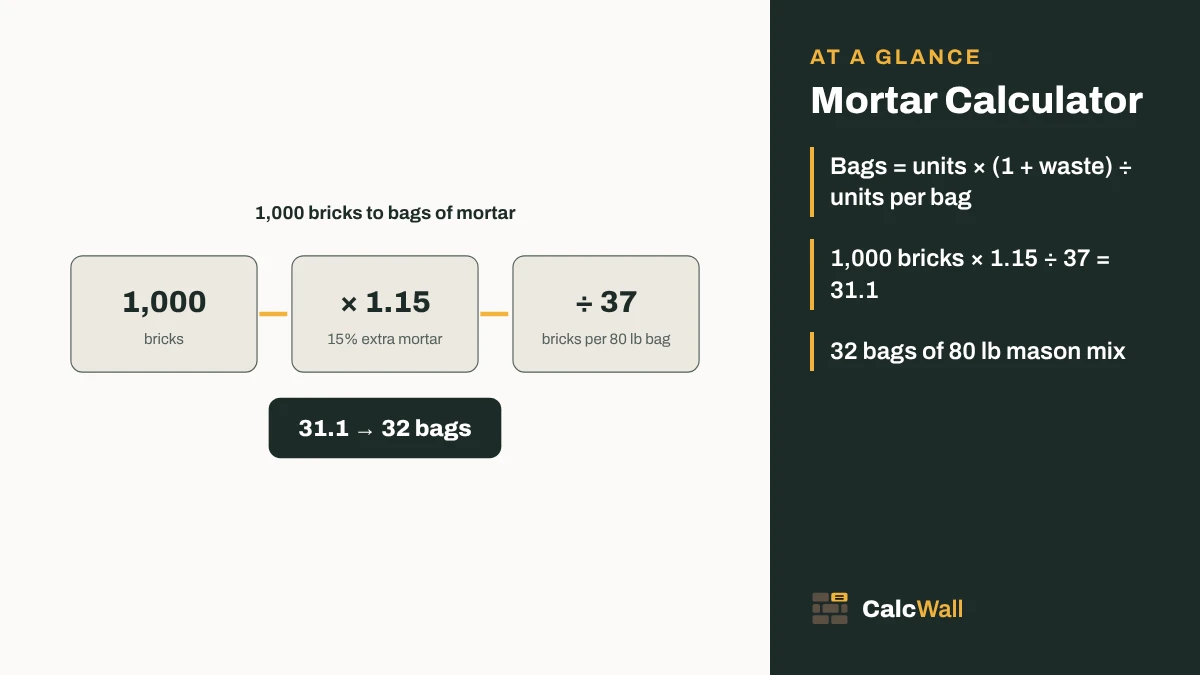
Quick answer: an 80 lb bag of mason mix lays up to 37 bricks or 13 concrete blocks, says QUIKRETE. So 1,000 bricks need 1,000 ÷ 37 = 27.03, so 28 bags, or 32 with 15% extra for waste. 100 blocks need 8 bags, or 9 with 15% extra.
How to use the mortar calculator
Choose brick or concrete block. Then choose how you know the job size.
- By count. Type the number of bricks or blocks. Use this when you already have a brick count, for example from the brick calculator.
- By wall area. Type the square feet or square meters of wall. The calculator counts the units for you from the brick or block size.
Pick the mortar. There are three options: 80 lb premixed mason mix, 70 lb masonry cement mixed with sand (block only), or your own bag with its yield. Then set the extra for waste. A price per bag is optional.
The answer is the number of bags. Below it you see the units, the bag yield, the mortar volume for brick, the sand for masonry cement and the cost.
Mortar formula
Bag makers print a yield: how many bricks or blocks one bag lays. The mortar calculator uses that yield. It works like this.
- Units. Use your count, or the wall area times the units per square foot.
- Waste. Multiply by 1 plus the waste. 15% extra is × 1.15.
- Bags. Divide by the units per bag and round up.
Bags = ceil(units × (1 + waste) ÷ units per bag)
Why use the bag yield and not the volume? The yield is what the maker stands behind. It already allows for the way the mix fills a joint. For brick, the calculator also shows the volume, so you can check the bags against it.
Mortar bags for brick
QUIKRETE’s data sheet says an 80 lb bag of Mason Mix No. 1136 lays up to 37 standard bricks. That is the default. It says “up to”, so it is a best case. The waste setting covers the rest.
| Units | 80 lb premix, no extra | 80 lb premix, 15% extra | 70 lb masonry cement, 15% extra | Sand for masonry cement |
|---|---|---|---|---|
| 100 bricks | 2.7 | 4 | no published yield | — |
| 500 bricks | 13.5 | 16 | no published yield | — |
| 1,000 bricks | 27.0 | 32 | no published yield | — |
| 2,000 bricks | 54.1 | 63 | no published yield | — |
| 100 blocks (8 × 8 × 16 in) | 7.7 | 9 | 4 | 0.48 US ton |
| 500 blocks | 38.5 | 45 | 20 | 2.40 US tons |
| 1,000 blocks | 76.9 | 89 | 39 | 4.79 US tons |
Premix: 37 bricks or 13 blocks per 80 lb bag (QUIKRETE 1136). Masonry cement: 30 blocks per 70 lb bag and 240 blocks per ton of sand (CMHA TEK 4-2A). Bag counts with extra are rounded up.
For brick by area, the calculator first counts the bricks. US modular brick is 6.75 per sq ft by BIA coursing (675 per 100 sq ft in BIA TN10). For other bricks, enter the size and the joint. The count is 144 ÷ ((length + joint) × (height + joint)).
Mortar bags for concrete block
The same data sheet says an 80 lb bag lays 13 standard 8 × 8 × 16 in blocks. With 70 lb masonry cement and sand, CMHA TEK 4-2A gives about 30 hollow units per bag.
By area, an 8 × 16 in block face is 0.889 sq ft, so 1.125 blocks per sq ft. 100 sq ft is 112.5 blocks. That is 10 bags of premix with 15% extra.
The yields are published for 8 × 16 in face blocks. Wider blocks, such as 12 in, use more mortar per block. Half-high and metric blocks have no published yield in our sources. For those, choose “My bag” and enter the yield from your bag or supplier. The concrete block calculator counts the blocks and core-fill grout too.
Joint size and mortar volume
For brick, the calculator also works out the mortar volume. Each brick needs a bed joint under it and a head joint at one end, both as deep as the brick.
Mortar per brick = ((length + joint) × (height + joint) − length × height) × depth
For modular brick with 3/8 in joints that is 13.9 cu in per brick, or 8.06 cu ft per 1,000. BIA TN10 lists 8.1, so the formula agrees. Per 100 sq ft of wall it is about 5.4 to 5.5 cu ft.
| Modular brick | Bricks per 100 sq ft | Mortar per 1,000 bricks | Mortar per 100 sq ft |
|---|---|---|---|
| 3/8 in joints, BIA coursing | 675 | 8.06 cu ft | 5.44 cu ft |
| 3/8 in joints, face + joint | 686 | 8.06 cu ft | 5.53 cu ft |
| 1/2 in joints, face + joint | 644 | 10.88 cu ft | 7.01 cu ft |
Before waste. Solid brick with full-depth joints; mortar in brick cores is not included.
Going from 3/8 to 1/2 in joints takes about 27% more mortar per square foot. The bag count by yield does not see this, so check the volume line if you lay wide joints. You may need more bags than the yield suggests.
Mortar types N, S, M and O
ASTM C270 sorts mortar into types M, S, N and O. The current edition is C270-26. The types differ in strength and in how the mix is made.
Type N and Type S are the two you will see most in stores. QUIKRETE gives a minimum compressive strength of 750 psi for Type N and 1,800 psi for Type S. QUIKRETE Mason Mix No. 1136 is sold as Type S.
Which type to use is set by your plans, your engineer or local code. The choice depends on where the wall is and the loads on it. We do not give a rule here, and we do not quote the C270 mix tables, because we have not read them.
The mortar type does not change the bag count in this calculator. The bag yield does. Read the yield on the bag you buy.
Mixing your own: sand and cement
Premixed mason mix has the sand in it. You only add water. Masonry cement is different: you mix it with sand on site.
For block, the calculator gives the masonry cement bags at about 30 blocks per 70 lb bag. It also gives the sand at about 240 blocks per ton, both from CMHA TEK 4-2A. 100 blocks with 15% extra need 4 bags and 0.48 ton of sand.
For brick, our sources do not give a masonry cement yield. Choose “My bag” and type the yield your bag or supplier gives. For sand by volume or weight, the sand calculator converts it.
Worked examples
Each example matches what the mortar calculator shows.
1,000 modular bricks
Premix at 37 per bag, 15% extra. 1,000 × 1.15 ÷ 37 = 31.1, so 32 bags. Mortar volume 1,000 × 0.00806 = 8.06 cu ft, or 9.27 cu ft with 15%.
100 sq ft of brick wall
Modular brick, BIA coursing: 675 bricks. 675 × 1.15 ÷ 37 = 20.98, so 21 bags.
100 concrete blocks
8 × 8 × 16 in. Premix: 100 × 1.15 ÷ 13 = 8.8, so 9 bags. Masonry cement: 115 ÷ 30 = 3.8, so 4 bags plus 115 ÷ 240 = 0.48 ton of sand.
Your own bag
A bag that lays 30 bricks, 1,000 bricks, 10% extra. 1,100 ÷ 30 = 36.7, so 37 bags.
Metric wall
10 m² of an example 215 × 65 mm brick with 10 mm joints: 592.6 bricks. At 37 per bag with 15%: 592.6 × 1.15 ÷ 37 = 18.4, so 19 bags. Mortar in the joints is about 17.6 liters per m².
Notes for pros
“Up to” yields. Bag yields are best cases. Keep at least 15% extra; BIA TN10 suggests 15 to 25%.
Watch wide joints. 1/2 in joints take about 27% more mortar than 3/8 in. Check the volume line.
Block width. Published yields are for 8 in block. Wider block and grouted cells need more.
Not included. Collar joints, parging, mortar in cores, and pointing of old work.
- This page estimates materials only. Mortar type, mix and strength come from your plans, your engineer and your local code.
- Concrete for the footing under the wall is a separate job: the concrete footing calculator works it out.
Sources
Where the numbers on this page come from. Everything else is plain geometry and unit conversion, which the calculator does with exact factors.
- QUIKRETE Mason Mix No. 1136 data sheet, QUIKRETE Companies, revised November 2020. Used for: an 80 lb (36.2 kg) bag laying up to 37 standard bricks or 13 standard 8 × 8 × 16 in blocks; Mason Mix meeting ASTM C270 and C1714 as Type S
- Mason Mix product line, QUIKRETE Companies, web page, read 13 November 2026. Used for: Mason Mix No. 1136 sold in 60 and 80 lb bags
- QUIKRETE Mortar Mix No. 1102 data sheet, QUIKRETE Companies, revised November 2020. Used for: Type N at 750 psi minimum and Type S at 1,800 psi minimum, and the pointer to ASTM C270 for choosing a type (as cited on our concrete block calculator)
- TEK 4-2A, Estimating Concrete Masonry Materials, Concrete Masonry & Hardscapes Association (CMHA, formerly NCMA), TEK 4-2A, web page modified 5 March 2024. Used for: about 30 hollow units per 70 lb bag of masonry cement, and about 240 units per ton of sand
- Technical Note 10, Dimensioning and Estimating Brick Masonry, Brick Industry Association (BIA), February 2009 (current per the BIA Technical Notes index, July 2026). Used for: Table 4: modular brick with 3/8 in joints at 675 per 100 sq ft, 5.5 cu ft of mortar per 100 sq ft and 8.1 cu ft per 1,000 brick; 15 to 25% waste on mortar
- ASTM C270-26, Standard Specification for Mortar for Unit Masonry, ASTM International, C270-26, the active edition on the ASTM store (page updated 17 July 2026). Used for: the mortar types M, S, N and O by name only; we have not read its proportion tables and do not quote them
- NIST Handbook 44, Appendix C: General Tables of Units of Measurement, National Institute of Standards and Technology, 2026 edition. Used for: 1 in = 25.4 mm, 1 sq ft = 0.09290304 m², 1 cu ft = 28.316846592 liters, 1 US ton = 0.90718474 tonne
BIA TN10 figures are as recorded from the PDF by our planning step on 13 November 2026; our joint formula reproduces 8.06 against TN10’s 8.1 cu ft per 1,000 brick.
Frequently asked questions
How many bags of mortar per 100 bricks?
About 2.7 bags of 80 lb mason mix. QUIKRETE says one bag lays up to 37 standard bricks, and 100 ÷ 37 = 2.7. With 15% extra for waste it is 3.1, so buy 4 bags. Wider joints or bigger bricks take more.
Type N or S mortar?
Type S is the stronger of the two. QUIKRETE gives a minimum of 1,800 psi for Type S and 750 psi for Type N. Both are ASTM C270 types. Use the type your plans or local code call for. In this calculator the type does not change the bag count; the bag yield does.
How much mortar for 100 blocks?
About 7.7 bags of 80 lb premix for 8 × 8 × 16 in block, at 13 blocks per bag (QUIKRETE). With 15% extra that is 9 bags. With 70 lb masonry cement it is about 30 blocks per bag (CMHA TEK 4-2A): 4 bags plus about half a ton of sand.
How much mortar for 1,000 bricks?
About 8.1 cu ft for modular brick with 3/8 in joints, before waste (BIA TN10). In bags of 80 lb mason mix, 1,000 ÷ 37 = 27.03, so 28 bags, or 32 with 15% extra. The two numbers come from different places: the bag count uses QUIKRETE’s yield of “up to” 37 bricks per bag, a best case, while BIA’s 8.1 cu ft is the volume of the joints themselves. We don’t turn that volume into bags because we have no published volume per bag to cite, so the bag count follows the maker’s yield. Use the figure on your own bag if it differs.
How do I work out mortar from the wall area?
Find the bricks first: wall area times bricks per square foot, 6.75 for modular brick. Then divide by the bag yield and add waste. 100 sq ft of modular brick is 675 bricks, which is 21 bags of 80 lb mix with 15% extra.
How much extra mortar should I buy?
BIA TN10 suggests 15 to 25% for mortar, more than for brick. Mortar is lost as droppings, in uneven joints and in batches that set before use. The calculator starts at 15% and goes up to 25%.
Can I mix my own mortar with sand?
Yes. For block, choose 70 lb masonry cement. The calculator gives the bags and the sand, at about 240 blocks per ton (CMHA TEK 4-2A). For other mixes, enter the yield your bag or supplier gives. We do not quote ASTM C270 mix proportions here.
Does it work in metric?
Yes. Pick meters and millimeters or a metric country. Enter the brick in mm and the area in m². Mortar volume shows in m³ and liters, and sand in tonnes. The bag yield stays per bag, so use the figure on your bag.
Is this mortar calculator free to use online?
Yes. The CalcWall Mortar Calculator is completely free and works online in any browser, on a phone, tablet or computer. There is nothing to download and no account to create, and the math runs right in your browser, so results appear as you type.