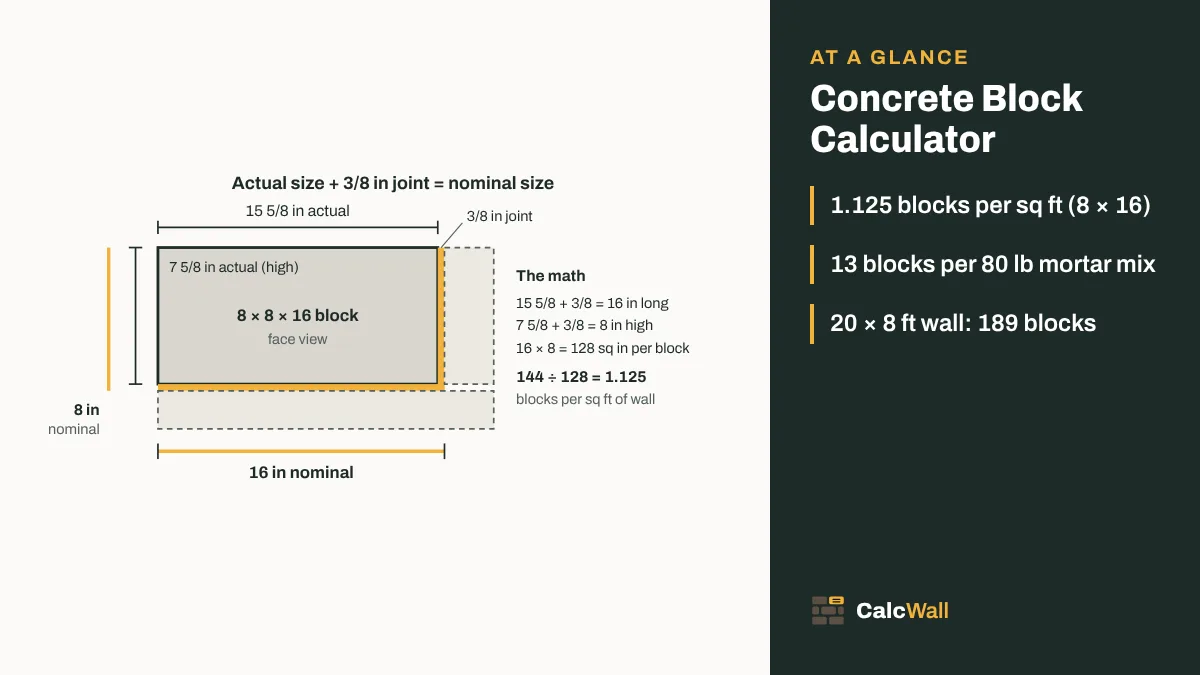
Quick answer: standard 8 × 8 × 16 in block lays 1.125 per square foot of wall. Multiply the wall area, less doors and windows, by 1.125 and add 5%. A 20 × 8 ft wall needs 189 blocks, 14 bags of 80 lb mortar mix and, if every core is filled, 45 cu ft of grout.
How many concrete blocks you need
Block take-offs work by area. A standard block, joint included, covers 16 × 8 in of wall. That is 128 sq in, and a square foot is 144 sq in, so each square foot of wall takes 144 ÷ 128 = 1.125 blocks. Titan America’s estimating guide uses the same 1.125 for 4, 8, 10 and 12 in standard block.
Width doesn’t change the count. A 6 in wall and a 12 in wall of the same length and height take the same number of blocks, because the face is the same 8 × 16 in. Width changes the weight, the grout and the price. For a garden wall that holds back soil, the retaining wall calculator adds the cap, base gravel and backfill.
- Measure the wall length and height in feet. Use the height of the blockwork itself, from the top of the footing to the top course.
- Multiply length × height to get the gross area in square feet.
- Subtract each door and window: width × height × how many.
- Multiply the net area by 1.125 for 8 × 16 in face block, or by 2.25 for 4 × 16 in half-high block.
- Add waste, usually 5%, and round up to whole blocks.
- Mortar: divide the blocks before waste by 13 for 80 lb premixed mortar mix, or by 30 for 70 lb masonry cement plus sand. Round up.
- Core fill: multiply the blocks before waste by the core volume (0.25 cu ft for 8 in block), divide by your fill spacing, then by 0.65 for 80 lb grout bags.
Blocks = (L × H − openings) × 1.125 × (1 + waste %)
That is exactly what the concrete block calculator above does. It rounds blocks up once for the whole wall, so it never asks you to buy a fraction of a block. Courses are the height divided by 8 in, rounded up, and blocks per course are the length divided by 16 in, rounded up.
A cross-check helps here. CMHA, the trade body that used to be NCMA, says in TEK 4-2A that you need 119 units per 100 sq ft including 5% waste. Our math gives 100 × 1.125 = 112.5, plus 5% = 118.1, which rounds up to 119. If you see 118 elsewhere, the only difference is whether the last part block was rounded up.
Concrete block sizes: nominal vs actual
Block is sold by its nominal size, the space it takes in the wall once the mortar is in. The block itself is 3/8 in smaller each way, because a standard mortar joint is 3/8 in thick. So an “8 × 8 × 16” block measures 7 5/8 × 7 5/8 × 15 5/8 in. Add one 3/8 in joint to the length and one to the height and you get 16 × 8 in.
The joint is why walls come out in neat numbers. Three courses are exactly 24 in, and a run of three blocks is exactly 4 ft. Lay out lengths and openings in 8 in steps and you cut fewer blocks. Angelus Block gives a tolerance of ±1/8 in on block dimensions, so a few blocks in a pallet may be a hair long or short.
| Nominal size (in) | Actual size (in) | Actual (mm) | Blocks per sq ft | Weight each |
|---|---|---|---|---|
| 4 × 8 × 16 | 3 5/8 × 7 5/8 × 15 5/8 | 92 × 194 × 397 | 1.125 | not in our sources |
| 6 × 8 × 16 | 5 5/8 × 7 5/8 × 15 5/8 | 143 × 194 × 397 | 1.125 | 27 lb |
| 8 × 8 × 16 | 7 5/8 × 7 5/8 × 15 5/8 | 194 × 194 × 397 | 1.125 | 40 lb |
| 10 × 8 × 16 | 9 5/8 × 7 5/8 × 15 5/8 | 244 × 194 × 397 | 1.125 | not in our sources |
| 12 × 8 × 16 | 11 5/8 × 7 5/8 × 15 5/8 | 295 × 194 × 397 | 1.125 | not in our sources |
| 8 × 4 × 16 half-high | 7 5/8 × 3 5/8 × 15 5/8 (nominal less 3/8) | 194 × 92 × 397 | 2.25 | not in our sources |
| 8 × 8 × 8 half block | 7 5/8 × 7 5/8 × 7 5/8 | 194 × 194 × 194 | counts as ½ | 22 lb |
Sizes are from Titan America and Basalite, weights from Basalite, and the 2.25 per sq ft for half-high block from Angelus. The half-high actual size is our arithmetic from the same 3/8 in rule. The first number in a block’s name is its width, the wall thickness. The 8 in height and 16 in length stay the same across the range.
The 8 × 8 × 16 row is the block most people mean when they look for an 8x8x16 concrete block calculator. If your store sells another face size, the per-square-foot figure changes: Angelus lists 1.00 for 8 × 18 in and 0.75 for 8 × 24 in face block. This tool covers the standard 8 × 16 and 4 × 16 in faces plus UK block.
Mortar per 100 blocks: why sources say 3 bags or 9
Look up mortar for block and you’ll find answers from about 3 bags per 100 blocks to about 9. That spread looks like a mistake, but it is mostly two different products sold in bags of similar size.
- Premixed mortar mix, such as QUIKRETE Mortar Mix, is cement, lime and sand already blended. You add only water, about 5 quarts per 80 lb bag. QUIKRETE says one 80 lb bag lays up to 13 standard 8 × 8 × 16 in blocks. That is 100 ÷ 13 = 7.7 bags per 100 blocks.
- Masonry cement is the binder only. You mix it with sand on site. CMHA TEK 4-2A says a 70 lb bag lays about 30 hollow units with face-shell bedding. That is 3.3 bags per 100 blocks, plus the sand.
So “3 bags per 100” is a masonry cement figure, and “8 or 9 bags” is a premix figure, sometimes with waste added. Titan America’s guide quotes 3 bags per 100 block as a rule of thumb, with 1 cu yd of sand per 7 bags, which only makes sense for cement you mix with sand.
| What’s in the bag | Blocks per bag | Bags per 100 blocks | Sand | Source |
|---|---|---|---|---|
| 80 lb premixed mortar mix (Type N) | up to 13 | 7.7 | none, add water | QUIKRETE |
| 70 lb masonry cement | about 30 | 3.3 | about 0.42 ton per 100 blocks | CMHA TEK 4-2A |
| 94 lb portland cement, mixed with lime and sand | about 62 | 1.6 | yes, plus hydrated lime | CMHA TEK 4-2A |
| “Bag of mortar”, type not stated | about 33 | 3 | 1 cu yd per 7 bags | Titan America (rule of thumb) |
The sand column comes from TEK 4-2A’s figure of about 240 units per ton of sand: 100 ÷ 240 = 0.42 ton. The calculator lets you choose 80 lb mortar mix or 70 lb masonry cement, and it says “plus sand” on the masonry cement line. For sand by volume or weight, use the sand calculator.
Two details matter when you compare the calculator with a store’s advice. First, QUIKRETE’s 13 is an “up to” figure, a clean best case. Thick joints, a full mortar bed instead of face shells only, or a lot of dropped mortar all cut the yield. Second, the calculator works mortar out from the blocks before waste, then rounds up. Broken blocks don’t use mortar, but a spare bag is cheap insurance.
There is one case where the concrete block mortar calculator gives no figure at all. Bag yields are only published for 8 × 16 in face block. For half-high 4 × 16 in block and for UK 440 × 215 mm block, no yield is published in our sources, so the mortar line reads “ask your supplier” instead of a number. Half-high block has twice the joints per square foot, so the 8 × 16 yield would undercount badly.
Filling block cores with grout or concrete
Hollow block has two cores, or cells. Filling them adds weight and strength, and it is how the bars in a reinforced wall are locked in. This is what people mean by core fill, block fill or a concrete block grout calculator: how much fill goes into the cells. If you would rather pour the wall solid, the concrete wall calculator gives the yards, form area and footing for the same size.
The calculator uses Titan America’s core volumes per block. It multiplies them by the blocks before waste, and by the share of blocks you fill. Every 2nd block means half the blocks, every 3rd means a third, and so on. Then it divides by 0.65 cu ft, the yield QUIKRETE gives for its 80 lb Core-Fill Grout, and rounds up to whole bags.
| Block width | Core fill per block (Titan) | Per 100 sq ft, from Titan | Per 100 sq ft (General Shale) | Blocks per 80 lb grout bag |
|---|---|---|---|---|
| 4 in | Not grouted. TEK 4-2A leaves 4 in units out of its grout table. | |||
| 6 in | 0.17 cu ft | 19.1 cu ft | 20.7 cu ft | 3.8 |
| 8 in | 0.25 cu ft | 28.1 cu ft | 29.7 cu ft | 2.6 |
| 10 in | 0.33 cu ft | 37.1 cu ft | 34.4 cu ft | 2.0 |
| 12 in | 0.39 cu ft | 43.9 cu ft | 49.9 cu ft | 1.7 |
The “from Titan” column is the per-block figure × 112.5 blocks, with no waste. The General Shale column is that maker’s own figure for solid-grouted stretcher walls. The two agree within about 15%. Real cores vary by plant and mould, so a maker’s figure for your exact block beats either one.
Bag counts are on the safe side. Titan’s 0.25 cu ft for an 8 in block means 0.65 ÷ 0.25 = 2.6 blocks per bag. QUIKRETE says its bag fills the cores of about 3 standard blocks. The calculator uses the Titan figure, so it may leave you with a few bags spare on a big wall.
For a big fill, bags add up fast. 45 cu ft is 1.67 cu yd, and many suppliers deliver grout as ready-mix. The concrete calculator handles footings and slabs, and the Sonotube calculator covers round piers. Ask for grout, not regular concrete, for block cells. Grout is fluid enough to fill a narrow cell to the bottom without voids.
Don’t plan to grout 4 in block. CMHA TEK 4-2A notes that grouting conventional 4 in units is not recommended, and the calculator refuses core fill for 4 in block. It also has no core volume for half-high block, so it asks you to choose no fill or another size.
Bond beams are separate. A bond beam is a course of U-shaped block filled solid around a horizontal bar, usually at the top of the wall and over openings. General Shale puts an 8 in bond beam at 15.9 cu ft of grout per 100 ft of wall with a center web, or 21.2 without. The calculator doesn’t add bond beams, so work them out and add the bags yourself.
Openings, corners and half blocks
Doors and windows come straight off the area. Enter each opening’s width and height and how many there are. The calculator multiplies them out and subtracts the total before it applies 1.125. A 3 × 7 ft door takes 21 sq ft off the wall, which is 21 × 1.125 = 23.6 blocks.
Openings still cost something. The block above a door sits on a lintel: a precast lintel, a steel angle or a bond beam of U-block filled with grout around bars. The lintel bears on the block either side. The calculator doesn’t count lintels, so add them to your list. Titan America gives about 0.22 cu ft of fill per foot for an 8 in bond beam lintel.
Corners are where people double count. If you measure two walls that meet at a corner from the outside, the corner block lands in both measurements. For 8 in block, the overlap is 8 in wide by the full height. On an 8 ft wall that is 0.667 × 8 = 5.3 sq ft, or 6 blocks per corner. Measure one wall to the outside corner and the other to the inside face, or subtract the overlap.
Half blocks don’t change the count much. In running bond, each course is offset half a block from the one below. At a free end or the edge of an opening, every other course needs a half block, or a full block cut in two. Two halves fill the space of one block, so the area method already covers them. Buy halves if your supplier stocks them, because cutting wastes time and blocks.
Corner and jamb blocks have one finished end and the same face size as a stretcher. Count them in the total and tell the yard how many you need of each. For a wall with many short returns, pick 10% waste in the calculator rather than 5%.
Blocks for common wall sizes
These are straight from the calculator with 8 × 8 × 16 in block, 5% extra, no openings and every core filled. Mortar is shown both ways. If you won’t fill the cores, ignore the last two columns. Use the concrete block wall calculator above for your exact wall and openings.
| Wall (L × H) | Blocks (+5%) | Courses × per course | 80 lb mortar mix | 70 lb masonry cement | Core fill, all cores | 80 lb grout bags |
|---|---|---|---|---|---|---|
| 10 × 3 ft | 36 | 5 × 8 | 3 | 2 | 8.4 cu ft | 13 |
| 10 × 4 ft | 48 | 6 × 8 | 4 | 2 | 11.3 cu ft | 18 |
| 16 × 4 ft | 76 | 6 × 12 | 6 | 3 | 18.0 cu ft | 28 |
| 20 × 4 ft | 95 | 6 × 15 | 7 | 3 | 22.5 cu ft | 35 |
| 20 × 6 ft | 142 | 9 × 15 | 11 | 5 | 33.8 cu ft | 52 |
| 20 × 8 ft | 189 | 12 × 15 | 14 | 6 | 45.0 cu ft | 70 |
| 24 × 8 ft | 227 | 12 × 18 | 17 | 8 | 54.0 cu ft | 84 |
| 30 × 8 ft | 284 | 12 × 23 | 21 | 9 | 67.5 cu ft | 104 |
| 40 × 8 ft | 378 | 12 × 30 | 28 | 12 | 90.0 cu ft | 139 |
| 50 × 6 ft | 355 | 9 × 38 | 26 | 12 | 84.4 cu ft | 130 |
A 10 × 3 ft wall is 4.5 courses of 8 in, so the calculator shows 5 courses: you’d build 4 or 5 and make up the rest with the cap. Per-course counts round up too, which is why a 30 ft wall shows 23 blocks per course for 22.5 blocks of length. The block totals come from area, so they don’t round twice.
Grout above 1 cu yd (27 cu ft) is worth pricing as ready-mix. A 40 × 8 ft wall filled solid takes 90 cu ft, which is 3.3 cu yd or 139 bags. Mixing that many bags by hand is a long day for a small crew.
Concrete block weight and pallets
Block weight decides how you get it to site. Basalite lists its 6 × 8 × 16 in block at 27 lb and its 8 × 8 × 16 in at 40 lb. When you choose 6 or 8 in block, the calculator multiplies the block count by those weights. The 189 blocks for a 20 × 8 ft wall weigh 189 × 40 = 7,560 lb, before mortar and grout.
That is far more than one pickup load, so jobs this size are usually delivered. Basalite ships 90 of its 8 in blocks per pallet, so 189 blocks are 2.1 pallets. Pallet counts and weights vary by plant, so check your yard’s numbers before you book a truck.
Weight also depends on the concrete. Angelus classes block as lightweight under 105 lb per cu ft, medium weight from 105 to under 125, and normal weight at 125 and over. Lightweight block is easier to lift and lay. Our sources don’t publish weights for 4, 10 or 12 in block, so the concrete block weight calculator line is left blank for those sizes rather than guessed.
Filled cores add their own weight on top. The calculator’s weight line is for the blocks only, so the footing has to be sized for the finished wall, grout and all, not just the block. Your plans set that.
Metric blocks per square metre (UK and Europe)
The standard UK and European concrete block is 440 × 215 mm on the face, laid with a 10 mm joint. With the joint, each block takes 450 × 225 mm of wall: 0.45 × 0.225 = 0.10125 m². So one square metre needs 1 ÷ 0.10125 = 9.88 blocks. H+H prints exactly 9.88 blocks per m² with 10 mm joints on its Celcon datasheet, and Tarmac lists the same 440 × 215 mm face for its Topcrete blocks.
Many builders round that to 10 per m², which is close enough for small jobs and gives you a little spare. The calculator keeps 9.88 and adds your waste on top. It picks 440 × 215 mm block automatically when the site is set to the United Kingdom, and you can choose it from the Block size list anywhere. Enter the wall in metres.
Tarmac sells Topcrete in 100, 140 and 215 mm thicknesses. The face, and so the count, stays the same, but the weight changes. Tarmac gives 19.0 kg for a 100 mm solid block and 26.6 kg for 140 mm, or 200 and 280 kg per m² laid. The calculator doesn’t show a weight for UK block, so use your maker’s figure.
There are two gaps here. No mortar yield per bag for 440 × 215 mm block is published in our sources, so the calculator shows no mortar figure for it. Ask your merchant. Also, Australia and New Zealand use a different block with a different face size, and we haven’t found a maker’s table we can cite. Use your supplier’s blocks-per-m² figure there.
Cinder block vs concrete block
People use the two names for the same thing. CMHA says “cinder block” and “concrete block” are essentially the same product: cement, water and aggregate, moulded and cured. Early makers mixed in cinders as a lighter aggregate than stone. The name stuck, and CMHA notes cinders are still used in some block today.
You can’t tell by weight alone, because other lightweight aggregates are just as light. What matters for a wall is the block’s strength, size and density, which the maker’s sheet gives. For counting and filling, a cinder block concrete fill calculator works exactly like this one: 1.125 blocks per sq ft and 0.25 cu ft of core fill per 8 in block.
Concrete block wall cost
We haven’t found a block price we can source and date, so the calculator doesn’t assume one. Prices change by region, plant, block type and order size. Enter your store’s price per block, per mortar bag and per 80 lb grout bag, and the calculator does the rest.
Cost = blocks × block price + mortar bags × bag price + grout bags × grout price
Get the prices from the same quote. A block yard may price mortar and grout differently from a big-box store, and delivery is often charged per pallet or per trip. Prices clear if you change the country, because the calculator never converts between currencies.
That figure is materials only. A full concrete block wall cost also includes the footing, rebar, lintels, a cap, scaffolding on taller walls, and labour. For the footing, the concrete cost calculator works out ready-mix and bag costs. If you are comparing a block wall with a framed one, the framing calculator counts studs and plates for the same length.
Worked examples
These match the concrete block calculator exactly. Enter the same values and you will see the same numbers.
A plain 20 × 8 ft wall, filled solid
8 × 8 × 16 in block, no openings, 5% extra, 80 lb mortar mix, every core filled.
Area: 20 × 8 = 160 sq ft. Blocks: 160 × 1.125 = 180, plus 5% = 189 blocks, 12 courses of 15.
Mortar: 180 ÷ 13 = 13.8, so 14 bags of 80 lb mortar mix. With masonry cement: 180 ÷ 30 = 6 bags of 70 lb, plus about 0.75 ton of sand.
Core fill: 180 × 0.25 = 45 cu ft (1.67 cu yd). 45 ÷ 0.65 = 69.2, so 70 bags of 80 lb core-fill grout. The blocks weigh 189 × 40 = 7,560 lb.
The calculator’s default wall: 20 × 8 ft with a door
Same wall with one 3 × 7 ft door, 5% extra, 80 lb mortar mix, no core fill.
Area: 160 − 21 = 139 sq ft. Blocks: 139 × 1.125 = 156.4, plus 5% = 164.2, so 165 blocks.
Mortar: 156.4 ÷ 13 = 12.03, so 13 bags of 80 lb mix, or 156.4 ÷ 30 = 5.2, so 6 bags of masonry cement. The blocks weigh 6,600 lb. Add a lintel over the door.
A 30 × 4 ft garden wall, partly grouted
8 in block, every 2nd block filled, 10% extra because of the cuts at the ends.
Area: 120 sq ft. Blocks: 120 × 1.125 = 135, plus 10% = 148.5, so 149 blocks, 6 courses of about 23.
Mortar: 135 ÷ 13 = 10.4, so 11 bags of 80 lb mix. Core fill: 135 ÷ 2 × 0.25 = 16.9 cu ft, or 26 bags of 80 lb grout.
A UK wall in 440 × 215 mm block
6 × 2.4 m with one 0.9 × 2.1 m door, 5% extra.
Area: 14.4 − 1.89 = 12.51 m². Blocks: 12.51 × 9.877 = 123.6, plus 5% = 129.7, so 130 blocks, 11 courses of about 14.
Mortar: no published bag yield for this block, so ask your merchant. In 100 mm Tarmac Topcrete solid block at 19.0 kg each, 130 blocks weigh about 2,470 kg.
Notes for masons
Say which bag. When you quote mortar per 100 blocks, name the bag. 7.7 bags of premix and 3.3 bags of masonry cement lay the same 100 blocks.
Lay out in 8 in. Lengths, heights and openings on the 8 in module save cuts and half blocks. Three blocks are exactly 4 ft.
Bond beams extra. The calculator’s grout is for cells only. An 8 in bond beam adds 15.9–21.2 cu ft per 100 ft (General Shale).
Watch corners. Two outside measurements count the corner twice: about 6 blocks per corner on an 8 ft wall of 8 in block.
- Footing first: work out the strip footing under the wall with the concrete calculator.
- Code: the figures here are estimating guides. Wall height, reinforcement, footing size and mortar type are set by your plans and local code.
- QUIKRETE is a trademark of The QUIKRETE Companies. The calculator works for any brand with the same bag yields.
Sources
Where the numbers on this page come from. Everything else is plain geometry and unit conversion, which the calculator does with exact factors.
- Block Estimating Guide, Titan America, undated (file posted January 2025). Used for: actual block sizes (nominal less 3/8 in), 1.125 blocks per sq ft, core fill of 0.17 / 0.25 / 0.33 / 0.39 cu ft per 6 / 8 / 10 / 12 in block, its rule of thumb of 3 bags of mortar per 100 block and 1 cu yd of sand per 7 bags, and 0.22 cu ft per foot for an 8 in bond beam lintel
- TEK 4-2A, Estimating Concrete Masonry Materials, Concrete Masonry & Hardscapes Association (CMHA, formerly NCMA), TEK 4-2A, web page modified 5 March 2024. Used for: 119 units per 100 sq ft including 5% waste, about 30 hollow units per 70 lb bag of masonry cement, about 62 per 94 lb bag of portland cement in cement-lime mortar, about 240 units per ton of sand, and the advice that 4 in units are not grouted
- CMU-FAQ-014: What is the difference between a cinder block and a concrete block?, Concrete Masonry & Hardscapes Association (CMHA), revised 2014, page modified 12 December 2024. Used for: cinder block and concrete block being essentially the same product, and cinders as an early lightweight aggregate
- QUIKRETE Mortar Mix No. 1102 data sheet, QUIKRETE Companies, revised November 2020. Used for: an 80 lb bag laying up to 13 standard 8 × 8 × 16 in blocks, Type N at 750 psi minimum, Type S at 1,800 psi minimum, the pointer to ASTM C270 for choosing a type, and about 5 quarts of water per bag
- QUIKRETE Core-Fill Grout (Coarse) No. 1585-07 data sheet, QUIKRETE Companies, revised November 2024. Used for: an 80 lb bag yielding about 0.65 cu ft, enough for the cores of about 3 standard 8 in blocks
- Tech Bulletin: Block Grout Fill Quantities, General Shale Brick (hosted by Canada Brick), dated 4 June 2020. Used for: grout per 100 sq ft of solid-grouted wall (20.7 / 29.7 / 34.4 / 49.9 cu ft for 6 / 8 / 10 / 12 in) and per 100 ft of 8 in bond beam (15.9 cu ft with a center web, 21.2 without)
- Building Blocks cut sheet (Washington), Basalite Concrete Products, undated (file posted March 2022). Used for: block weights (6 in 27 lb, 8 in 40 lb, 8 × 8 × 8 in half 22 lb) and units per pallet (120, 90 and 150)
- CMU Basics & Glossary, Angelus Block Co., © 2024. Used for: the meaning of nominal size, the ±1/8 in size tolerance, density classes (lightweight under 105 lb/cu ft, normal weight 125 and over) and the bond beam definition
- Wall Weights and Areas (from CMACN Design of Reinforced Masonry Structures, 2015), Angelus Block Co., page © 2026. Used for: units per sq ft by face size: 1.125 for 8 × 16 in, 2.25 for 4 × 16 in, 1.00 for 8 × 18 in and 0.75 for 8 × 24 in
- Celcon Blocks product datasheet, H+H UK, 2025 datasheet (no revision date printed). Used for: 9.88 blocks per m² laid for 440 × 215 mm blocks with 10 mm joints
- Topcrete Standard dense concrete blocks, Tarmac, product page, undated, viewed 11 November 2026. Used for: 440 × 215 mm face size, 100, 140 and 215 mm thicknesses, unit weights (100 mm solid 19.0 kg, 140 mm solid 26.6 kg) and laid weights (200 and 280 kg/m²)
- NIST Handbook 44, Appendix C: General Tables of Units of Measurement, National Institute of Standards and Technology, 2026 edition. Used for: 1 cu yd = 27 cu ft, 1 ft = 0.3048 m, 1 in = 25.4 mm and 1 lb = 0.45359237 kg
Frequently asked questions
How many blocks are in 100 square feet?
A standard 8 × 16 in block covers 0.889 sq ft, so 100 sq ft of wall takes 112.5 blocks. Add 5% for breakage and you get 118.1, which rounds up to 119. That is the same 119 per 100 sq ft that CMHA (NCMA) gives in TEK 4-2A, and the same number this calculator shows for a 10 × 10 ft wall.
How many bags of mortar per 100 blocks?
It depends on the bag. QUIKRETE says an 80 lb bag of premixed Mortar Mix lays up to 13 standard blocks, which is 7.7 bags per 100 blocks. CMHA TEK 4-2A says a 70 lb bag of masonry cement lays about 30 hollow units once you mix it with sand, which is 3.3 bags per 100. Both are right; they are different products.
How much concrete fills a cinder block?
Titan America puts the two cores of an 8 × 8 × 16 in block at 0.25 cu ft. A 6 in block holds 0.17 cu ft, a 10 in 0.33 and a 12 in 0.39. Use a fluid core-fill grout, or the mix your plans call for, rather than stiff concrete, so it flows to the bottom of each cell.
What size is an 8x8x16 block really?
It measures 7 5/8 × 7 5/8 × 15 5/8 in (194 × 194 × 397 mm), per Titan America. The 8 × 8 × 16 name is the nominal size, which adds the 3/8 in mortar joint. Angelus gives a tolerance of ±1/8 in on block dimensions.
How much does a block weigh?
Basalite lists its standard 6 × 8 × 16 in block at 27 lb and its 8 × 8 × 16 in block at 40 lb, with an 8 × 8 × 8 in half block at 22 lb. Weights change with the concrete a plant uses, so lightweight block can be noticeably lighter. Check your supplier’s sheet for 4, 10 and 12 in units.
How many blocks for a 10 ft by 4 ft wall?
10 × 4 = 40 sq ft. 40 × 1.125 = 45 blocks, and 5% extra makes 47.25, so buy 48 blocks of 8 × 8 × 16 in. It is 6 courses high and about 8 blocks per course. Mortar is 4 bags of 80 lb mortar mix, or 2 bags of 70 lb masonry cement plus sand.
Do I need to fill every core?
Only if the wall is designed to be solid grouted. Many walls are partly grouted: the cells with vertical bars and the bond beams are filled and the rest stay hollow. Your plans or local code set the pattern. The calculator offers every core, every 2nd, 3rd or 4th block, or none.
Cinder block vs concrete block: what is the difference?
For practical purposes there isn’t one. CMHA says the two are essentially the same product: cement, water and aggregate. Early makers used cinders as a lighter aggregate, which gave the name. The calculator works the same way for both.
How much waste should I add?
CMHA TEK 4-2A allows 5% for waste and breakage, which is the calculator’s default. Pick 10% for walls with lots of cuts, short runs or openings, or when blocks are delivered loose. Use none only when you want the exact count with no spares.
How many blocks on a pallet?
It varies by plant. Basalite ships 90 of its 8 × 8 × 16 in blocks, 120 of its 6 in blocks and 150 of its 8 × 8 × 8 in halves per pallet. At 90 per pallet, the 189 blocks for a 20 × 8 ft wall are 2.1 pallets, so you’d order 3 or ask for a part pallet.
How many blocks per square metre?
For UK and European 440 × 215 mm blocks with a 10 mm joint, each block covers 450 × 225 mm = 0.10125 m², so you need 9.88 per m². H+H prints the same 9.88 per m² on its Celcon datasheet. People often round it to 10.
How much does a block wall cost?
We have not found a block price we can source and date, so the calculator doesn’t assume one. Enter your store’s price per block, per mortar bag and per grout bag, and it multiplies them by the quantities. Labour, footings, rebar and delivery are extra.
How many courses for an 8 ft wall?
Twelve. Each course of standard block is 8 in high, joint included, and 8 ft is 96 in, so 96 ÷ 8 = 12. With 4 in high half-high block it is 24 courses. The footing and any cap add to the finished height.
How much sand do I need for block mortar?
None for premixed mortar mix, which already contains sand. With masonry cement, CMHA TEK 4-2A works out to about 240 blocks per ton of sand, so 180 blocks need about 0.75 ton. Titan America’s rule of thumb is 1 cu yd of sand per 7 bags of mortar.
Which mortar type, N or S, for block?
QUIKRETE Mortar Mix is Type N, with a minimum strength of 750 psi. Type S has a minimum of 1,800 psi in the same data sheet. QUIKRETE points to ASTM C270 for choosing a type. Your plans, designer or local code decide which one the wall needs.
How many 80 lb bags of core fill per block?
At 0.65 cu ft per 80 lb bag, an 8 in block (0.25 cu ft) takes 0.38 of a bag, or 2.6 blocks per bag. A 6 in block takes 0.26 bag, a 10 in 0.51 and a 12 in 0.60. QUIKRETE itself says a bag fills about 3 standard blocks, so these figures are on the safe side.
Do I need rebar in a block wall?
It depends on the wall’s height, what it holds back or carries, your soil and your area’s wind and seismic rules. Load-bearing and retaining walls usually need reinforcement designed for the job. Your plans or building department set the bar size and spacing, and every cell with a bar is grouted.
Is this concrete block calculator free to use online?
Yes. The CalcWall Concrete Block Calculator is completely free and works online in any browser, on a phone, tablet or computer. There is nothing to download and no account to create, and the math runs right in your browser, so results appear as you type.