Quick answer: cubic feet = square feet × depth in inches ÷ 12. Divide by the bag yield and round up. A 10 × 10 ft floor at 1/4 in is 2.08 cu ft, or 2.29 with 10% extra. That is 5 bags of LevelQuik RS (0.49 cu ft each) or 4 bags of ARDEX K 15.
How to calculate self-leveling concrete
Self-leveler is sold by the bag, but you need it by volume. The volume is the floor area times the average depth. Each bag makes a known volume of mixed material, so the bag count is the volume divided by that yield, rounded up. If the floor will stay as bare concrete, the polished concrete floor cost calculator prices grinding and polishing it instead of covering it.
- Measure the area in square feet. For a plain room that is length × width. Split L-shaped rooms into rectangles and add them.
- Find the depth. On a flat floor, use the depth you want to add. On a sloping or wavy floor, measure the thinnest and thickest spots and average them.
- Convert to cubic feet: area × depth in inches ÷ 12.
- Add waste, usually 10%, for what stays in the bucket, the hose or the pump, and for low spots you did not find.
- Divide by the bag yield for your product (table below) and round up to whole bags.
- Check the deepest spot against the product’s maximum thickness before you buy.
Bags = area (sq ft) × average depth (in) ÷ 12 × (1 + waste) ÷ yield (cu ft per bag), rounded up
This is what the calculator above does. Pick Box / room for a rectangle, Area × depth if you already know the square footage, or Sloped slab to enter a deep end and a shallow end. It lists the bag count for all six products at once, with a tick next to the one you picked.
Every count is rounded up once, for the whole order. Because the yields are each maker’s own, it also works as a concrete floor leveler calculator for any other brand: work out that bag’s yield from its coverage and compare it with the closest product in the list.
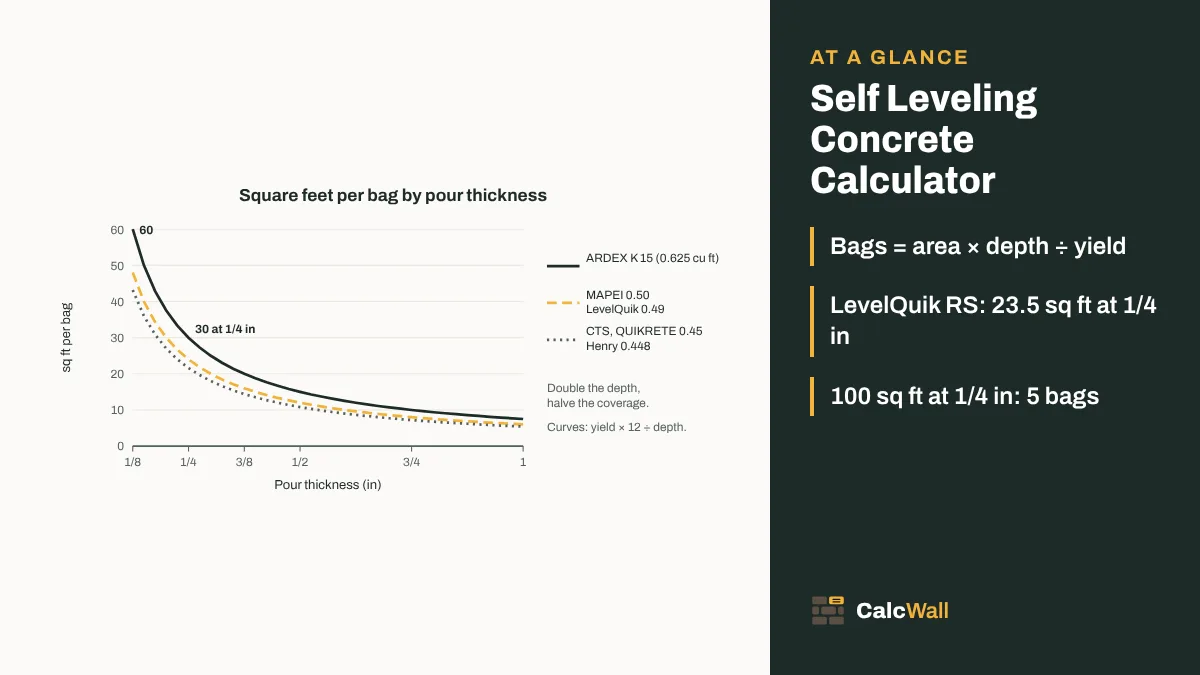
The yields come from each maker’s own coverage figure: coverage in sq ft × thickness in inches ÷ 12. LevelQuik RS covers 23.5 sq ft at 1/4 in (the middle of Custom’s 23–24 range), so its yield is 23.5 × 0.25 ÷ 12 = 0.49 cu ft. CTS and QUIKRETE print their yields directly, 0.45 cu ft per 50 lb bag.
Need a fill deeper than these products allow? The deepest neat rating on this page is 2 in (MAPEI). Past that, look at an aggregate-extended mix or regular concrete, and the concrete calculator handles that. This page is for thin, flowable underlayments.
Self leveling concrete coverage per bag by thickness
Coverage is the number most people want from a self-leveling concrete coverage calculator, and it depends on two things only: how much mixed material a bag makes, and how deep you pour it. The table shows each product’s published figure, the yield the calculator uses, and the coverage that yield gives at three common depths.
| Product (bag) | Published coverage | Yield used | Sq ft at 1/8 in | Sq ft at 1/4 in | Sq ft at 1/2 in | Thickness range |
|---|---|---|---|---|---|---|
| Custom LevelQuik RS (50 lb) | 23–24 sq ft at 1/4 in | 0.49 cu ft | 47.0 | 23.5 | 11.8 | Featheredge to 1.5 in per pour |
| ARDEX K 15 (55 lb) | 30 sq ft at 1/4 in | 0.625 cu ft | 60.0* | 30.0 | 15.0 | 1/4 in average minimum to 1 1/2 in neat; 5 in with aggregate |
| CTS Rapid Set TRU (50 lb) | 0.45 cu ft; 11–12 sq ft at 1/2 in | 0.45 cu ft | 43.2 | 21.6 | 10.8 | 1/8 in over the high point; aggregate above 1.5 in |
| MAPEI Ultraplan Easy (50 lb) | 24 sq ft at 1/4 in | 0.50 cu ft | 48.0 | 24.0 | 12.0 | 1/16 to 2 in single lift |
| Henry 555 LevelPro (40 lb) | 43 sq ft at 1/8 in | 0.448 cu ft | 43.0 | 21.5 | 10.8 | 1/8 in over high points; no maximum on the 2005 sheet |
| QUIKRETE Self-Leveling Floor Resurfacer (50 lb) | 0.45 cu ft; 21 sq ft at 1/4 in | 0.45 cu ft | 43.2 | 21.6 | 10.8 | Feather edge to 5/8 in per layer |
* ARDEX’s current data sheet sets an average minimum of 1/4 in, so the 1/8 in figure is arithmetic only. The coverage columns are yield × 12 ÷ depth, so they line up with the calculator. They can differ a little from a maker’s own chart. QUIKRETE, for example, prints both 0.45 cu ft and 21 sq ft at 1/4 in, and 21 sq ft at 1/4 in works out to 0.44 cu ft. The calculator uses the printed 0.45.
The Henry 555 figures come from Henry’s August 2005 data sheet (Rev. 08/05), the newest one we could find. A current sheet on henry.com could not be found when this page was written. If your bag prints a different coverage, divide it by the same arithmetic: sq ft × depth ÷ 12 gives the yield.
Bag weights differ, so compare yield, not weight. A 55 lb bag of ARDEX K 15 makes 0.625 cu ft. A 40 lb bag of Henry 555 makes 0.448 cu ft, close to the 0.45 of a 50 lb bag of CTS TRU or QUIKRETE. Bag price per cubic foot is the fair way to compare cost.
Bags per 100 square feet by thickness
This is the quick lookup for a 100 sq ft room. The first number is the exact result, the second is what you buy after rounding up. No waste is added here. Add 10% to the cubic feet before you divide if you want the same answer the calculator gives at its default setting.
| Product | 1/8 in (1.04 cu ft) | 1/4 in (2.08 cu ft) | 1/2 in (4.17 cu ft) | 1 in (8.33 cu ft) |
|---|---|---|---|---|
| LevelQuik RS | 2.13 → 3 | 4.26 → 5 | 8.51 → 9 | 17.02 → 18 |
| ARDEX K 15 | below its minimum | 3.33 → 4 | 6.67 → 7 | 13.33 → 14 |
| CTS Rapid Set TRU | 2.31 → 3 | 4.63 → 5 | 9.26 → 10 | 18.52 → 19 |
| MAPEI Ultraplan Easy | 2.08 → 3 | 4.17 → 5 | 8.33 → 9 | 16.67 → 17 |
| Henry 555 LevelPro | 2.33 → 3 | 4.65 → 5 | 9.30 → 10 | 18.60 → 19 |
| QUIKRETE resurfacer | 2.31 → 3 | 4.63 → 5 | 9.26 → 10 | over 5/8 in: pour in layers |
Notice how close most of them sit. At 1/4 in, five of the six products land on 5 bags per 100 sq ft. The bigger ARDEX bag is the outlier. The gap grows with depth: at 1 in, LevelQuik RS needs 18 bags while CTS TRU and Henry 555 need 19, and ARDEX needs 14.
Rounding matters on small jobs. 4.26 bags means five, and the spare 0.74 of a bag is your waste allowance. On a bigger floor, round the whole order up once rather than room by room. The calculator’s project total does that for you.
Uneven or sloped floors: average depth from readings
Few floors that need leveling are the same depth everywhere. Old slabs dip toward a drain, and wood floors sag between bearing walls. Using the deepest reading for the whole room buys too many bags. Using the shallowest leaves you short.
For a floor that slopes evenly from one side to the other, the average of the thinnest and thickest readings gives the right volume. That is how the calculator’s Sloped slab shape works: length × width × (deep end + shallow end) ÷ 2.
To take the readings, set a rotary laser or a long straight board on blocks so it sits level above the floor. Measure down to the slab at a grid of points, every few feet and at every obvious dip or hump. The highest point of the slab is where the pour is thinnest. It still needs the product’s minimum: 1/8 in for Henry 555 and CTS TRU.
A floor that dips in the middle is not a straight slope. Split it into zones, work out each zone with its own average depth, and add them up with the calculator’s project total. A dished 12 × 12 room might be a flat border at 1/8 in plus a 6 × 6 ft middle averaging 1/2 in.
Low spots are where bags vanish. A round dip 4 ft across and 1/2 in deep all over holds 3.1416 × 2² × 0.5 ÷ 12 = 0.52 cu ft, a full bag of most products. Find these before you order. If the low spot is deeper than the product allows, fill it first with a patch or an extended mix.
Minimum and maximum thickness
Every self-leveler has a range. Below the minimum, the material may not flow or bond well. Above the maximum, it can crack, curl or stay soft too long. The data sheets state these limits in plain numbers.
Here is the rule that one of the top-ranking floor-leveling calculators gets wrong: the thickest spot, not the average, must stay under the maximum. That page checks the average depth against the single-pour limit. A floor that runs from 1/4 in to 2 1/4 in has an average of 1 1/4 in, which looks fine for a 1.5 in product. But the 2 1/4 in end is 3/4 in over the limit.
| Product | Minimum | Maximum in one pour | Going deeper | Wear surface? |
|---|---|---|---|---|
| LevelQuik RS | Featheredge | 1.5 in | Second layer once the first is walkable; re-prime after 12 h | No |
| ARDEX K 15 | 1/4 in average | 1 1/2 in neat | Up to 5 in with aggregate; over wood or metal to 1/2 in | No |
| CTS Rapid Set TRU | 1/8 in over the high point (3/8 in if polished) | Not stated | Above 1.5 in, add 25 lb of 3/8 in pea gravel per bag | Yes |
| MAPEI Ultraplan Easy | 1/16 in | 2 in single lift | 24 h wait before a second application | No |
| Henry 555 LevelPro | 1/8 in over high points | Not stated on the 2005 sheet | Ask Henry | Not stated |
| QUIKRETE resurfacer | Feather edge | 5/8 in per layer | More layers, primed between each | Not stated; sold to go under tile, vinyl or carpet |
The calculator works out quantities. It does not check your readings against these limits, so do that step yourself with the table. If the deep end is over the limit, you have three choices: fill the low area first, pour in two lifts within the maker’s timing, or choose a product with a higher limit.
The minimum matters as much. ARDEX’s current data sheet sets an average minimum of 1/4 in for K 15. If your floor only needs 1/8 in of fill, a product rated for featheredge or 1/16 in is a better match.
Primer and floor prep
Every product on this page calls for a primer, and each maker names its own. Primer seals the slab so it does not suck water out of the mix, and it helps the leveler bond. It also stops air bubbling up out of porous concrete and leaving pinholes.
- LevelQuik RS: LevelQuik Advanced Acrylic Primer on porous surfaces, MBP Multi-Surface Bonding Primer or TechPrime E epoxy on others. Undiluted on wood.
- ARDEX K 15: ARDEX P 51 mixed 1:1 with water on absorbent concrete, with a first coat at 3 parts water on very absorbent slabs. ARDEX P 82 on non-porous surfaces.
- CTS Rapid Set TRU: Rapid Set TXP epoxy primer with sand broadcast to refusal.
- MAPEI Ultraplan Easy: “an appropriate MAPEI primer”. The data sheet does not name one, so ask MAPEI for your substrate.
- Henry 555: HENRY 554 primer, 1:1 with water on concrete, with a first coat at 3 parts water on very absorbent concrete. Full strength on wood. It covers 100–150 sq ft per quart.
- QUIKRETE resurfacer: QUIKRETE Concrete Bonding Adhesive, 1 part to 2 parts water, two coats on old porous concrete, dry to the touch in 1–2 hours.
For Henry 554 the primer count is easy to work out. A 144 sq ft room at 100–150 sq ft per quart needs one to two quarts. Buy the larger number for a dusty or thirsty slab.
Prep comes before primer. Concrete must be clean, sound and free of dust, paint, sealer and loose patches. Custom lists ICRI CSP 3 as the ideal surface profile for demanding work, and CTS asks for CSP 3 to 5. Smooth or sealed concrete usually needs grinding or shot blasting to get there.
Over wood, stiffness is the issue. Henry asks for at least 3/4 in tongue-and-groove, APA rated plywood. MAPEI accepts plywood or OSB on joists up to 19.2 in apart, meeting L/360. Custom and QUIKRETE call for metal lath fastened to the wood. Custom specifies 2.5 lb/yd² lath fastened every 6–8 in. ARDEX limits K 15 over wood or metal to 1/2 in.
Seal the room before you mix. Fill cracks and gaps at the walls, plug floor drains and holes, and dam the doorways. Self-leveler is runny enough to find every gap.
Mixing water, working time and pours
Self-leveler is mixed one whole bag at a time with a measured amount of water. More water makes it flow more easily, but the data sheets are clear that it weakens the mix. CTS says not to go over 4.5 qt per bag, and Henry warns against overwatering.
| Product | Water per bag | Flow or working time | Walk on | Floor covering |
|---|---|---|---|---|
| LevelQuik RS (50 lb) | 5.25–5.75 qt (5–5.4 L) | Pot life over 15 min | 2–4 h | Tile after 4 h; moisture-sensitive after 16 h |
| ARDEX K 15 (55 lb) | 7 qt (6.6 L) | 10 min flow time | 2–3 h | Tile after 6 h; others after 16 h |
| CTS Rapid Set TRU (50 lb) | 4.0–4.5 qt (3.8–4.3 L) | 20 min working; 15 min flow life | 2–3 h | Adhesive or thinset after 6 h; coatings after 12 h |
| MAPEI Ultraplan Easy (50 lb) | 5.75–6 qt (5.44–5.68 L) | Up to 15 min flow | 2–3 h | 3 h, or 16–24 h for moisture-sensitive (at 1 in) |
| Henry 555 (40 lb) | 5 qt | 10 min flow at 70°F | 2–3 h | Tile after 6 h; others after 16 h |
| QUIKRETE resurfacer (50 lb) | About 5 qt (4.7 L) | Fluid for about 20 min | Not stated | Not stated; follow the flooring maker |
If you want a fast concrete leveling product, look at the walk-on and floor covering columns, not just the name. Times are at about 70°F. Cold rooms slow everything down, and hot rooms shorten the flow time, sometimes a lot. Use the table to plan the water you need on site. Five bags of LevelQuik RS need about 26–29 qt, roughly 7 gallons, plus water for cleaning.
The flow time sets the pace of the job. Each new batch has to go down while the edge of the last one is still wet, or you get a ridge where they meet. On a small room, one person mixing and one pouring can usually keep up. Bigger floors need more mixers, or a pump.
Think about the number of pours before you start. On a big floor or one with several rooms, plan where each batch goes and where a day’s work will stop. A dam or form board at a doorway gives a clean edge for the next day. Mix outside the room if you can, and keep a clear path from the mixing station to the pour.
Metric: kg per m² per mm
The volume math is simpler in metric. One square meter poured one millimeter deep is exactly one liter. So liters = m² × depth in mm, and a bag that makes 13.86 L covers 13.86 m² at 1 mm, or 2.31 m² at 6 mm.
Many European and Australian products quote coverage as kilograms of powder per m² per mm instead. The table converts each yield both ways, using 28.317 L per cubic foot and the bag weights printed on each data sheet.
| Product | Bag | Liters per bag | m² per bag at 6 mm | kg powder per m² per mm |
|---|---|---|---|---|
| LevelQuik RS | 22.68 kg | 13.86 | 2.31 | 1.64 |
| ARDEX K 15 | 25 kg | 17.70 | 2.95 | 1.41 |
| CTS Rapid Set TRU | 22.7 kg | 12.74 | 2.12 | 1.78 |
| MAPEI Ultraplan Easy | 22.7 kg | 14.16 | 2.36 | 1.60 |
| Henry 555 | 18.14 kg | 12.68 | 2.11 | 1.43 |
| QUIKRETE resurfacer | 22.6 kg | 12.74 | 2.12 | 1.77 |
The kg figure is the bag weight divided by the liters it makes. If a product in your country lists 1.6 kg per m² per mm, a 4 × 3 m room at 6 mm takes 12 × 6 × 1.6 = 115 kg of powder, about five 25 kg bags before waste.
In a metric country the calculator opens in meters, with depth in centimeters. Enter 6 mm as 0.6 cm. The result shows in m³ and liters, and the bag list still uses the six products above. Prices are entered in your own currency, per bag. So it works as a self levelling concrete calculator in metric units too, with the same six bag yields.
We found no reliable published installed price for self-leveling floors in the UK, Canada, Australia, New Zealand or Germany, so this page gives none for those markets. Check a local supplier for the bag price and enter it in the calculator.
Concrete leveler vs floor resurfacer
QUIKRETE’s product in the list is a resurfacer, and the name matters. Its data sheet calls it a self-finishing underlayment for thin work: from a feather edge to 5/8 in per layer. Deeper areas go in more than one layer, primed between each.
The other five are self-leveling underlayments built for deeper fills. LevelQuik RS and ARDEX K 15 go to 1.5 in in one pour, MAPEI Ultraplan Easy to 2 in. ARDEX K 15 goes to 5 in with aggregate added, and CTS TRU takes pea gravel above 1.5 in.
So the choice comes from the deepest reading. If the worst spot is under 5/8 in, a resurfacer can do it in one layer. If it is 1 in, a resurfacer needs two layers with primer between, while an underlayment does it in one pour. Using the QUIKRETE self-leveling concrete calculator setting for a 1 in fill gives the right bag count, but the job still has to be poured in layers.
Neither is the same as a decorative finish floor. If you want the cement surface itself to be the floor, CTS TRU is the one product here that its maker rates as a wear surface. For a coated garage or shop floor, plan the coating with the epoxy calculator.
How flat the floor must be for tile or vinyl
The finished floor sets how flat the leveler has to be. For tile, the US standard is ANSI A108.02, as quoted by Scott Carothers of the Ceramic Tile Education Foundation in Stone World (August 16, 2024).
- Tile with all edges under 15 in: no more than 1/4 in in 10 ft from the required plane, and no more than 1/16 in in 12 in.
- Tile with any edge 15 in or longer: no more than 1/8 in in 10 ft, and no more than 1/16 in in 24 in.
Large-format tile is why so many floors get leveled. A 12 × 24 in tile falls into the stricter group, and a floor that was fine for 12 in tile can fail by a factor of two. Plan the tile and thinset with the tile calculator and the thinset calculator.
Vinyl makers each set their own rule. MSI’s luxury vinyl guide, for one, asks for a floor flat within 3/16 in in a 10 ft radius and 1/32 in in 12 in. Read the instructions for the exact floor you are buying, because they decide the warranty.
Carpet is more forgiving, but a big dip still shows. Measure for it with the carpet calculator once the floor is flat.
Self leveling concrete cost
Fixr publishes an estimate of $1.80 to $5 per sq ft for self-leveling concrete, materials and labor, and about $35 per 50 lb bag (page updated January 31, 2025). These are US published estimates, not quotes. Prices vary by brand, store and region.
For material cost alone, enter your bag price in the calculator and it multiplies by the rounded bag count. At Fixr’s $35 a bag, the 5 bags for a 100 sq ft room at 1/4 in come to $175, or $1.75 per sq ft for material before primer. Primer, a mixing paddle, buckets and a gauge rake add to that.
Depth drives the cost more than anything else. Every extra 1/4 in on a 100 sq ft floor adds 2.08 cu ft, which is 3.3 to 4.7 bags depending on the product. When one hump sets the depth for the whole room, price grinding it down against the extra bags.
Worked examples
These match the calculator with its default 10% waste unless noted. Change the bag size or waste in the tool to check them.
A 10 × 10 ft floor at 1/4 in
10 × 10 = 100 sq ft. 100 × 0.25 ÷ 12 = 2.08 cu ft. Plus 10% = 2.29 cu ft. LevelQuik RS: 2.29 ÷ 0.49 = 4.68, so 5 bags. ARDEX K 15: 2.29 ÷ 0.625 = 3.67, so 4 bags. MAPEI Ultraplan Easy: 4.58, so 5 bags. CTS TRU, Henry 555 and QUIKRETE: about 5.1, so 6 bags.
100 sq ft at 1/4 in, no waste
Using Area × depth with waste set to None: 100 × 0.25 ÷ 12 = 2.08 cu ft. LevelQuik RS: 2.08 ÷ 0.49 = 4.26 bags before waste, which the calculator rounds up to 5. ARDEX K 15: 2.08 ÷ 0.625 = 3.33, so 4 bags.
A sloping 12 × 10 ft floor
Readings of 1/2 in at the low end and 1/8 in at the high end. Average depth = (0.5 + 0.125) ÷ 2 = 0.3125 in. 12 × 10 × 0.3125 ÷ 12 = 3.13 cu ft, plus 10% = 3.44 cu ft. LevelQuik RS: 7.02, so 8 bags. ARDEX K 15: 5.5, so 6 bags. MAPEI: 6.88, so 7 bags.
The deep end, 1/2 in, is well inside every product’s limit. The 1/8 in high end meets the Henry and CTS minimum, but not ARDEX’s 1/4 in average minimum, so pick another product or pour a little deeper. These are the calculator’s Sloped slab defaults.
A 12 × 12 ft room at 3/8 in
144 × 0.375 ÷ 12 = 4.5 cu ft, plus 10% = 4.95 cu ft. LevelQuik RS: 10.11, so 11 bags. MAPEI Ultraplan Easy: 9.9, so 10 bags. ARDEX K 15: 7.92, so 8 bags. Henry 555: 11.05, so 12 bags. Water for 11 bags of LevelQuik RS: 11 × 5.25–5.75 = 58–63 qt, about 15 gallons.
Metric: a 4 × 3 m room at 6 mm
12 m² × 6 mm = 72 L, plus 10% = 79.2 L (0.0792 m³). LevelQuik RS makes 13.86 L a bag: 79.2 ÷ 13.86 = 5.71, so 6 bags. MAPEI: 79.2 ÷ 14.16 = 5.59, so 6 bags. ARDEX K 15: 79.2 ÷ 17.70 = 4.48, so 5 bags. In the calculator, enter 4 m, 3 m and 0.6 cm.
Notes for flooring installers
Check the deep end. Average depth is for buying bags. The single deepest reading is what you check against the product’s maximum.
Measure the water. Use a marked bucket for every batch. The sheets give a range in quarts, and going over weakens the pour.
Prime to the sheet. Each brand names its own primer and dilution. Follow the one on the bag you are pouring.
Know your flooring. Tile with any edge 15 in or longer needs 1/8 in in 10 ft. Check the target before you set the depth.
A good habit on any self-leveler job is to stage every bag in the room you will mix in before the first one is opened. Count them against the calculator’s number. Running out halfway through a pour leaves a cold joint that has to be ground flat later.
Keep a gauge rake or a smoother on hand, and wear spiked shoes if you need to walk in the wet pour. Most of these products level themselves, but a little help in the corners and along the walls gives a cleaner result.
Sources
Where the numbers on this page come from. Everything else is plain geometry and unit conversion, which the calculator does with exact factors.
- TDS-108 LevelQuik RS (Rapid Setting) Self-Leveling Underlayment, Custom Building Products, published 1/18/2024. Used for: 50 lb bag; coverage 46–48 sq ft at 1/8 in, 23–24 at 1/4, 11.5–12 at 1/2, 5.75–6 at 1, 3.8–4 at 1.5 in; featheredge to 1.5 in per pour; 5.25–5.75 qt water; pot life over 15 min; walkable in 2–4 h; tile after 4 h, moisture-sensitive floors after 16 h; primers; metal lath over wood; L/360 and L/720 deflection; not a wear surface; second-layer timing
- ARDEX K 15 Premium Self-Leveling Underlayment, Technical Data, ARDEX Americas, content updated 2026-04-02. Used for: 55 lb (25 kg) bag; 30 sq ft at 1/4 in; 7 qt water; average minimum 1/4 in, 1 1/2 in neat, 5 in with aggregate; 10 min flow time; walkable 2–3 h; tile after 6 h, other floors after 16 h; ARDEX P 51 primer 1:1, double prime on very absorbent concrete; not a wear surface
- ARDEX K 15 Summary Brochure, ARDEX Engineered Cements, AF128 12/15. Used for: ARDEX P 82 primer on non-porous surfaces and installation over wood or metal to 1/2 in
- TRU Self-Leveling Datasheet DS_021_EN, CTS Cement Manufacturing Corp. (Rapid Set), DS_021_EN_101322P, © 2022. Used for: 50 lb bag, 0.45 cu ft yield; 15–16 sq ft at 3/8 in, 11–12 at 1/2 in; 1/8 in minimum over the high point (3/8 in for polished floors); 25 lb pea gravel per bag above 1.5 in; 4.0–4.5 qt water; 20 min working time, 15 min flow life; foot traffic in 2–3 h; TXP epoxy primer with sand broadcast; rated as a wear surface
- Ultraplan Easy Technical Data Sheet, MAPEI Corporation, edition date June 25, 2024. Used for: 50 lb bag; 24 sq ft at 1/4 in, 12 at 1/2, 9 at 3/4, 6 at 1, 4 at 1.5, 3 at 2 in; 1/16 to 2 in single lift; 5.75–6 qt water; flow time up to 15 min; walk after 2–3 h; floor covering after 3 h or 16–24 h; plywood or OSB at 19.2 in on center and L/360; not a wear surface; 24 h before a second application
- HENRY 555 LevelPro Self-Leveling Underlayment data sheet, W.W. Henry Company (copy hosted by a retailer), Rev. 08/05; a current sheet on henry.com could not be found. Used for: 40 lb bag; 43 sq ft at 1/8 in; 5 qt water; 1/8 in minimum over high points; 10 min flow time at 70°F; walk on after 2–3 h; tile after 6 h, other floors after 16 h; 3/4 in tongue-and-groove plywood minimum
- HENRY 554 LevelPro Primer data sheet, W.W. Henry Company (copy hosted by a retailer), 01/07. Used for: 100–150 sq ft per quart; 1:1 with water on concrete, a first coat with 3 parts water on very absorbent concrete; full strength on wood
- QUIKRETE Self-Leveling Floor Resurfacer No. 1249-50 Data Sheet, QUIKRETE Companies, revised January 2024. Used for: 50 lb bag, 0.45 cu ft, 21 sq ft at 1/4 in; feather edge to 5/8 in per layer; about 5 qt water; fluid for about 20 min; Concrete Bonding Adhesive 1:2 with water as primer; wood floors with expanded metal lath
- How to Define Large-Format Tile and Its Subfloor Requirements, Stone World (Scott Carothers, Ceramic Tile Education Foundation), August 16, 2024. Used for: ANSI A108.02 substrate flatness: 1/4 in in 10 ft and 1/16 in in 12 in for tile under 15 in; 1/8 in in 10 ft and 1/16 in in 24 in for tile with an edge of 15 in or more
- Luxury vinyl tile and plank installation guide, MSI, no date shown; read November 11, 2026. Used for: one vinyl maker’s flatness rule: within 3/16 in in a 10 ft radius and 1/32 in in 12 in
- How much does it cost to level concrete?, Fixr, updated January 31, 2025. Used for: published estimate of $1.80 to $5 per sq ft installed and about $35 per 50 lb bag
- NIST Handbook 44, Appendix C: General Tables of Units of Measurement, National Institute of Standards and Technology, 2026 edition. Used for: 1 cu ft = 28.317 liters, 1 in = 25.4 mm, 1 lb = 0.4536 kg
Frequently asked questions
How much area does a bag of self-leveler cover?
At 1/4 in, a 50 lb bag covers about 21–24 sq ft, depending on the brand: MAPEI Ultraplan Easy lists 24 sq ft, LevelQuik RS 23–24 and QUIKRETE’s resurfacer 21. ARDEX K 15 comes in a 55 lb bag and lists 30 sq ft. Henry 555 comes in a 40 lb bag and lists 43 sq ft at 1/8 in, which works out to about 21.5 at 1/4 in. Halve the coverage each time you double the depth.
How thick can self-leveling concrete be poured?
It depends on the product. LevelQuik RS goes to 1.5 in in one pour, ARDEX K 15 to 1 1/2 in neat (5 in with aggregate), MAPEI Ultraplan Easy to 2 in, and QUIKRETE’s resurfacer to 5/8 in per layer. Check the deepest spot on the floor against that number, not the average depth.
How many bags of self-leveling concrete for 100 square feet at 1/4 in?
100 sq ft at 1/4 in is 2.08 cu ft. With LevelQuik RS at 0.49 cu ft per bag that is 4.26 bags, so 5 bags. ARDEX K 15 needs 3.33, so 4 bags. With 10% extra the counts stay the same, 5 and 4, because both round up to the same whole bag.
Do I need primer under self-leveler?
Yes, every data sheet on this page calls for one. Each brand names its own: LevelQuik Advanced Acrylic Primer, ARDEX P 51, Rapid Set TXP epoxy with a sand broadcast, a MAPEI primer, HENRY 554, or QUIKRETE Concrete Bonding Adhesive mixed 1 to 2 with water. Primer seals the pores so the slab does not pull water out of the mix.
How long does self-leveler take to dry?
Most of these products take foot traffic after 2–3 hours (LevelQuik RS lists 2–4). Tile can usually go down after 4–6 hours. Moisture-sensitive floors such as vinyl, wood or carpet need longer, typically 16 hours or more. MAPEI lists 16–24 hours for those at 1 in thick. Cold or damp rooms take longer.
Can I pour self-leveler over plywood?
Many products allow it if the floor is stiff and primed. Henry asks for at least 3/4 in tongue-and-groove plywood. MAPEI accepts plywood or OSB on joists no more than 19.2 in apart, meeting L/360. Custom and QUIKRETE call for metal lath fastened to the wood. ARDEX limits K 15 over wood to 1/2 in thick.
How much water goes in a bag of self-leveler?
It varies by brand: about 5 qt per 40 lb bag of Henry 555, 5.25–5.75 qt per 50 lb of LevelQuik RS, 5.75–6 qt for MAPEI Ultraplan Easy, 4.0–4.5 qt for CTS TRU, about 5 qt for QUIKRETE’s resurfacer and 7 qt per 55 lb bag of ARDEX K 15. Measure the water every time. Extra water weakens the mix.
Why did my self-leveler crack?
The usual causes are things the data sheets warn about: too much water, a skipped or wrong primer, a pour thicker than the product allows, or a floor that flexes. Over wood, the subfloor has to be stiff enough. Custom’s sheet uses L/360 as the limit for porcelain tile. Cracks in the slab underneath can also come through.
How do I measure an uneven floor for self-leveler?
Set a laser or a long straightedge across the floor and measure down to the slab at the high and low spots. The high spot needs at least the product’s minimum (1/8 in for Henry and CTS). Enter the thinnest and thickest readings in the Sloped slab shape and the calculator uses their average.
How much does self-leveling concrete cost per square foot?
Fixr publishes an estimate of $1.80 to $5 per sq ft installed, and about $35 per 50 lb bag (page updated January 31, 2025). Those are US dollar estimates. Enter your local bag price in the calculator for a material cost in your own currency.
How many bags of self-leveler for a 12x12 room?
A 12 × 12 ft room is 144 sq ft. At 1/4 in that is 3.00 cu ft, or 3.30 with 10% extra: 7 bags of LevelQuik RS or MAPEI Ultraplan Easy, or 6 bags of ARDEX K 15. At 3/8 in it is 4.95 cu ft with waste: 11 bags of LevelQuik RS, 10 of MAPEI or 8 of ARDEX.
Can self-leveler be the finished floor?
Most cannot. Custom, ARDEX and MAPEI all say their underlayments are not a wear surface and must be covered. CTS Rapid Set TRU is the exception on this page: CTS says it is designed as a wear surface for foot and rubber-wheeled traffic and can be polished after 24 hours.
What is the difference between self-leveling underlayment and resurfacer?
Both flow out flat. A resurfacer such as QUIKRETE’s is meant for thin work, from a feather edge to 5/8 in per layer. Underlayments such as LevelQuik RS, ARDEX K 15 and MAPEI Ultraplan Easy go to 1.5–2 in in one pour, so they can fill a much deeper low spot.
Can I pour self-leveler in two layers?
Yes, within each maker’s rules. Custom says to pour the second layer once the first is walkable, and to re-prime if more than 12 hours have passed. MAPEI lists a 24 hour wait before a second application. QUIKRETE builds depths over 5/8 in in layers, primed between each one.
How flat does a floor need to be for tile or vinyl?
For tile with all edges under 15 in, ANSI A108.02 allows 1/4 in in 10 ft. For tile with any edge 15 in or longer, the limit is 1/8 in in 10 ft. Vinyl makers set their own rules. MSI, for example, asks for 3/16 in in a 10 ft radius. Always check the sheet for your flooring.
Is this self leveling concrete calculator free to use online?
Yes. The CalcWall Self Leveling Concrete Calculator is completely free and works online in any browser, on a phone, tablet or computer. There is nothing to download and no account to create, and the math runs right in your browser, so results appear as you type.