Quick answer: at about 20 °C (68 °F), walk on new concrete after 48 hours, drive a car on it after 7 days and keep heavy loads off for 28 days. Keep it moist for at least 7 days. At 10 °C (50 °F) every time stretches by half, so cars wait about 10.5 days.
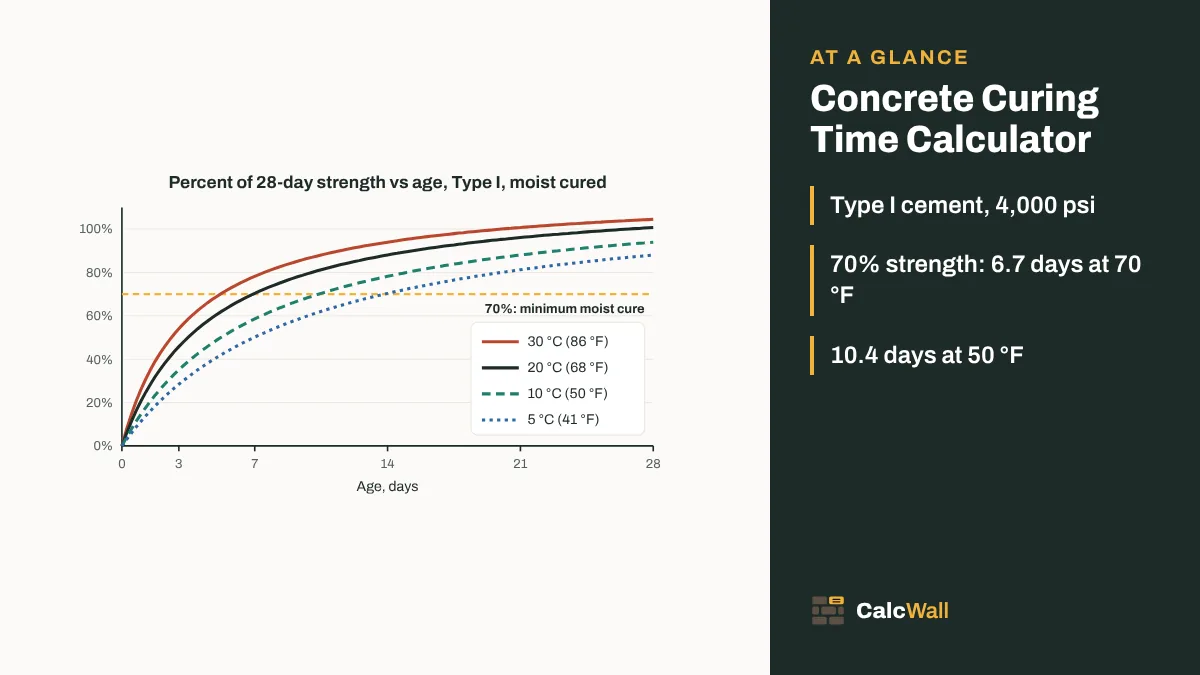
How to use the concrete curing time calculator
The tool answers one question: how many days until your concrete reaches a given strength at your temperature. Everything else on the result, from the walk time to the strength table, comes from that same curve. It works in °F and psi or °C and MPa, and it follows your country setting.
- Pick the cement and curing. Most ready-mix and bagged concrete uses Type I or I/II cement and is moist cured on site. Pick Type III only if the supplier says high-early. The steam-cured options are for precast plants.
- Enter the 28-day strength. This is the strength on the ticket or the bag: 4,000 psi is common for bagged mix, and 20 or 25 MPa for metric house work.
- Enter the average concrete temperature. Use the concrete temperature if you have it, or the temperature under the blankets or enclosure if it's protected. Otherwise use the average air temperature over the first week. Below 0 °C (32 °F) the tool shows no times, because fresh concrete must not freeze. One steady number is a simplification, which the section on temperature explains.
- Choose the target. Either a percent of the 28-day strength (70% is the default, the usual end of moist curing) or a strength in psi or MPa, such as the figure your engineer gave for stripping forms.
- Add the pour date if you want calendar dates next to each milestone and each row of the table.
The result shows the days to your target, then a strength table for days 1, 3, 7, 14, 28 and 56, then four milestones: light foot traffic, cars, heavy loads and how long to keep it moist. Below 40 °F (4.4 °C) a cold-weather warning appears. Above 32 °C (about 90 °F) you get a reminder to keep the surface wet.
You can share the result as a link. The link stores your inputs, so whoever opens it sees the same numbers. It is a concrete curing calculator for planning. It can’t see your actual concrete, and it isn’t a design tool.
Curing, setting and drying are different things
People use these words as if they meant the same thing, and that causes most of the bad advice about new concrete. They are separate processes on different clocks.
Setting is the change from a plastic mass to a solid. It happens in hours. QUIKRETE’s Fast-Setting mix reaches final set in 20 to 40 minutes; ordinary concrete takes longer, depending on mix and temperature. Some sites say concrete “sets in 24–48 hours”. That is wrong: 48 hours is a typical foot-traffic time, long after set.
Curing is what you do to keep moisture and temperature right so the cement keeps reacting. ACI 308R-16 defines it that way. Concrete doesn’t cure by drying out. Airflow speeds up moisture loss, not strength gain. PCA guidance says concrete left to dry in air reaches only about 50% of the strength of moist-cured concrete.
Strength gain is the result of curing, and it doesn’t stop at 28 days. That age is when strength is specified and tested. On the ACI 209 curve, moist-cured Type I concrete keeps going to about 108% of the 28-day figure by day 56.
Drying is the slow loss of spare mix water after curing ends. It matters for floors, coatings and adhesives, not for strength. A slab can be strong enough for a truck and still too wet for vinyl plank. That is why a concrete drying time calculator built on strength alone would mislead you. Drying gets its own section below.
One more mix-up: a curing compound is not a sealer. A curing compound is a membrane sprayed on right after finishing to hold water in. A sealer is a protective coat, usually applied weeks later. A few products, such as acrylic cure-and-seal, do both jobs, and their labels say so.
Concrete strength by day: 1, 3, 7, 14 and 28 days
The calculator uses the strength-time equation in ACI 209R-92. It is a simple curve fitted to laboratory data for moist-cured and steam-cured concrete, with two constants for each cement type. WSDOT’s PGSuper documentation reproduces the constants.
f(t) = t ÷ (a + β × t) × f′c28
Here t is age in days, f′c28 is the 28-day strength, and a and β depend on the cement. For moist-cured Type I, a = 4.0 and β = 0.85. At 7 days that is 7 ÷ (4.0 + 0.85 × 7) = 7 ÷ 9.95 = 0.704, or 70.4%.
You will see a “40, 65, 90, 99%” table on many sites, often credited to the Portland Cement Association. We could not find a PCA source that publishes it. The table below is our own arithmetic from the ACI 209 constants at a steady 20 °C, so treat it as a model, not a test result.
| Age | Type I, moist | Type III, moist | Type I, steam | Type III, steam | 4,000 psi Type I | 25 MPa Type I |
|---|---|---|---|---|---|---|
| 1 day | 20.6% | 31.1% | 51.3% | 59.5% | 820 psi | 5.2 MPa |
| 3 days | 45.8% | 59.3% | 77.9% | 82.4% | 1,830 psi | 11.5 MPa |
| 7 days | 70.4% | 80.1% | 91.5% | 92.6% | 2,810 psi | 17.6 MPa |
| 14 days | 88.1% | 92.2% | 97.9% | 97.1% | 3,520 psi | 22.0 MPa |
| 28 days | 100.7% | 99.8% | 101.4% | 99.5% | 4,030 psi | 25.2 MPa |
| 56 days | 108.5% | 104.1% | 103.3% | 100.8% | 4,340 psi | 27.1 MPa |
| 90 days | 111.8% | 105.8% | 104.0% | 101.2% | 4,470 psi | 28.0 MPa |
Two things stand out. The 28-day value isn’t exactly 100%, because the constants are fitted to data rather than forced through that point. The calculator shows those small overshoots as they come. And Type III is far ahead early but ends lower: its curve levels off near 109% of the 28-day figure (1 ÷ 0.92), against about 118% for Type I (1 ÷ 0.85).
If you came for a concrete psi calculator or a concrete strength calculator, the next table is the quick version. It applies the moist-cured Type I curve at 20 °C to common mix strengths. For other temperatures, enter your own in the tool above.
| 28-day mix | Day 1 | Day 3 | Day 7 | Day 14 | Day 28 |
|---|---|---|---|---|---|
| 2,500 psi | 520 psi | 1,150 psi | 1,760 psi | 2,200 psi | 2,520 psi |
| 3,000 psi | 620 psi | 1,370 psi | 2,110 psi | 2,640 psi | 3,020 psi |
| 4,000 psi | 820 psi | 1,830 psi | 2,810 psi | 3,520 psi | 4,030 psi |
| 5,000 psi | 1,030 psi | 2,290 psi | 3,520 psi | 4,400 psi | 5,040 psi |
| 20 MPa (Australian N20, UK ST4) | 4.1 MPa | 9.2 MPa | 14.1 MPa | 17.6 MPa | 20.1 MPa |
| 25 MPa (UK ST5) | 5.2 MPa | 11.5 MPa | 17.6 MPa | 22.0 MPa | 25.2 MPa |
Bag data sheets publish lower early numbers. QUIKRETE Concrete Mix lists 2,500 psi at 7 days and 4,000 psi at 28 days, which is 62.5% at a week. A sheet gives a minimum the product meets, so it sits below a mid-range curve. For the metric conversion, 4,000 psi is 27.6 MPa (4,000 × 0.006894757 = 27.58). Some sheets print 27.5, which is a rounding slip.
How temperature changes curing time
Cement reacts faster when it is warm and slower when it is cold. The maturity method in ASTM C1074 puts a number on that. The simplest version, the Nurse-Saul function, adds up degrees above a datum temperature over time. The FHWA says a datum of −10 °C (14 °F) is generally used.
equivalent age = days × (T + 10) ÷ 30, with T in °C
The 30 is the reference of 20 °C minus the −10 °C datum. NRMCA names 20 °C as one of two usual reference temperatures. At 20 °C a day counts as one day. At 10 °C it counts as 20 ÷ 30 = 0.67 of a day. At 30 °C it counts as 1.33 days. The calculator feeds that equivalent age into the ACI 209 curve, and it shows the factor under the result.
Here is how that plays out for 70% strength, the usual point to stop moist curing. Think of it as the concrete curing time chart the calculator works from. These are estimates from the model, not measured data.
| Steady temperature | Each day counts as | 70%, Type I | 70%, Type III | Walk (48 h guide) | Cars (7-day guide) | Heavy (28-day guide) |
|---|---|---|---|---|---|---|
| 40 °F (4.4 °C) | 0.48 day | 14.4 days | 9.4 days | 4.2 days | 14.5 days | 58.2 days |
| 50 °F (10 °C) | 0.67 day | 10.4 days | 6.8 days | 3 days | 10.5 days | 42 days |
| 60 °F (15.6 °C) | 0.85 day | 8.1 days | 5.3 days | 2.3 days | 8.2 days | 32.9 days |
| 70 °F (21.1 °C) | 1.04 days | 6.7 days | 4.4 days | 1.9 days | 6.8 days | 27 days |
| 80 °F (26.7 °C) | 1.22 days | 5.7 days | 3.7 days | 1.6 days | 5.7 days | 22.9 days |
| 90 °F (32.2 °C) | 1.41 days | 4.9 days | 3.2 days | 1.4 days | 5 days | 19.9 days |
The milestone columns are for Type I cement. Each is the 20 °C guide divided by the factor in the second column. At 50 °F, 7 ÷ 0.667 = 10.5 days.
What the model leaves out. Real concrete doesn’t sit at one temperature. It warms itself as the cement reacts, cools at night and loses heat fast in thin sections. Proper maturity testing logs the concrete temperature over time and calibrates the curve to that exact mix. NRMCA CIP 39 also suggests a 0 °C datum for Type I cement, which would make cold days count for less than this tool assumes.
So a single steady number is a simplification. It’s good for planning and for seeing how much the cold costs you. It doesn’t replace field-cured cylinders or a calibrated maturity sensor when a load or a stripping decision depends on it.
Hot concrete gets strong faster at first, but NRMCA notes it ends up weaker at later ages than concrete cured near 70 °F (20 °C). The ACI 209 curve doesn’t model that loss, so the calculator’s late-age numbers in hot weather run on the high side.
When you can walk, drive and build on new concrete
No building code sets a walk-on or drive-on time for a patio or driveway. The times people quote are trade guidance. The calculator uses the Illinois Ready Mixed Concrete Association’s flatwork guide: foot traffic after 48 hours under normal conditions, vehicles off for 7 days, and no heavy loads for at least 28 days.
We take “normal conditions” as 20 °C (68 °F). The calculator finds the strength that Type I concrete reaches at 48 hours, 7 days and 28 days at 20 °C. Then it works out how long your concrete takes to reach that same percentage at your temperature and cement. That is how the guide stretches in the cold and shrinks in the heat.
| Job | Typical time at about 20 °C | Source | Notes |
|---|---|---|---|
| Light foot traffic on a slab | 48 hours | IRMCA flatwork guide | About 35% of the 28-day strength on the Type I curve |
| Cars on a driveway | 7 days | IRMCA flatwork guide | About 70% on the Type I curve |
| Heavy loads: dumpsters, RVs, equipment | At least 28 days | IRMCA flatwork guide | Thickness and base matter as much as age |
| Wall and column forms off | 12–24 hours | US Army FM 5-428, Table 5-8 | Forms that carry no load; 1–7 days in cold weather (NRMCA CIP 27) |
| Fence post takes strain, regular mix | 24 hours | QUIKRETE 1101 data sheet | Bagged Concrete Mix |
| Walk on, or load a post, fast-setting mix | 4 hours | QUIKRETE 1004 data sheet | Product-specific |
| Foot and vehicle traffic, one high-strength bag mix | 24 h and 72 h | Sakrete High-Strength product page | Product-specific claim, faster than IRMCA |
| Acrylic sealer (example product) | At least 28 days | MASCO Acrylic Sealer data sheet | Follow your own sealer’s label |
| Begin moisture testing for wood floors | 30–45 days at the earliest | NWFA concrete subfloor guide | Ideal conditions only; test, then decide |
Sakrete’s 24-hour and 72-hour claims are for one specific bag mix. They don’t apply to ready-mix or to other products. If your bag gives a time, follow the bag. If it doesn’t, use the trade guidance and the calculator.
For a driveway, the clock isn’t the whole story. A thin slab under a loaded truck can crack at any age. Our concrete driveway cost calculator covers thickness and base, which decide what the slab can carry once it’s cured.
How long to keep concrete moist, and how
Start curing as soon as finishing is done. NRMCA is plain about this. A slab that dries out in the first day loses strength it never gets back. The table sets out how long each source asks for. They don’t all agree, so the longer figure is the safe one.
| Source | Minimum curing period | Conditions |
|---|---|---|
| PCA guidance (via Penn State CE 584) | 7 days, or until 70% of specified strength | Ordinary cement |
| PCA guidance (via Penn State CE 584) | 3 days | High-early-strength concrete above 10 °C (50 °F) |
| NRMCA CIP 11 | 3 to 7 days, or as specified | General in-place concrete |
| NRMCA CIP 12 | At least 3 days | Hot weather |
| QUIKRETE Concrete Mix 1101 | 5 days | 70 °F (21 °C) or warmer |
| QUIKRETE Concrete Mix 1101 | 7 days | 50–70 °F (10–21 °C) |
| US Army FM 5-428 | Usually 3 days to 2 weeks | Cast-in-place concrete |
ACI 308R-16 has a section on minimum curing requirements, but the free preview leaves it out and the full guide is paid. We haven’t quoted figures from it. The calculator shows 7 days and the day your concrete reaches 70%, so you can use whichever comes later.
| Method | How | Cautions |
|---|---|---|
| Sprinkling or fogging | Keep the surface wet all the time with a sprinkler or soaker hose | It must be continuous. Wet, dry, then wet again is not acceptable curing (NRMCA) |
| Ponding | Flood a flat slab inside a low dam | The most thorough water method (NRMCA), but only practical on level slabs |
| Wet burlap | Lay it once the surface won’t mark, and keep it soaked | Can leave patchy color on colored concrete (QUIKRETE) |
| Plastic sheeting | ASTM C171 film, at least 4 mils, laid flat, joints sealed, edges weighted | Wrinkles cause dark streaks; avoid where looks matter |
| Curing compound | Spray, brush or roll after final finishing, while damp but not wet. ASTM C309 or C1315 | Full coverage. Not if rain or below 50 °F is expected within 24 h (QUIKRETE). Wax-free if you will paint. Not in late fall where deicers will be used |
On a hot, dry or windy day, the surface can dry before finishing is even done. NRMCA suggests windbreaks, sunshades, fogging or evaporation retarders for that window. Then go straight to curing.
Fast-setting and high-early mixes
There are two ways to get concrete strong sooner, and they aren’t the same thing. A Type III high-early cement is a ready-mix or precast choice. It hydrates faster. In the calculator, choose “Type III high-early cement, moist cured”. On the ACI 209 curve it reaches 70% at 20 °C in 4.5 days instead of 6.9.
A fast-setting bag mix is a product with its own chemistry. QUIKRETE Fast-Setting reaches final set in 20 to 40 minutes and can take foot traffic or a post load after 4 hours. Its sheet gives 1,000 psi at 24 hours, 2,500 psi at 7 days and 4,000 psi at 28.
Sakrete Fast Setting lists 2,500 psi at 3 days, 3,500 at 7 and 4,000 at 28. Neither fits the ACI 209 curves well. For these, follow the bag rather than the calculator’s milestones.
Most fence and deck posts go in with fast-setting mix. The post hole concrete calculator works out how many bags each hole needs. Fast-setting mix still needs moist curing: QUIKRETE asks for 5 days in warm weather.
Accelerating admixtures sit in between. NRMCA says calcium chloride works but should not exceed 2% by weight of cement, and it recommends non-chloride types where steel corrosion is a concern. The calculator has no accelerator setting. If your ticket shows one, the model will run slow, which errs on the safe side.
Cold-weather and hot-weather curing
NRMCA defines cold weather as more than three days in a row averaging below 40 °F (4.4 °C). The calculator shows a cold-weather note below that line. The rules that matter most:
- Don’t let it freeze early. Protect concrete from freezing until it reaches 500 psi (3.5 MPa), per NRMCA. QUIKRETE puts it as the first 48 hours for its bagged mix.
- Place it warm enough. FM 5-428 and CIP 27 give minimum concrete temperatures of about 55 °F for sections under 12 in, 50 °F for 12 to 36 in and 45 °F for 36 to 72 in.
- Keep the heat in. Insulated blankets, tarps, or straw under plastic sheets are common. Vent fuel-burning heaters in enclosures, for safety and because the fumes can make the surface dust.
- Remove protection slowly. A sudden drop in temperature can crack the surface. NRMCA warns about a difference of more than about 35 °F (20 °C) between surface and core.
- Wait for 3,500 psi before freeze-thaw. Air-entrained concrete that will get wet and freeze should reach about 3,500 psi first, per NRMCA.
One honest gap: NRMCA says 500 psi takes about two days, but the model says a 4,000 psi Type I mix at a steady 40 °F gets there in about 28 hours. The model doesn’t know about cold ground, thin edges or wind. Use the longer of the two for protection, and the calculator for everything after.
Hot weather has no single temperature trigger in NRMCA CIP 12. It is any mix of heat, wind and low humidity that speeds up moisture loss and hydration. The calculator’s hot-weather note appears above 32 °C (about 90 °F); that threshold is the tool’s own, not a standard.
In heat, start curing at once and keep it going at least 3 days. Use white curing compound or wet burlap under plastic. Don’t sprinkle water on the surface to help finishing, and don’t add water to concrete more than 1½ hours old.
Drying before flooring, paint or sealer
Strength and dryness run on separate clocks. You can drive on a slab after a week, and it can still hold too much water for a glued-down floor months later. A concrete dry time calculator based on days alone is guesswork. The real answer comes from a test.
The rule of thumb. BRANZ quotes an old rule of a month of drying for every 25 mm of slab. A 100 mm (4 in) slab would need about four months. It’s a rough guide at best. Drying depends on the mix, the air humidity, the temperature and the airflow over the surface.
The test. ASTM F2170 measures relative humidity inside the slab with probes. For a slab drying from the top only, the probe goes at 40% of the thickness; for one drying from both sides, 20%. Wait 24 hours after drilling for the hole to settle before reading. BRANZ’s table of maximum readings at 40% depth runs from 80% RH for timber strip to 90% for PVC. Your flooring maker’s own limit is the one that counts.
Wood floors. The NWFA says that even under ideal conditions a slab may take 30–45 days before you can begin evaluating it. That is the start of testing, not a green light.
Sealers and coatings. Many sealers want fully cured concrete; MASCO Acrylic Sealer asks for at least 28 days. Cure-and-seal products go on at day zero instead, as the curing membrane. Our sealant calculator works out coverage once you’ve chosen one. Epoxy coatings and self-leveling toppings have their own moisture limits on their data sheets. The epoxy calculator and self leveling concrete calculator handle the quantities. If you would rather grind and polish the slab, the polished concrete cost calculator prices that instead.
Worked examples
Each example below uses the calculator’s defaults unless stated, and the numbers match what the tool shows. Check them by entering the same inputs.
A driveway poured on a cool autumn day
Type I/II, 4,000 psi, 50 °F, target 70%. 50 °F is 10 °C, so each day counts as (10 + 10) ÷ 30 = 0.667 days. On the curve, 70% needs an equivalent age of 0.7 × 4.0 ÷ (1 − 0.7 × 0.85) = 6.91 days. Real time = 6.91 ÷ 0.667 = 10.4 days. Day 7 shows 59% = 2,340 psi and day 28 shows 94% = 3,760 psi. Walk at 3 days, cars at 10.5, heavy loads at 42.
A metric garage slab in summer
Units °C and MPa, Type I/II, 25 MPa, average 25 °C, target 70%. Each day counts as 35 ÷ 30 = 1.17 days. 70% (17.5 MPa) arrives at 6.91 ÷ 1.167 = 5.9 days. Day 7 shows 75% = 18.7 MPa, day 28 shows 103% = 25.7 MPa. Light foot traffic at 1.7 days, cars at 6 days, heavy loads at 24 days. Above 32 °C the hot-weather note would appear; at 25 °C it doesn’t.
Reaching 3,000 psi with high-early cement
An engineer wants 3,000 psi before loading a wall. Choose “A strength I need”, a 4,000 psi mix, 70 °F and 3,000 psi. That is 75%. Type I/II: equivalent age 0.75 × 4.0 ÷ (1 − 0.75 × 0.85) = 8.28 days, ÷ 1.037 = 8 days. Switch to Type III: 0.75 × 2.3 ÷ (1 − 0.75 × 0.92) = 5.56, ÷ 1.037 = 5.4 days. High-early cement saves about two and a half days here.
Cold-weather protection to 500 psi
Type I/II, 4,000 psi, 40 °F, “A strength I need” = 500 psi, or 12.5% (shown as 13%). Each day counts as (4.44 + 10) ÷ 30 = 0.48. Equivalent age = 0.125 × 4.0 ÷ (1 − 0.125 × 0.85) = 0.559 days, ÷ 0.481 = 1.2 days. NRMCA’s guide is about two days, so keep the blankets on for 48 hours. Cars wait 14.5 days.
At exactly 40 °F the cold-weather note stays hidden, because it starts just below 4.44 °C. Enter 39 °F and it shows.
Those are the main ways to use it as a concrete cure time calculator. You can also read it backwards: put in the day you need the slab and change the temperature until the cars milestone lands before it. That tells you how warm you need to keep it.
Notes for pros
The tool is a planning curve. It is generic ACI 209 with a steady-temperature Nurse-Saul factor. For stripping, tensioning or opening to traffic on a spec job, use field-cured cylinders or calibrated maturity sensors.
Datum choice moves cold results. The tool uses −10 °C per FHWA. NRMCA CIP 39 suggests 0 °C for Type I. At 5 °C the second gives a factor of 0.25 instead of 0.5, so cold estimates here lean optimistic.
Blended mixes aren’t modeled. There is no setting for fly ash or slag. If the ticket shows either, ask the supplier for their strength data and compare it with the curve.
Curing compound and coatings clash. NRMCA recommends wax-free compounds where paint follows. If any coating or adhesive goes on later, choose the compound with that in mind.
- Milestones on this page are trade and maker guidance, not code. Specifications, the engineer of record and the local building authority decide load and form-stripping times.
- For quantities, start with the concrete calculator, then plan the cure here.
Sources
Where the numbers on this page come from. Everything else is plain geometry and unit conversion, which the calculator does with exact factors.
- PGSuper Technical Guide: Time-Dependent Material Models (ACI 209R-92), Washington State Department of Transportation, Bridge and Structures Office, PGSuper 8.0 documentation. Used for: the ACI 209R-92 strength-time equation and its Table 2.2.1 constants (moist-cured Type I a = 4.0, β = 0.85; Type III a = 2.3, β = 0.92; steam-cured Type I a = 1.0, β = 0.95; Type III a = 0.7, β = 0.98). Every percent, psi and MPa figure in the strength tables is arithmetic from these constants.
- Maturity Testing for Concrete Pavement Applications (TechBrief FHWA-IF-06-004), Federal Highway Administration, November 2005. Used for: the Nurse-Saul maturity function M = Σ(Ta − T0)Δt, the −10 °C (14 °F) datum temperature, and the note that both maturity functions are set out in ASTM C1074
- CIP 39: Maturity Methods to Estimate Concrete Strength, National Ready Mixed Concrete Association (NRMCA), Concrete in Practice series, footer years 2006 and 2019. Used for: maturity expressed as equivalent age at a reference temperature of 20 °C or 23 °C, and the 0 °C datum it suggests for Type I cement
- Curing Concrete: Normal, Hot and Cold Weather (CE 584 course library), Pennsylvania State University, Department of Civil and Environmental Engineering (compiled from PCA Design and Control of Concrete Mixtures), undated course page. Used for: curing for at least 7 days or until 70% of the specified strength, 3 days for high-early-strength concrete above 10 °C (50 °F), and air-dried concrete gaining only about 50% of the strength of moist-cured concrete
- CIP 11: Curing In-Place Concrete, NRMCA, Concrete in Practice series, 1982, 1989, 2000, 2017. Used for: cure for at least 3 to 7 days or as specified; start right after finishing; fogging, sprinkling and ponding; no alternate wetting and drying; plastic film to ASTM C171 at least 4 mils thick, which can streak; curing compounds to ASTM C309 or C1315, wax-free where paint follows
- CIP 27: Cold Weather Concreting, NRMCA, Concrete in Practice series, footer years 1998 and 2014. Used for: cold weather as more than 3 days in a row averaging below 40 °F; protect from freezing until 500 psi (3.5 MPa), which it says takes about two days; 3,500 psi before freeze-thaw exposure; placing temperatures by section size; calcium chloride no more than 2% by weight of cement; vented heaters; blankets; the 35 °F (20 °C) surface-to-core warning; forms left 1 to 7 days in cold weather
- CIP 12: Hot Weather Concreting, NRMCA, Concrete in Practice series, footer years 1982, 1989, 2000, 2014. Used for: the hot-weather definition, lower later-age strength when concrete is cured hot early, curing for at least 3 days, wet burlap and plastic, white curing compound, windbreaks and fogging, no water sprinkled on the surface for finishing, no water added to concrete more than 1½ hours old
- FM 5-428 Concrete and Masonry (paras 5-72, 5-81, 5-82, 5-93; Tables 5-6 and 5-8), Headquarters, Department of the Army, 18 June 1998. Used for: protect from freezing at 40 °F or lower, minimum placing temperatures of 55, 50 and 45 °F by section size, curing of cast-in-place concrete usually 3 days to 2 weeks, and form stripping of walls and columns at 12 to 24 hours
- Concrete Guide for Residential Exterior Flatwork, Illinois Ready Mixed Concrete Association (IRMCA), undated. Used for: the milestone guidance the calculator scales: foot traffic after 48 hours under normal conditions, vehicles off for 7 days, and no heavy loads for at least 28 days
- High-Strength Concrete Mix (4,000 PSI) product page, Sakrete, product page, accessed 11 November 2026. Used for: the product-specific claim of foot traffic in 24 hours and vehicle traffic in 72 hours
- Fast Setting Concrete Mix technical data sheet, Sakrete (Oldcastle APG / CRH), Rev. 05/18. Used for: published strengths of 2,500 psi at 3 days, 3,500 psi at 7 days and 4,000 psi at 28 days
- QUIKRETE Concrete Mix data sheet, Product No. 1101, The QUIKRETE Companies, revised October 2022. Used for: moist cure 5 days at 70 °F (21 °C) or higher and 7 days at 50–70 °F; 2,500 psi at 7 days and 4,000 psi at 28 days; protect from freezing for the first 48 hours; no curing compound if rain or temperatures below 50 °F (10 °C) are expected within 24 hours, nor in late fall where deicers will be used; plastic laid flat and sealed; burlap and plastic can discolor colored concrete; posts take strain after 24 hours
- QUIKRETE Fast-Setting Concrete Mix data sheet, Product No. 1004, The QUIKRETE Companies, revised November 2025. Used for: final set in 20 to 40 minutes, wait 4 hours before walking on a slab or loading a post, moist cure 5 days in warm weather, 1,000 psi at 24 hours, 2,500 psi at 7 days and 4,000 psi (27.6 MPa) at 28 days
- ACI 308R-16 Guide to External Curing of Concrete (free preview), American Concrete Institute, Committee 308, ACI 308R-16, first printing May 2016 (supersedes 308R-01). Used for: the definition of curing (keeping moisture and temperature so hydration can go on). The preview omits section 3.9 on minimum requirements, so no minimum from it is quoted here.
- MASCO Acrylic Sealer product data sheet, MASCO (Mason’s Supply Company), rev. 8/3/2023. Used for: an example sealer that needs concrete cured at least 28 days
- Is that concrete floor dry yet? (BUILD 92), BRANZ (Neil Lee, concrete scientist), BUILD magazine, February/March 2006. Used for: the old rule of thumb of a month of drying per 25 mm of slab, the factors that change drying, and its table of maximum relative humidity before floor coverings (probe at 40% depth: timber strip 80%, carpet 85%, PVC 90%)
- NWFA Installation Guidelines: Concrete Subfloors, National Wood Flooring Association, © 2019, drawings dated 9-2-19. Used for: under ideal conditions a slab may take 30–45 days before you can begin evaluating it for wood flooring, and the flooring and adhesive makers’ moisture limits govern
- Performing Correct and Accurate RH Testing in Concrete Slabs, Wagner Meters (Jason Spangler), undated. Used for: ASTM F2170 probe depth of 40% of the slab thickness (20% when it dries from both sides) and the 24-hour wait for the hole to reach equilibrium
- NCC 2022 Housing Provisions, Part 4.2 Footings, slabs and associated elements, Australian Building Codes Board, NCC 2022. Used for: an Australian house footing or slab needs at least N20, 20 MPa at 28 days
- Standardised Prescribed Concrete, Tarmac, product page, accessed 11 November 2026. Used for: UK BS 8500 mixes ST4 (20 N/mm²) for garage bases and floor slabs and ST5 (25 N/mm²) for external paving bases
- NIST Handbook 44, Appendix C: General Tables of Units of Measurement, National Institute of Standards and Technology, 2026 edition. Used for: 1 psi = 6.894757 kPa, so 4,000 psi = 27.58 MPa (27.6 rounded) and 500 psi = 3.45 MPa
Frequently asked questions
How long does concrete take to cure?
Curing is the time you keep it moist and warm: at least 7 days for ordinary concrete, or until it reaches 70% of its design strength, per PCA guidance. Strength keeps climbing after that. On the ACI 209 curve, Type I concrete at 20 °C (68 °F) is at 70% on day 7, about 100% on day 28 and 108% on day 56.
How long before I can walk on new concrete?
The Illinois Ready Mixed Concrete Association says foot traffic is fine after 48 hours under normal conditions. That assumes about 20 °C. At 10 °C (50 °F) the calculator stretches it to 3 days, because the concrete gains strength about two thirds as fast. Fast-setting bag mixes are different: QUIKRETE says 4 hours for its Fast-Setting mix.
How long before I can drive on a new driveway?
Keep cars off for 7 days at normal temperatures, per IRMCA. The calculator scales that by temperature: about 10.5 days at 50 °F and 14.5 days at 40 °F for Type I concrete. Sakrete claims 72 hours for its High-Strength mix, but that is one product’s claim, not general guidance.
How long before heavy trucks can use new concrete?
IRMCA says avoid heavy loads such as dumpsters, RVs and equipment for at least 28 days. In cold weather the calculator moves that out to about 42 days at 50 °F. A loaded truck on a thin residential driveway can crack it even when the concrete is fully cured, so thickness and base matter too.
How strong is concrete after 7 days?
About 70% of its 28-day strength for moist-cured Type I cement at 20 °C on the ACI 209 curve. A 4,000 psi mix is near 2,810 psi. Type III high-early cement is near 80%. Bag data sheets list lower figures: QUIKRETE Concrete Mix gives 2,500 psi at 7 days, which is 62.5% of 4,000, because sheets state minimums.
Is concrete fully cured at 28 days?
No. Twenty-eight days is the age at which strength is specified and tested, not the end of strength gain. On the ACI 209 curve for moist-cured Type I cement, strength reaches about 108% of the 28-day value by day 56 and 112% by day 90, if the concrete stays moist. Drying for floors can take longer still.
What is the difference between curing and drying?
Curing means keeping water in the concrete so the cement keeps reacting and gaining strength. Drying means letting spare water leave so floor coverings, coatings and adhesives bond and don’t fail. You cure first, for days. Drying takes weeks to months, and you check it with relative humidity probes rather than counting days.
How does cold weather affect curing time?
Strength gain slows with temperature. With the Nurse-Saul model the calculator uses, a day at 10 °C (50 °F) counts as 0.67 of a day at 20 °C, and a day at 4.4 °C (40 °F) counts as 0.48. So 70% strength takes about 10.4 days at 50 °F and 14.4 days at 40 °F, against 6.9 days at 68 °F.
Can concrete cure below freezing?
Fresh concrete must not freeze. NRMCA says protect it until it reaches 500 psi (3.5 MPa), and QUIKRETE says protect bagged mix for the first 48 hours. The maturity model counts some gain down to −10 °C (14 °F), but that only applies to concrete that is already hard and kept from freezing by its own heat or by blankets. So the calculator gives no times below 0 °C (32 °F). Enter the temperature of the concrete under its protection instead, and check the strength with test cylinders before loading.
How long should I keep concrete wet?
At least 7 days for ordinary cement or until it reaches 70% of its strength, per PCA. QUIKRETE says 5 days at 70 °F or warmer and 7 days at 50–70 °F. NRMCA gives 3 to 7 days unless the specification says more. Keep it wet the whole time: letting it dry and then wetting it again is not acceptable curing.
Should I cover new concrete with plastic?
Plastic works well if it is laid flat, sealed at the joints and weighted at the edges, as QUIKRETE describes. NRMCA asks for film to ASTM C171, at least 4 mils thick. Wrinkles leave dark streaks, so skip plastic where looks matter and on colored concrete. Use a curing compound or keep the surface wet there instead.
When can forms be removed from a footing or wall?
The US Army’s FM 5-428 table gives 12 to 24 hours for walls and columns, where the forms carry no load. In cold weather NRMCA says forms may need 1 to 7 days. Footing side forms are similar, but your engineer or local inspector decides, and a cold pour needs more time.
How long does fast-setting concrete take to cure?
QUIKRETE Fast-Setting Concrete Mix reaches final set in 20 to 40 minutes and can take foot traffic or a post load after 4 hours. It still needs moist curing: the data sheet says 5 days in warm weather. It reaches 1,000 psi at 24 hours, 2,500 psi at 7 days and 4,000 psi at 28 days.
When can I put a sealer on new concrete?
Read the sealer’s label. MASCO Acrylic Sealer, for example, needs concrete cured at least 28 days. Cure-and-seal products are different: they go on right after finishing, as the curing membrane. Our sealant calculator works out how many gallons to buy once you know which product you are using.
How long before I can lay flooring on a new slab?
Test rather than count days. An old BRANZ rule of thumb says a month of drying per 25 mm of slab, so a 100 mm (4 in) slab needs about four months. The NWFA says even an ideal slab takes 30–45 days before you can start evaluating it. Run ASTM F2170 relative humidity tests and follow the flooring maker’s limit.
Does rain hurt freshly poured concrete?
Rain on a surface that has not set can wash out cement paste and leave a weak, dusty top. Cover the slab with plastic if rain is coming. QUIKRETE also says do not apply curing compound if rain is expected within 24 hours. Once the concrete has hardened, gentle rain does no harm and even helps keep it moist.
How long before I can build on a footing?
No single published figure covers it, because it depends on the load and the mix. Side forms on walls come off in 12 to 24 hours per FM 5-428, but that is not the same as loading. Many inspectors and engineers set their own wait, so ask them. In cold weather, use the calculator to see how far behind normal your concrete is.
Is this concrete curing time calculator free to use online?
Yes. The CalcWall Concrete Curing Time Calculator is completely free and works online in any browser, on a phone, tablet or computer. There is nothing to download and no account to create, and the math runs right in your browser, so results appear as you type.