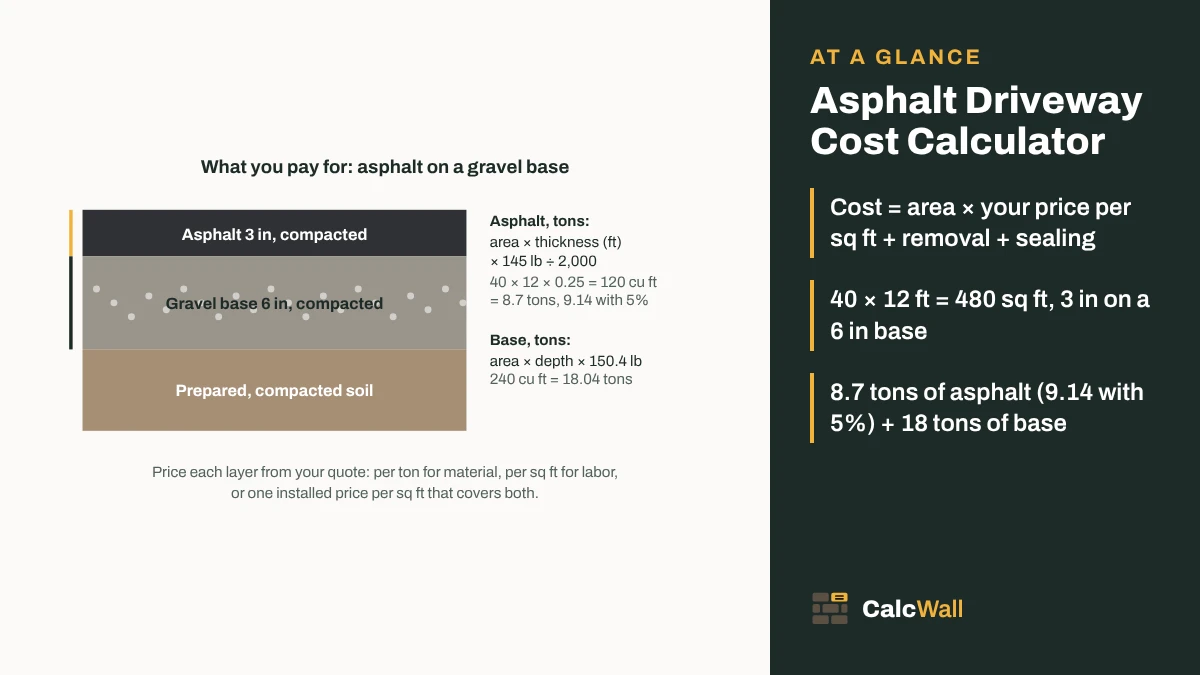
Quick answer: asphalt driveway cost = area × the installed price per square foot in your quote, plus removal, sealing and any flat extras. A 40 × 12 ft driveway is 480 sq ft and, at 3 in, takes 8.7 tons of asphalt (9.14 with 5% waste) on 18.04 tons of gravel base.
When can I pave? Check the next 7 days
Type your US ZIP code to see the next 7 days from the US National Weather Service, with a badge for each day: Good, Risky or No for an asphalt driveway. It is a planning guide, not a guarantee: check the forecast again the evening before.
The forecast check covers US ZIP codes only (it uses the US National Weather Service). Wherever you are, the rules below still apply: hold them against your own national weather service’s forecast.
How each day is rated
- Good A high of at least 50 °F (10 °C), not falling during the day, and rain no more than a slight chance (20%).
- Risky A high of 40–49 °F (5–9 °C), a temperature that falls during the day, or a chance of rain (30–50%).
- No A high below 40 °F (5 °C), or rain likely (60% or more): asphalt goes down only on a dry surface.
Hot mix cools fast on a cold day and gets hard to compact. Thin top courses need the most warmth, so most paving crews want 50 °F and rising. Your paver’s own limits come first.
Rain words follow the National Weather Service: 20% is a “slight chance”, 30–50% a “chance”, 60–70% “likely”. The forecast is for the ZIP’s center point, so a hilltop or a valley can be a few degrees off.
Where these rules come from
- Construction and Material Specifications, Item 401.06 Weather Limitations, Ohio Department of Transportation, 2005 CMS. Used for: place asphalt only on a dry surface; no surface courses when the air is below 40 °F (5 °C); thin courses need a 50 °F (10 °C) surface
- Cold Weather Paving, Pavement Interactive, Reference Desk, read 16 November 2026. Used for: cold-weather paving is commonly taken as air below about 50 °F (10 °C)
- API Web Service, US National Weather Service, api.weather.gov documentation, read 16 November 2026. Used for: the 7-day forecast in 12-hour periods; free open data, no key
- Forecast terms (probability of precipitation), NWS Binghamton, NY, web page, read 16 November 2026. Used for: 20% slight chance, 30–50% chance, 60–70% likely
- ZCTA Gazetteer file, US Census Bureau, 2025 Gazetteer (2025_Gaz_zcta_national). Used for: the point each ZIP code is looked up at (ZCTA internal point)
How to use the calculator
The calculator works in the same order as a paving quote. Fill it in step by step.
- Pick the job. A new driveway, a replacement (the old one comes out first) or an overlay (a new layer on top of the old asphalt).
- Enter the size. Length and width, or the total area if you have already added up an odd shape. Feet or meters.
- Set the thickness. The compacted asphalt thickness and the gravel base depth from your quote. An overlay has no new base, so that box hides.
- Type your prices. Either one installed price per square foot (most quotes) or line items: asphalt per ton, base per ton and labor per square foot. Add removal for a replacement, a seal coat and any flat extras such as edging, drainage or a permit.
- Compare with concrete. Optional. Type a concrete price per square foot and the calculator puts the concrete total next to the asphalt total.
The answer is the total, the cost per square foot and a line for each item. Under it you get the tons of asphalt and base for the job. Those quantities come from the same engine as our asphalt calculator, so the tons agree on both pages.
Until you type a price, the main answer shows the asphalt to order instead of a cost. The calculator never invents a price for you. Copy the link to save or share your numbers, or open the live 3D model to see the asphalt on its base.
Asphalt driveway cost per square foot
Pavers price most driveways by the square foot (or square meter). The figure covers everything on the quote divided by the area: grading, base, asphalt, rolling and cleanup. That is why the asphalt driveway cost per square foot is the easiest way to compare two quotes for the same driveway.
Total = area × installed price per sq ft + removal + sealing + flat extras
Cost per sq ft = total ÷ area
If your quote lists items instead, the calculator adds them up the same way a paver does:
Total = asphalt tons × price per ton + base tons × price per ton + area × labor per sq ft + extras
Then it divides by the area, so you get a per-square-foot figure you can compare with an all-in quote. Two quotes that look far apart often turn out to be for different thicknesses. Put both through the calculator with their own thickness and the difference in tons shows straight away.
What the price includes: base, asphalt, labor, removal
Read the quote line by line. Each item below is a box in the calculator, and each one changes the total in a different way.
| Item | How it is usually priced | What drives it | Box in the calculator |
|---|---|---|---|
| Asphalt (hot mix) | Per ton, or inside the per-sq-ft price | Area × compacted thickness × 145 lb/cu ft | Asphalt per ton |
| Gravel base | Per ton, or inside the per-sq-ft price | Area × compacted depth × 2.03 tons per cu yd | Base per ton |
| Labor and equipment | Per sq ft, or per day | Area, access, hand work at edges | Labor per sq ft |
| Removing the old surface | Per sq ft, sometimes with a haul fee | Area, thickness of the old surface | Removal per sq ft |
| Seal coat | Per sq ft | Area; often a later job | Seal coat per sq ft |
| Edging, drainage, permit | Flat amount | Your site and your local rules | Other, flat |
Weights: asphalt at 145 lb per cu ft (FHWA estimating table), compacted base at 2.03 tons per cu yd (Tennessee DOT), as in our asphalt and road base calculators.
The base. The base carries the load. It is crushed stone, spread and rolled in layers. Its weight runs about the same as the asphalt per inch: 1.21 tons of asphalt or 1.25 tons of base per 100 sq ft at 2 in. A 6 in base therefore weighs about twice as much as 3 in of asphalt. If the quote does not mention the base at all, ask.
Labor. Crews, the paver machine, the roller and trucks. Small jobs cost more per square foot because the crew and machines still have to come out.
Removal. Only for a replacement. Breaking out old concrete is a different job from milling old asphalt, so ask which one the quote prices.
New vs replacement vs overlay
The same driveway can be priced three ways, and the job type changes which boxes count.
- New. Dig out topsoil, grade for drainage, lay and roll the base, then pave. The calculator counts base and asphalt.
- Replacement. The old surface comes out first, then it is the same as a new driveway. The removal box appears. A sound old base may be reworked rather than replaced; if so, set the base depth to what is being added.
- Overlay. Cracks are repaired, a tack coat goes down, and a new layer is paved over the old asphalt. There is no new base, so the base box hides and the starting thickness drops to 2 in as an example. An overlay only works on a surface that is sound underneath. Your paver should check before quoting one.
How to measure your driveway
Most driveways are not one clean rectangle. Split yours into rectangles and triangles, work out each one and add them up. Then use the area option in the calculator.
- Rectangle: length × width.
- Triangle (a flare at the street): the two short sides × each other ÷ 2.
- Curve or turnaround: for a round end, π × radius² ÷ 2 for a half circle.
Measure to the edge that will be paved, not to the lawn line. Remember the apron between the property line and the street if your quote includes it, since it is often paved to a different spec. If the drive will be edged with a poured curb, count the curb concrete separately, since it is not part of the asphalt.
Cost by driveway size
Size is the biggest driver of the total. This table gives the area and the material for common sizes, so you can see what a per-square-foot price buys. Multiply the area by your quote’s price per square foot to get the total.
| Driveway | Size | Area | Asphalt at 2 in | Asphalt at 3 in | Base at 6 in |
|---|---|---|---|---|---|
| One car, short | 20 × 10 ft | 200 sq ft | 2.42 tons | 3.63 tons | 7.52 tons |
| One car, long | 50 × 12 ft | 600 sq ft | 7.25 tons | 10.88 tons | 22.56 tons |
| Two cars side by side | 20 × 20 ft | 400 sq ft | 4.83 tons | 7.25 tons | 15.04 tons |
| Two cars, deeper | 24 × 24 ft | 576 sq ft | 6.96 tons | 10.44 tons | 21.65 tons |
| Long single lane | 100 × 12 ft | 1,200 sq ft | 14.50 tons | 21.75 tons | 45.11 tons |
Tons before waste: area × thickness (ft) × 145 lb ÷ 2,000 for asphalt; area × 0.5 ft × 150.4 lb ÷ 2,000 for base. Sizes are examples; measure yours.
The per-square-foot price of a small driveway is often higher than for a big one, because the crew, the paver and the trucks cost much the same to bring out either way. Price your own size rather than scaling a quote for a different one.
For quick checks of a line-item quote, the weight per 100 sq ft helps:
| Layer | Thickness | Tons per 100 sq ft | Tonnes per 10 m² |
|---|---|---|---|
| Asphalt | 2 in (5 cm) | 1.21 | 1.16 |
| Asphalt | 3 in (7.5 cm) | 1.81 | 1.74 |
| Asphalt | 4 in (10 cm) | 2.42 | 2.32 |
| Gravel base | 4 in (10 cm) | 2.51 | 2.41 |
| Gravel base | 6 in (15 cm) | 3.76 | 3.61 |
| Gravel base | 8 in (20 cm) | 5.01 | 4.82 |
Asphalt 2,323 kg/m³ and base 2,409 kg/m³, the same densities in metric. Metric column: 10 m² × thickness in m × density.
Sealing and upkeep cost
A seal coat is a thin liquid layer brushed or sprayed on to protect the surface. It is priced by area, so tick it in the calculator by typing the seal coat price per square foot from your quote. The calculator adds it as its own line.
Sealing is usually a later job, not part of the paving. Ask your paver how long the new asphalt should cure before the first coat, and follow the sealer maker’s directions for how often to reapply. To budget for upkeep, multiply the seal coat line by the number of times you expect to seal over the years you plan to stay.
Need the amount of sealer for a DIY job? The sealant calculator works out gallons from the area, the coats and the coverage on the label. It is set up for concrete sealer, so type the coverage printed on your asphalt sealer.
Asphalt vs concrete driveway cost
The fair way to compare asphalt vs concrete driveway cost is two quotes for the same area, the same base and the same access. Type the concrete price per square foot into the compare box and the calculator shows the concrete total and the difference.
The concrete driveway cost calculator builds a concrete price from ready-mix, labor, base and finish, and it shows published installed prices for concrete and asphalt by country with their dates. Run the same size through both pages.
Price is not the only difference. Concrete needs forms and curing time before you drive on it. Asphalt is laid hot and rolled, and is usually open sooner. Asphalt needs sealing over its life; concrete may need joints resealed. Ask each contractor what upkeep their surface needs and add it to the comparison.
Worked examples
The tons below come straight from the calculator. The prices are made-up round numbers to show the arithmetic, not market prices. Use your own quotes.
New single-lane driveway, all-in quote
40 × 12 ft = 480 sq ft, 3 in asphalt on 6 in base. Asphalt 480 × 0.25 × 145 = 17,400 lb = 8.7 tons, 9.14 with 5% waste. Base 480 × 0.5 = 240 cu ft × 150.4 lb = 18.04 tons. With a made-up quote of $10 per sq ft: 480 × $10 = $4,800.
Two-car replacement with removal and sealing
24 × 24 ft = 576 sq ft. Made-up prices: $10 per sq ft installed, $2 per sq ft removal, $0.50 per sq ft seal coat. 576 × 10 = $5,760, + 576 × 2 = $1,152, + 576 × 0.5 = $288. Total $7,200, which is $12.50 per sq ft. Asphalt at 3 in: 10.44 tons, 10.96 with waste.
Line-item quote
40 × 12 ft, 3 in on 6 in. Made-up prices: asphalt $100 per ton, base $30 per ton, labor $3 per sq ft. Asphalt 9.135 × $100 = $913.50. Base 18.04 × $30 = $541.33. Labor 480 × $3 = $1,440. Total $2,894.83, $6.03 per sq ft.
Overlay
20 × 20 ft, 2 in overlay, no new base. Asphalt 400 × (2 ÷ 12) × 145 = 9,667 lb = 4.83 tons, 5.08 with waste. At a made-up $5 per sq ft: $2,000.
Metric driveway
12 × 3.5 m = 42 m², 7.5 cm asphalt on 15 cm base. Asphalt 42 × 0.075 = 3.15 m³ × 2,323 kg = 7.32 tonnes, 7.68 with waste. Base 6.3 m³ × 2,409 kg = 15.17 tonnes. Enter your price per m² to get the cost.
Want the gravel only? The road base calculator gives tons and yards for the base layer, and the gravel driveway calculator prices a driveway with no asphalt at all.
Notes for pros
Same tons as the Asphalt Calculator. 145 lb/cu ft compacted, FHWA estimating table. Enter compacted thickness.
Base has no waste added. The base tons are compacted in place. Add your own allowance for loose material and grade changes.
Per ton or per tonne. Metric prices are per tonne. Switching units converts typed prices exactly, so totals do not jump.
Share the quote. The link carries sizes and prices, so a customer can reopen the same numbers.
- This page estimates cost and quantities. It does not design a pavement. Thickness and base depth come from your paver or engineer for your soil and traffic.
- Density varies with the mix and the compaction you reach. For mix designs that run heavier or lighter, use the material choice in the asphalt calculator.
Why there are no default prices
We only show a price as fact when we have read a dated source for it. For this page we planned to use a national cost guide, but on 13 November 2026 we could not read it to check its figures. So every price box starts empty and the page shows no average. That is less handy than a ready-made number, but a number we cannot check is worse than none. When we can read and date a source, we will add country prices with the date, as on our concrete cost pages.
Sources
Where the numbers on this page come from. Everything else is plain geometry and unit conversion, which the calculator does with exact factors.
- Application Rates and Weights for Estimating Purposes, Federal Highway Administration, Federal Lands Highway, 2009. Used for: hot mix asphalt at 145.2 lb/cu ft (2,325 kg/m³): the 145 lb density our Asphalt Calculator uses, so the tons on both pages agree
- Roadway Design Guidelines, Chapter 4: Pavement and Roadway Materials, Tennessee Department of Transportation, Revised 08/01/2019. Used for: aggregate base at 2.03 tons per compacted cu yd (150.4 lb/cu ft), the density our Road Base Calculator uses for the gravel base
- NIST Handbook 44, Appendix C: General Tables of Units of Measurement, National Institute of Standards and Technology, 2026 edition. Used for: 1 short ton = 2,000 lb, 1 lb = 0.45359237 kg, 1 ft = 0.3048 m, 1 cu yd = 27 cu ft
Frequently asked questions
How much does a 2-car asphalt driveway cost?
Multiply its area by the installed price per square foot in your quote. A two-car driveway 20 × 20 ft is 400 sq ft, and 24 × 24 ft is 576 sq ft. At 3 in thick they take 7.25 and 10.44 tons of asphalt before waste. We do not print a national average, because we could not check a dated published price when this page was written.
Is asphalt cheaper than concrete?
Compare two quotes for the same area. Enter the asphalt quote in the calculator and the concrete price per square foot in the compare box, and it shows both totals and the difference. Our concrete driveway cost calculator lists published concrete and asphalt prices by country, with their dates.
How thick should an asphalt driveway be?
Your paving contractor sets it for your soil, climate and traffic. The calculator starts at 3 in of compacted asphalt on 6 in of compacted gravel as an example. Each extra inch of asphalt adds about 0.6 tons per 100 sq ft, so the thickness on the quote matters for the price.
How often should you seal asphalt?
Follow the sealer maker’s directions and your paver’s advice for your climate, and ask how long new asphalt should cure before the first coat. The calculator prices one seal coat per square foot, so you can see what each round of sealing adds.
How many tons of asphalt do I need for a driveway?
Area × thickness in feet × 145 lb ÷ 2,000. A 40 × 12 ft driveway at 3 in is 120 cu ft, which is 17,400 lb or 8.7 tons. With 5% extra for waste, order about 9.14 tons.
Why are there no default prices?
Every price on CalcWall needs a dated source we have read. For this page the cost guide we planned to use could not be read, so we left every price box empty rather than guess. Type in the prices from your own quotes. The quantities (tons of asphalt and base) work without any prices.
Does the price per square foot include the base?
In most all-in quotes, yes: the installed price covers grading, base, asphalt and labor. Check your quote. If it lists items separately, switch to line items and enter the asphalt and base per ton and the labor per square foot.
What does an overlay cost compared with a new driveway?
An overlay keeps the old asphalt and base and adds a new layer on top, so there is no digging, no new base and less asphalt. Choose Overlay, enter the overlay thickness and the overlay price from your quote. Only a sound old surface can take an overlay; your paver will check.
Does the calculator work in metric?
Yes. Pick meters and centimeters, or a metric country. Areas are in m², asphalt and base in tonnes, and prices per m² or per tonne in your own currency. Switching units converts the prices you typed, so the total stays the same.
Is this asphalt driveway cost calculator free to use online?
Yes. The CalcWall Asphalt Driveway Cost Calculator is completely free and works online in any browser, on a phone, tablet or computer. There is nothing to download and no account to create, and the math runs right in your browser, so results appear as you type.