Quick answer: gallons = area × 1.10 × coats ÷ coverage per gallon, rounded up. A 24 × 24 ft garage with two coats at 250 sq ft per gallon needs 6 gallons.
How to calculate epoxy for a floor
- Measure the length and width of the floor and multiply them for the area.
- Subtract anything you won’t coat, like a fixed workbench or a raised step.
- Add about 10% for porous concrete, the edges and what stays in the tray.
- Multiply by the number of coats and divide by the coverage per gallon (or per litre) from the data sheet. Round up.
Gallons = area × (1 + waste) × coats ÷ coverage per gallon
Metric example: a 7 × 7 m floor is 49 m², plus 10% = 53.9 m²; two coats = 107.8 m². At 6 m² per litre that is 17.97, so 18 litres.
The defaults in the calculator (250 sq ft per gallon, 6 m² per litre) are only there so the page shows a working example. Epoxy products cover anywhere from under 100 to over 300 sq ft per gallon, so put in the number from your product’s data sheet. That single number matters more than anything else you enter.
Coverage, mils and film thickness
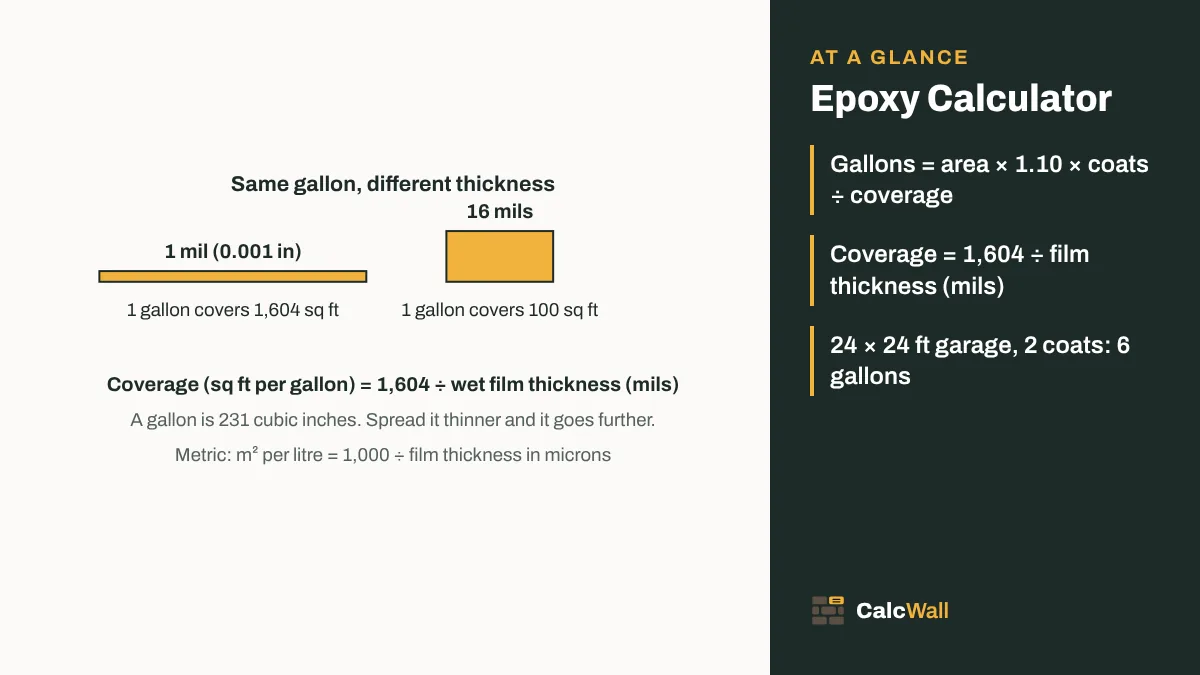
Why do two cans of “garage floor epoxy” cover such different areas? Thickness. A US gallon is 231 cubic inches of liquid, and how far it goes depends only on how thick you spread it. Data sheets give that thickness in mils, thousandths of an inch.
Spread 1 mil thick, a gallon covers 231 ÷ 0.001 ÷ 144 = 1,604 sq ft. Divide that by the wet film thickness on the data sheet and you have the theoretical coverage:
| Wet film thickness | Theoretical coverage per US gallon | Typical use |
|---|---|---|
| 4 mils | 401 sq ft | Thin sealer or water-based coat |
| 6 mils | 267 sq ft | Roll-on garage kit coat |
| 8 mils | 201 sq ft | Primer or base coat |
| 10 mils | 160 sq ft | Heavier base coat |
| 16 mils | 100 sq ft | High-build 100% solids coat |
| 20 mils | 80 sq ft | High-build or broadcast coat |
| ⅛ in (125 mils) | 12.8 sq ft | Self-levelling or slurry floor |
Two things push real coverage below these figures. First, bare concrete soaks up some of the first coat, so expect less coverage on the primer than on later coats. Second, water- and solvent-based products shrink as they dry. A product with 50% volume solids applied at 8 mils wet dries to about 4 mils. The data sheet tells you the volume solids and the coverage it was tested at; trust that over the theory.
In metric, a litre spread 100 microns thick covers 10 m², so m² per litre = 1,000 ÷ microns. A coat of 200 microns (about 8 mils) covers 5 m² per litre.
Primer, base coat, flakes and top coat
Most garage floors are not one product but a system. Each layer comes with its own coverage rate, so work them out one at a time and add the totals to your shopping list. If you would rather grind the slab than coat it, the polished concrete cost calculator prices that finish.
- Primer: a thin, penetrating first coat that seals the pores. Coverage is often higher than the base coat, but the first coat on bare concrete is where porous floors eat extra material.
- Base or body coat: the colored layer that gives the floor its thickness. This is usually the biggest quantity.
- Decorative flakes: broadcast into the wet base coat. They are sold by weight, and the rate depends on whether you want a light scatter or full coverage, so take it from the flake maker.
- Top coat: a clear coat, often polyaspartic or polyurethane, that locks in the flakes and takes the wear. Check its coverage separately.
Epoxy for common garage sizes
Gallons for two coats with 10% extra, at 250 sq ft per gallon (the calculator’s example rate). Swap in your own coverage for a real order.
| Garage floor | Area | Coating area (2 coats + 10%) | Gallons at 250 sq ft/gal |
|---|---|---|---|
| 12 × 22 ft (one car) | 264 sq ft | 581 sq ft | 3 (2.32) |
| 20 × 20 ft (two car) | 400 sq ft | 880 sq ft | 4 (3.52) |
| 22 × 24 ft (two car) | 528 sq ft | 1,162 sq ft | 5 (4.65) |
| 24 × 24 ft (two car) | 576 sq ft | 1,267 sq ft | 6 (5.07) |
| 30 × 30 ft (three car) | 900 sq ft | 1,980 sq ft | 8 (7.92) |
Measuring the floor
- Measure wall to wall at floor level, not at the top of a curb or stem wall.
- Doing the curbs and stem walls too? Add their height × length as extra rows. They take only a strip, but on a big garage it adds up.
- Leave out what stays put, like a built-in cabinet base, under “Areas not coated”.
- Steps and landings are worth adding: the tread, the riser and the landing are each a rectangle.
- Don’t forget the apron inside the door if you plan to coat it; it is often a separate pour.
If you only need the floor area, the square yards calculator handles it in any unit. Coating a new slab? Get the concrete right first with the concrete calculator, and let it cure for as long as the coating maker asks before you start.
Worked examples
Two-car garage, roll-on kit
A 20 × 20 ft garage, two coats of a product rated at 250 sq ft per gallon: 400 × 1.10 × 2 = 880 sq ft ÷ 250 = 3.52, so 4 gallons.
Thick 100% solids system
The same 400 sq ft garage, one base coat at 16 mils. At 1,604 ÷ 16 = 100 sq ft per gallon: 400 × 1.10 ÷ 100.25 = 4.39, so 5 gallons for that coat alone. Thick systems cost more per square foot, but they hide more of the concrete’s flaws.
Basement floor in metric
A 6 × 8 m basement, two coats at 6 m² per litre: 48 × 1.10 × 2 = 105.6 m² ÷ 6 = 17.6, so 18 litres. If the product comes in 5 litre kits, that is 4 kits.
Kits, batches and pot life
Two-part epoxy is sold in kits: a resin and a hardener you mix together. Once mixed, it starts to cure, and the clock (the pot life) runs faster in a full bucket than spread thin on the floor, because the reaction makes heat.
- Round up to whole kits. You cannot buy 0.6 of a kit, and you don’t want to run out halfway across a wet floor.
- Mix only what you can spread in the pot life on the data sheet. On a hot day that time gets shorter.
- Pour it out in ribbons straight after mixing and spread from there, rather than working out of the bucket.
- Keep one batch number for colored base coats. Small color differences between batches show on a big floor.
Notes for floor coating installers
Mils math. Theoretical coverage = 1,604 × volume solids ÷ dry film thickness (mils). For 100% solids, wet and dry film are the same.
Profile and porosity. A ground or shot-blasted floor takes more primer than smooth concrete. Raise the waste figure for the first coat rather than for every coat.
Moisture. Test the slab for moisture before you quote; coating over a damp slab is a common cause of failure. Use the test method and limits the coating maker specifies.
Conditions. Surface and air temperature, humidity and the dew point all affect cure and recoat times. Work to the window on the data sheet.
Tips before you buy
- Read the data sheet, not just the box. The coverage on the box is often the best case; the data sheet says at what thickness.
- Price by the square foot. Divide the kit price by the area it really covers at your thickness to compare products fairly.
- Buy a little extra top coat. It is the layer that takes the wear and the one you will touch up.
Sources
Where the numbers on this page come from. Everything else is plain geometry and unit conversion, which the calculator does with exact factors.
- NIST Handbook 44, Appendix C: General Tables of Units of Measurement, National Institute of Standards and Technology, 2026 edition. Used for: 1 US gallon = 231 cubic inches, the basis of the 1,604 sq ft per gallon per mil figure, and the litre and square metre conversions
- GacoFloor E10 100% Solids Epoxy product data sheet, Gaco, revised July 2026. Used for: an example of rated coverage: 16 mils dry film at 1 gallon per 100 sq ft for a 100% solids epoxy
- Corotech V430 100% Solids Epoxy Floor Coating technical data sheet, Benjamin Moore. Used for: an example of real-world coverage below the theoretical figure: 100–150 sq ft per gallon at 10–15 mils
Frequently asked questions
How much epoxy do I need for a garage floor?
Multiply the floor area by the number of coats, add about 10% and divide by the coverage per gallon. A 24 × 24 ft garage is 576 sq ft; plus 10% that is 633.6 sq ft, and two coats make 1,267.2 sq ft. At 250 sq ft per gallon that is 5.07, so 6 gallons.
How much does a gallon of epoxy cover?
It depends on the product and on how thick it is applied: thin roll-on coatings cover far more than thick self-levelling or flake systems. The data sheet gives the coverage for the film thickness. Use that figure.
How many coats of epoxy do I need?
Most garage systems use a primer or base coat and one or two top coats. Enter the coats of the product you are calculating; if primer and top coat cover differently, calculate them separately.
Does concrete texture matter?
Yes. Rough or porous concrete soaks up more material, especially on the first coat. That is what the waste allowance is for; raise it for very porous or shot-blasted floors.
What about epoxy for tabletops or resin art?
This calculator is for floor coatings measured by area. Deep pours for tables and river boards are measured by volume (length × width × depth).
What does mils mean on an epoxy label?
A mil is a thousandth of an inch (0.001 in, about 25 microns). Data sheets give film thickness in mils. One US gallon spread 1 mil thick covers 1,604 sq ft, so divide 1,604 by the wet thickness to get the coverage: 10 mils is about 160 sq ft per gallon.
How much epoxy for a two-car garage?
A 20 × 20 ft two-car garage is 400 sq ft. With 10% extra and two coats at 250 sq ft per gallon, that is 3.52, so 4 gallons. A thick 100% solids system rated at 100 sq ft per gallon would need about 4.4 gallons per coat.
Can I mix a whole kit at once?
Only if you can spread it before the pot life runs out. Mixed epoxy heats up in the bucket and sets faster there than on the floor. Mix what you can roll out in the time on the data sheet, pour it onto the floor in ribbons and keep moving.
Is this epoxy calculator free to use online?
Yes. The CalcWall Epoxy Calculator is completely free and works online in any browser, on a phone, tablet or computer. There is nothing to download and no account to create, and the math runs right in your browser, so results appear as you type.