Quick answer: a solid-grouted 8 in block wall takes 36.1 cu ft of grout per 100 sq ft (CMHA TEK 04-02A, 3% waste included). That is 1.34 cu yd, or 55 bags of 80 lb grout. Grouting one cell every 48 in drops it to 6.1 cu ft per 100 sq ft.
How to use the block fill calculator
This concrete block fill calculator needs five things: the wall length, the wall height, the block width, which cells you fill, and any bond beam length. It multiplies the wall area by the grout rate for that width and spacing from CMHA TEK 04-02A Table 3. Then it adds the bond beams and divides by the bag yield.
- Wall length and height. Measure the whole face of the wall in feet or meters. The table rates are per square foot of wall, so the calculator doesn’t ask for a block count.
- Block width. Pick the nominal width: 6, 8, 10, 12 or 14 in (shown as 150 to 350 mm). There is no 4 in option, for reasons covered below.
- Cores filled. Every core means solid grouting. The other choices are the spacing of grouted cells, from 16 in to 120 in apart, or none if you only fill bond beams.
- Bond beam length. Add up every grouted horizontal course: the top of the wall, any mid-height beams and the lintels over openings.
- Extra. The table already includes 3% waste. Add 5, 10 or 15% more if you are bucketing by hand or pumping a long line.
- Grout bag. 80 lb preblended grout (0.66 cu ft) is the default. You can also choose 80 lb or 60 lb concrete mix, or a 3,000 lb bulk bag.
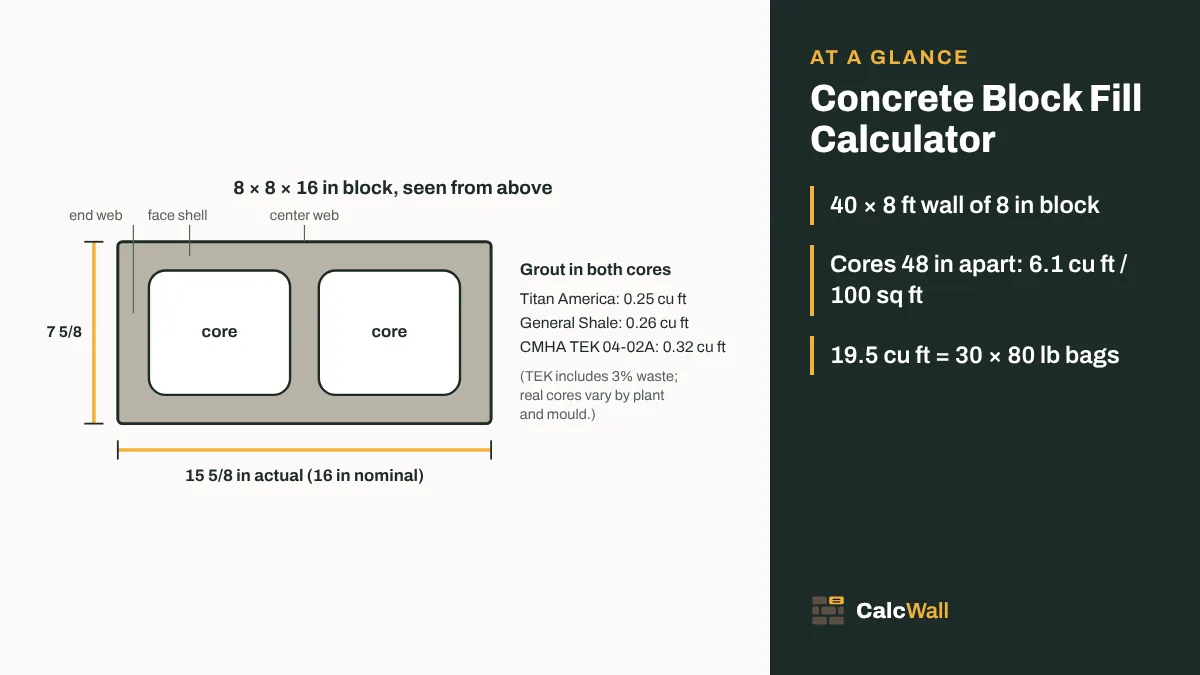
Out of the box it shows a 40 × 8 ft wall of 8 in block with one cell grouted every 48 in. That is 320 sq ft × 6.1 ÷ 100 = 19.5 cu ft, or 0.72 cu yd and 30 bags of 80 lb grout.
Openings are simple. Doors and windows have no cells, so take their area off before you enter the wall. The easiest way is to enter the net area as a length and a height: a 40 × 8 ft wall with a 3 × 7 ft door is 299 sq ft, so enter 299 × 1.
If you also need the blocks, mortar and a rough core fill in one go, the concrete block calculator has a simpler fill option: every core, or every 2nd, 3rd or 4th block. It uses Titan America’s core volumes, which run lower than the CMHA table. This page is the one to use as a concrete grout calculator: grout spacing, bond beams and bag counts you can order from.
Block fill volume formula: cells, bond beams and waste
Block fill is a lookup, not a geometry problem. You could measure a core and multiply, but cores taper, webs vary and mortar fins steal space. The CMHA table already folds those into one rate per 100 sq ft of wall. The calculator follows these steps.
- Wall area = length × height, in square feet. In meters, the calculator converts with 1 ft = 0.3048 m.
- Core grout = wall area × the Table 3 rate for your block width and spacing ÷ 100.
- Bond beam grout = bond beam length × cu ft per foot. That rate is 0.66 cu ft ÷ the Table 5 feet per bag.
- Total = (core grout + bond beam grout) × (1 + extra %).
- Cubic yards = total ÷ 27. Bags = total ÷ bag yield, rounded up to a whole bag.
Grout (cu ft) = [area × rate ÷ 100 + bond ft × (0.66 ÷ ft per bag)] × (1 + extra)
The calculator also shows grout per square foot (or liters per m²) of wall. That helps when you compare a quote. A solid 8 in wall comes out at 0.361 cu ft per sq ft, which is 110 liters per m².
Waste needs one note. The 3% in Table 3 covers ordinary spillage. It doesn’t cover a cell that blows out, or grout running sideways into hollow cells nobody blocked off. On a partly grouted wall, masons mortar the webs round the grouted cells so the grout stays put. If they don’t, that is where the extra goes.
Grout per 100 sq ft of block wall by width and spacing
This is CMHA TEK 04-02A Table 3 in full, the same figures the calculator uses. They are for hollow, single-wythe walls of two-core units, with 3% waste built in. A spacing of 8 in means every cell is filled. TEK 04-02A has no issue date of its own; the CMHA page was last modified in March 2024.
| Grouted cells (spacing) | 6 in wall | 8 in wall | 10 in wall | 12 in wall | 14 in wall |
|---|---|---|---|---|---|
| 8 in (solid, every cell) | 25.6 | 36.1 | 47.0 | 58.9 | 74.5 |
| 16 in | 12.8 | 18.1 | 23.5 | 29.5 | 37.3 |
| 24 in | 8.6 | 12.1 | 15.7 | 19.7 | 24.8 |
| 32 in | 6.4 | 9.1 | 11.8 | 14.8 | 18.6 |
| 40 in | 5.2 | 7.3 | 9.4 | 11.8 | 14.9 |
| 48 in | 4.3 | 6.1 | 7.9 | 9.9 | 12.4 |
| 56 in | 3.7 | 5.2 | 6.8 | 8.5 | 10.6 |
| 64 in | 3.2 | 4.6 | 5.9 | 7.4 | 9.3 |
| 72 in | 2.9 | 4.1 | 5.3 | 6.6 | 8.3 |
| 80 in | 2.6 | 3.7 | 4.7 | 5.9 | 7.5 |
| 88 in | 2.4 | 3.3 | 4.3 | 5.4 | 6.8 |
| 96 in | 2.2 | 3.1 | 4.0 | 5.0 | 6.2 |
| 104 in | 2.0 | 2.8 | 3.7 | 4.6 | 5.7 |
| 112 in | 1.9 | 2.6 | 3.4 | 4.3 | 5.3 |
| 120 in | 1.8 | 2.5 | 3.2 | 4.0 | 4.9 |
Cubic feet of grout per 100 sq ft of wall. Divide by 27 for cubic yards: a solid 8 in wall is 36.1 ÷ 27 = 1.34 cu yd per 100 sq ft, a 12 in wall 2.18.
Read across for your block and down for your spacing. The pattern is close to proportional: halve the number of grouted cells and the grout roughly halves. A 16 in spacing is one cell in every block, 32 in is one cell in every second block, and 48 in one in every third.
Spacings between the rows don’t exist on site. Block is laid in 8 in steps, so a bar called for at 30 in really goes in the cell at 24 or 32 in. Ask the designer which, and use that row. Rounding down to the tighter spacing is the safe guess for an estimate.
Grout per block and blocks per cubic yard
Most people think in blocks, not square feet. Standard block lays at 1.125 per sq ft of wall (Titan America), so 100 sq ft holds 112.5 blocks. Divide a Table 3 rate by 112.5 and you get grout per block, waste included.
| Block (two-core) | CMHA, cu ft per block (incl. 3%) | Titan America, cu ft per block | General Shale, cu ft per block | Blocks per cu yd (CMHA / Titan) |
|---|---|---|---|---|
| 4 in | Not grouted. TEK 04-02A leaves 4 in units out of its table. | |||
| 6 × 8 × 16 in | 0.228 | 0.17 | 0.184 | 119 / 159 |
| 8 × 8 × 16 in | 0.321 | 0.25 | 0.264 | 84 / 108 |
| 10 × 8 × 16 in | 0.418 | 0.33 | 0.306 | 65 / 82 |
| 12 × 8 × 16 in | 0.524 | 0.39 | 0.444 | 52 / 69 |
| 14 × 8 × 16 in | 0.662 | not listed | not listed | 41 / – |
CMHA column: Table 3 solid rate ÷ 112.5. General Shale column: its per-100 sq ft figure (20.7 / 29.7 / 34.4 / 49.9) ÷ 112.5. Blocks per cu yd: 27 ÷ cu ft per block.
The spread is real. CMHA is a generic table for typical units with 3% waste; Titan and General Shale describe their own units with no waste. Cores are shaped by each plant’s moulds, so shell and web thickness move the volume. If your supplier publishes a figure for your exact block, it beats all three.
The calculator uses CMHA because it covers every width and spacing from one source and errs on the high side. Expect a few bags left over on a big wall if your block matches Titan’s. That is cheaper than a crew standing round waiting for a second delivery.
One common mistake on the web is worth fixing here. The CMHA figure for 8 in block is about 0.312 cu ft per block before the 3% waste (0.321 with it). That is 0.312 × 1,728 = 539 cu in, not 312 cu in. Mixing up cubic feet and cubic inches gives a blocks-per-yard figure that is far too high.
Solid vs partial grouting, and rebar cells
Solid grouting fills every cell from bottom to top. It gives the heaviest wall and uses the most grout: 36.1 cu ft per 100 sq ft for 8 in block. Partial grouting fills only the cells that hold vertical bars, plus bond beams. At 48 in spacing that same wall takes 6.1 cu ft, about a sixth.
The spacing comes from the design, not the estimator. Plans say something like “#5 at 48 in o.c., grout cells with reinforcing”. Enter 48 in as the spacing and that is your core grout. If the plans say “solid grout”, use every core.
Rebar cells turn up in more places than the regular spacing. Designers often add bars at corners, wall ends, both jambs of every opening and under beam bearings. Each one is a grouted cell. Count them and, if there are many, step up one row in the table, say from 48 to 40 in.
Grout locks the bar to the block, so a bar in a hollow cell does nothing. That is why every cell with a bar is filled. Some plans also fill extra cells under heavy point loads or at anchor bolts. Read the notes as well as the drawings.
A partly grouted wall has to keep the grout in the right cells. Masons usually spread mortar on the webs round the cells to be grouted, so grout can’t run sideways into hollow cells. Some lay mesh or a plug under a bond beam for the same reason. Lost grout doesn’t show up until the bags run out.
Bond beams and lintels
A bond beam is a course of U-shaped or knock-out block filled solid with grout round one or two horizontal bars. Most walls have one at the top. Taller walls may have more at mid-height, and lintels over openings are bond beams too. Table 3 covers the vertical cells only, and TEK 04-02A says extra grout may be needed for horizontal courses. So the calculator adds them as a separate line.
| Block width | CMHA Table 5, ft per 80 lb bag | Calculator, cu ft per ft | Titan bond beam lintel, cu ft per ft | General Shale bond beam, cu ft per ft |
|---|---|---|---|---|
| 6 in | 2.7 | 0.244 | 0.173 | not listed |
| 8 in | 2.0 | 0.330 | 0.22 | 0.159 with center web, 0.212 without |
| 10 in | not listed | 0.430 (scaled) | not listed | not listed |
| 12 in | 1.6 | 0.413 | 0.37 | 0.272 with center web, 0.329 without |
| 14 in | not listed | 0.522 (scaled) | not listed | not listed |
Calculator figures: 0.66 cu ft ÷ feet per bag. General Shale publishes cu ft per 100 ft; divided by 100 here.
For 10 and 14 in walls, the bond beam figure is scaled, not published. TEK 04-02A Table 5 has no 10 or 14 in rows. The calculator takes the 8 in figure × 47.0 ÷ 36.1 for 10 in, and the 12 in figure × 74.5 ÷ 58.9 for 14 in. Those are the ratios of the solid-grout rates in Table 3. The calculator shows a note when it does this.
Treat the scaled figures as rough. The 10 in result, 0.430 cu ft per ft, comes out a touch above the published 12 in figure of 0.413, which can’t be right for real units. It errs on the safe side. If you build with 10 or 14 in bond beam block, ask the maker for its void volume and work the beam out by hand.
The CMHA bond beam figures run well above both makers’. An 8 in beam is 0.330 cu ft per ft by CMHA, 0.22 by Titan and 0.159 to 0.212 by General Shale. Some of that is the unit: a bond beam block with a center web holds less. Some grout may also drop into the cells below a bond beam unless mesh or a plug stops it.
Lintels are short but add up. A lintel is longer than its opening, because each end bears on the block beside it. Add the bearing length from your plans to every opening width, and put the total in the bond beam box. Precast or steel lintels need no grout; leave them out.
Grout or concrete for filling concrete blocks
Masonry grout is not mortar and not quite concrete. It is cement, sand, sometimes pea gravel and a lot of water, mixed to an 8 to 11 in slump so it flows into narrow cells and round bars. ASTM C476 covers it. TEK 09-04A cites the 2002 edition; check which edition your local code adopts.
| Fill | Aggregate | Slump or flow | Strength | Clear space round bars |
|---|---|---|---|---|
| Fine grout (ASTM C476) | Sand under 3/8 in only | 8–11 in | 2,000 psi min. at 28 days (strength method) | 1/4 in or more |
| Coarse grout (ASTM C476) | Sand plus pea gravel under 1/2 in | 8–11 in | 2,000 psi min. at 28 days (strength method) | 1/2 in or more |
| Core-fill grout, Australia (CMAA) | 10 mm coarse aggregate | Pourable, no segregation | 12 MPa min., 20 MPa preferred; 300 kg/m³ cement min. | Not stated |
| Blockfill, New Zealand (Firth) | Not stated | 450–530 mm flow spread | 17.5 to 35 MPa grades | Not stated |
US rows: CMHA TEK 09-04A and STRUCTURE magazine (August 2011). Australia: CMAA Concrete Masonry Handbook (2010). New Zealand: Firth (2024).
By proportion, ASTM C476 grout is 1 part cement, 0 to 1/10 part lime and 2¼ to 3 parts sand. Coarse grout adds 1 to 2 parts of coarse aggregate, according to IMI’s summary. You can also order it by strength, which is how most ready-mix grout is sold.
Fine or coarse? TEK 09-04A says the choice depends mainly on the smallest clear size of the grout space, the pour height and cost. Coarse grout is the usual pick for big, open cells, but the pea gravel needs room. In a congested cell with a lapped bar, or a tall pour in small block, fine grout is the one that reaches the bottom.
The detailed size limits are in Table 7 of TMS 602. We didn’t find a copy we can cite, so check it in your specification.
Grout or concrete mix? Bagged concrete mix has bigger stone and is made for a stiffer slump. Poured into a 6 or 8 in cell with a bar in it, it tends to bridge and leave voids. Where plans call for grout, use grout.
The calculator offers 80 and 60 lb concrete mix bags for jobs where your plans or building official accept it, such as a few cells in a garden wall. Don’t add extra water to concrete mix to make it flow, because that weakens it.
Mortar, sand and gravel are not cell fill. Some websites list them, but none of them bonds to bars or carries load like grout. Antifreeze is banned in C476 grout, and TEK 09-04A advises against chloride admixtures because they corrode the steel.
Why 4 in block is not grouted. TEK 04-02A leaves 4 in units out of Table 3 and says grouting conventional 4 in units is not recommended. The cells are too small to place and consolidate grout properly. That is why the calculator starts at 6 in. If a 4 in wall seems to need grout, it probably needs a wider block.
Lifts, cleanouts and consolidation
Two heights matter. The lift is the grout placed in one go before you stop and consolidate. The pour is everything placed before the wall goes up any higher. You need both to plan cleanouts and crew time, though neither changes the volume.
Low-lift grouting. Build the wall to scaffold height or to a bond beam, then grout. TEK 03-02A, based on the 2005 masonry specification, sets this at 5 ft without cleanouts. F&R’s 2022 summary of TMS 602 says cleanouts are needed once a pour exceeds 5 ft 4 in. Use the figure in your project specification.
High-lift grouting. Build the wall to full height, up to a 24 ft pour, and grout it from the top in lifts. Lifts are normally 5 ft. They can be up to 12 ft 8 in only when all three hold: the block has cured at least 4 hours, the slump stays at 10 to 11 in, and there is no reinforced bond beam part-way up the pour.
Cleanouts. High-lift pours need openings in the face shells of the bottom course so mortar droppings can be cleared and the bars checked. TEK 03-02A and F&R give a 3 in minimum opening, at the base of every cell with a bar, and no more than 32 in apart in a solid-grouted wall. Seal them before grouting.
Consolidation. Puddling with a rod is allowed for pours of 12 in or less. Above that, TEK 03-02A says mechanical vibration is required. Then reconsolidate 3 to 10 minutes later, once the block has drawn water out of the grout and it has settled. Skip that and you get gaps under bond beams.
Timing. Grout must go in within 1½ hours of adding water and before it starts to set. With bagged grout and a small mixer, that sets how many bags a crew can mix ahead. With ready-mix, it sets how long the truck can wait.
Bags, bulk bags or a grout pump
The calculator rounds bags up to a whole number for the whole job. Bag yield is the one thing to check against your product, because yields differ. CMHA uses 0.66 cu ft for an 80 lb bag; QUIKRETE prints 0.65 for its own Core-Fill Grout. The calculator uses the CMHA figure so the table and the bags come from one source.
| Product | Yield | Bags for 100 sq ft of solid 8 in wall (36.1 cu ft) | Source and date |
|---|---|---|---|
| 80 lb preblended grout | 0.66 cu ft | 55 | CMHA TEK 04-02A Table 4, undated |
| 80 lb QUIKRETE Core-Fill Grout (coarse) | 0.65 cu ft (cores of about 3 standard 8 in blocks) | 56 | QUIKRETE data sheet, rev. November 2024 |
| 80 lb concrete mix | 0.60 cu ft | 61 | QUIKRETE data sheet, rev. October 2022 |
| 60 lb concrete mix | 0.45 cu ft | 81 | QUIKRETE data sheet, rev. October 2022 |
| 3,000 lb bulk bag of preblended grout | about 25 cu ft | 2 | CMHA TEK 04-02A Table 4, undated |
| Bagged core fill, Australia, New Zealand, UK | No reliable published yield found. Read the yield on the bag and divide the volume by it. | ||
Bags = 36.1 ÷ yield, rounded up. 36.1 ÷ 0.66 = 54.7, so 55.
Bags are fine for a garden wall or a few cells. A solid-grouted 40 × 8 ft wall takes 176 bags of 80 lb grout, which is over 7 tons to lift, mix and pour by hand. Past a cubic yard or two, price ready-mix grout and a grout pump or a crane bucket. The calculator gives cubic yards so you can order straight from the result.
A 3,000 lb bulk bag sits between the two. CMHA puts its yield at about 25 cu ft, close to a cubic yard. Each one needs a forklift or a mixer with a hopper, but it saves opening dozens of small bags.
We don’t print a bag price. We found no published grout bag price with a date for this page, and prices vary by store and region. Type your own price per bag into the calculator and it multiplies it by the bag count.
Core fill in Australia, New Zealand and the UK
The calculator’s block widths are US nominal sizes. Its 150 and 200 mm labels are those same US blocks in metric, not Australian or New Zealand 15 and 20 series units. Those have a different shape and lay at 12½ blocks per m², so their grout differs.
| Block (CMAA) | Grout per m² of wall | Grout per 100 blocks | Blocks per m³ of grout |
|---|---|---|---|
| 15.01 / 15.42 (150 series) | 0.054 m³ | 0.43 m³ | 220 |
| 20.01 / 20.42 (200 series) | 0.083 m³ | 0.66 m³ | 150 |
| 20.48 | 0.100 m³ | 0.80 m³ | 120 |
| 30.48 | 0.180 m³ | 1.44 m³ | 69 |
CMAA Concrete Masonry Handbook, December 2010. The column labels were garbled in the copy we read; we matched them by arithmetic (0.66 m³ per 100 blocks × 12½ blocks per m² ÷ 100 = 0.083 m³ per m²). The handbook doesn’t state a waste allowance.
Australia. For a concrete block fill calculator in Australia, the CMAA table above is the better guide. The calculator’s 200 mm option gives 110 liters per m², about 33% more than CMAA’s 83 liters for 20.01 blocks. Its 150 mm option gives 78 liters per m², about 44% more than the 54 liters for 15.01 blocks. Use the calculator for spacing and bond beams, then scale down if your supplier confirms the CMAA figures for its block.
The CMAA asks for grout of at least 12 MPa, preferably 20 MPa, with at least 300 kg/m³ of cement and 10 mm aggregate. It says not to grout more than 3 m in one pour, and to fill in two stages about 30 minutes apart when the lift is over 2.4 m. It also calls for clean-out openings at the base, or a bottom joint left open and hosed out.
New Zealand. We found no published New Zealand grout-per-m² table we could cite. Check with your block maker before you use the Australian figures, because NZ block shapes may differ. Firth sells ready-mixed Blockfill in 17.5 to 35 MPa grades, made to NZS 3104 and NZS 4210. Your consented plans set the grade and which cells are filled.
United Kingdom. Hollow 140 and 215 mm blocks are used for some reinforced and retaining walls, but we found no reliable published core-fill volume for them. Measure a core, multiply by the cells you fill, and add waste. Or ask the block maker for the void volume. For a garden wall of stacking blocks, the retaining wall calculator counts the blocks, base and drainage stone.
Worked examples
Each example uses the calculator as it stands, with the default 80 lb preblended grout (0.66 cu ft) and no extra unless stated. The results match what the tool shows.
A solid-grouted 8 in wall
40 ft × 8 ft wall, 8 in block, every core. Area = 320 sq ft. Grout = 320 × 36.1 ÷ 100 = 115.5 cu ft = 4.28 cu yd. Bags = 115.52 ÷ 0.66 = 175.03, so 176 bags of 80 lb. In 80 lb concrete mix it is 193 bags, and in 3,000 lb bulk bags, 5. Grout per sq ft of wall: 0.361 cu ft.
Partial grouting with a bond beam
60 ft × 8 ft wall, 8 in block, cells at 32 in, one bond beam along the top (60 ft). Cores = 480 × 9.1 ÷ 100 = 43.7 cu ft. Bond beam = 60 × (0.66 ÷ 2.0) = 19.8 cu ft. Total = 63.5 cu ft = 2.35 cu yd. Bags = 63.48 ÷ 0.66 = 96.2, so 97 bags. The bond beam is almost a third of the grout.
A 10 in wall, where the bond beam is scaled
30 ft × 10 ft wall, 10 in block, cells at 48 in, 30 ft bond beam. Cores = 300 × 7.9 ÷ 100 = 23.7 cu ft. Bond beam = 30 × 0.33 × 47.0 ÷ 36.1 = 12.9 cu ft. Total = 36.6 cu ft = 1.36 cu yd, or 56 bags (36.59 ÷ 0.66 = 55.4). The calculator notes that the 10 in bond beam figure is scaled.
A metric wall, 200 mm block
12 m × 2.4 m wall, 200 mm (8 in) block, every core. Area = 28.8 m² = 310.0 sq ft. Grout = 310.0 × 36.1 ÷ 100 = 111.9 cu ft = 3.17 m³ (3,169 liters, 110 liters per m²), or 170 bags of 80 lb. For Australian 20.01 blocks, the CMAA figure would be 28.8 × 0.083 = 2.39 m³.
The last example shows why the block type matters as much as the wall size. Same face area, two published rates, and about 0.8 m³ of difference. Check what you are actually laying before you order.
Before the grout, the wall needs a footing. The concrete footing calculator sizes the concrete for a strip footing under the wall. If you are weighing block against a cast wall, the concrete wall calculator gives the volume for a poured wall of the same size.
Notes for pros
Count every bond beam. Top beam, mid-height beams and every lintel with its bearing. On a partly grouted wall they can be a third of the grout.
Round spacing down. Bars at corners, jambs and ends add cells. If there are many, step up a row, from 48 to 40 in, rather than counting cells one by one.
Check the edition. TEK 03-02A (2005 spec) puts low-lift at 5 ft; F&R’s 2022 summary of TMS 602 puts cleanouts above 5 ft 4 in. Your spec decides.
Order by maker’s volume. CMHA runs over a quarter above Titan for 8 in block. For a big pour, the maker’s void volume can save a part load.
- This page gives grout quantities, not a design. Bar sizes, grout spacing, grout strength and lift heights come from your plans, your engineer and your local code.
- The tables are published figures from the bodies named, with the editions shown. Local code decides what you build.
For a slab or footing pour on the same job, the concrete calculator works out the yards. If you are mixing your own grout or concrete from cement, sand and gravel, the concrete mix ratio calculator turns a volume into bags of cement and loads of sand.
Sources
Where the numbers on this page come from. Everything else is plain geometry and unit conversion, which the calculator does with exact factors.
- TEK 04-02A, Estimating Concrete Masonry Materials, Concrete Masonry & Hardscapes Association (CMHA, formerly NCMA), TEK 04-02A, undated (web page modified 5 March 2024). Used for: Table 3 grout per 100 sq ft of wall for 6 to 14 in hollow two-core units with 3% waste; Table 4 yields of about 0.66 cu ft per 80 lb bag of preblended grout and about 25 cu ft per 3,000 lb bulk bag; Table 5 bond beam yields of 2.7, 2.0 and 1.6 linear ft per 80 lb bag for 6, 8 and 12 in; the note that 4 in units are left out and not recommended for grouting; extra grout for horizontal courses; waste varying between pumping and bucketing
- TEK 03-02A, Grouting Concrete Masonry Walls, CMHA (formerly NCMA), TEK 03-02A, undated (web page modified 6 March 2024); cites ACI 530.1-05/ASCE 6-05/TMS 602-05. Used for: low-lift grouting to 5 ft without cleanouts; 12 ft 8 in lifts when the masonry has cured 4 hours, slump is 10 to 11 in and there are no intermediate reinforced bond beams; 24 ft maximum pour height; 3 in cleanouts at cores with bars and at 32 in for solid grouting; puddling up to 12 in; reconsolidation 3 to 10 minutes after placing; grout placed within 1½ hours of adding water
- TEK 09-04A, Grout for Concrete Masonry, CMHA (formerly NCMA), TEK 09-04A, undated (web page modified 10 March 2024); cites ASTM C476-02. Used for: fine grout (sand under 3/8 in only) and coarse grout (pea gravel under 1/2 in added), slump of 8 to 11 in, 2,000 psi minimum at 28 days by the strength method, the choice of type depending on grout space, pour height and economics, antifreeze being prohibited and chlorides advised against
- Masonry Grout Placement: Code Criteria, Froehling & Robertson (F&R), published 27 September 2022 (edition of TMS 602 not named). Used for: cleanouts when grout pours exceed 5 ft 4 in, 12 ft 8 in lifts under TMS 602 Article 3.5D, 3 in minimum cleanout opening, 32 in maximum cleanout spacing for solid grouting, and mechanical vibration
- Questions We Made Up About Masonry, Part 2: Grouting Options, STRUCTURE magazine (series provided by The Masonry Society), Diane Throop, August 2011. Used for: clear distance from a bar to the masonry of 1/2 in for coarse grout and 1/4 in for fine grout, how lift limits changed between the 1999, 2002, 2005 and 2008 editions of the MSJC specification, and the 24 ft maximum pour height
- Masonry Grout, Technology Brief 2.11.2, International Masonry Institute (IMI), August 2009. Used for: ASTM C476 proportions by volume (1 part cement, 0 to 1/10 lime, 2¼ to 3 parts sand, plus 1 to 2 parts coarse aggregate for coarse grout) and slump of 10 to 11 in for higher lifts, 8 to 9 in for lower ones
- Block Estimating Guide, Titan America, undated (file posted January 2025). Used for: actual block size (15 5/8 × 7 5/8 in face), 1.125 blocks per sq ft, core fill of 0.17 / 0.25 / 0.33 / 0.39 cu ft per 6 / 8 / 10 / 12 in two-core block, and bond beam lintel fill of 0.173 / 0.22 / 0.37 cu ft per ft for 6 / 8 / 12 in
- Tech Bulletin: Block Grout Fill Quantities, General Shale Brick (hosted by Canada Brick), dated 4 June 2020. Used for: grout per 100 sq ft of solid-grouted stretcher wall (20.7 / 29.7 / 34.4 / 49.9 cu ft for 6 / 8 / 10 / 12 in) and bond beam void per 100 ft (8 in: 15.9 with a center web, 21.2 without; 12 in: 27.2 and 32.9)
- QUIKRETE Core-Fill Grout (Coarse) No. 1585-07 data sheet, QUIKRETE Companies, revised November 2024. Used for: an 80 lb bag yielding about 0.65 cu ft, enough for the cores of about 3 standard 8 × 8 × 16 in blocks
- Concrete Mix No. 1101 product data sheet, QUIKRETE Companies, revised October 2022. Used for: bag yields of about 0.60 cu ft for 80 lb and 0.45 cu ft for 60 lb
- Concrete Masonry Handbook (Concrete Masonry Walling, MA45), Concrete Masonry Association of Australia (CMAA), December 2010. Used for: 12½ blocks per m²; grout of 0.054 / 0.083 / 0.100 / 0.180 m³ per m² (0.43 / 0.66 / 0.80 / 1.44 m³ per 100 blocks) for 15.01, 20.01, 20.48 and 30.48 blocks; grout of at least 12 MPa (20 MPa preferred), 300 kg/m³ of cement and 10 mm aggregate; clean-out openings; no single pour over 3 m and two stages over 2.4 m
- Blockfill concrete, Firth Concrete (New Zealand), web page published 3 October 2024. Used for: New Zealand ready-mixed block fill in 17.5 to 35 MPa grades, flow spread of 450 to 530 mm, made to NZS 3104 and NZS 4210
- NIST Handbook 44, Appendix C: General Tables of Units of Measurement, National Institute of Standards and Technology, 2026 edition. Used for: 1 cu yd = 27 cu ft, 1 ft = 0.3048 m, 1 cu ft = 1,728 cu in, and the metric conversions
Frequently asked questions
How much concrete does it take to fill a cinder block wall?
It depends on the block width and how many cells you fill. CMHA TEK 04-02A puts a solid-grouted 8 in wall at 36.1 cu ft per 100 sq ft, with 3% waste included. A 40 × 8 ft wall (320 sq ft) filled solid takes 115.5 cu ft, which is 4.28 cu yd or 176 bags of 80 lb grout. Cinder block and concrete block fill the same way.
How much grout per 8 inch block?
Titan America gives 0.25 cu ft for both cores of its 8 × 8 × 16 in block. The CMHA table works out to 0.32 cu ft per block (36.1 ÷ 112.5 blocks), including 3% waste. Real cores vary by plant, so use your maker’s figure if it has one. The calculator uses the CMHA figure.
How many blocks does one yard of grout fill?
For 8 in block, about 84 blocks by the CMHA table (27 ÷ 0.321) or 108 by Titan America’s core volume (27 ÷ 0.25). For 6 in block it is about 119 by CMHA, and for 12 in block about 52. These are solid-filled blocks, both cores.
How many 80 lb bags to fill block cores?
At 0.66 cu ft per bag, a solid-grouted 8 in wall takes 36.1 ÷ 0.66 = 54.7, so 55 bags per 100 sq ft. With grout every 48 in, the same 100 sq ft takes 6.1 cu ft, or 10 bags. QUIKRETE says one 80 lb bag of its Core-Fill Grout fills the cores of about 3 standard 8 in blocks.
How much grout per 100 square feet of block wall?
Solid grouted: 25.6 cu ft for 6 in, 36.1 for 8 in, 47.0 for 10 in, 58.9 for 12 in and 74.5 for 14 in block (CMHA TEK 04-02A, 3% waste included). With one grouted cell every 48 in, it drops to 4.3, 6.1, 7.9, 9.9 and 12.4 cu ft. The full table is on this page.
Do I need to fill every core?
Only when the wall is designed to be solid grouted. Many reinforced walls are partly grouted: only the cells with vertical bars and the bond beams are filled, and the rest stay hollow. Your plans, engineer or local code set the pattern. The calculator covers every core, spacings from 16 to 120 in, or bond beams only.
What is partial grouting?
Partial grouting fills only some cells, usually the ones holding vertical bars at a set spacing such as 32 or 48 in, plus cells beside openings, at corners and in bond beams. It saves a lot of grout. An 8 in wall grouted at 48 in takes 6.1 cu ft per 100 sq ft against 36.1 for every core.
How much grout does a bond beam take?
CMHA TEK 04-02A Table 5 says an 80 lb bag fills about 2.7 ft of 6 in bond beam, 2.0 ft of 8 in and 1.6 ft of 12 in. At 0.66 cu ft per bag that is 0.244, 0.330 and 0.413 cu ft per foot. Titan America and General Shale publish lower figures for their own units.
Should I fill blocks with grout or concrete?
Use masonry grout to ASTM C476 where the plans call for grout, which is the case for reinforced walls. Grout is placed at 8 to 11 in slump and has small aggregate, so it flows round the bars and fills narrow cells. Bagged concrete mix is made stiffer, with bigger stone. Use it only where your plans or building official allow it.
What is the difference between fine and coarse grout?
Fine grout uses only sand smaller than 3/8 in. Coarse grout adds pea gravel smaller than 1/2 in. Coarse grout needs more room: at least 1/2 in clear between the bar and the block, against 1/4 in for fine grout. The grout space, the pour height and cost decide which you use.
How high can I pour grout in one lift?
CMHA TEK 03-02A, citing the 2005 masonry specification, gives 5 ft as the usual lift. Lifts can go up to 12 ft 8 in if the block has cured at least 4 hours, the slump stays at 10 to 11 in and there are no reinforced bond beams part-way up. Your project specification and local code decide.
When are cleanouts needed?
When the pour height is above the low-lift limit. F&R’s 2022 summary of TMS 602 says cleanouts are needed when grout pours exceed 5 ft 4 in; TEK 03-02A, based on the 2005 edition, uses 5 ft. Cleanouts are holes at least 3 in across in the bottom course, at every cell with a bar and at most 32 in apart in a solid-grouted wall.
What slump should block fill grout have?
ASTM C476 and the masonry specification call for 8 to 11 in, as TEK 09-04A summarises. IMI suggests the higher end, 10 to 11 in, for taller lifts and dry, absorbent block, and 8 to 9 in for low lifts. For 12 ft 8 in lifts the slump has to stay at 10 to 11 in.
Can I use a ready-mix truck or pump to fill cores?
Yes. Ready-mix grout is common on bigger walls, often placed with a grout pump or a bucket. TEK 04-02A notes that pumping and bucketing waste different amounts, which is why the calculator lets you add extra on top of the 3% already in the table. Above a few cubic yards, bags get slow.
How soon after laying block can I grout?
TEK 03-02A says the masonry must cure at least 4 hours before grouting in tall (12 ft 8 in) lifts. For low lifts, follow your specification. Grout itself must be placed within 1½ hours of adding water and before it starts to set, so plan the mixing to match the crew.
Do I need rebar in filled cores?
Filling cores alone does not make a reinforced wall. Load-bearing and retaining walls usually need bars sized for the job, set by your plans, engineer or local code. Every cell that holds a bar must be grouted, and the bar needs clear space round it so the grout can bond to it.
How much core fill for 200 series blocks in Australia?
The Concrete Masonry Association of Australia gives about 0.083 m³ of grout per m² of wall for 20.01 blocks filled solid, or about 0.66 m³ per 100 blocks. A 10 m × 2.4 m wall (24 m²) needs about 2.0 m³. This calculator’s 200 mm option uses the US 8 in table and gives about 33% more.
Is this block fill calculator free to use online?
Yes. The CalcWall Block Fill Calculator is completely free and works online in any browser, on a phone, tablet or computer. There is nothing to download and no account to create, and the math runs right in your browser, so results appear as you type.