Quick answer: square yards = length × width in feet × 1.10 ÷ 9, rounded up. A 12 × 15 ft room needs 22 sq yd of carpet.
How to calculate carpet
- Measure the length and width of each room, closet and hallway in feet.
- Subtract anything not carpeted, like a fireplace hearth or a built-in cabinet.
- Add about 10% for seams and trimming.
- Divide square feet by 9 for square yards (metric: the result is already in m²). Round up.
Square yards = (area − not carpeted) × 1.10 ÷ 9
Metric example: a 4 × 5 m room is 20 m², plus 10% = 22 m².
Carpet is still priced by the square yard in the US because a square yard is exactly 3 ft × 3 ft, or 9 sq ft. If a store quotes per square foot, multiply by 9 to compare it with a per-yard price.
Measuring rooms, closets and halls
Measure wall to wall at the widest point and round each measurement up to the next half foot. The fitter trims the edge into the tack strip, so a little extra at each wall is normal, not waste.
- Closets: measure into the closet to the back wall, including the area under the door.
- Doorways: carpet usually stops at the middle of the door, under the closed door. Add that strip to the room that gets carpet.
- Bay windows and alcoves: add them as a separate rectangle. The roll has to reach into them too.
- Leave out hearths, built-in cabinets and kitchen islands under “Areas not carpeted”.
Need the area in another unit for a quote? The square yards calculator converts from feet, inches or meters, and the square meters calculator goes the other way.
Carpet for common room sizes
Square yards to buy with 10% extra, rounded up, before any seam plan.
| Room | Floor area | Carpet with 10% (sq yd) |
|---|---|---|
| 10 × 10 ft | 100 sq ft | 13 |
| 10 × 12 ft | 120 sq ft | 15 |
| 12 × 12 ft | 144 sq ft | 18 |
| 12 × 15 ft | 180 sq ft | 22 |
| 14 × 16 ft | 224 sq ft | 28 |
| 16 × 20 ft | 320 sq ft | 40 |
Rooms up to 12 ft wide in one direction can usually be done from a 12 ft roll without a seam. Above that, read the next section before you budget.
Roll widths, seams and fill strips
Most residential broadloom in the US is made 12 ft wide; some lines come wider, so check the label on the sample. In Europe and the UK, 4 m and 5 m rolls are common. You buy a length off the roll, the full width, which is why the order for an awkward room can be well above its floor area.
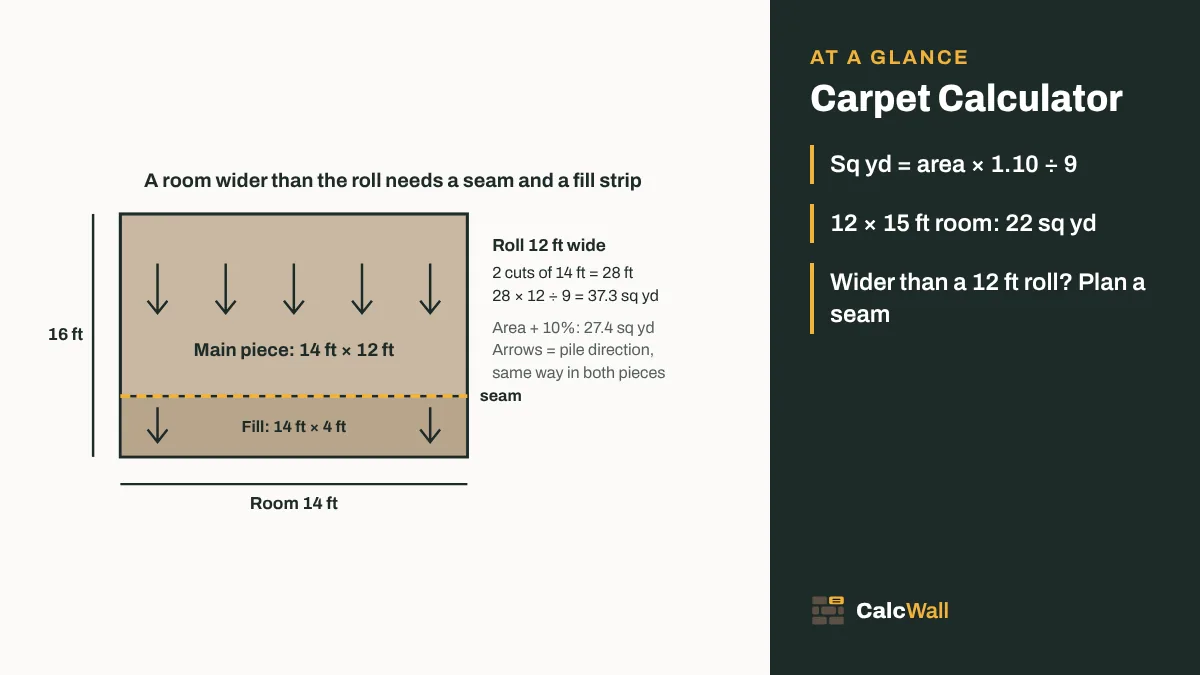
Pieces of the same carpet laid next to each other need their pile running the same way, or the seam shows as a change in color. That rule is what drives the waste. In a 14 × 16 ft room, running the roll along the 14 ft side, the main piece covers 12 ft of the 16 ft width. The 4 ft gap is filled from a second 14 ft cut, and that cut gives you three 4 ft strips, two of which are spare. The order is 28 ft of 12 ft roll, about 37.3 sq yd, against 27.4 sq yd by area. Run the roll the other way and it takes 32 ft of roll, 42.7 sq yd. The spare strips are often big enough for a closet or a hallway, which is why fitters plan the whole house at once.
Where the seam goes matters as much as how much carpet you buy. Seams should run the length of the room, in the same direction as the main foot traffic, and not straight across a doorway. Ask the fitter to show you the seam plan with the quote.
Carpet for stairs
Each step takes a piece that covers the tread, wraps over the nose and runs down the riser. Measure one step along that path, then multiply by the number of steps and the stair width.
| Stairs (36 in wide, 19 in per step) | Carpet area | Square yards |
|---|---|---|
| 3 steps (porch or sunken room) | 14.25 sq ft | 1.6 |
| 7 steps (half flight) | 33.25 sq ft | 3.7 |
| 13 steps (typical full flight) | 61.75 sq ft | 6.9 |
| 14 steps | 66.5 sq ft | 7.4 |
The 19 in figure is a rule of thumb for a 10 in tread and a 7½ in riser; measure your own. Landings are just another rectangle. Most makers want the pile running down the stairs, and a 12 ft roll fits four 36 in step pieces side by side across its width. Enter the steps as one row with the quantity set to the number of steps.
Pad, gripper and transitions
- Pad (cushion): about the same area as the carpet. It has no pile direction, so it wastes less. Use the type and thickness the carpet maker recommends; for most stretched-in residential carpet the cushion should be no thicker than 7⁄16 in.
- Tack strip: runs around the edge of every room. Its length is the room perimeter, less doorways.
- Transitions: where carpet meets tile, wood or vinyl, you need a metal or wood strip for each doorway. Count the doorways.
- Old carpet: removal and disposal is often priced by the square yard too; ask before you sign.
Worked examples
Bedroom with closet and hall
A 12 × 15 ft bedroom (180 sq ft), a 6 × 2 ft closet (12 sq ft) and a 10 × 3½ ft hall (35 sq ft): 227 sq ft × 1.10 ÷ 9 = 27.7, so 28 sq yd. The bedroom is 12 ft wide, so a 12 ft roll covers it without a seam.
Living room wider than the roll
A 14 × 16 ft living room: 224 sq ft × 1.10 ÷ 9 = 27.4, so the calculator says 28 sq yd. From a 12 ft roll with matching pile, a realistic cut is 28 ft of roll, about 37.3 sq yd. Budget for the cut plan, not the area.
Metric bedroom
A 3.6 × 4.2 m bedroom is 15.12 m², plus 10% = 16.6, so 17 m². On a 4 m roll the 3.6 m width fits in one piece, cut 4.2 m long plus trimming.
Notes for carpet fitters
Plan the house, not the room. Fill strips and offcuts from big rooms often finish closets, halls and stairs. Lay out every room on one roll diagram before ordering.
Pile direction. Adjoining pieces of the same carpet need the same pile direction. Ideally pile runs toward the main entrance, but the cut plan may decide.
Seams. Keep them few, along the room, parallel to traffic, out of pivot points and not perpendicular to doorways. Keep light from raking across them.
Patterns. Patterned carpet needs extra length to match the repeat at every seam. Add one pattern repeat per cut as a starting point.
Tips before you buy
- Ask for the seam plan with every quote. Two quotes with different square yards often just have different seam plans.
- Buy from one dye lot for the whole job. Color can shift between production runs.
- Laying hard flooring elsewhere? The tile calculator works the same way for floors, by area plus waste.
Sources
Where the numbers on this page come from. Everything else is plain geometry and unit conversion, which the calculator does with exact factors.
- CRI 105 Standard for Installation of Residential Carpet, The Carpet and Rug Institute, 2019 edition (revisions through 2018). Used for: keeping pile direction the same in adjoining pieces, keeping seams to a minimum and out of line with doorways and main traffic, machine direction and pile down the stairs, and cushion thickness for stretch-in carpet
- NIST Handbook 44, Appendix C: General Tables of Units of Measurement, National Institute of Standards and Technology, 2026 edition. Used for: 1 square yard = 9 square feet and the square meter conversions
Frequently asked questions
How do I calculate how much carpet I need?
Multiply the length by the width of each room, add them up, add about 10% for seams and trimming and divide by 9 to get square yards. A 12 × 15 ft room is 180 sq ft; plus 10% that is 198 sq ft, or 22 square yards.
How many square feet are in a square yard?
Exactly 9: a square yard is 3 ft × 3 ft. One square meter is 1.196 square yards.
How much extra carpet should I order?
About 10% for a simple room. Carpet comes in fixed roll widths (often 12 ft or 4 m), so a room wider than the roll needs a seam and may need much more; patterned carpet also needs extra to match. Ask your fitter for a seam plan.
Do I include closets and hallways?
Yes: add each closet or hallway as another area. Subtract anything that will not be carpeted, such as a fireplace hearth.
Does the price include padding and fitting?
Only if you enter a price per square yard that includes them. Underlay, gripper strips and labour are often priced separately.
Why does the store quote more carpet than my room needs?
Because carpet comes off a roll of fixed width, usually 12 ft. A room wider than the roll needs a seam and a fill strip, and the fill has to run the same way as the main piece. A 14 × 16 ft room is 27.4 sq yd with 10% extra, but the cut from a 12 ft roll can use about 37 sq yd. Ask for the seam plan to see where the extra goes.
How much carpet do I need for stairs?
Measure one step along the carpet’s path: tread depth plus riser height plus about 1½ in to wrap the nose. A 10 in tread and 7½ in riser need about 19 in per step. For 13 steps, 36 in wide, that is 13 × 3 × 1.58 = 61.75 sq ft, or 6.9 sq yd before waste.
How much carpet pad do I need?
About the same area as the carpet, but pad has no pile direction, so it wastes less when cut. Use the room area plus a little for trimming. Use the cushion the carpet maker recommends; the wrong pad can void the carpet warranty.
Is this carpet calculator free to use online?
Yes. The CalcWall Carpet Calculator is completely free and works online in any browser, on a phone, tablet or computer. There is nothing to download and no account to create, and the math runs right in your browser, so results appear as you type.