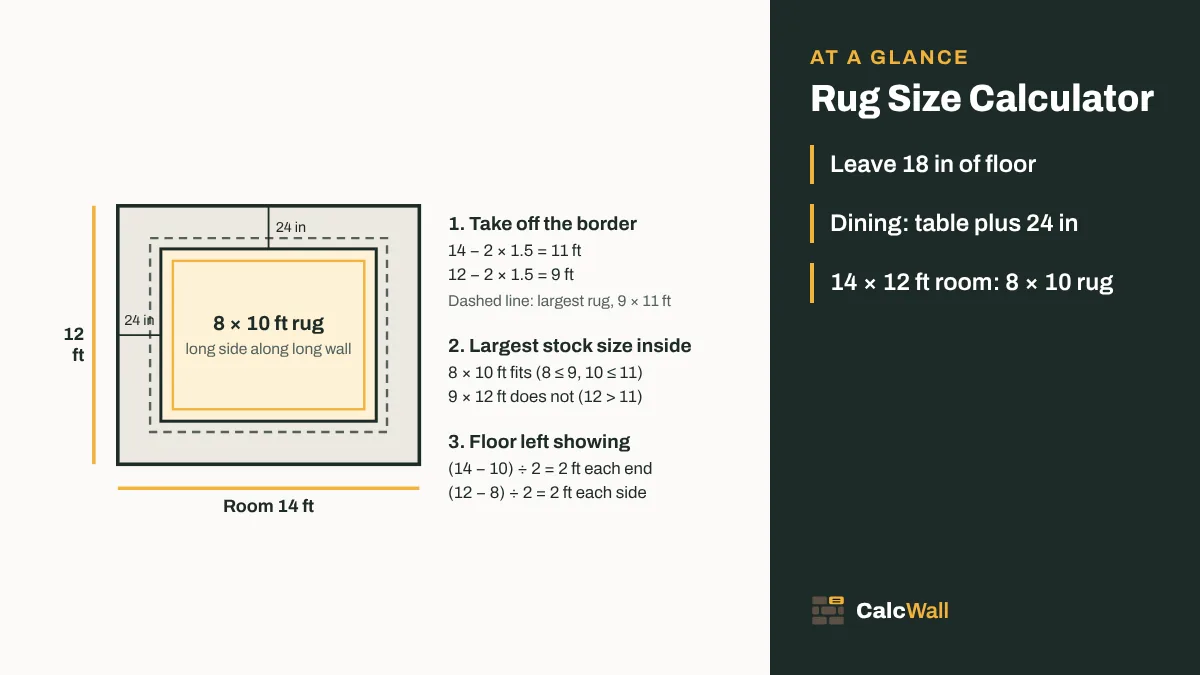
Quick answer: largest rug = (room length − 2 × border) × (room width − 2 × border). A 14 × 12 ft room with 18 in of floor showing fits up to 9 × 11 ft, so an 8 × 10 ft rug, with 24 in of floor left all round.
How to calculate rug size
Most rugs look best with a band of bare floor around them, the same width on every side. That band is the “border” in the calculator. Pick it first, then the rug size follows.
- Measure the room wall to wall at floor level, or just the area you want the rug to cover (an open-plan seating zone, for example).
- Choose the border. About 18 in (45 cm) is the usual starting point. Design guides quote anything from 12 to 24 in. It is a rule of thumb, not a requirement.
- Subtract twice the border from the length and from the width. That is the largest rug that leaves the border you chose.
- Pick the largest common size that is no bigger in either direction. The rug can be turned, so its long side always goes along the room’s long side.
Largest rug = (room length − 2 × border) × (room width − 2 × border)
Work in one unit. With the room in feet and the border in inches, divide the border by 12 first: 18 in is 1.5 ft, so 14 − 3 = 11 ft and 12 − 3 = 9 ft. In metric the calculator converts the room to centimeters, so a 4 × 3.5 m room with a 45 cm border gives 400 − 90 = 310 cm by 350 − 90 = 260 cm.
Rug sizes jump in big steps, so the exact limit almost never matches a rug you can buy. The calculator shows three things: the largest common size that fits, the floor you will actually see with it, and the next size up. If the next size up only breaks your border by a few inches, it may still be the better choice. A rug size a little too big usually looks better than one a little too small.
Rug sizes by room size
The rug size for a room at an 18 in (45 cm) border, worked through the calculator. The last two columns are the floor you will see with that rug.
| Room | Largest rug (18 in border) | Common size that fits | Floor at each end | Floor at each side |
|---|---|---|---|---|
| 10 × 8 ft | 7 × 5 ft | 4 × 6 ft | 24 in | 24 in |
| 12 × 10 ft | 9 × 7 ft | 6 × 9 ft | 18 in | 24 in |
| 12 × 12 ft | 9 × 9 ft | 6 × 9 ft | 18 in | 36 in |
| 14 × 12 ft | 11 × 9 ft | 8 × 10 ft | 24 in | 24 in |
| 15 × 12 ft | 12 × 9 ft | 9 × 12 ft | 18 in | 18 in |
| 16 × 13 ft | 13 × 10 ft | 9 × 12 ft | 24 in | 24 in |
| 16 × 14 ft | 13 × 11 ft | 9 × 12 ft | 24 in | 30 in |
| 18 × 15 ft | 15 × 12 ft | 12 × 15 ft | 18 in | 18 in |
| 20 × 16 ft | 17 × 13 ft | 12 × 15 ft | 30 in | 24 in |
The same in metric at a 45 cm border:
| Room | Largest rug (45 cm border) | Common size that fits | Floor at each end | Floor at each side |
|---|---|---|---|---|
| 3 × 2.5 m | 210 × 160 cm | 120 × 170 cm | 65 cm | 65 cm |
| 3.5 × 3 m | 260 × 210 cm | 160 × 230 cm | 60 cm | 70 cm |
| 4 × 3 m | 310 × 210 cm | 200 × 300 cm | 50 cm | 50 cm |
| 4 × 3.5 m | 310 × 260 cm | 200 × 300 cm | 50 cm | 75 cm |
| 4.5 × 3.5 m | 360 × 260 cm | 250 × 350 cm | 50 cm | 50 cm |
| 5 × 4 m | 410 × 310 cm | 300 × 400 cm | 50 cm | 50 cm |
| 5.5 × 4.5 m | 460 × 360 cm | 300 × 400 cm | 75 cm | 75 cm |
Notice the 12 × 12 ft room. A square room and a rectangular rug leave a lopsided border: 18 in at the ends and 36 in at the sides. If that bothers you, look for a square rug, or put the rug under the furniture group rather than in the middle of the room.
Standard rug sizes in feet and centimeters
There is no official standard for rug sizes. These are the sizes most retailers stock, and the ones the calculator picks from. Always check the label: a rug sold as “8 × 10” can measure 7 ft 10 in × 9 ft 10 in.
| US size (ft) | In inches | In cm (approx.) | Typical use |
|---|---|---|---|
| 2 × 3 | 24 × 36 | 61 × 91 | Door mat, bathroom |
| 3 × 5 | 36 × 60 | 91 × 152 | Entry, beside a bed |
| 4 × 6 | 48 × 72 | 122 × 183 | Small room, reading corner |
| 5 × 8 | 60 × 96 | 152 × 244 | Under a coffee table, twin bed |
| 6 × 9 | 72 × 108 | 183 × 274 | Small living room, full or queen bed |
| 8 × 10 | 96 × 120 | 244 × 305 | Living room, queen bed, six-seat table |
| 9 × 12 | 108 × 144 | 274 × 366 | Large living room, king bed |
| 10 × 14 | 120 × 168 | 305 × 427 | Large room, all furniture on |
| 12 × 15 | 144 × 180 | 366 × 457 | Great room, open plan |
In the UK, Europe, Australia and New Zealand rugs are sold in centimeters, and the sizes are not straight conversions of the US ones. The calculator’s metric list is 60 × 90, 80 × 150, 120 × 170, 160 × 230, 200 × 300, 250 × 350 and 300 × 400 cm. Some shops add in-between sizes such as 240 × 340 cm; if yours does, check it against the “largest rug” line in the result.
Living room layouts
In a living room the border rule tells you the biggest rug the room can take. The furniture tells you the smallest that will look right. There are three usual layouts.
- All legs on. Sofa, chairs and tables all sit on the rug, with at least 8 in of rug past the furniture. This needs a big rug, usually 9 × 12 ft or more, and a room big enough to leave a border around it.
- Front legs on. The front legs of the sofa and chairs sit on the rug and the back legs on the floor. The rug should run 6–8 in past each end of the sofa, so a 10 ft rug suits a sofa up to about 8 ft 8 in long (120 in less 8 in at each end).
- Floating. Only the coffee table sits on the rug. It works in small rooms, but the rug should still be wider than the coffee table by a good margin; 5 × 8 or 6 × 9 ft is typical.
To check a layout, measure the seating group instead of the room: the outside of the sofa and chairs, plus 8 in each way. Then make sure the room still leaves a border around that rug. If the group needs a 9 × 12 ft rug but the calculator says the room only takes 8 × 10, move to front legs on.
Dining room rugs and chair pull-out
A dining rug has one job the others do not: the back legs of a chair must stay on the rug when someone pulls it out to sit down. If they drop off the edge, the chair wobbles and catches every time. The usual rule is about 24 in (60 cm) of rug past every edge of the table.
Minimum dining rug = (table length + 48 in) × (table width + 48 in)
In metric that is the table plus 120 cm each way, or more if your chairs are deep; some guides allow up to 80 cm a side. Note that this is a minimum, the opposite of what the calculator gives. Use both: the table rule tells you the smallest dining room rug size, the calculator tells you the largest the room can take with floor showing. Any stock size between the two works.
- Four-seat table, about 36 × 48 in: at least 84 × 96 in (7 × 8 ft), so a 6 × 9 is too narrow; go to 8 × 10.
- Six-seat table, about 40 × 72 in: at least 88 × 120 in, so 8 × 10 ft.
- Eight-seat table, about 42 × 96 in: at least 90 × 144 in, so 9 × 12 ft.
- Round table, 48 in across: at least 96 in, so an 8 ft round or square rug.
Then check the room. A 9 × 12 ft rug in a 12 × 13 ft dining room leaves only 6 in at the ends. That is usually a sign the table is too big for the room, not that the rug rule is wrong.
Bedroom rugs by bed size
A bedroom rug is mostly about what your feet land on when you get up. The rule of thumb is 18–24 in (45–60 cm) of rug past the sides of the bed, and often past the foot too. Most people turn the rug crosswise, so its long side runs across the bed.
| Bed (mattress W × L) | Width to cover at 18–24 in each side | Usual rug, long side across the bed | Rug past each side |
|---|---|---|---|
| Twin, 38 × 75 in | 74–86 in | 5 × 8 ft (96 in across) | 29 in |
| Full, 53 × 75 in | 89–101 in | 6 × 9 ft (108 in across) | 27½ in |
| Queen, 60 × 80 in | 96–108 in | 8 × 10 ft (120 in across) | 30 in |
| King, 76 × 80 in | 112–124 in | 9 × 12 ft (144 in across) | 34 in |
| California king, 72 × 84 in | 108–120 in | 8 × 10 ft (120 in across) | 24 in |
Bed frames are wider than the mattress, so measure the frame if it has a wide rail or a sleigh end. For metric beds the same idea works in centimeters: a bed frame 160 cm wide plus 60 cm each side needs 280 cm across, so a 200 × 300 cm rug turned crosswise. If the bed sits in a tight room, you can also enter the floor area around the bed as the “room” in the calculator and set the border to zero to see what fits.
The other option is a pair of runners or small rugs, one each side of the bed, about 2½ × 7 ft or 3 × 5 ft. They are cheaper and easier to clean, and they suit a bed pushed into a corner.
Runners, entries and odd rooms
- Hall runners: leave 3–6 in of floor each side of the runner and about the same at each end. A 36 in hall takes a runner 24–30 in wide. Runners are commonly 2 to 3 ft wide and 6 to 15 ft long.
- Entries: the rug should be at least as wide as the door opening, and thin enough that the door clears it. Check the gap under the door before you buy a deep pile.
- L-shaped or open-plan rooms: size the rug to the zone, not the whole floor. Mark it out with painter’s tape and live with it for a day.
- Fireplaces and built-ins: measure from the hearth or the cabinet face, not the wall behind it.
Covering the whole floor rather than zoning it? That is carpet, not a rug: the carpet calculator works out the square yards, and the square yards calculator converts any floor area. Putting tile under the rug? Start with the tile calculator.
Worked examples
Living room, 14 × 12 ft
Border 18 in = 1.5 ft. Largest rug: 14 − 3 = 11 ft by 12 − 3 = 9 ft. The largest stock size inside 9 × 11 ft is 8 × 10 ft; 9 × 12 ft is too long. Floor showing: (14 − 10) ÷ 2 = 2 ft at each end and (12 − 8) ÷ 2 = 2 ft at each side. The calculator shows 8 × 10 ft, 24 in and 24 in, and 9 × 12 ft as the next size up.
Metric living room, 4 × 3.5 m
Border 45 cm. Largest rug: 400 − 90 = 310 cm by 350 − 90 = 260 cm. The largest stock size inside that is 200 × 300 cm; 250 × 350 cm is too long. Floor showing: (400 − 300) ÷ 2 = 50 cm at each end and (350 − 200) ÷ 2 = 75 cm at each side.
Dining room, 13 × 11 ft, 40 × 72 in table
The table rule gives a minimum of (40 + 48) × (72 + 48) = 88 × 120 in, about 7 ft 4 in × 10 ft. The calculator, at an 18 in border, gives a maximum of 13 − 3 = 10 ft by 11 − 3 = 8 ft. 8 × 10 ft sits between the two, with 18 in of floor at each end and each side.
Bedroom, 12 × 11 ft, queen bed
At 18 in the calculator gives a largest rug of 8 × 9 ft and picks 6 × 9 ft, with 18 in at the ends and 30 in at the sides; 8 × 10 ft is too big. Turned across the bed, a 6 × 9 ft rug gives (108 − 60) ÷ 2 = 24 in past each side of a queen, inside the 18–24 in rule.
Notes for designers and installers
Quote the actual size. Stock rugs often run 1–2 in short of the label. On tight dining layouts, use the measured size, not the nominal one.
Pads. Order or cut the pad 1–2 in smaller than the rug on every side so it never shows at the edge.
Door swing. Rug plus pad can add ½ in or more. Check every door that swings over the rug before it is laid.
Tape it out. Mark the rug with painter’s tape for the client. It settles the 8 × 10 or 9 × 12 debate faster than any drawing.
Tips before you buy
- When in doubt, go bigger. A rug that is slightly too large usually looks better than one that leaves furniture stranded.
- Check custom prices. If the calculator’s largest rug falls well between stock sizes, a custom or bound-carpet rug can be cut to that exact size.
- Plan the curtains too. Floor-length curtains and a rug meet at the same wall; the curtain size calculator gives the rod and panel sizes.
Sources
Where the numbers on this page come from. Everything else is plain geometry and unit conversion, which the calculator does with exact factors.
- How to Measure for a Rug: Room-by-Room Guide, Rugknots. Used for: rules of thumb: 18–24 in of bare floor around a rug (12–18 in in small rooms); dining rugs at least 24 in past every side of the table, so add 48 in to the table size; bedroom rugs 18–24 in past the sides and foot of the bed; front-legs rugs 6–8 in past each end of the sofa; runners 3–6 in clear of each wall; pads 1–2 in smaller than the rug
- Rug Size Guide, Parachute. Used for: at least 1 ft of floor showing; rugs 8 in past a furniture group; dining rug sizes by table (6 × 9 ft for six, 8 × 10 for eight, 9 × 12 for ten or more); rug choices by bed size (5 × 8 to 9 × 12 ft); common US sizes
- The Ultimate Rug Size Guide for UK Homes, Rug Love. Used for: metric retail sizes (80 × 150, 120 × 170, 160 × 230, 200 × 300 cm and up); 60–80 cm around a dining table; about 60 cm of rug past each side of a bed
- Mattress Size Comparison, Casper. Used for: US mattress sizes used in the bed table: twin 38 × 75 in, full 53 × 75 in, queen 60 × 80 in, king 76 × 80 in, California king 72 × 84 in
Frequently asked questions
What size rug do I need for my room?
A common rule of thumb is to leave about 18 in (45 cm) of bare floor on every side. In a 14 × 12 ft room that allows a rug up to 9 × 11 ft, so the largest common size that fits is 8 × 10 ft, leaving 2 ft of floor all round.
How much floor should show around a rug?
Usually 12–24 in (30–60 cm) in living rooms and bedrooms; smaller rooms can go down to about 8–12 in. It is a matter of taste, not a rule; change the border to see what fits.
What are the standard rug sizes?
In the US the common sizes are 2 × 3, 3 × 5, 4 × 6, 5 × 8, 6 × 9, 8 × 10, 9 × 12, 10 × 14 and 12 × 15 ft. In Europe, the UK and Australia rugs are usually sold in centimeters, such as 120 × 170, 160 × 230 and 200 × 300 cm. Sizes vary by maker.
What size rug goes under a queen bed?
An 8 × 10 ft rug turned so the 10 ft side runs across the bed is the usual choice. A queen is 60 in wide, so that leaves 30 in of rug on each side. A 6 × 9 ft rug turned the same way leaves 24 in each side and suits a smaller room.
What size rug goes under a king bed?
A king is 76 in wide. A 9 × 12 ft rug across the bed leaves 34 in each side; an 8 × 10 ft leaves 22 in, which works but looks tight if the nightstands sit on it.
What size rug for a dining table?
Add about 24 in (60 cm) on every side so the chairs stay on the rug when pulled out: that is the table size plus 48 in. A 40 × 72 in table needs at least 88 × 120 in, so an 8 × 10 ft rug.
Is an 8 × 10 rug too big for a 10 × 12 room?
With 18 in of floor showing, a 10 × 12 ft room takes a rug up to 7 × 9 ft, so 6 × 9 ft is the calculator’s pick. An 8 × 10 leaves only 12 in on every side. That is fine if you like the look of a nearly wall-to-wall rug.
Should the sofa legs be on the rug?
Either all legs on or just the front legs on both work. What looks wrong is a rug that floats a long way in front of the sofa. For front legs on, the rug should run about 6–8 in past each end of the sofa.
Does the calculator turn the rug?
Yes. It always lines up the rug’s long side with the room’s long side, so it does not matter which way round you enter the room.
What size rug pad do I need?
About 1–2 in smaller than the rug on every side, so the pad does not show at the edges. For an 8 × 10 ft rug that is about 7 ft 8 in × 9 ft 8 in to 7 ft 10 in × 9 ft 10 in. Many pads are sold to the rug size and trimmed with scissors.
Is this rug size calculator free to use online?
Yes. The CalcWall Rug Size Calculator is completely free and works online in any browser, on a phone, tablet or computer. There is nothing to download and no account to create, and the math runs right in your browser, so results appear as you type.