Quick answer: tiles = area × 1.10 ÷ area of one tile with its joint, rounded up. A 12 × 10 ft floor with 12 × 12 in tiles and 1/8 in joints needs 130 tiles (13 boxes of 10).
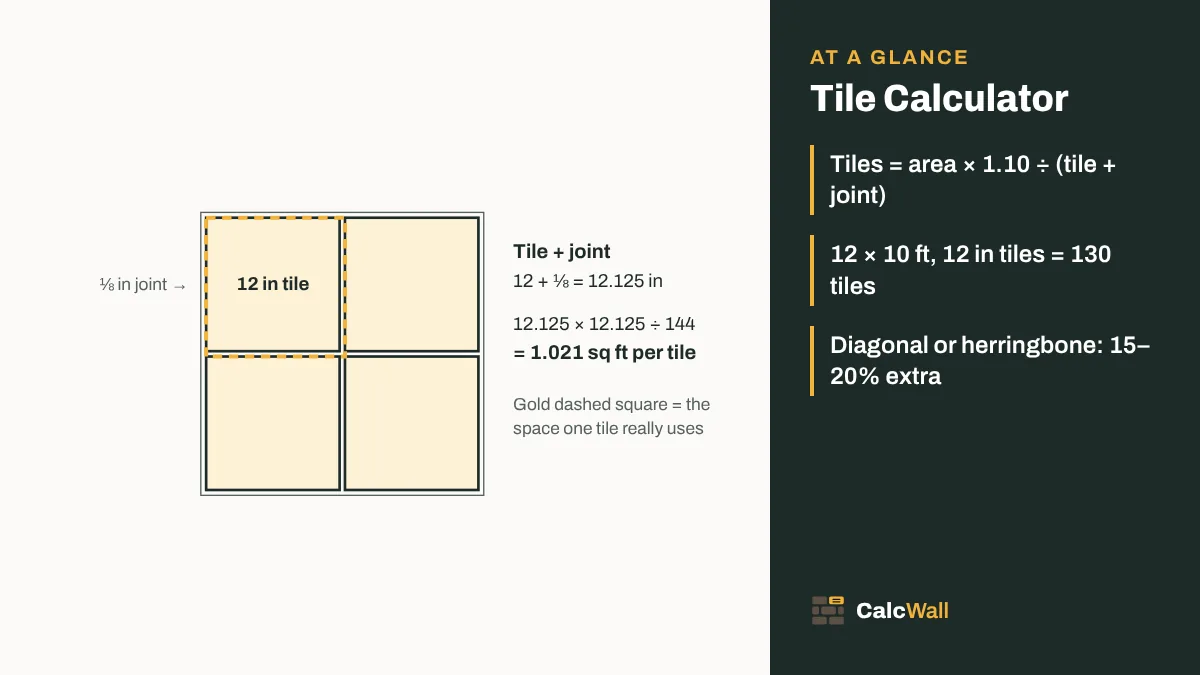
How to calculate tiles
- Measure the length and width of each area. Split L-shaped rooms into rectangles.
- Subtract anything you will not tile, such as a kitchen island or a built-in tub.
- Add waste: usually 10%, more for diagonal and herringbone layouts (see below).
- Divide by the area of one tile plus its joint: (tile length + joint) × (tile width + joint). Round up to whole tiles, then to whole boxes.
Tiles = area × (1 + waste) ÷ ((L + joint) × (W + joint))
Metric example: a 4 × 3 m floor is 12 m², plus 10% = 13.2 m². A 30 × 30 cm tile with a 3 mm joint takes 30.3 × 30.3 cm = 0.0918 m², so 13.2 ÷ 0.0918 = 143.8, rounded up to 144 tiles.
Measuring floors and walls
Most tile shortages start with a rushed measurement, not a bad formula. A few minutes with a tape and a sketch on paper saves a second trip to the store, and a second trip is exactly when you find the shop has sold out of your batch.
- Floors: measure wall to wall at the widest points. Don’t knock anything off for the gap under baseboards; that edge is where your cut pieces go.
- Odd shapes: break the room into rectangles and triangles. A bay window or angled wall is usually a triangle on the end of a rectangle (half of base × height).
- Walls and backsplashes: measure each wall to the height you will tile, not to the ceiling. Backsplashes are often 18 in between the counter and the upper cabinets.
- Windows and doors: subtract big openings. Leave small things like outlets and switch plates in; the tile you cut out around them is waste anyway.
- Tubs, showers and islands: enter them under “Areas not tiled” so the calculator takes their footprint off.
Why the grout joint matters
Every tile uses a little more space than its own face, because a grout joint runs along one side and one end of it. That is why the calculator asks for the joint width and adds it to the tile size before dividing. To check the face area of one tile, the square inches calculator gives it in square inches and square feet.
With big tiles the difference is small, about 2% for 12 in tiles with 1/8 in joints. With small tiles it adds up fast: a 4 in tile with a 1/8 in joint covers about 6% more floor than the tile alone. Check the joint width your tile maker recommends. Rectified tiles, which are ground to precise sizes, can usually take narrower joints than tiles with natural, slightly uneven edges.
Tiles per square foot by size
Use this to sanity-check the calculator or to compare sizes in the store. Figures include the joint shown and no waste.
| Tile size | Joint | Covers per tile | Tiles per 100 sq ft |
|---|---|---|---|
| 3 × 6 in subway | 1/16 in | 0.129 sq ft | 776 |
| 4 × 4 in | 1/8 in | 0.118 sq ft | 847 |
| 6 × 6 in | 1/8 in | 0.261 sq ft | 384 |
| 12 × 12 in | 1/8 in | 1.021 sq ft | 98 |
| 6 × 24 in plank | 1/8 in | 1.026 sq ft | 98 |
| 18 × 18 in | 1/8 in | 2.281 sq ft | 44 |
| 12 × 24 in | 1/8 in | 2.031 sq ft | 50 |
| 24 × 24 in | 1/8 in | 4.042 sq ft | 25 |
| 8 × 48 in plank | 1/8 in | 2.715 sq ft | 37 |
Metric sizes, per 10 m² with a 3 mm joint: 30 × 30 cm takes 109 tiles, 30 × 60 cm takes 55, 60 × 60 cm takes 28 and 20 × 120 cm planks take 41.
How much extra tile to buy
Extra covers the cuts at the edges, the odd tile that cracks while you cut it, and a few spares for repairs later. How much you need depends mostly on the layout.
| Layout | Typical extra |
|---|---|
| Straight lay, simple room | 10% |
| Diagonal, herringbone or many cuts | 15–20% |
| Large-format tiles (24 in / 60 cm and up) | 15% |
| Small bathroom with a toilet, vanity and tub to cut around | 15% |
These are common rules of thumb, not a standard. Your supplier or installer may suggest a different figure for your pattern and room. If you are torn between two numbers, go with the higher one: most stores take back unopened boxes, but they cannot sell you more of a discontinued tile.
Worked examples
Bathroom floor with a tub
An 8 × 5 ft bathroom with a 5 × 2.5 ft tub along one end: 40 − 12.5 = 27.5 sq ft to tile. With 12 × 24 in tiles and 1/8 in joints each tile covers 2.031 sq ft. Small rooms mean lots of cuts, so add 15%: 27.5 × 1.15 ÷ 2.031 = 15.6, so 16 tiles. In boxes of 8, that is 2 boxes.
Kitchen backsplash
A 14 ft run of counter with an 18 in backsplash is 14 × 1.5 = 21 sq ft. With 3 × 6 in subway tile and 1/16 in joints each tile covers 0.129 sq ft. With 10% extra: 21 × 1.10 ÷ 0.129 = 179.2, so 180 tiles. Subway tile is often sold by the square foot or by the box, so check how many tiles the box holds.
Shower walls
A tub-shower alcove with a 60 in back wall and two 32 in end walls, tiled to 72 in: (5 + 2.67 + 2.67) × 6 = 62 sq ft. With 12 × 24 in tiles and 15% extra: 62 × 1.15 ÷ 2.031 = 35.1, so 36 tiles. With 12 × 12 in tiles and 10% extra it would be 67.
Boxes, batches and spares
Tile is sold by the box, and the box label tells you two things that matter: how many tiles or square feet are inside, and the shade or lot number. Enter the tiles per box in the calculator and it rounds up to whole boxes for you.
- Buy it all at once. Color can shift a little between production runs. Boxes from the same lot will match; boxes bought a month later might not.
- Open a few boxes and mix them as you lay, so any small variation spreads out instead of showing up as a patch.
- Keep the spares. Store a few whole tiles and the empty box label in the garage. When a tile cracks in five years, you will be glad you did.
Thinset, grout and the rest
Tiles are only part of the shopping list. You will also need thinset mortar to stick them down, grout for the joints, and often a backer board or membrane underneath. The thinset calculator works out the bags for your area and trowel size. For backer board on walls, the drywall calculator counts sheets the same way, since cement board comes in similar sheet sizes. And if a flooring store quotes by the square yard, the square yards calculator converts your area.
Notes for tile setters
Joint on one side. The calculator adds one joint to the length and one to the width of each tile, so a field of n tiles has n joints. Fine for estimating; perimeter joints at the walls are not counted.
Large format. Big tiles need a flatter substrate and full mortar coverage. Follow the tile and mortar makers’ flatness and coverage requirements, and allow the extra waste for lippage control and cuts.
Layout first. Snap center lines and dry-lay a row each way before you mix. Shifting the grid half a tile often turns two sliver cuts into two good-sized ones.
Movement joints. Leave soft joints at walls and changes of plane, and in large fields, as set out in the TCNA Handbook’s movement-joint guidance. Fill them with sealant, not grout.
Sources
Where the numbers on this page come from. Everything else is plain geometry and unit conversion, which the calculator does with exact factors.
- TCNA Handbook for Ceramic, Glass, and Stone Tile Installation, Tile Council of North America, 2026 edition. Used for: industry installation methods behind the notes for tile setters (substrate, coverage, layout)
- Going deeper into TCNA EJ171 (movement joints), TileLetter. Used for: a plain-English summary of TCNA detail EJ171 on movement joints at walls, changes of plane and in large fields
- NIST Handbook 44, Appendix C: General Tables of Units of Measurement, National Institute of Standards and Technology, 2026 edition. Used for: exact inch, foot and meter conversions for tile and joint sizes
Frequently asked questions
How do I calculate how many tiles I need?
Work out the area (length × width), add 10% for cuts and breakage, and divide by the area of one tile including its grout joint. A 12 × 10 ft floor is 120 sq ft; with 10% extra that is 132 sq ft. A 12 × 12 in tile with a 1/8 in joint covers 12.125 × 12.125 ÷ 144 = 1.021 sq ft, so you need 132 ÷ 1.021 = 129.3, rounded up to 130 tiles.
How much extra tile should I buy?
About 10% for a straight lay in a simple room, 15% or more for a diagonal or herringbone pattern, small rooms with many cuts, or large tiles. Keep a few spare tiles for future repairs: the same batch is hard to match later.
Does the grout joint change the number of tiles?
Slightly. Each tile plus its joint takes up a little more space than the tile alone, so wide joints mean fewer tiles. With 12 in tiles a 1/8 in joint saves about 2%; with small tiles the effect is larger.
How do I tile around a kitchen island or a tub?
Enter the whole room, then add the island or tub under “Areas not tiled” so its footprint is subtracted.
How many boxes of tile do I need?
Divide the number of tiles by the tiles per box printed on the carton and round up. The calculator does this when you enter the tiles per box; you can also enter the price per box for the total cost.
How many tiles are in a square foot?
It depends on the tile size and the joint. With 1/8 in joints, a square foot holds about 8.5 tiles of 4 × 4 in, 3.8 tiles of 6 × 6 in, just under 1 tile of 12 × 12 in and about half a 12 × 24 in tile. Divide 144 by (tile length + joint) × (tile width + joint) in inches.
Should I buy all my tile at once?
Yes. Tile is made in batches, and the color and even the size can shift slightly between them. Buy everything, including the extra, in one order and check that the boxes share the same shade or lot number.
How many tiles do I need for a shower?
Measure each wall to the height you will tile, add them up and subtract the opening. A standard alcove with a 60 in back wall, two 32 in end walls and tile to 72 in is about 62 sq ft. With 12 × 24 in tiles and 15% extra, that is 36 tiles.
Is this tile calculator free to use online?
Yes. The CalcWall Tile Calculator is completely free and works online in any browser, on a phone, tablet or computer. There is nothing to download and no account to create, and the math runs right in your browser, so results appear as you type.