Quick answer: rolls = wall area minus doors and windows, plus 15%, ÷ coverage per roll, rounded up. A 12 × 10 ft room with 8 ft walls, a door and two windows needs 14 rolls at 27 sq ft per roll.
How to calculate wallpaper
- Measure the length and height of each wall.
- Subtract doors and windows.
- Add waste for pattern matching: usually 10–15%.
- Divide by the usable coverage per roll (on the label) and round up.
Rolls = (walls − doors and windows) × (1 + waste) ÷ coverage per roll
Metric example: two 4 m and two 3 m walls, 2.4 m high, are 33.6 m²; minus a 0.9 × 2.1 m door and a 1.2 × 1.2 m window that is 30.27 m². Plus 15% = 34.81 m², ÷ 5.33 m² per roll = 6.53, so 7 rolls.
The pattern repeat, the drop match and the roll width change how many full-height strips each roll gives. This calculator works by area; the label coverage and the waste allowance cover that. For big repeats, check the strip count below as well.
Measuring the room
- Wall height: measure from the top of the baseboard to the ceiling or crown molding, not floor to ceiling, if the baseboard stays on.
- Wall length: measure each wall along its widest point. Going around the room and adding the walls up gives you the perimeter.
- Doors and windows: enter them in the calculator. A quick rule many paint and paper stores use is to take off about 20 sq ft for a standard door or window, if you don’t want to measure each one.
- Feature wall only? Enter just that wall. One wall is where a bold, expensive paper makes the most sense anyway.
- Ceilings: add the ceiling as another area, length × width. Papering a ceiling is a two-person job.
Roll sizes: US and European
Rolls are not one standard size, which is the main reason people order the wrong amount. Always use the figure on the label of the paper you are buying.
- US single roll: usually sold as about 27 sq ft. Stores price per single roll but often only sell double or triple rolls, so a “price per roll” may cover only half of what is in the package.
- US double roll: about 54–56 sq ft.
- European roll: 0.53 m wide and 10.05 m long, which is 5.33 m² (about 57 sq ft).
Before you add waste, notice that the label figure is the paper on the roll. Some of it always ends up in the bin once you trim the top and bottom of every strip and line up the pattern.
Pattern repeat and match
The repeat is how far down the paper you go before the design starts again. Every strip has to start at the same point in the design, so the bigger the repeat, the more you cut off and throw away. Sherwin-Williams publishes the usable yield of a single roll by repeat, which is a good way to sanity-check your order:
| Pattern repeat | Usable yield per single roll |
|---|---|
| 0–6 in | about 25 sq ft |
| 7–12 in | about 22 sq ft |
| 13–18 in | about 20 sq ft |
| 19–23 in | about 18 sq ft |
If you use one of these usable yields as the coverage per roll in the calculator, drop the extra to about 5%, because the waste is already built into the yield.
Counting drops per roll
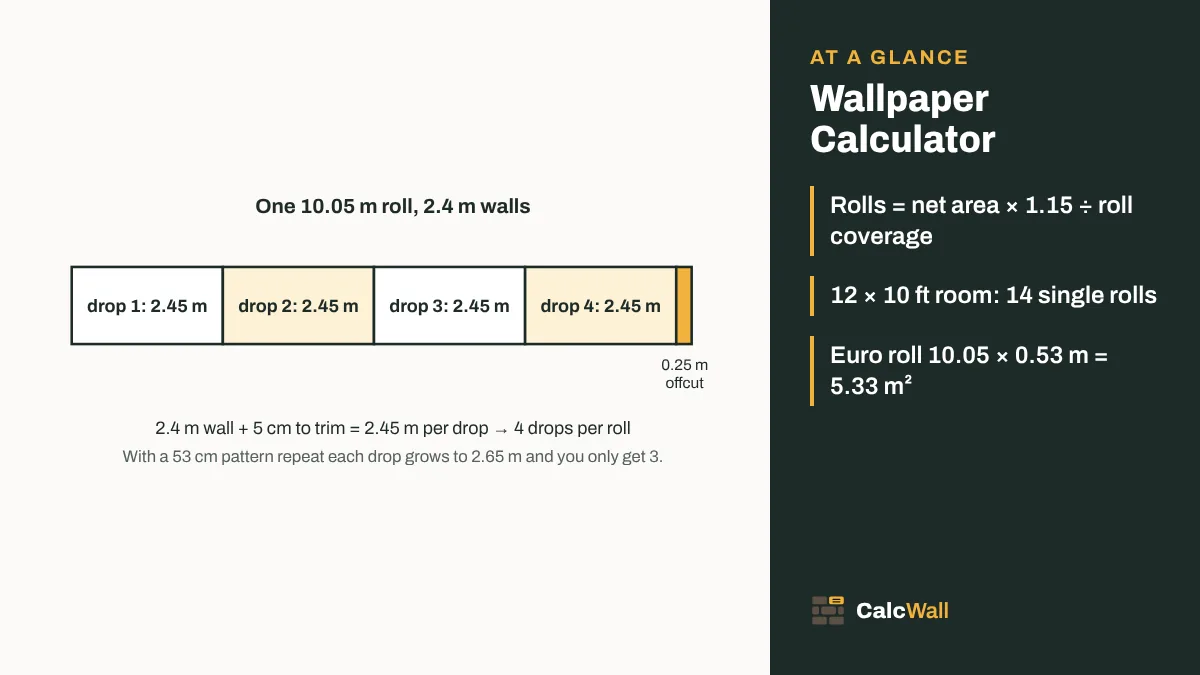
For European rolls, and for any paper with a large repeat, it is worth counting strips (decorators call them drops) as a second check. Each drop is the wall height plus a little extra to trim; with a repeat, the drop length goes up to the next whole repeat.
| Wall height | Drop (with 5 cm to trim) | Drops per 10.05 m roll | Drop with a 53 cm repeat | Drops per roll |
|---|---|---|---|---|
| 2.3 m | 2.35 m | 4 | 2.65 m | 3 |
| 2.4 m | 2.45 m | 4 | 2.65 m | 3 |
| 2.5 m | 2.55 m | 3 | 2.65 m | 3 |
| 2.7 m | 2.75 m | 3 | 3.18 m | 3 |
Then divide the distance around the room by the roll width (0.53 m) to get the number of drops, and divide by drops per roll. Round up both times.
Rolls for common room sizes
US single rolls at 27 sq ft, 8 ft walls, one door and one window taken off (about 33 sq ft), and 15% extra. Large repeats need more.
| Room | Area to cover | Single rolls | Double rolls |
|---|---|---|---|
| 10 × 10 ft | 287 sq ft | 13 | 7 |
| 10 × 12 ft | 319 sq ft | 14 | 7 |
| 12 × 12 ft | 351 sq ft | 15 | 8 |
| 12 × 14 ft | 383 sq ft | 17 | 9 |
| 14 × 16 ft | 447 sq ft | 20 | 10 |
Worked examples
Bedroom with a medium repeat
The default 12 × 10 ft room with 8 ft walls has 307 sq ft to cover after the door and two windows. By label coverage, 307 × 1.15 ÷ 27 = 13.1, so 14 single rolls. The paper has a 15 in repeat, so the usable yield is about 20 sq ft: 307 × 1.05 ÷ 20 = 16.1, so 17 single rolls. Order the higher number.
European paper, counted in drops
A 4 × 3 m room, 2.4 m high, is 14 m around: 14 ÷ 0.53 = 26.4, so 27 drops. A plain paper gives 4 drops per roll, so 27 ÷ 4 = 6.75, 7 rolls, the same as the area method. With a 53 cm repeat it is only 3 drops per roll: 27 ÷ 3 = 9 rolls. Openings save a drop or two, but that is the size of the gap a big pattern makes.
One feature wall
A 12 ft wall behind a bed, 8 ft high, with nothing to subtract: 96 sq ft × 1.15 ÷ 27 = 4.1, so 5 single rolls, which usually means 3 double rolls. Buy the spare: matching a discontinued pattern later is close to impossible.
Before you order
- Check the lot number. Every roll should carry the same run or batch number. Colors can shift between print runs.
- Buy one extra roll. It covers a bad cut and gives you patches for later repairs.
- Open and check before you cut. Look at a length from each roll in daylight before the first strip goes up. Stores rarely take back cut rolls.
- Painting the other walls? The wall square footage calculator gives you the area for paint with the same measurements.
- Doing a board and batten wall instead? Try the board and batten calculator.
Notes for paperhangers
Area vs drops. The calculator uses area ÷ label coverage with a waste factor. For large repeats or half-drop matches, cross-check with drops: perimeter ÷ roll width, then drops per roll from height + trim rounded up to the repeat.
Start plumb. Snap a plumb line for the first drop, not the corner. Plan the last, mismatched seam for the least visible corner, often behind a door.
Trim allowance. Add about 5 cm (2 in) to the height of each drop for trimming at top and bottom, more on uneven ceilings. If the ceiling is textured and you plan to strip it first, the popcorn ceiling removal cost calculator prices that job.
Batches. Keep one batch per room and note the lot number. Hold back a part roll for repairs and store it flat and dry.
Sources
Where the numbers on this page come from. Everything else is plain geometry and unit conversion, which the calculator does with exact factors.
- How to estimate how much wallpaper you need, Sherwin-Williams. Used for: usable yield per single roll by pattern repeat, the 20 sq ft per door or window rule of thumb, single rolls sold as double or triple rolls, and matching lot numbers
- How many rolls do I need? (roll calculator), A.S. Création. Used for: the standard European roll of 10.05 × 0.53 m and the 5 cm allowance on each drop for trimming
- NIST Handbook 44, Appendix C: General Tables of Units of Measurement, National Institute of Standards and Technology, 2026 edition. Used for: exact foot, inch and meter conversions for roll and wall areas
Frequently asked questions
How do I calculate how much wallpaper I need?
Add up the wall areas (length × height of each wall), subtract doors and windows, add about 15% for pattern matching and trimming, and divide by the usable coverage of one roll. A 12 × 10 ft room with 8 ft walls, one door and two windows has 307 sq ft to cover; plus 15% that is 353.05 sq ft, or 14 rolls at 27 sq ft each.
How much does a roll of wallpaper cover?
It depends on the roll. A US single roll is usually sold as about 27 sq ft (a double roll about 54–56 sq ft), and a common European roll of 0.53 × 10.05 m is 5.33 m². The usable coverage after pattern matching is lower, so use the figure on your roll label.
How much extra wallpaper should I buy?
Around 10% for a plain paper or a small repeat, 15% or more for a large pattern repeat, a drop match or a room with many corners. Buy every roll from the same batch (lot number): colours can differ between batches.
Should I subtract doors and windows?
Yes. Enter each door and window under “Doors and windows”. Small openings save less than their area, because the pattern still has to line up around them; that is one reason to keep the waste allowance.
Does this work for the ceiling?
Yes: add the ceiling as another area, with the room length and width as its two sizes.
What is a pattern repeat?
The distance down the paper before the design starts again, printed on the label in inches or centimeters. Every strip has to start at the same point in the pattern, so a big repeat means more paper trimmed off the top or bottom of each drop. A plain or random-match paper has no repeat to allow for.
What is the difference between a straight match and a drop match?
In a straight match the design lines up straight across from strip to strip. In a half-drop match every second strip starts half a repeat lower, so you cut drops from the roll in a staggered way and usually waste a little more. The label shows which one you have.
How many rolls of wallpaper for a 12 × 12 room?
With 8 ft walls, one door and one window (about 33 sq ft of openings), there are 351 sq ft to cover. With 15% extra and 27 sq ft per single roll that is 15 single rolls, which most stores sell as 8 double rolls. A large pattern repeat can push it higher.
Is this wallpaper calculator free to use online?
Yes. The CalcWall Wallpaper Calculator is completely free and works online in any browser, on a phone, tablet or computer. There is nothing to download and no account to create, and the math runs right in your browser, so results appear as you type.