Quick answer: tons = BTU/h ÷ 12,000. ENERGY STAR’s room AC chart gives 12,000 BTU/h, 1 ton, for 450 to 550 sq ft with an 8 ft ceiling. Add 10% for a very sunny room, 600 BTU/h per extra person beyond two and 4,000 BTU/h for a kitchen. A 500 sq ft room needs about 1 ton.
How to use the AC tonnage calculator
Pick a method first. There are three.
- ENERGY STAR chart. This is the default. Type the floor area, or the length and width. Then set the ceiling height, how sunny the room is, how many people use it and whether it is a kitchen. You get the capacity in BTU/h, the tons and the kW, with every step shown.
- Area × BTU per sq ft. Use this when you have your own figure, for example a Manual J load divided by the floor area. The value filled in, 24 BTU/h per sq ft, is the ratio in Trane’s home-size chart: 500 sq ft per ton. It is a rule of thumb, not a standard.
- BTU/h to tons. Type a capacity from a quote, a data plate or a load report, and the calculator converts it to tons and kW. This is the “BTU to tons” mode.
Every result shows the exact tonnage and the next half ton up. It also shows how many square feet each ton covers in your answer, and what the 500 sq ft per ton rule of thumb would have said. Share the link to send the same numbers to someone, or add them to your list.
If an input is missing or out of range, the result disappears and a message says what to fix. The share buttons stop working until you fix it, so you never send a stale answer.
AC size by square footage
The simplest way to size an air conditioner is by the floor area it has to cool. ENERGY STAR publishes a chart for room air conditioners: you find your floor area in the left column and read the capacity in BTU per hour on the right. The capacities assume an 8 ft ceiling.
Measure the room wall to wall and multiply length by width. A 14 × 12 ft bedroom is 168 sq ft. If the space is not a rectangle, split it into rectangles and add them up. The square meters calculator handles odd shapes, in feet or meters.
The chart’s rows meet at their ends: 100–150, then 150–250, and so on. We read a value on the line as the top of the lower row, so exactly 150 sq ft gets 5,000 BTU/h. Below 100 sq ft the calculator uses the smallest row and tells you the room is below the chart. Above 2,500 sq ft the chart stops, and so does the chart method. Cool a bigger area room by room, or use a load calculation.
Only measure the space the unit will really cool. A room AC in a bedroom with the door shut cools the bedroom, not the hall. For a whole house with central air, the chart is a rough first look at best. It was written for room units, and a house has many rooms, ducts and a lot more going on.
BTU and tons
Air conditioner capacity is given in BTU per hour (BTU/h) or in tons. One ton of cooling is 12,000 BTU/h, so tons = BTU/h ÷ 12,000. The ton here has nothing to do with weight. It is a rate of cooling.
tons = BTU/h ÷ 12,000 · kW = BTU/h × 0.29307107 ÷ 1,000
Outside the US, capacity is usually given in kilowatts. The British thermal unit is defined exactly as 1,055.05585262 joules (NIST SP 811, footnote 9). An hour has 3,600 seconds, so 1 BTU/h is 0.29307107 W and 1 ton is 3.5169 kW. The calculator uses the exact figure, so going back and forth between units does not drift.
| Tons | BTU/h | kW |
|---|---|---|
| 0.5 t | 6,000 | 1.76 |
| 1 t | 12,000 | 3.52 |
| 1.5 t | 18,000 | 5.28 |
| 2 t | 24,000 | 7.03 |
| 2.5 t | 30,000 | 8.79 |
| 3 t | 36,000 | 10.55 |
| 3.5 t | 42,000 | 12.31 |
| 4 t | 48,000 | 14.07 |
| 5 t | 60,000 | 17.58 |
BTU/h = tons × 12,000; kW = BTU/h × 1,055.05585262 ÷ 3,600 ÷ 1,000. Plain arithmetic.
Central systems are usually described in tons and room units in BTU/h. So the calculator shows the exact number in both, plus the next half ton up. That last line is only rounding: check the sizes of the models you are actually quoted.
Sun, people, kitchen and ceiling height
ENERGY STAR gives four adjustments to its chart. The calculator applies each one as its own line, so you can see what it does.
| Adjustment | ENERGY STAR says | For a 6,000 BTU/h room |
|---|---|---|
| Heavily shaded | reduce capacity by 10% | 5,400 BTU/h |
| Very sunny | increase capacity by 10% | 6,600 BTU/h |
| More than two people | add 600 BTU for each additional person | 4 people: 7,200 BTU/h |
| Kitchen | increase capacity by 4,000 BTU | 10,000 BTU/h |
Rules from the ENERGY STAR room AC page, read 17 Nov 2026. The last column is plain arithmetic from the 150–250 sq ft row.
The order matters a little. The calculator works in this order:
- Read the capacity for your floor area from the chart.
- Scale it for the ceiling height (height ÷ 8 ft).
- Take off 10% for heavy shade, or add 10% for a very sunny room.
- Add 600 BTU/h for each person beyond two.
- Add 4,000 BTU/h for a kitchen.
- Divide by 12,000 for tons.
The fixed additions are not scaled by the percentage, because a person or a stove gives off the same heat in a sunny room as in a shady one.
Ceiling height is the one step that is ours. ENERGY STAR says its capacities are calculated for an 8 ft ceiling, but it gives no rule for other heights. A taller room holds more air, so we scale the chart capacity by your height ÷ 8 ft. A 10 ft ceiling adds 25%. This is CalcWall’s approximation, not ENERGY STAR’s, and the result line says so. Heights within 0.05 ft of 8 ft, such as a 2.44 m metric ceiling, count as 8 ft.
Climate zone adjustments
Many AC calculators ask for a climate zone and raise or lower the answer by a factor. The ENERGY STAR chart has no climate factor, and the competitor pages in our research did not say where their factors came from. So this AC tonnage calculator does not invent one.
What you can do is use the sun setting honestly. A west-facing room with big windows in a hot place is “very sunny”. A room under trees on the north side is “heavily shaded”. If you live somewhere very hot or very humid, treat the result as the low end and get a load calculation, which works from the weather data for your area.
If you know a better figure for your home, switch to the area × BTU per sq ft method and type it. The result then shows how your figure compares with the rule of thumb.
AC size chart
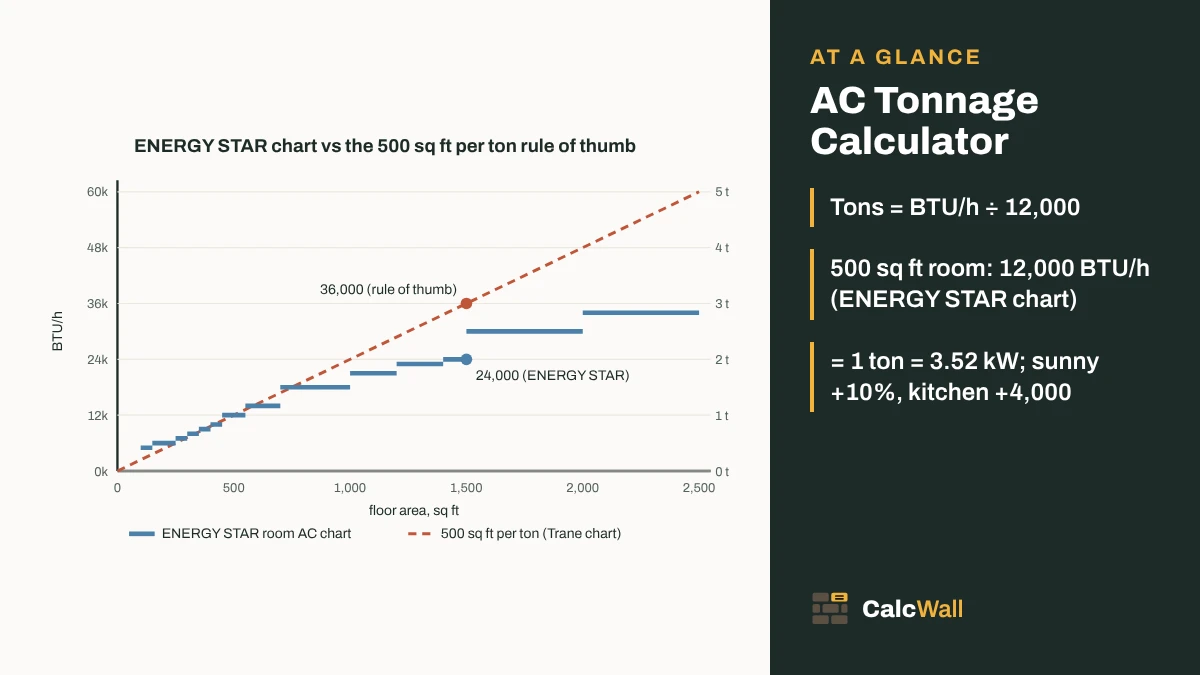
Here is the ENERGY STAR chart with the tons and kW added. The last column shows how many square feet one ton covers at the top of each row, and the rule-of-thumb column what 500 sq ft per ton would give for the same area.
| Area to be cooled | Capacity (ENERGY STAR) | Tons | kW | Rule of thumb at top of row | Sq ft per ton at top of row |
|---|---|---|---|---|---|
| 100–150 sq ft | 5,000 BTU/h | 0.42 | 1.47 | 0.30 t | 360 |
| 150–250 sq ft | 6,000 BTU/h | 0.50 | 1.76 | 0.50 t | 500 |
| 250–300 sq ft | 7,000 BTU/h | 0.58 | 2.05 | 0.60 t | 514 |
| 300–350 sq ft | 8,000 BTU/h | 0.67 | 2.34 | 0.70 t | 525 |
| 350–400 sq ft | 9,000 BTU/h | 0.75 | 2.64 | 0.80 t | 533 |
| 400–450 sq ft | 10,000 BTU/h | 0.83 | 2.93 | 0.90 t | 540 |
| 450–550 sq ft | 12,000 BTU/h | 1.00 | 3.52 | 1.10 t | 550 |
| 550–700 sq ft | 14,000 BTU/h | 1.17 | 4.10 | 1.40 t | 600 |
| 700–1,000 sq ft | 18,000 BTU/h | 1.50 | 5.28 | 2.00 t | 667 |
| 1,000–1,200 sq ft | 21,000 BTU/h | 1.75 | 6.15 | 2.40 t | 686 |
| 1,200–1,400 sq ft | 23,000 BTU/h | 1.92 | 6.74 | 2.80 t | 730 |
| 1,400–1,500 sq ft | 24,000 BTU/h | 2.00 | 7.03 | 3.00 t | 750 |
| 1,500–2,000 sq ft | 30,000 BTU/h | 2.50 | 8.79 | 4.00 t | 800 |
| 2,000–2,500 sq ft | 34,000 BTU/h | 2.83 | 9.96 | 5.00 t | 882 |
Area and capacity from ENERGY STAR (8 ft ceiling; the page prints the last value as “34,00”, read as 34,000). Tons, kW and the two right-hand columns are plain arithmetic; the rule of thumb is 500 sq ft per ton from Trane’s chart.
Look at how the two drift apart. For small rooms they are close. From about 700 sq ft the chart gives less and less per square foot: 2,500 sq ft gets 34,000 BTU/h, under 3 tons, against 5 tons by the rule of thumb. A room unit cools one open space, and the chart reflects that. A whole house with many rooms is a different job.
Why bigger is not better
It is tempting to round up a lot, just to be safe. ENERGY STAR warns against it. An oversized air conditioner is less effective, wastes energy and does not cool any better. Air conditioners remove both heat and humidity. If the unit is too large, it cools the room before it has a chance to remove the humidity, and the cool, moist air feels damp and clammy.
So round up to the next size you can buy, not two sizes. That is what the “next half ton up” line is for. If the exact figure sits right on a size, like 1.00 ton, that size is the one.
Why Manual J is the real answer
This calculator is an estimate. The real answer for a home comes from a load calculation by ACCA Manual J, 8th edition (ANSI/ACCA 2 Manual J – 2016). It is the standard for working out equipment sizing loads for homes. A contractor enters your walls, windows, insulation, air leaks, ducts and local weather, room by room.
You need a real Manual J when:
- you are putting in or replacing a central system or a heat pump for the whole house;
- a permit or your local inspector asks for a load calculation;
- you are replacing equipment and want to know whether the old unit was the right size, rather than just copying it.
Ask each installer for the cooling load in BTU/h and how they got it. Type it into the “BTU/h to tons” mode to see it in tons, and compare it with the chart. If one quote is far above the others, ask why. For heating, the furnace size calculator does the matching job.
Worked examples
Each example uses the calculator as it stands, and the numbers match what it shows.
Living room, 500 sq ft (the default)
500 sq ft is in the 450–550 row: 12,000 BTU/h. 8 ft ceiling, average sun, two people, not a kitchen. 12,000 ÷ 12,000 = 1.00 ton, 3.52 kW. The rule of thumb also gives 1 ton.
Sunny bedroom for three, 14 × 12 ft
168 sq ft → 6,000 BTU/h. Very sunny: × 1.1 = 6,600. One person beyond two: + 600 = 7,200 BTU/h. That is 0.60 tons, 2.11 kW. A room unit of at least 7,200 BTU/h.
Kitchen with a 9 ft ceiling, 16 × 14 ft, four people
224 sq ft → 6,000. Ceiling 9 ÷ 8 = 1.125: 6,750. Two people beyond two: + 1,200. Kitchen: + 4,000. Total 11,950 BTU/h, 1.00 ton (0.996), 3.50 kW. Next half ton up: 1 ton.
Shaded family room, 600 sq ft, 10 ft ceiling
600 sq ft → 14,000. Ceiling 10 ÷ 8 = 1.25: 17,500. Heavily shaded: × 0.9 = 15,750 BTU/h. That is 1.31 tons, 4.62 kW. Next half ton up: 1.5 tons.
Metric room, 40 m²
40 m² = 430.6 sq ft → the 400–450 row: 10,000 BTU/h = 2.93 kW, 0.83 tons.
BTU to tons: a 36,000 BTU/h quote
36,000 ÷ 12,000 = 3.00 tons, 10.55 kW.
Your own figure: 1,800 sq ft at 24 BTU/h per sq ft
1,800 × 24 = 43,200 BTU/h = 3.60 tons, 12.66 kW. Next half ton up: 4 tons. The ENERGY STAR chart would give 30,000 BTU/h (2.5 tons) for the same area, which shows why a whole house needs a load calculation.
Notes for pros
Room units. The chart is ENERGY STAR’s room AC chart. Use it for single rooms and open spaces up to 2,500 sq ft.
Every step visible. Chart row, ceiling, sun, people and kitchen are separate lines, so a homeowner can check them.
Your load in. Type a Manual J load in BTU/h or kW to get tons and the next half ton.
Share it. The link carries the method, units, area, ceiling, sun, people and kitchen.
- This tool does not do a load calculation, pick equipment by airflow or check a code. Your local code and inspector decide what is needed.
- For airflow, the CFM calculator and the air changes per hour calculator cover the room side. Better insulation lowers the load: the insulation calculator works out the material.
Sources
Where the numbers on this page come from. Everything else is plain geometry and unit conversion, which the calculator does with exact factors.
- ENERGY STAR Certified Room Air Conditioners, U.S. EPA, ENERGY STAR (energystar.gov), web page, undated; step 2 “Find the correct cooling capacity for your room size” (read 17 November 2026). Used for: the sizing chart (area to be cooled in sq ft → capacity needed in BTU/h, 14 rows from 100–150 sq ft = 5,000 to 2,000–2,500 sq ft = 34,000), “calculated based on an 8-foot ceiling”, and the four adjustments: heavily shaded −10%, very sunny +10%, +600 BTU for each person beyond two, kitchen +4,000 BTU; also that an oversized unit cools the room before it can remove the humidity. The page prints the last capacity as “34,00”; we read it as 34,000
- What Is HVAC Capacity (And Why Does It Matter?), Trane (residential glossary), web page, last modified 27 March 2025 (read 17 November 2026). Used for: “one ton = 12,000 BTUs”, and its home-size chart (1,000 sq ft = 2 tons … 2,500 sq ft = 5 tons), which Trane calls “only an estimate”. We use it only as the 500 sq ft per ton rule of thumb
- ACCA Manual J – Residential Load Calculation, 8th Edition-Full, ANSI/ACCA 2-2016, Air Conditioning Contractors of America (ACCA); listing in the U.S. DOE Building America Solution Center (PNNL), 8th edition, ANSI/ACCA 2 Manual J – 2016 (listing read 17 November 2026). Used for: named as the professional load calculation, described there as the standard covering equipment sizing loads for single-family detached homes. We did not read the manual and use none of its tables
- NIST Guide to the SI, Footnotes (Special Publication 811), National Institute of Standards and Technology, web page, updated 18 August 2025, footnote 9 (read 17 November 2026). Used for: 1 Btu_IT = 1.055 055 852 62 kJ exactly, so 1 BTU/h = 0.29307107 W and 1 ton (12,000 BTU/h) = 3.5169 kW
- NIST Handbook 44, Appendix C: General Tables of Units of Measurement, National Institute of Standards and Technology, 2026 edition. Used for: 1 ft = 0.3048 m and 1 sq ft = 0.09290304 m² (exact), for metric input
Frequently asked questions
What size AC for a 1,500 sq ft house?
The ENERGY STAR chart gives 24,000 BTU/h for 1,400 to 1,500 sq ft: 2 tons. The 500 sq ft per ton rule of thumb from Trane’s chart gives 3 tons. The gap is why a whole house needs a Manual J load calculation. ENERGY STAR’s chart is written for room units cooling one open space, so use it as the low end, not as the answer.
How many square feet does a ton of AC cool?
In the ENERGY STAR room AC chart, 12,000 BTU/h (1 ton) covers 450 to 550 sq ft at an 8 ft ceiling. Trane’s home-size chart works out at 500 sq ft per ton and Trane calls it only an estimate. Sun, people, kitchens, ceiling height and insulation all move the real figure.
How many BTU is a ton of air conditioning?
One ton of cooling is 12,000 BTU per hour. To turn BTU/h into tons, divide by 12,000: 18,000 BTU/h is 1.5 tons and 36,000 is 3 tons. In kilowatts, 1 ton is 3.517 kW, from the exact BTU in NIST SP 811.
Is a bigger air conditioner better?
No. ENERGY STAR says an oversized unit is less effective and wastes energy. If the unit is too large, it cools the room before it has a chance to remove the humidity, and the room feels damp and clammy. Pick the capacity the room needs, not the biggest one on the shelf.
How do sun, people and a kitchen change the AC size?
ENERGY STAR gives four adjustments. Take 10% off for a heavily shaded room, add 10% for a very sunny one, add 600 BTU/h for each person beyond two who regularly uses the room, and add 4,000 BTU/h if the unit cools a kitchen. The calculator shows each one as its own line.
Does ceiling height change the AC size?
Yes. ENERGY STAR’s capacities are based on an 8 ft ceiling. A higher ceiling means more air to cool, so the calculator scales the chart capacity by your height ÷ 8 ft. That scaling is CalcWall’s approximation, not ENERGY STAR’s, and the result line says so.
Is this AC tonnage calculator a Manual J?
No. It is an estimate from a published chart and simple adjustments. ACCA Manual J (8th edition, ANSI/ACCA 2 – 2016) is the load calculation a contractor runs on your actual house. Use this tool to plan and to check that a quote is in a sensible range.
Can I use the AC tonnage calculator in square meters and kW?
Yes. Switch the units to m², m and kW, or pick a metric country. Area and height convert exactly (1 ft = 0.3048 m), and capacity converts with 1 BTU/h = 0.29307107 W. The ENERGY STAR chart itself stays in sq ft, so the result shows which row your area falls in.
Is this ac tonnage calculator free to use online?
Yes. The CalcWall AC Tonnage Calculator is completely free and works online in any browser, on a phone, tablet or computer. There is nothing to download and no account to create, and the math runs right in your browser, so results appear as you type.