Quick answer: packs = area × 1.05 × layers ÷ coverage per pack, rounded up. A 30 × 24 ft attic with packs that cover 40 sq ft needs 19 packs for one layer.
How to calculate insulation
- Measure the area to insulate: the attic floor, or the length × height of each wall.
- Subtract openings such as a hatch, a window or a door.
- Add a little extra for trimming and odd bays: about 5%.
- Multiply by the number of layers and divide by the coverage per pack printed on the label. Round up.
Packs = (area − openings) × 1.05 × layers ÷ coverage per pack
Metric example: an 8 × 6 m loft is 48 m², plus 5% = 50.4 m². With rolls that cover 5 m² that is 10.08, so 11 rolls.
This is a quantity estimate only. It does not choose an R-value or check U-values, vapour control or fire rules; follow the product instructions and the energy code or building regulations that apply where you live. Fitting downlights in an insulated ceiling? They need IC-rated housings; the recessed lighting calculator lays out how many and how far apart.
Measuring attics, walls and floors
Insulation goes in the space you are keeping warm or cool, so measure that, not the outside of the house.
- Attic floor: measure the floor of the attic from one outside wall to the other. Don’t measure the roof slope unless you are insulating the roof itself.
- Walls: length × height of each wall you are filling. Add them up and take off the windows and doors. A typical 12 × 10 ft room with 8 ft walls has 352 sq ft of wall, or 307 sq ft after a 3 × 7 ft door and two 3 × 4 ft windows.
- Floors over a crawl space or garage: length × width of the floor above.
- Framing: don’t subtract studs or joists. Label coverage is the area of wall or floor a pack fills when fitted between framing at the stated spacing.
- Knee walls and slopes in a finished attic are separate rectangles. Measure each and add them as extra rows.
For the wall area on its own, the wall square footage calculator takes off doors and windows for you. Hanging drywall over the new insulation? The drywall calculator uses the same wall sizes.
Reading the package label
Every bag or roll of batts lists the R-value, the thickness, the width and length of each piece, how many pieces are inside, and the square feet the package covers. That last figure is what the calculator needs.
A few examples from one manufacturer’s fact sheet show how much it varies:
| Batt | Thickness | Piece size | Pieces per package | Covers per package |
|---|---|---|---|---|
| R-13 | 3½ in | 15 × 93 in | 12 | 116.25 sq ft |
| R-13 | 3½ in | 23 × 93 in | 11 | 163.40 sq ft |
| R-19 | 6¼ in | 15 × 94 in | 10 | 97.92 sq ft |
| R-30 (high density) | 8¼ in | 15 × 48 in | 11 | 55.00 sq ft |
| R-38 (high density) | 10¼ in | 15 × 48 in | 8 | 40.00 sq ft |
You can check any label the same way: piece width × piece length × pieces ÷ 144. For the first row, 15 × 93 × 12 ÷ 144 = 116.25 sq ft. Other makers’ products differ, so always use the number on the package you are buying.
R-value, thickness and layers
R-value is how well insulation resists heat flow. The higher the number, the better it insulates. The Department of Energy adds a few points worth knowing before you shop:
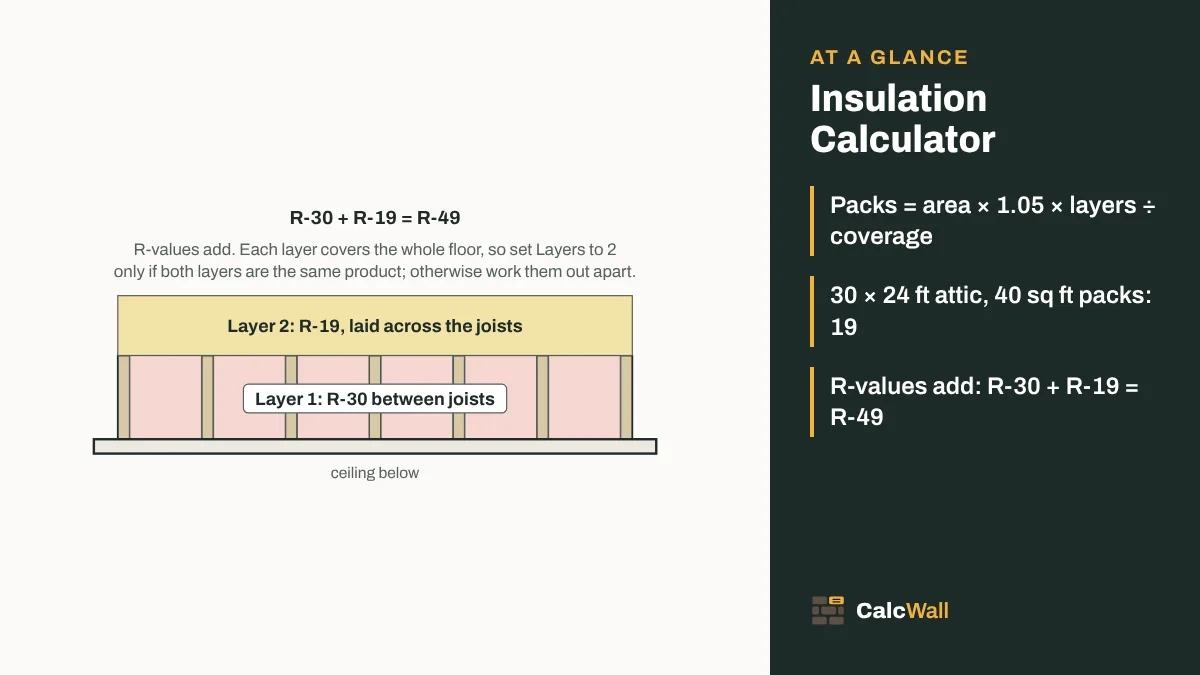
- Layers add up. R-30 between the joists plus R-19 laid across them gives R-49.
- Squashing it costs you. Insulation that is compressed does not give its full rated R-value, so don’t stuff a thick batt into a shallow wall.
- Framing leaks heat. Heat moves more easily through studs and joists, so a whole wall performs below the batt’s own rating.
Thickness for a given R-value is not fixed either. One maker sells R-19 batts at 6¼ in and another at 6½ in, and high-density products reach the same R-value in less depth.
The DOE publishes recommended R-values by climate zone. For attics, its guidance is:
| Climate zone | Uninsulated attic | Attic with 3–4 in already | Uninsulated floor |
|---|---|---|---|
| 1 | R30–R49 | R19–R38 | R13 |
| 2 | R49–R60 | R38–R49 | R13 |
| 3 | R49–R60 | R38–R49 | R19 |
| 4 except marine | R60 | R49 | R19 |
| 4 marine and 5 | R60 | R49 | R30 |
| 6 | R60 | R49 | R30 |
| 7 and 8 | R60 | R49 | R38 |
These are recommendations, not code minimums. Your local energy code or building regulations decide what is required for a permit, so check them first, then pick the product and enter its coverage here.
Blown-in insulation
Loose-fill cellulose and fiberglass are sold in bags too, but the coverage per bag changes with the depth you blow. Every bag has a chart: for each target R-value it gives the depth to install and the square feet one bag covers at that depth. Pick your row and enter that coverage per bag in the calculator.
Two things catch people out. Loose fill settles over time, so the chart usually gives an installed depth and a settled depth; blow to the installed one. And because settling increases density, R-value does not rise in step with depth, which is why you should read the coverage from the chart rather than scale it yourself.
Worked examples
Attic with R-30 batts
A 30 × 24 ft attic floor is 720 sq ft. Using R-30 packages that cover 55 sq ft: 720 × 1.05 ÷ 55 = 13.7, so 14 packages.
Topping up an attic
The same attic gets a second layer of R-19 across the joists, in packages covering 97.92 sq ft: 720 × 1.05 ÷ 97.92 = 7.7, so 8 packages. Together with the R-30 underneath, that is R-49.
Walls of one room
A 12 × 10 ft room with 8 ft walls has 307 sq ft of wall after the door and two windows. With R-13 packages covering 116.25 sq ft: 307 × 1.05 ÷ 116.25 = 2.8, so 3 packages.
Common mistakes
- Measuring the roof instead of the attic floor when the floor is what you are insulating. The roof slope is bigger, so you over-order.
- Buying by R-value alone. Two R-19 products can cover different areas per bag. Compare the square feet.
- The wrong width. 15 in batts suit 16 in framing and 23 in batts suit 24 in framing. Check your spacing before you buy.
- Blocking vents. Keep insulation clear of soffit vents and away from anything the maker says needs clearance, such as some light fixtures and flues.
Notes for insulation installers
Label math. Coverage per package = piece width × length × pieces ÷ 144. Use it to compare bags priced differently.
Layers. Set Layers to 2 only for two layers of the same product. Different products: run the calculator once for each.
Air sealing first. Seal top plates, penetrations and the attic hatch before insulating; air leaks undo a lot of R-value.
Vapour control and fire. Facing direction, vapour retarders and exposed facings are set by the product instructions and local code, not by this estimate.
Tips before you buy
- Wear long sleeves, gloves, goggles and a dust mask when handling fiberglass or blowing loose fill.
- Lay boards across the joists to kneel on in the attic, and never step between them.
- Keep the receipts and a spare bag. Most stores take back unopened packs.
Sources
Where the numbers on this page come from. Everything else is plain geometry and unit conversion, which the calculator does with exact factors.
- Insulation, U.S. Department of Energy, Energy Saver. Used for: what R-value means, that layer R-values add, that compressed insulation loses R-value, and the DOE’s recommended R-values by climate zone
- EcoBatt Insulation fact sheet, Knauf Insulation, valid from April 2025. Used for: example batt sizes, thicknesses and square feet per package in the label table
- Fiberglass Manufacturers Fact Sheet (BID-380), Johns Manville, December 2019. Used for: evidence that the same R-value comes in different thicknesses from different makers (e.g. R-19 at 6½ in)
- NIST Handbook 44, Appendix C: General Tables of Units of Measurement, National Institute of Standards and Technology, 2026 edition. Used for: square foot and square metre conversions
Frequently asked questions
How do I calculate how much insulation I need?
Measure the area to insulate (length × width of the attic floor, or length × height of each wall), subtract openings, add a little extra and divide by the coverage on one pack. A 30 × 24 ft attic is 720 sq ft; plus 5% that is 756 sq ft, or 19 packs that cover 40 sq ft each.
What R-value do I need?
That depends on your climate zone, the part of the building and the local energy code or building regulations. This calculator does not choose an R-value or a thickness; check the requirement that applies where you live, then enter the coverage of the product that meets it.
How does a second layer change the amount?
Each layer covers the whole area again, so two layers need twice as many packs. Choose 2 under “Layers” for a second layer laid across the first.
Do I subtract the joists or studs?
No. Batt coverage on the label is the area of the wall or floor the pack fills when fitted between framing at the stated spacing, so enter the whole area.
Does this work for blown-in insulation?
Yes, if you enter the coverage per bag the manufacturer gives for the depth you want. Blown-in coverage depends strongly on depth, so read it from the bag chart.
How many square feet does a bag of insulation cover?
It is printed on the bag and varies a lot. As examples from one maker’s fact sheet, a package of R-13 batts 15 × 93 in covers 116.25 sq ft, R-19 batts 15 × 94 in cover 97.92 sq ft, and R-30 batts 15 × 48 in cover 55 sq ft. Thicker insulation means fewer square feet per bag.
What R-value should my attic have?
The U.S. Department of Energy’s guidance for an uninsulated attic is R30–R49 in climate zone 1, R49–R60 in zones 2 and 3, and R60 in zones 4 to 8. Your local energy code may set a different minimum, so check it before you buy.
Can I squash thicker insulation into a thinner wall?
You can, but you lose some of what you paid for. The Department of Energy notes that compressed insulation does not give its full rated R-value. Buy batts made for the depth of your studs or joists.
Is this insulation calculator free to use online?
Yes. The CalcWall Insulation Calculator is completely free and works online in any browser, on a phone, tablet or computer. There is nothing to download and no account to create, and the math runs right in your browser, so results appear as you type.