Quick answer: box fill is allowances times the volume per wire. Count each wire once, each device twice, all clamps once and up to four grounds once. Two 14/2 cables and a switch with clamps make 8 × 2.00 in³ = 16.0 in³, so an 18.0 in³ device box fits.
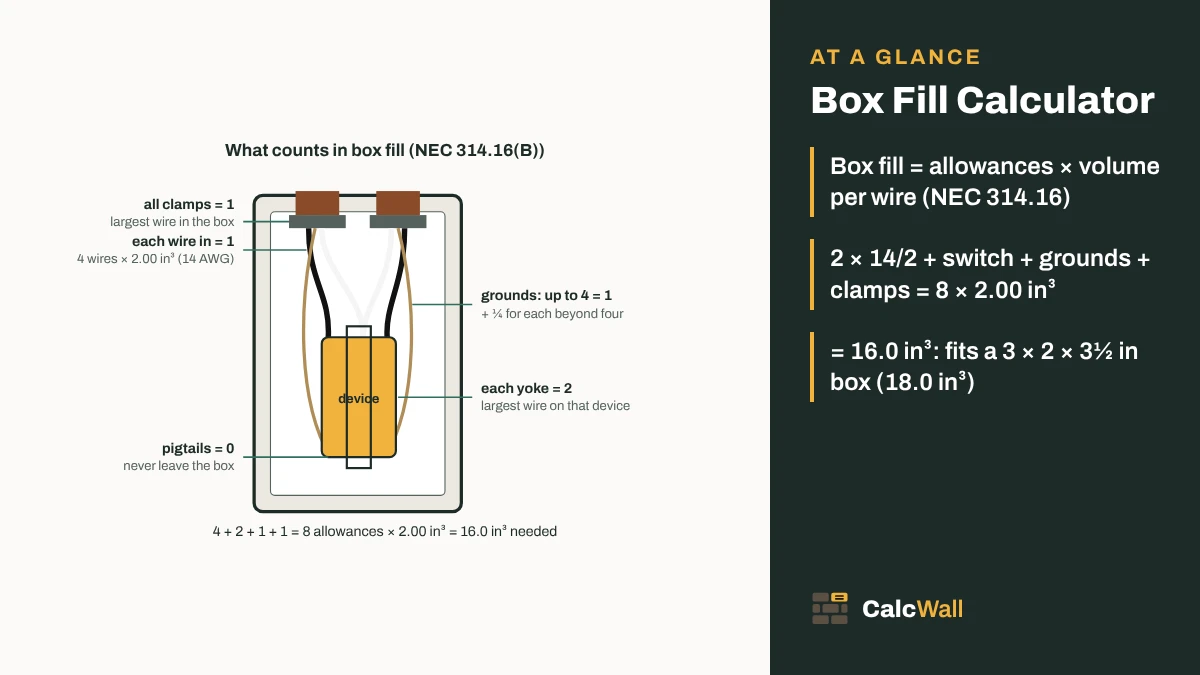
How box fill works
Every outlet, switch and junction box has to leave free space for the wires inside it. The National Electrical Code sets that space in section 314.16. In plain words: the volume of the box must be at least the box fill, and the box fill is worked out by counting what is inside and giving each item a volume from a table.
Box fill = Σ (allowances × volume per conductor)
The box passes when box volume ≥ box fill
The volume per conductor depends on the wire size, from 1.50 in³ for 18 AWG up to 5.00 in³ for 6 AWG. Each item in the box adds a set number of allowances: one for each wire, two for each device, one for all the clamps together, and so on. Mixed sizes are fine: each line uses its own wire size.
Using the box fill calculator:
- Pick the box. Choose a metal box from the code table, or “Marked volume” for a plastic box and type the number stamped inside. Ganged boxes and marked plaster rings, domed covers or extension rings add their volume.
- Add the wires. One line per wire size, with how many wires of that size. Leave the grounds out of this list; they have their own line.
- Add the devices. One line per yoke (the metal strap of a switch or receptacle), with the largest wire connected to it.
- Grounds and fittings. How many ground wires enter the box and the largest one, and tick clamps, fixture studs or hickeys if the box has them.
The big number is the box fill. Under it you see whether your box fits, how much space is left, every allowance line, and the smallest metal boxes in the table that would work. Share the link or add it to your shopping list.
This is a box fill volume check only. It does not size conduit fill, wire ampacity, breakers or the larger pull and junction boxes for 4 AWG and bigger wires (NEC 314.28). It is based on NEC 2023 section 314.16; your local code and inspector (the authority having jurisdiction) decide.
Volume per conductor by wire size
This is NEC Table 314.16(B) (in the 2023 text it is numbered Table 314.16(B)(1)). It gives the free space each conductor needs, by wire size. The code prints both cubic centimeters and cubic inches.
| Wire size (AWG) | Free space per conductor (in³) | Free space per conductor (cm³) |
|---|---|---|
| 18 | 1.50 | 24.6 |
| 16 | 1.75 | 28.7 |
| 14 | 2.00 | 32.8 |
| 12 | 2.25 | 36.9 |
| 10 | 2.50 | 41.0 |
| 8 | 3.00 | 49.2 |
| 6 | 5.00 | 81.9 |
NEC Table 314.16(B), as reproduced in NFPA’s 2023-cycle Public Inputs (read 17 Nov 2026). No Second Revision for 2023 changed it.
The cm³ values are the code’s own rounded figures, not exact conversions: 1.50 in³ is 24.58 cm³, printed as 24.6. The calculator uses the column for the unit you pick, so a box right at the limit can fit in one unit and miss in the other by a hair. In the US, work in cubic inches.
14 AWG needs 2.00 in³ and 12 AWG needs 2.25 in³. That gap of a quarter cubic inch per wire is why a box that fits with 14 AWG can fail once the same layout is run in 12 AWG.
Counting devices, clamps and grounds
Section 314.16(B) lists what to count. The calculator follows it line for line.
| Item in the box | Allowances | Sized by | NEC 314.16 |
|---|---|---|---|
| Wire that enters and ends or is spliced in the box | 1 each | its own size | (B)(1) |
| Wire that passes through without a splice | 1 each | its own size | (B)(1) |
| Unbroken loop at least twice the free length of 300.14 | 2 each | its own size | (B)(1) |
| Wire or pigtail that never leaves the box | 0 | – | (B)(1) |
| Internal cable clamps, any number | 1 in total | largest wire in the box | (B)(2) |
| Luminaire studs; hickeys | 1 for each type | largest wire in the box | (B)(3) |
| Device or equipment, per yoke or strap | 2 (2 per gang if wider than one 2 in box) | largest wire connected to it | (B)(4) |
| Ground wires (EGCs) entering, up to four | 1 in total | largest ground entering | (B)(5) |
| Each ground wire beyond four | ¼ each | largest ground entering | (B)(5) |
| Terminal block assembly | 1 each | largest wire on it | (B)(6), 2023 |
| Locknuts, bushings; cable connectors clamping outside the box | 0 | – | (B), (B)(2) |
Wires. A 14/2 cable brings two insulated wires plus a bare ground. The two insulated wires go in the wire list; the ground goes in the ground count. A 14/3 brings three plus a ground.
Devices. The double allowance goes with the yoke, not the box. A switch fed with 14 AWG in a box that also has 12 AWG wires still counts 2 × 2.00 in³. The calculator lets you set each device’s own wire size, which many simpler box fill calculators skip.
Clamps and studs. Clamps count once however many there are. Fixture studs and hickeys count once for each type. All of them are sized by the largest wire in the box.
Grounds and the 2023 change. In the 2020 text, up to four grounds count as one allowance and each extra one adds a quarter.
For 2023, the panel took equipment bonding jumpers out of that count, because they generally start and end inside the box, and made clear that the quarter allowance is based on the largest ground entering the box (First Revision 7734, Second Revision 7528). The 2020 and 2023 text has no separate allowance for an isolated ground: count it with the other grounds entering.
Terminal blocks. New in 2023, each terminal block assembly in a box counts one allowance, based on the largest wire landed on it (Second Revision 7529). Most house boxes have none; the input sits under “Terminal blocks”.
One exception. Grounds, and up to four fixture wires smaller than 14 AWG, that come into the box from a domed luminaire or similar canopy and end in that box may be left out. Leave them out of the calculator too.
Standard box volumes
This is NEC Table 314.16(A) for metal boxes. A metal box of these sizes that is not marked with its volume is taken to have the volume in the table. The right-hand columns show how many wires of one size fit if there is nothing else in the box: no devices, clamps or grounds. As soon as you add those, use the calculator.
| Trade size (in) | Type | in³ | cm³ | 18 | 16 | 14 | 12 | 10 | 8 | 6 |
|---|---|---|---|---|---|---|---|---|---|---|
| 4 × 1¼ | round/octagonal | 12.5 | 205 | 8 | 7 | 6 | 5 | 5 | 4 | 2 |
| 4 × 1½ | round/octagonal | 15.5 | 254 | 10 | 8 | 7 | 6 | 6 | 5 | 3 |
| 4 × 2⅛ | round/octagonal | 21.5 | 353 | 14 | 12 | 10 | 9 | 8 | 7 | 4 |
| 4 × 1¼ | square | 18.0 | 295 | 12 | 10 | 9 | 8 | 7 | 6 | 3 |
| 4 × 1½ | square | 21.0 | 344 | 14 | 12 | 10 | 9 | 8 | 7 | 4 |
| 4 × 2⅛ | square | 30.3 | 497 | 20 | 17 | 15 | 13 | 12 | 10 | 6 |
| 4¹¹⁄₁₆ × 1¼ | square | 25.5 | 418 | 17 | 14 | 12 | 11 | 10 | 8 | 5 |
| 4¹¹⁄₁₆ × 1½ | square | 29.5 | 484 | 19 | 16 | 14 | 13 | 11 | 9 | 5 |
| 4¹¹⁄₁₆ × 2⅛ | square | 42.0 | 689 | 28 | 24 | 21 | 18 | 16 | 14 | 8 |
| 3 × 2 × 1½ | device | 7.5 | 123 | 5 | 4 | 3 | 3 | 3 | 2 | 1 |
| 3 × 2 × 2 | device | 10.0 | 164 | 6 | 5 | 5 | 4 | 4 | 3 | 2 |
| 3 × 2 × 2¼ | device | 10.5 | 172 | 7 | 6 | 5 | 4 | 4 | 3 | 2 |
| 3 × 2 × 2½ | device | 12.5 | 205 | 8 | 7 | 6 | 5 | 5 | 4 | 2 |
| 3 × 2 × 2¾ | device | 14.0 | 230 | 9 | 8 | 7 | 6 | 5 | 4 | 2 |
| 3 × 2 × 3½ | device | 18.0 | 295 | 12 | 10 | 9 | 8 | 7 | 6 | 3 |
| 4 × 2⅛ × 1½ | device | 10.3 | 169 | 6 | 5 | 5 | 4 | 4 | 3 | 2 |
| 4 × 2⅛ × 1⅞ | device | 13.0 | 213 | 8 | 7 | 6 | 5 | 5 | 4 | 2 |
| 4 × 2⅛ × 2⅛ | device | 14.5 | 238 | 9 | 8 | 7 | 6 | 5 | 4 | 2 |
| 3¾ × 2 × 2½ | masonry box/gang | 14.0 | 230 | 9 | 8 | 7 | 6 | 5 | 4 | 2 |
| 3¾ × 2 × 3½ | masonry box/gang | 21.0 | 344 | 14 | 12 | 10 | 9 | 8 | 7 | 4 |
| 1¾ min. depth | FS, single cover/gang | 13.5 | 221 | 9 | 7 | 6 | 6 | 5 | 4 | 2 |
| 2⅜ min. depth | FD, single cover/gang | 18.0 | 295 | 12 | 10 | 9 | 8 | 7 | 6 | 3 |
| 1¾ min. depth | FS, multiple cover/gang | 18.0 | 295 | 12 | 10 | 9 | 8 | 7 | 6 | 3 |
| 2⅜ min. depth | FD, multiple cover/gang | 24.0 | 395 | 16 | 13 | 12 | 10 | 9 | 8 | 4 |
NEC Table 314.16(A) Metal Boxes, max conductors by AWG. FS and FD rows give a minimum depth. Top row, 8 AWG: 4, as corrected for 2023 by First Revision 7727; the 2020 table printed 5. The panel said the error came in with the metric work for the 2002 edition (12.5 ÷ 3.00 = 4.17, so 4 is right).
Plastic and other boxes. Nonmetallic boxes, and any box of 100 in³ or less that is not in the table, must be durably and legibly marked with their volume by the maker. That marked number is what you use. A table-size metal box may also be marked with a larger volume; if it is, you may use the marked figure.
Adding volume. The box volume is the total of the assembled sections plus the space in plaster rings, domed covers, extension rings and so on that are marked with their volume, or are made from boxes listed in the table. Ganged device boxes add up section by section. Type the ring or cover volume into “Rings or covers”.
Barriers. A box with a barrier is split into separate spaces, each checked on its own. An unmarked barrier takes up 0.5 in³ (8.2 cm³) if metal, or 1.0 in³ (16.4 cm³) if nonmetallic. Check each space with its own run of the calculator.
Worked examples
Each example uses the calculator as it stands, in cubic inches unless stated. Click Reset to load the first one.
Single-gang switch box with 14/2 cable
A 3 × 2 × 3½ in metal device box (18.0 in³), two 14/2 cables in through internal clamps, one switch. Wires: 4 × 2.00 = 8.0. Switch: 2 × 2.00 = 4.0. Grounds: 2 entering = 1 × 2.00 = 2.0. Clamps: 1 × 2.00 = 2.0. Box fill 16.0 in³: it fits, 2.0 in³ to spare, room for 1 more 14 AWG wire. In cm³: 262.4 of 295.
4 in square with mixed 12 and 14 AWG and two devices
A 4 × 2⅛ in square box (30.3 in³). Two 12/2 and two 14/2 cables.
Wires: 4 × 2.25 = 9.0 and 4 × 2.00 = 8.0. A receptacle on 12 AWG: 2 × 2.25 = 4.5. A switch on 14 AWG: 2 × 2.00 = 4.0. Four grounds, largest 12 AWG: 1 × 2.25 = 2.25. Clamps at the largest wire, 12 AWG: 2.25. Box fill 30.0 in³: it fits with 0.3 in³ spare. In cm³: 492.0 of 497. If you fit a mud ring marked with its volume, add that volume to the box.
More than four grounds
A large junction box with 17 cables, each with a 12 AWG ground. Grounds: 1 for the first four + 13 × ¼ = 4.25 allowances × 2.25 = 9.5625 in³. Counted one each, the same grounds would be 17 × 2.25 = 38.25 in³.
Ceiling light box that is too small
A 4 × 1½ in octagon box (15.5 in³), two 12/2 cables, clamps and a fixture stud. Wires: 4 × 2.25 = 9.0. Grounds: 2.25. Clamps: 2.25. Stud: 2.25. Box fill 15.75 in³: too small by 0.25 in³. Add an extension ring marked 3.5 in³ and the box holds 19.0 in³, with 3.25 in³ spare. Or use a 4 × 2⅛ in octagon (21.5 in³).
Plastic box with a marked volume
A single-gang plastic box marked 22.5 in³ with three 12/2 cables and one receptacle. Wires: 6 × 2.25 = 13.5. Receptacle: 4.5. Grounds: 2.25. No internal clamps. Box fill 20.25 in³: it fits with 2.25 in³ spare, room for one more 12 AWG wire.
Notes for pros
Device wire, not box wire. Size each yoke by the largest conductor landed on that device.
Grounds: ¼ beyond four. Bonding jumpers that stay in the box are out of the count in 2023.
Marked beats table. Nonmetallic and non-table boxes use the maker’s marked volume.
Rings count. Add marked plaster rings, domed covers and extension rings to the box volume.
- Edition: built on the 2023 NEC 314.16, from NFPA’s own 2023 revision record. The 2020 rules are the same except that bonding jumpers were in the ground count, there was no terminal block allowance, and the top row of Table 314.16(A) showed 5 × 8 AWG. We have not checked the 2026 edition text. Use the edition your area adopted.
- Outside the US: this follows the US NEC. Canada uses the Canadian Electrical Code, and the UK, Australia, New Zealand and Germany have their own wiring rules. We have not built those rules in. Your local rules and inspector decide.
- Not covered: conduit fill, conductor ampacity, conduit bodies (314.16(C)) and boxes for 4 AWG and larger wires (314.28). Box fill is only one of many things an inspector checks.
Sizing the circuits that feed these boxes for backup power? The generator wattage calculator adds up running and starting watts. Planning ceiling lights? The recessed lighting calculator counts the fittings, and the cubic inches calculator works out the volume of any box from its inside sizes.
Sources
Where the numbers on this page come from. Everything else is plain geometry and unit conversion, which the calculator does with exact factors.
- NEC Code-Making Panel 9, First Draft: Public Input responses (2023 NEC revision cycle), National Fire Protection Association (NFPA 70), Annual 2022 revision cycle (NFPA 70-2020 text being revised into the 2023 edition), read 17 November 2026. Used for: the NEC 2020 text of 314.16, 314.16(A), (A)(1), (A)(2), 314.16(B) and (B)(1) to (B)(5) as reproduced in the Public Inputs; Table 314.16(A) Metal Boxes (24 rows: volume in in³ and cm³, maximum conductors 18 to 6 AWG) and Table 314.16(B) Volume Allowance Required per Conductor (18 AWG 1.50 in³ / 24.6 cm³ to 6 AWG 5.00 in³ / 81.9 cm³); the panel statements for FR-7727 (Table 314.16(A) top row, 8 AWG corrected from 5 to 4), FR-7734 (bonding jumpers taken out of the ground count; quarter allowance based on the largest EGC entering) and FR-7977 (one allowance per terminal block)
- NEC Code-Making Panel 9, Second Draft: Second Revision statements (2023 NEC revision cycle), National Fire Protection Association (NFPA 70), Annual 2022 revision cycle, Second Revisions No. 7528 and 7529, read 17 November 2026. Used for: the 2023 wording of 314.16(B)(5) Equipment Grounding Conductor Fill (SR-7528: “Where up to four equipment grounding conductors enter a box, a single volume allowance … based on the largest equipment grounding conductor entering the box. A 1/4 volume allowance shall be made for each additional equipment grounding conductor that enters the box …”) and new 314.16(B)(6) Terminal Block Fill (SR-7529: one allowance for each terminal block assembly, based on the largest conductor terminated to it); the 2023 name “Table 314.16(B)(1)”; and that no Second Revision in that report changed Table 314.16(A) or (B)
Frequently asked questions
How many 12 gauge wires can go in a single gang box?
It depends on the box and what else is in it. A 3 × 2 × 3½ in metal device box is 18.0 in³, and each 12 AWG wire needs 2.25 in³, so the table allows 8 if there is nothing else in the box. Add a receptacle (2), the grounds (1) and clamps (1) and only 4 fit: 8 × 2.25 = 18.0 in³. For a plastic box, use its marked volume.
Do ground wires count in box fill?
Yes, but not one each. Under NEC 314.16(B)(5), up to four ground wires (equipment grounding conductors) entering the box count as one allowance, sized by the largest ground. Each one beyond four adds a quarter. In the 2023 text, only grounds that enter the box count: a bonding jumper that starts and ends inside the box does not.
Does a switch or receptacle count as two wires?
Yes. Each yoke or strap counts as two allowances, sized by the largest wire connected to the device on that yoke, not the largest wire in the box. A device too wide for a single 2 in device box counts two allowances for each gang it needs.
Do wire nuts and pigtails count in box fill?
No. The NEC says no allowance is needed for small fittings such as locknuts and bushings, and a conductor no part of which leaves the box is not counted. So a pigtail that runs from a splice to a device inside the box counts zero. Wire connectors (wire nuts) are not listed as an item to count.
What size junction box do I need for 4 wires?
Four 14 AWG wires, their grounds and internal clamps are 6 allowances × 2.00 = 12.0 in³, so a 4 × 1¼ in octagon or a 3 × 2 × 2½ in device box (both 12.5 in³) is the smallest metal box in the table. With 12 AWG it is 13.5 in³: a 3 × 2 × 2¾ in device box (14.0 in³) or bigger.
What happens if a box is overfilled?
An overfilled box does not meet NEC 314.16, which says boxes must be of a size that gives free space for all the wires in them, so an inspector can turn it down. Crammed wires and devices are also harder to fold in without damaging insulation or loosening a connection. Fix it with a bigger box, or add volume with a plaster ring, raised cover or extension ring that is marked with its volume.
Does the box fill table work for plastic boxes?
No. Table 314.16(A) only lists metal boxes. Nonmetallic boxes, and any box of 100 in³ or less not in the table, must be marked by the maker with their volume. Choose “Marked volume” in the calculator and type the number stamped inside the box.
Which edition of the NEC does this calculator use?
The 2023 NEC 314.16, built from NFPA’s own record of the 2023 revision: the 2020 text and tables as reproduced there, plus the 2023 changes to the ground count, the new terminal block allowance and the corrected top row of Table 314.16(A). We have not checked the 2026 edition. Your area may have adopted a different edition, with local changes, and your inspector decides.
Is this box fill calculator free to use online?
Yes. The CalcWall Box Fill Calculator is completely free and works online in any browser, on a phone, tablet or computer. There is nothing to download and no account to create, and the math runs right in your browser, so results appear as you type.