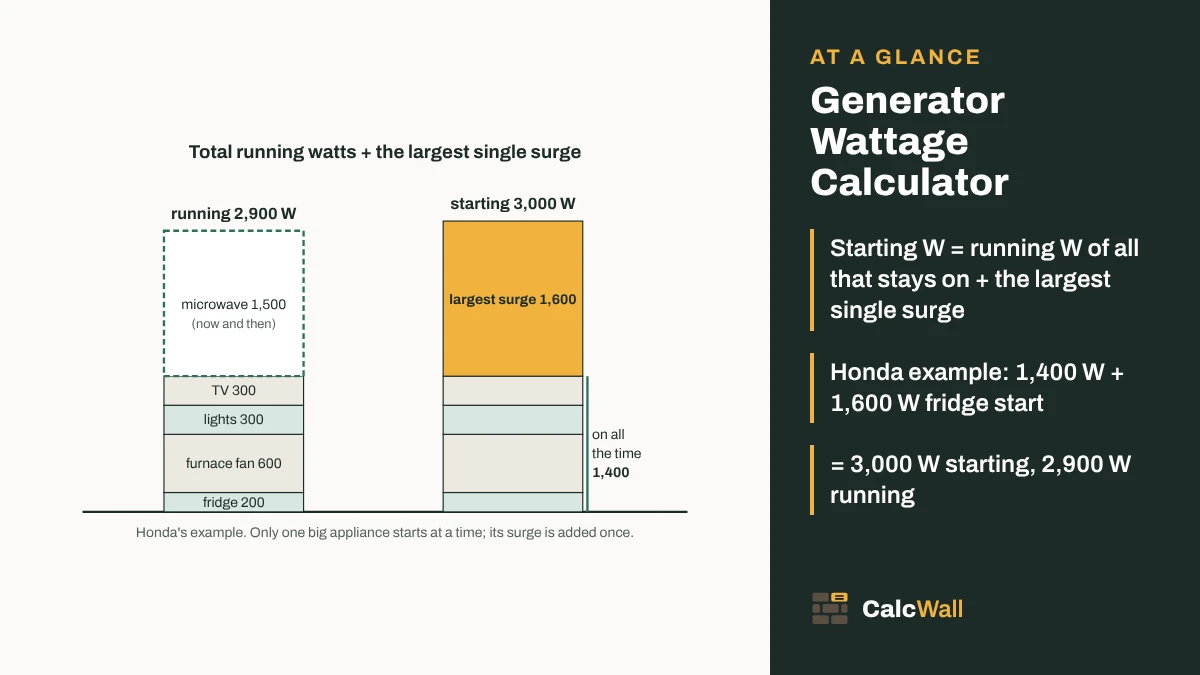
Quick answer: add the running watts of everything that will be on at once, then add the single largest starting surge. Honda’s home example (refrigerator, furnace fan, five lights, TV and a microwave used on its own) needs 2,900 W running and 3,000 W starting, so a 3,000 W generator runs it.
How to size a generator with the calculator
The question most people start with is “what size generator do I need?” The honest answer is: it depends on what you plan to run at the same time. A generator does not power a house by its floor area. It powers a list of appliances. So the calculator works from that list.
- Start from a list. The tool opens with Honda’s home example. Pick another example under “Start from”, or an empty list, and build your own.
- Add appliances. Pick one from the makers’ figures, or choose “My own” and type the watts from the nameplate. Each row has running watts, starting watts and how many.
- On all the time, or now and then. A fridge and a furnace fan stay on. A microwave or a power tool is used now and then, on its own. Rows set to “now and then” count one at a time, as Honda advises.
- Headroom. Add 10, 20 or 25% if you want spare capacity. That is your choice: none of the makers’ worksheets we read sets a figure.
- Check a generator. Type a generator’s running and starting watts from its spec sheet, and the calculator says if it covers your list and how hard it is loaded.
The big number is the starting (peak) watts you need. Under it are the running watts. Look for a generator rated at least that much on both. Use the share button to send the list, or add it to your shopping list.
Running vs starting watts
Every generator spec sheet lists two numbers, and every appliance has two numbers too. Getting running vs starting watts straight is most of the job.
Running watts (also called rated watts) are what an appliance draws while it works. A TV, a light or a heater draws about the same from the moment it is switched on.
Starting watts (also called surge watts) are the short burst some appliances need to get going. Anything with a motor or a compressor does this: a fridge, a freezer, a furnace fan, a well pump, an air conditioner. Generac describes the surge as a short burst of extra power that a motor needs at start-up. Honda lists a refrigerator at 200 W running but 1,600 W starting, eight times as much.
That peak is what trips a generator that looked big enough on paper. The running watts of a list may add up to 1,400 W, yet the moment the fridge kicks in, the generator has to find another 1,600 W for a second or two. If it cannot, the voltage dips, lights flicker, and the motor may stall or the breaker trip.
Champion notes that, where a maker gives no figure, starting watts may be estimated at 1 to 2 times the running watts. Treat that as a rough range for planning, not a number to rely on. The maker’s own figure is better.
The rule: total running watts plus the largest surge
Two maker worksheets we could read set out the same method. Champion’s wattage chart says to total the running watts of all the items the generator will power, then add the highest single starting watt. Honda’s page splits the list into a continuous need (what runs all the time) and an occasional need (the largest starting load), and adds them.
Running watts needed = Σ running watts of what stays on + the largest now-and-then appliance
Starting watts needed = Σ running watts of what stays on + the largest single starting watts
Why only one surge? Motors rarely start at the very same instant, and you can make sure they don’t. Honda’s first tip is to start appliances with high starting wattage at different times: start the fridge and the furnace separately and you need 1,600 W of surge, not 3,200 W.
Full starting watts, not the difference. Both worksheets add the largest starting figure in full. In Honda’s example, the fridge’s 200 W running is already in the 1,400 W total, and its full 1,600 W start is added on top. Strictly, that counts 200 W twice. We follow the sources as written and show the sum in the result, so you can see it. The double count is a small margin in your favour.
Some charts list additional starting watts: the extra above running, not the whole start. If your chart does, add the running watts to it before you type it into the starting box. The calculator flags a starting figure lower than the running figure as a mistake.
Resistive loads. Honda lists the lights, TV and microwave with starting watts equal to running watts. That means no extra surge, and the calculator treats it that way. Leave starting watts blank for a heater, kettle or toaster.
Appliance wattage chart
These are the only appliance figures the calculator offers, each exactly as the maker printed it. We did not fill in the gaps with estimates. The same appliance differs a lot from guide to guide, which is the best reason to use your own nameplate.
| Appliance | Running watts | Starting watts | Source |
|---|---|---|---|
| Refrigerator | 200 | 1,600 | Honda |
| Refrigerator | 400 | 2,200 | Champion |
| Refrigerator / freezer | 700 | 2,200 | Generac |
| Furnace fan (1/4 hp) | 600 | 1,600 | Honda |
| 5 lights | 300 | 300 (no surge) | Honda |
| TV | 300 | 300 (no surge) | Honda |
| TV, LED | 80 | none listed | Champion |
| Microwave | 1,500 | 1,500 (no surge) | Honda |
| Microwave | 800 | none listed | Champion |
| Blender | 500 | 700 | Champion |
| Desktop computer | 100 | none listed | Champion |
| Electric stove | 2,000 | none listed | Champion |
| Clothes dryer, electric | 5,400 | 6,750 | Generac |
Honda: “How much power do I need?”, US models. Champion: Generator Wattage Chart flyer, worked example. Generac: “What does surge/starting wattage mean?”, 26 Nov 2025. Read 13 Nov 2026.
Look at the fridge rows: 200, 400 and 700 W running from three makers. Fridges really do vary that much, by size, age and type. The chart is a starting point. The plate on the back of your fridge is the answer.
You may have expected a long chart of 50 appliances, with well pumps, air conditioners and power tools. Many sites have one, but most do not say where the numbers came from, and some contradict themselves (one lists a heat pump with lower starting than running watts). We only show figures we could trace to a maker. For anything else, type in the figures from the nameplate or the maker’s manual.
Reading a nameplate
The U.S. Department of Energy’s Energy Saver page says the wattage of most appliances is stamped on the bottom or back of the appliance, or on its nameplate. If the plate shows amps instead, multiply the amps by the volts. The calculator has a small converter for that: type both, and add the result as an appliance.
Starting watts are rarely printed on a plate. For a motor appliance, check the manual or ask the maker. If you only have the running figure, Champion’s 1 to 2 times range gives you a rough bracket to try.
Generator size for common setups
The generator size for a house, a cabin or a campsite comes from the list, so here are the three example lists the calculator offers. Each uses the makers’ figures above, worked by the rule.
| Setup | What it runs | Running watts needed | Starting watts needed |
|---|---|---|---|
| Home essentials (Honda) | fridge, furnace fan, 5 lights, TV on; microwave now and then | 1,400 + 1,500 = 2,900 W | 1,400 + 1,600 = 3,000 W |
| Same, staggered (Honda) | one appliance at a time | 1,500 W | 1,600 W |
| Kitchen and office (Champion) | fridge, microwave, blender, computer, LED TV, stove, all on | 3,880 W | 3,880 + 2,200 = 6,080 W |
| Bigger backup with a dryer | Generac fridge and dryer, Honda furnace fan and 5 lights, all on | 7,000 W | 7,000 + 6,750 = 13,750 W |
Worked with the calculator, no headroom. The staggered row is Honda’s own: “you can get away with as little as 1600 watts” if you run the big appliances one at a time.
The table shows how much the answer moves with habits. The same five appliances need 3,000 W if you leave everything on, or 1,600 W if you are willing to switch things off while the fridge or furnace starts. The dryer changes everything: one large heating appliance with a motor can quadruple the size you need.
For a whole-house standby generator, Generac says to size it so its continuous rating exceeds the total continuous load you plan to run, and recommends an in-home assessment. Use this generator size calculator to understand the numbers and shortlist, and have the final sizing done by a dealer or a licensed electrician.
Worked examples
Each example uses the calculator as it stands. The numbers match what the tool shows.
Honda’s home essentials
On all the time: fridge 200 + furnace fan 600 + 5 lights 300 + TV 300 = 1,400 W. Microwave 1,500 W, now and then, on its own. Running needed 1,400 + 1,500 = 2,900 W. Largest surge: the fridge or furnace at 1,600 W. Starting needed 1,400 + 1,600 = 3,000 W. Honda: “a 3000 watt generator would be able to run everything easily.”
Champion’s kitchen and office
All on: fridge 400 + microwave 800 + blender 500 + computer 100 + LED TV 80 + stove 2,000 = 3,880 W running. Largest single starting watts: the fridge at 2,200. Starting needed 3,880 + 2,200 = 6,080 W, as in Champion’s chart.
Bigger backup with a dryer and 10% headroom
Fridge / freezer 700, dryer 5,400, furnace fan 600, 5 lights 300, all on: 7,000 W running. Largest surge: the dryer at 6,750 W. Starting needed 13,750 W. With 10% headroom: 7,000 × 1.1 = 7,700 W running and 13,750 × 1.1 = 15,125 W starting.
Your own appliance from its nameplate
A plate reads 5.0 A at 120 V: 5 × 120 = 600 W running. With no starting figure, the calculator treats it as no surge. If it has a motor and the maker gives a starting figure, type it in.
Checking a generator
Honda’s list again (2,900 W running, 3,000 W starting) against a generator with a spec sheet of 2,800 W running and 3,200 W starting. Starting is fine, but running is short: loaded to 2,900 ÷ 2,800 = 104%. Run less at once, or pick a bigger unit.
Safety: transfer switch and placement
Sizing is the easy part. A generator makes carbon monoxide, which you cannot see or smell, and the U.S. Consumer Product Safety Commission’s safety alert on it is short and blunt. These points come from it.
- Outside only. Keep the generator at least 20 feet from doors, windows and vents that could let carbon monoxide indoors.
- Never indoors. Not in a home, garage, basement, crawlspace or shed, even with doors and windows open.
- CO alarms. Fit battery-operated CO alarms, or plug-in alarms with battery backup, in the home.
- No backfeeding. Never power the house wiring by plugging the generator into a wall outlet.
- Cords. Connect appliances with heavy-duty extension cords made for outdoor use, with no cuts and all three prongs.
- Wet weather and fuel. Generators can shock and electrocute, especially in wet conditions. Never store generator fuel in the home.
Transfer switch. To run house circuits rather than plug-in appliances, the generator has to be connected to the wiring in a way that cuts the house off from the utility first. That is the job of a transfer switch or an approved interlock, installed by a licensed electrician to your local rules. We do not set out those rules here: they differ by place and are for your electrician and your local inspector.
Notes for pros
Nameplate wins. The preset figures are the makers’ examples. Overwrite them with the real plate or manual figures.
Full start, added once. Champion and Honda add the largest starting figure in full. Additional-watt charts need the running added back.
Standby units. Generac sizes standby generators by continuous rating against the continuous load. Compare running watts there.
kVA. Enter the power factor from the spec sheet to see kVA = kW ÷ PF for both needs.
- This is an estimate from the figures you type. It does not check wire sizes, breaker ratings, voltage (120/240 V) or how loads split across a generator’s outlets. Those are for the spec sheet and an electrician.
- Outside the US: the preset figures come from US maker guides for 120 V models. In the UK, Canada, Australia, New Zealand and Germany use your own nameplates. The arithmetic is the same in any country.
- Large motor loads (well pumps, central air) can need more starting power than a simple list shows. Ask the maker for the starting figure, and talk to the generator dealer for anything over the portable range.
Ventilating a room or sizing a fan for a workshop where the generator is stored (never running)? The CFM calculator and the air changes per hour calculator work out airflow. Planning lights to run off backup power? The recessed lighting calculator counts the fittings.
Sources
Where the numbers on this page come from. Everything else is plain geometry and unit conversion, which the calculator does with exact factors.
- How much power do I need? (What size generator do I need?), American Honda Motor Co., Power Equipment, web page, undated, US models only (read 13 November 2026). Used for: the worksheet method (continuous power need plus the largest occasional starting need), the example of 1,400 W + 1,600 W = 3,000 W, and its table: refrigerator 200 W running / 1,600 W starting, furnace fan (1/4 hp) 600 / 1,600, 5 lights 300 / 300, TV 300 / 300, microwave 1,500 / 1,500
- Generator Wattage Chart (flyer), Champion Power Equipment, PDF, no date printed; file path dated March 2021 (read 13 November 2026). Used for: the rule “total the running watts of all items, then add the highest single starting watt”; the note that starting watts may be estimated at 1 to 2 times running watts; the worked example (refrigerator 400 / 2,200, microwave 800, blender 500 / 700, desktop computer 100, LED TV 80, electric stove 2,000: 3,880 + 2,200 = 6,080 W)
- What does surge/starting wattage mean?, Generac Power Systems, support article, dated 26 November 2025 (read 13 November 2026). Used for: example figures: refrigerator / freezer 700 W running, 2,200 W surge; electric clothes dryer 5,400 W running, 6,750 W surge; the advice that a home standby generator’s continuous rating should exceed the total continuous load
- Estimating Appliance and Home Electronic Energy Use, U.S. Department of Energy, Energy Saver, web page, undated (read 13 November 2026). Used for: the wattage of most appliances is on the bottom or back, or on the nameplate; watts = amps × volts. The page no longer carries a list of typical wattages, so none is quoted from it
- Portable Generator Hazards (CPSC Safety Alert), U.S. Consumer Product Safety Commission, Publication 5123, 2017 version (code 5123/0407/RV0917) and October 2021 version (5123/102021). Used for: outside only, at least 20 ft from doors, windows and vents (2017 version); never indoors, in garages, basements, crawlspaces or sheds; CO alarms with battery backup; no backfeeding through a wall outlet; heavy-duty outdoor extension cords; shock risk in wet conditions; no fuel stored in the home (2021 version)
Frequently asked questions
How do I calculate what size generator I need?
List what you will run at the same time. Add up their running watts. Then add the single largest starting surge, because only one big motor should start at a time. That is the method in the Champion and Honda worksheets. Honda’s home example: 1,400 W running plus a 1,600 W refrigerator start gives 3,000 W.
What size generator do I need to run a house?
It depends on what you keep on, not the size of the house. Honda’s essentials example (refrigerator, furnace fan, five lights, TV and a microwave used on its own) needs 2,900 W running and 3,000 W starting. Add an electric dryer at Generac’s 5,400 W running and you pass 13,000 W starting. A whole-house standby unit should be sized from a proper load assessment by a dealer or electrician.
Will a 3,500 watt generator run a fridge?
On its own, by the makers’ figures, yes. Honda lists a refrigerator at 200 W running and 1,600 W starting, Champion at 400 and 2,200, Generac at 700 and 2,200. All fit inside 3,500 W. Whether it also runs everything else depends on the rest of your list, and whether the 3,500 is the running or the starting rating. Put both into the calculator.
How many watts does a refrigerator use?
The three maker guides we read give 200 W (Honda), 400 W (Champion) and 700 W (Generac) running, and 1,600 to 2,200 W to start. That spread is why the nameplate on your own fridge wins. If it only shows amps, multiply by the volts.
What size generator do I need for an RV?
Use the same method: list the RV appliances you will run together, add their running watts and the one largest starting surge. The roof air conditioner is usually the biggest starter, so find its running and starting watts from the RV or air conditioner maker and type them in. We have not found a maker figure we could check for RV air conditioners, so the calculator does not guess one.
What is the difference between running and starting watts?
Running (rated) watts are what an appliance draws while it works. Starting (surge) watts are the short burst a motor needs to get going, such as a fridge compressor or a furnace fan. Honda lists a refrigerator at 200 W running but 1,600 W starting. Heaters, lights and toasters have no real surge.
Do I add starting watts minus running watts?
Not with the worksheets we read. Champion says to add the highest single starting watt to the total running watts, and Honda adds the full 1,600 W start to the 1,400 W running total. That counts the biggest motor’s running watts twice, which works as a small built-in margin. Some guides list extra (additional) starting watts instead. If yours does, add its running watts to get the starting figure before you type it in.
Can I plug a generator into a wall outlet to power the house?
No. The CPSC says never to power house wiring by plugging the generator into a wall outlet, which is called backfeeding. Plug appliances into the generator with heavy-duty outdoor extension cords. To connect a generator to your home’s wiring, talk to a licensed electrician about a transfer switch or an approved interlock.
Where should I put a portable generator?
Outside only. The CPSC says keep it at least 20 feet from doors, windows and vents, and never run it in a home, garage, basement, crawlspace or shed, even with doors and windows open. Fit battery or battery-backup CO alarms in the home.
What is kVA and why would I need it?
Standby generators are often rated in kW and kVA. kVA is the apparent power: kW divided by the power factor. Enter a power factor in the calculator and it shows kVA for your running and starting needs. Take the power factor from the generator’s spec sheet.
Is this generator wattage calculator free to use online?
Yes. The CalcWall Generator Wattage Calculator is completely free and works online in any browser, on a phone, tablet or computer. There is nothing to download and no account to create, and the math runs right in your browser, so results appear as you type.