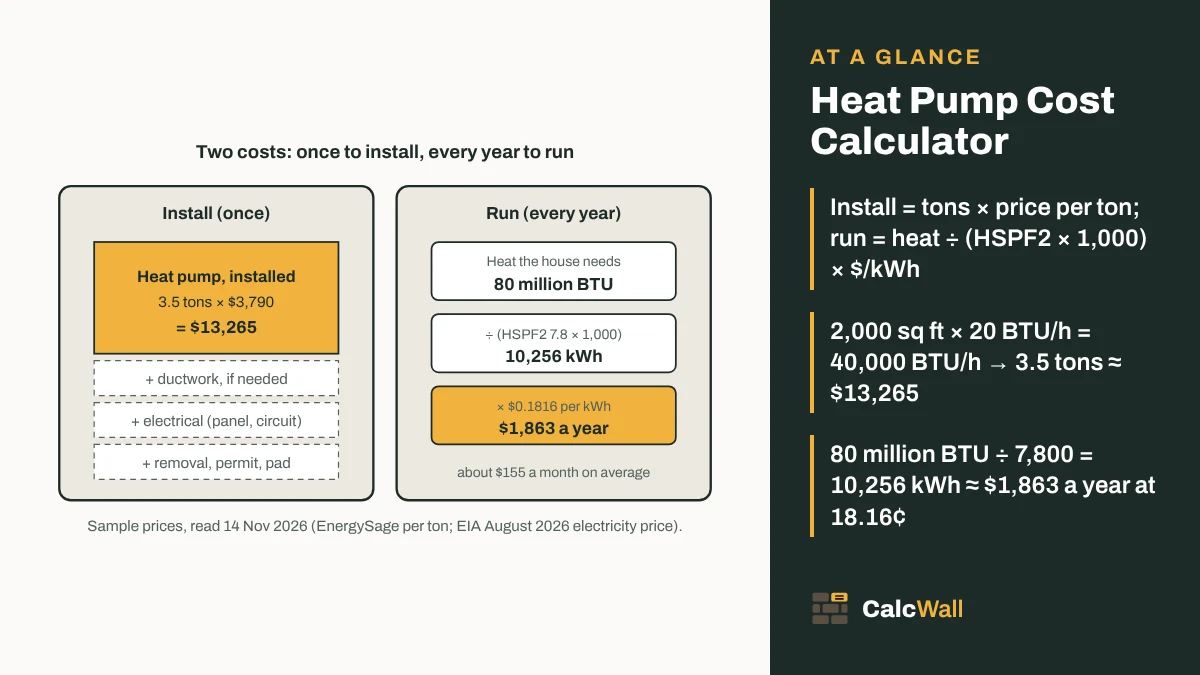
Quick answer: installed cost = tons × price per ton, plus extras. Running cost = yearly heat ÷ (HSPF2 × 1,000) × your price per kWh. A 2,000 sq ft house at an example 20 BTU/h per sq ft needs 3.5 tons: about $13,265 at a sample $3,790 per ton, and $1,863 a year at 18.16 cents per kWh.
How to use the heat pump cost calculator
A heat pump has two prices. One you pay once, to have it put in. The other comes every winter on the electric bill. Most cost pages only give you the first. This calculator does both, and then sets them against a gas furnace so you can see whether, and when, the switch pays for itself.
Pick what you want to see at the top: installed cost, yearly running cost or payback vs a gas furnace. Then pick the type, ducted, mini-split or geothermal, and work down the four short sections.
- Size. Give the heated floor area and a heat load per square foot, or the heat load from a Manual J report, or just the size you were quoted. The load per square foot filled in, 20 BTU/h, is an example. Change it.
- Installed cost. The price per ton is a dated sample (US dollars) so you get a number straight away. Type the figure from your own quote, add ductwork, electrical work and anything else, or put the quote’s total in the last box.
- Running cost. Either give your heating degree days and two temperatures, or, better, last year’s gas use from your bills. Then the heat pump’s efficiency and your electricity price.
- Gas furnace. For the payback view: the furnace’s AFUE, your gas price and what the furnace (and AC) would cost instead. Leave that last one at 0 if the choice is between a heat pump and keeping what you have.
Everything updates as you type. If a box is wrong, the result goes blank and tells you which one, so you never copy an old number. The share link carries all your inputs, and “Add to list” saves the lines for your quote meeting.
Heat pump cost by type
There are three kinds most homeowners choose between. A ducted air-source heat pump replaces a central AC or furnace and uses the ducts you have. A ductless mini-split has an outdoor unit and one or more wall heads, so it suits additions, old houses without ducts, or a single cold room.
A geothermal (ground-source) heat pump swaps heat with the ground through buried loops. It is the most efficient and by far the dearest to put in, because of the drilling or digging.
Here is what two cost guides published this year. They do not agree, which tells you something: prices swing with the region, the house and the installer.
| Type | Installed range (Fixr, Jan 2026) | Per ton, before incentives (EnergySage, Mar 2026) |
|---|---|---|
| Ductless mini-split | $2,000 – $8,000 | $9,163 (all zones) |
| Ducted air-source | $5,000 – $15,000 | $3,790 |
| Geothermal (ground-source) | $15,000 – $35,000 | no figure given |
| All types | $5,000 – $15,000 (average $8,350) | $4,350 |
Sample prices, read 14 Nov 2026, US dollars. EnergySage’s figures come from quotes on its marketplace, mostly in Massachusetts. Neither source is a price list; get three quotes.
The mini-split line looks odd until you read the small print. A single-zone mini-split for one room is cheap. A whole house of them, with a head in every bedroom, is not, and EnergySage’s per-ton figure is for those whole-house jobs. So the calculator uses the per-ton sample for ducted and ductless and shows Fixr’s range next to the answer as a check. For geothermal there is no per-ton sample: type your quote.
What makes up an installed price? The unit itself, the labor (Fixr gives $75 to $125 an hour), and often extras the first quote leaves out. Ducts may need sealing, resizing or replacing. An older electrical panel may need a new circuit or an upgrade. The old furnace or AC has to come out. Put each of those in its own box so you can compare quotes line by line.
Cost by size (tons)
Heat pumps are sold by capacity, in tons in the US. One ton is 12,000 BTU per hour. The calculator works out the size like this:
- Heat load = heated floor area × heat load per sq ft, or the design load from a report.
- Tons needed = heat load ÷ 12,000.
- Size = tons needed, rounded up to the next half ton (or the next whole kW in metric).
Installed cost = size × price per ton + ductwork + electrical + other
Be honest with yourself about the load per square foot. It is the shakiest number here. Fixr suggests 30 to 60 BTU per sq ft; EnergySage gives a rule of thumb of about a ton per 600 sq ft, which is 20.
Two houses of the same size can be miles apart, because insulation, windows, air leaks and the coldest night of the year all change it. That is why the sizing here is a rough estimate, and why the real one is an ACCA Manual J calculation done by your installer. If you have that number, choose “My heat load” and type it in.
Fixr’s table by home size gives a feel for the spread. The last column is the per-ton sample times the middle of each size range, so you can see how the two sources compare.
| Home size | Size (Fixr) | Installed (Fixr, Jan 2026) | Ducted at $3,790 per ton |
|---|---|---|---|
| 1,000 sq ft | 2 tons | $5,000 – $8,000 | $7,580 (2 tons) |
| 1,500 sq ft | 2.5 – 3 tons | $6,700 – $14,000 | $10,423 (2.75 tons) |
| 2,000 sq ft | 3 – 4 tons | $8,000 – $20,000 | $13,265 (3.5 tons) |
| 2,500 sq ft | 3.5 – 5 tons | $9,500 – $22,000 | $16,108 (4.25 tons) |
| 3,000 sq ft | 4 – 6 tons | $15,000 – $25,000 | $18,950 (5 tons) |
Sample prices, read 14 Nov 2026. Last column: tons × $3,790, rounded to the dollar; before ductwork, electrical work or rebates.
A bigger unit is not a safer buy. It costs more up front and tends to switch on and off in short bursts. Round up to the next size that covers the load, not two sizes up.
Running cost per year
To run, a heat pump needs electricity for the heat your house loses over a winter. The calculator finds that yearly heat in one of two ways.
- From last year’s gas bills (the better way, if you heat with gas now). The gas you burned × the old furnace’s AFUE = the heat that reached the rooms. 900 therms at 80% is 72 million BTU. Only count gas used for heating; take off a summer month’s use for water heating and cooking.
- From the heat load and degree days. A house loses heat in proportion to how much colder it is outside. So yearly heat = design load × 24 hours × heating degree days ÷ (indoor temperature − design outdoor temperature). Degree days for your town are published by weather services. The filled-in 5,000 °F-days, 70 °F indoors and 10 °F design are only examples.
kWh a year = yearly heat (BTU) ÷ (HSPF2 × 1,000)
HSPF2 is the US heating rating: BTU of heat per watt-hour over a season. Divide it by 3.412 and you have the seasonal COP, the kWh of heat per kWh of electricity. The default, 7.8 HSPF2, is the ENERGY STAR minimum for split systems, so a better unit will do better.
For geothermal the default is a COP of 3.6, ENERGY STAR’s minimum for closed-loop water-to-air units (a rated figure, not a seasonal one). The default electricity price is the US residential average from the EIA for August 2026, 18.16 cents per kWh. Put in the rate from your own bill.
Here is the yearly heating cost by home size at four electricity prices, with the example inputs (20 BTU/h per sq ft, 5,000 °F-days, 70 °F inside, 10 °F design, HSPF2 7.8). The last column is a 95% gas furnace at $1.48 a therm.
| Home size | kWh a year | At 12¢ | At 18.16¢ | At 25¢ | At 35¢ | Gas furnace |
|---|---|---|---|---|---|---|
| 1,000 sq ft | 5,128 | $615 | $931 | $1,282 | $1,795 | $623 |
| 1,500 sq ft | 7,692 | $923 | $1,397 | $1,923 | $2,692 | $935 |
| 2,000 sq ft | 10,256 | $1,231 | $1,863 | $2,564 | $3,590 | $1,246 |
| 2,500 sq ft | 12,821 | $1,538 | $2,328 | $3,205 | $4,487 | $1,558 |
| 3,000 sq ft | 15,385 | $1,846 | $2,794 | $3,846 | $5,385 | $1,869 |
Heating only. Yearly heat = sq ft × 20 × 24 × 5,000 ÷ 60 BTU; kWh = heat ÷ 7,800; gas therms = heat ÷ 0.95 ÷ 100,000. Rounded to the dollar.
Monthly cost is the yearly figure ÷ 12, but no real bill looks like that. January carries most of it and July none (for heating; if you also cool with it, that is extra and not counted here).
Heat pump vs furnace
A heat pump moves heat rather than making it, so it gets more than one unit of heat out of each unit of electricity. A gas furnace burns fuel and gets a little less than one unit out. That sounds like an easy win for the heat pump, but electricity usually costs more per unit of energy than gas, so the answer comes down to your two prices.
The tipping point is easy to work out. At $1.48 a therm and a 95% furnace, gas heat costs 5.3 cents per kWh of heat. A heat pump with a COP of 2.29 matches that at about 12.2 cents per kWh. Below that, the heat pump is cheaper to run. With an old 80% furnace the break-even rises to about 14.4 cents, and with a geothermal unit at COP 3.6 to about 19.1 cents.
If your gas costs more, or your power less, the heat pump wins sooner.
Payback (years) = (heat pump cost − furnace cost) ÷ (gas cost a year − heat pump cost a year)
If the heat pump costs more to run, there is no payback on fuel. That is a real answer at average US prices, not a bug, and it is why we ask for your prices. One thing tilts it: a heat pump also cools. If your AC is due for replacement too, put the price of a furnace and an AC in the “instead” box.
Rebates and tax credits: what to check
Many cost pages still say there is a 30% federal tax credit for heat pumps “through 2032”. That is out of date. The IRS says the energy efficient home improvement credit (section 25C), which covered air-source heat pumps, applies to improvements made through December 31, 2025. The residential clean energy credit (section 25D), which covered geothermal heat pumps, is not available for property placed in service after December 31, 2025. EnergySage’s 2026 cost guide says the same: the 30% credit expired after 2025.
So for an install in 2026 there is no federal credit to count on. What is left is local: state programs, utility rebates and sometimes lower electricity rates for heat pump homes. Ask your utility and your state energy office, and ask each installer which rebates they handle. Programs change often, so we do not list amounts, and the calculator includes none. If you get one, take it off the installed cost or the quote total.
Worked examples
Each example uses the calculator as it is. The numbers match what it shows.
1. Ducted heat pump for a 2,000 sq ft house
2,000 sq ft × 20 BTU/h per sq ft = 40,000 BTU/h. ÷ 12,000 = 3.33 tons, rounded up to 3.5 tons. × $3,790 per ton (sample) = $13,265 installed, before ductwork or electrical work. Fixr’s range for ducted: $5,000 to $15,000.
2. Running it for a year
Yearly heat = 40,000 × 24 × 5,000 ÷ (70 − 10) = 80,000,000 BTU. At HSPF2 7.8: 80,000,000 ÷ 7,800 = 10,256 kWh. × $0.1816 = $1,863 a year, about $155 a month on average.
3. From last year’s gas bills
900 therms of gas for heating, old furnace 80% AFUE: 900 × 100,000 × 0.80 = 72,000,000 BTU of heat. Heat pump: 72,000,000 ÷ 7,800 = 9,231 kWh × $0.1816 = $1,676 a year. A new 95% furnace would burn 757.9 therms × $1.48 = $1,122.
4. Payback with your own prices
Same house, electricity 10 cents per kWh, gas $2.00 a therm, a furnace and AC quote of $9,000. Heat pump: 10,256 kWh × $0.10 = $1,026 a year. Furnace: 842.1 therms × $2.00 = $1,684. Saving $659 a year. Extra to install $13,265 − $9,000 = $4,265. Payback = 4,265 ÷ 658.57 = 6.5 years.
5. At US average prices
Same house at 18.16 cents and $1.48: heat pump $1,863 a year, 95% furnace $1,246. The heat pump costs $616 a year more to run, so the calculator shows no payback.
6. A metric example (UK)
185 m² × 60 W/m² = 11.1 kW, rounded up to 12 kW. Yearly heat = 11.1 kW × 24 × 2,800 °C-days ÷ (21 − (−12)) = 22,604 kWh. At a seasonal COP of 2.29: 9,871 kWh of electricity. At £0.25 per kWh (type your tariff): £2,468 a year.
Notes for pros
Size from your load. Use “My heat load” with your Manual J figure; the area method is only for a first look.
Line items. Price per ton, ducts, electrical and other are separate so a customer can compare quotes line by line.
Bills beat degree days. Gas use × old AFUE is the house’s real heat, already including its leaks and habits.
Share the numbers. The link carries sizes, prices and rates in one currency, so the homeowner sees what you see.
- This tool does not do a Manual J or Manual S selection, check capacity at the design temperature, model backup strip heat or defrost, or check any code. HSPF2 is a seasonal rating for one climate region, so a cold site may do worse.
- For room airflow, the CFM calculator and the air changes per hour calculator cover the duct side. Cutting the load first with the insulation calculator can mean a smaller heat pump.
Sources
Where the numbers on this page come from. Everything else is plain geometry and unit conversion, which the calculator does with exact factors.
- How Much Does a Heat Pump Cost? [2026 Data], Fixr, updated 22 January 2026 (read 14 November 2026). Used for: installed price ranges by type (ductless mini-split $2,000–$8,000; air-source $5,000–$15,000; geothermal $15,000–$35,000), the national average of $8,350, the cost by home size and tonnage table, labor at $75–$125 an hour, and 1 ton = 12,000 BTU. Sample prices only
- How much does a heat pump cost in 2026?, EnergySage, updated 19 March 2026 (read 14 November 2026). Used for: the sample installed price per ton before incentives (ducted $3,790; ductless $9,163; all types $4,350), from EnergySage Marketplace quotes, which the page says come mostly from Massachusetts; and its statement that the 30% federal credit expired after 2025
- Electric Power Monthly, “Retail Service by Customer Sector”, U.S. Energy Information Administration (EIA), data for August 2026, released 23 October 2026. Used for: the default electricity price: US residential average 18.16 cents per kWh in August 2026
- Natural Gas Residential Price (annual) and FAQ “How do I convert natural gas prices…”, U.S. Energy Information Administration (EIA), annual series released 30 September 2026; FAQ read 14 November 2026. Used for: the default gas price: $15.34 per thousand cubic feet in 2025, ÷ 10.37 therms per Mcf (the FAQ, at 1,037 Btu per cubic foot in 2025) = $1.48 per therm
- Heat Pump Equipment Key Product Criteria; Geothermal Heat Pumps Key Product Criteria, ENERGY STAR (U.S. EPA), web pages read 14 November 2026 (geothermal requirements effective 1 January 2012). Used for: default efficiencies: split-system air-source heat pumps ≥ 7.8 HSPF2 (cold-climate: ducted ≥ 8.1, non-ducted ≥ 8.5); closed-loop water-to-air geothermal ≥ 3.6 COP
- Purchasing Energy-Efficient Residential Furnaces, U.S. Department of Energy, Federal Energy Management Program, last updated 25 September 2026. Used for: the default gas furnace AFUE of 95% (ENERGY STAR, northern region; 90% southern) and the 80% “less efficient” comparison model
- Energy Efficient Home Improvement Credit (25C); Residential Clean Energy Credit (25D), Internal Revenue Service, pages last reviewed 28 April 2026 and 4 July 2026. Used for: the end of the federal credits: 25C “for improvements made through December 31, 2025”; 25D (which lists geothermal heat pumps) “not available for any property placed in service after December 31, 2025”
- Guide for the Use of the International System of Units (SI), NIST Special Publication 811, National Institute of Standards and Technology, 2008 edition, Appendix B.8. Used for: 1 Btu/h = 0.2930711 W, so 1 kWh = 3,412.14 Btu, 1 ton = 3.517 kW and 1 therm (100,000 Btu) = 29.31 kWh
Frequently asked questions
How much does a heat pump cost for a 2,000 sq ft house?
Fixr’s 2026 table puts a 2,000 sq ft house at 3 to 4 tons and $8,000 to $20,000 installed. With our example load of 20 BTU/h per sq ft the calculator sizes it at 3.5 tons; at EnergySage’s sample $3,790 per ton for a ducted system that is $13,265 before any ductwork or electrical work. Your quotes are what count.
Is a mini-split cheaper than a central heat pump?
For one or two rooms, yes: Fixr gives $2,000 to $8,000 for a ductless mini-split against $5,000 to $15,000 for a ducted air-source system. For a whole house it often is not. EnergySage’s quotes average $9,163 per ton for ductless against $3,790 for ducted, because every room needs its own indoor head.
How much does it cost to run a heat pump per month?
Divide the yearly cost by 12. In our example (80 million BTU of heat a year, HSPF2 7.8, 18.16 cents per kWh) it is $1,863 a year, about $155 a month on average. Real bills are high in midwinter and near zero for heating in summer, and cooling is extra.
Is there still a federal tax credit for heat pumps?
No, not for new installs. The IRS says the energy efficient home improvement credit (25C) covers improvements made through December 31, 2025, and the residential clean energy credit (25D), which covered geothermal heat pumps, is not available for property placed in service after that date. Check your state and your utility for rebates; we do not list amounts.
What size heat pump do I need?
Size = design heat load ÷ 12,000 BTU/h per ton, rounded up. A 40,000 BTU/h load needs 3.33 tons, so a 3.5 ton unit. The calculator can estimate the load from floor area × a load per sq ft, but that is a rough figure. An ACCA Manual J calculation by your installer gives the real one.
Is a heat pump cheaper to run than a gas furnace?
It depends on your two prices. At the US averages we use (18.16 cents per kWh, $1.48 per therm), a 7.8 HSPF2 heat pump costs $23.28 per million BTU of heat and a 95% gas furnace $15.58, so gas is cheaper. The heat pump wins below about 12.2 cents per kWh at that gas price, or with a more efficient heat pump.
What is HSPF2 and how does it turn into COP?
HSPF2 is the heating rating on US air-source heat pumps: BTU of heat per watt-hour of electricity over a season. Divide by 3.412 to get the seasonal COP. HSPF2 7.8, the ENERGY STAR minimum for split systems, is a COP of 2.29: each kWh of electricity gives 2.29 kWh of heat.
Can I use the heat pump cost calculator in kW, m² and euros?
Yes. Pick your country at the top of the page or switch the units. Floor area is then in m², the load in W/m² and kW, gas in kWh and the price per kW. Prices stay in one currency: if the currency changes they are cleared, and you type local ones. The sample prices are US dollars only.
Is this heat pump cost calculator free to use online?
Yes. The CalcWall Heat Pump Cost Calculator is completely free and works online in any browser, on a phone, tablet or computer. There is nothing to download and no account to create, and the math runs right in your browser, so results appear as you type.