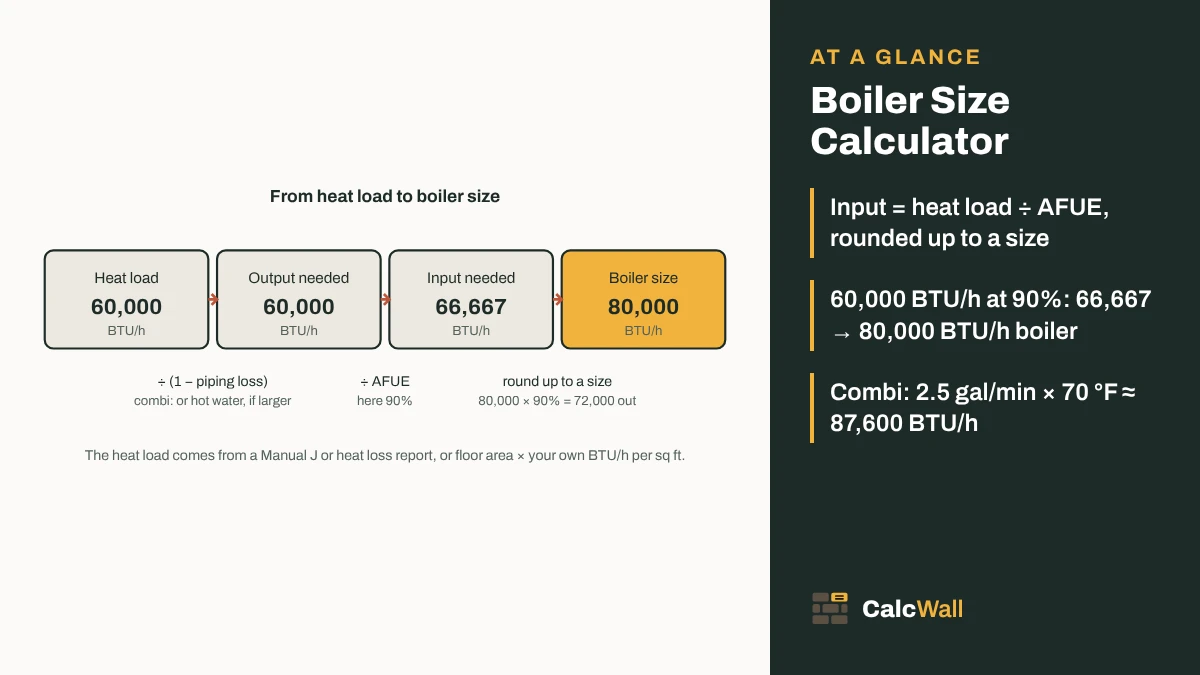
Quick answer: boiler size = heat load ÷ AFUE, rounded up to a real model. A 60,000 BTU/h load at 90% AFUE needs 66,667 BTU/h input, so an 80,000 BTU/h boiler. A combi must also heat tap water: 2.5 gal/min warmed 70 °F needs about 87,600 BTU/h.
How to use the boiler size calculator
First choose the boiler type. A heating-only boiler (often called a system or regular boiler) heats the radiators or floor loops, and hot water comes from a tank. A combi also heats tap water on demand, so it has a second job to size for.
Then tell it what you know. There are three modes:
- The heat load. The design heating load from a Manual J or heat loss report, in BTU/h or kW. This is the best input. The 60,000 BTU/h filled in is only an example.
- Floor area and heat load per sq ft. Heated floor area times your own figure. There is no official table of these figures, so it is yours to type.
- Check my current boiler. Type the rating from the old boiler’s data plate to see the heat it delivers, per sq ft if you add the area, and how far it is above your load.
Set the AFUE of the boiler you are looking at and any piping losses that are not in the load. For a combi, type the hot water flow you want and the temperature rise. Last, say whether your quotes give input or output ratings, and type the sizes. The calculator picks the smallest one that covers what is needed, and shows the one below it too.
How to size a boiler
A boiler has to replace the heat the house loses on a cold day. A combi also has to warm tap water as fast as you draw it. The calculator follows these steps:
- Heat load: from a report, or floor area × heat load per sq ft.
- Heating output needed = heat load ÷ (1 − piping losses). With no losses to add, it equals the load.
- Combi only: hot water output = flow × temperature rise × the heat capacity of water. The calculator takes the larger of the two outputs, not their sum, on the basis that a combi does not heat the taps and the radiators at full rate at the same time. Check the combi’s hot-water rating on its data sheet too.
- Input needed = output needed ÷ AFUE.
- Boiler size: the smallest size in your list whose output covers it. An input rating is turned into output by × AFUE first.
Input BTU/h = max(heat load ÷ (1 − piping loss), hot water) ÷ AFUE
Why round up and not to the nearest size? A boiler a little under the load leaves the house short on the coldest days. One a little over just runs a bit less. The calculator shows the size below as well, so you can see how close it was.
Heat loss first
Everything starts with the design heat load. The professional method in the US is ACCA Manual J, 8th edition (ANSI/ACCA 2 Manual J – 2016). In other countries installers use their own heat loss methods. Both give the same kind of answer: how many BTU/h or kW the house loses at the design outdoor temperature.
Many boiler calculators on the web ask for bedrooms or a climate zone and multiply by a fixed factor. We looked for a primary source for such factors at the Department of Energy and the national labs and did not find one, so this calculator does not use them. If you only have the floor area, type your own figure per sq ft and treat the answer as a rough guide.
The furnace size calculator uses the same heat load and AFUE steps for a warm-air furnace. The insulation calculator works out materials if you plan to cut the heat loss first, which can let you buy a smaller boiler.
Output vs input: AFUE
A boiler burns fuel at its input rating and delivers heat at its output. AFUE, annual fuel utilization efficiency, links the two. The Department of Energy defines it as the annual heat output of a furnace or boiler compared with the fuel energy it uses in a year. At 90% AFUE, 90% of the fuel’s energy heats the home.
Quotes give one or the other, and it matters. A “100,000 BTU/h boiler” at 90% AFUE gives 90,000 BTU/h of heat if 100,000 is the input, but 100,000 if it is the output. Set the “rated by” box to match the quotes you have.
| System (US DOE ranges) | AFUE | Input for 60,000 BTU/h output |
|---|---|---|
| Older, low-efficiency systems | 56% to 70% | 107,143 to 85,714 BTU/h |
| Mid-efficiency systems | 80% to 83% | 75,000 to 72,289 BTU/h |
| High-efficiency systems | 90% to 98.5% | 66,667 to 60,914 BTU/h |
AFUE ranges from the DOE “Furnaces and Boilers” page. Input = 60,000 ÷ AFUE.
The DOE also notes that AFUE does not include heat lost from pipes and ducts. If your boiler’s pipes run through a cold basement or crawl space and the load does not include them, enter a percentage in the piping box.
Which output figure to type. US boiler data sheets often list two outputs: the heating capacity, and a lower net rating that has already taken off an allowance for piping and pick-up. Type one, and set the piping box to match: with the heating capacity, keep your piping loss; with the net rating, set the piping loss to 0, or the same loss is counted twice. If you are not sure which one a sheet shows, ask the supplier.
Combi boilers: hot-water flow sizing
A combi heats tap water as it flows through, with no tank. So its size is set by the flow you want and how much the water has to warm up, not only by the house.
BTU/h = gal/min × 8.345 lb × 60 min × rise °FkW = L/min × 4.1868 kJ/(kg·K) × rise °C ÷ 60
Where the numbers come from: one BTU warms one pound of water by one degree Fahrenheit, and a US gallon of water weighs about 8.345 lb. In metric the same heat capacity is 4.1868 kJ per kg per kelvin (NIST SP 811), and a litre of water is about 1 kg.
| Flow (US) | Output at 70 °F rise | Flow (metric) | Output at 35 °C rise |
|---|---|---|---|
| 1.5 gal/min | 52,576 BTU/h | 8 L/min | 19.5 kW (66,668 BTU/h) |
| 2 gal/min | 70,101 BTU/h | 10 L/min | 24.4 kW (83,335 BTU/h) |
| 2.5 gal/min | 87,627 BTU/h | 12 L/min | 29.3 kW (100,002 BTU/h) |
| 3 gal/min | 105,152 BTU/h | 14 L/min | 34.2 kW (116,669 BTU/h) |
| 3.5 gal/min | 122,677 BTU/h | 16 L/min | 39.1 kW (133,336 BTU/h) |
Plain physics; the flows and rises are examples. Your winter cold-water temperature sets the real rise.
Look at how big these numbers are next to a typical heat load. In many homes the hot water, not the heating, decides the size of a combi. That is why the calculator shows which one set the size. If the flow you need gives a very large boiler, a heating-only boiler with a hot water tank may suit better.
Size by heat load (chart)
With the example list of input sizes, 60,000 to 150,000 BTU/h, here is the smallest that covers each load at two AFUE levels. There are no piping losses and no hot water in this chart.
| Heat load | Input at 85% | Size at 85% | Input at 95% | Size at 95% |
|---|---|---|---|---|
| 40,000 | 47,059 | 60,000 | 42,105 | 60,000 |
| 60,000 | 70,588 | 80,000 | 63,158 | 80,000 |
| 80,000 | 94,118 | 100,000 | 84,211 | 100,000 |
| 100,000 | 117,647 | 125,000 | 105,263 | 125,000 |
| 120,000 | 141,176 | 150,000 | 126,316 | 150,000 |
All figures in BTU/h. Size = smallest input in the list with input × AFUE ≥ load. The list is an example: type the sizes on your quotes.
Why bigger is not better
It is tempting to buy a size up “to be safe”. The DOE says a properly sized system operates most efficiently and points out that many existing systems are oversized. A boiler much bigger than the load reaches temperature fast, shuts off and starts again often in mild weather, and costs more to buy.
So the calculator picks the smallest size that covers the need and shows how far above it that size is. If it is well above the need (where to draw that line is your call; the calculator does not set one), ask whether a size in between exists. The check mode is useful here: type your old boiler’s rating and your heat load, and see how oversized it was. The new one does not need to match it.
Worked examples
Each example uses the calculator as it stands. The numbers match what it shows.
Heating-only boiler, US
Load 60,000 BTU/h, 90% AFUE, no piping losses. Input needed 60,000 ÷ 0.9 = 66,667 BTU/h. With input sizes 60, 80, 100, 125 and 150 thousand: the 60,000 gives 54,000, 10% short; the 80,000 BTU/h gives 72,000, 20% above the load.
Combi, US
Same house, but a combi for 2.5 gal/min at a 70 °F rise: 2.5 × 8.345 × 60 × 70 = 87,627 BTU/h, more than the 60,000 for heating, so hot water sets the size. Input needed at 90%: 97,363 BTU/h. The 100,000 BTU/h input gives 90,000, 2.7% above.
Combi, metric (output ratings)
Heat load 17.5 kW. Hot water 10 L/min warmed 35 °C: 10 × 4.1868 × 35 ÷ 60 = 24.4 kW, which sets the size. With output sizes 18, 24, 28, 30, 35 and 40 kW: 24 kW is 1.7% short, so 28 kW, 14.6% above. A heating-only boiler for the same house would be 18 kW.
Pipes in a cold basement
Load 60,000 BTU/h for the rooms only, 10% piping losses: 60,000 ÷ 0.9 = 66,667 BTU/h output needed. At 90% AFUE: 74,074 BTU/h input. The 80,000 BTU/h size gives 72,000, 8% above.
Checking the old boiler
Data plate: 100,000 BTU/h input, 80% AFUE: 80,000 BTU/h of heat. A heat load of 52,000 BTU/h means the old boiler is 53.8% bigger than the load.
Notes for pros
Rating basis. Set input or output to match the data sheet; the pick always compares output with the need.
Combi = max, not sum. The tool sizes for the larger of heating and tap water; confirm the hot-water rating on the data sheet.
Piping once. Enter piping losses only when the load leaves them out.
Share the numbers. The link carries load, AFUE, losses, hot water, basis and sizes.
- This boiler size calculator does not work out a heat load, select radiators or check a code. The load comes from Manual J or a heat loss survey; equipment, flues and local rules are the installer’s job.
- For warm-air systems use the furnace size calculator; for the airflow a warm-air system needs, the CFM calculator.
Sources
Where the numbers on this page come from. Everything else is plain geometry and unit conversion, which the calculator does with exact factors.
- Furnaces and Boilers, U.S. Department of Energy (energy.gov, Energy Saver), web page, undated (read 13 November 2026 for CalcWall’s furnace page; the same page covers boilers). Used for: the AFUE definition (a furnace’s or boiler’s annual heat output compared with its annual fuel energy), the AFUE ranges for older, mid-efficiency and high-efficiency systems, AFUE not including piping or duct losses, and the advice that a properly sized system runs most efficiently and many existing systems are oversized
- Manual J Residential Load Calculation, 8th Edition (ANSI/ACCA 2 Manual J – 2016), Air Conditioning Contractors of America (ACCA), 8th edition, ANSI/ACCA 2 Manual J – 2016 (product page read 13 November 2026). Used for: named as the professional method for the design heat load. We did not read the manual itself and use none of its tables
- Guide for the Use of the International System of Units (SI), NIST Special Publication 811, National Institute of Standards and Technology (A. Thompson, B. N. Taylor), 2008 edition, Appendix B.8. Used for: 1 Btu_IT/h = 0.2930711 W; 1 Btu_IT = 1,055.056 J and 1 cal_IT = 4.1868 J, so 1 Btu per lb per °F = 4.1868 kJ per kg per K, the heat capacity used for hot water
- NIST Handbook 44, Appendix C: General Tables of Units of Measurement, National Institute of Standards and Technology, 2026 edition. Used for: 1 US gallon = 3.785411784 L, 1 lb = 0.45359237 kg and 1 sq ft = 0.09290304 m² (exact)
Frequently asked questions
What size boiler do I need for my house?
One whose heat output covers your home’s design heat load, the heat it loses on a cold day, from a Manual J or heat loss report. Divide the load by the boiler’s AFUE to get the input rating, then pick the next size up. A 60,000 BTU/h load at 90% AFUE needs 66,667 BTU/h input, so an 80,000 BTU/h input boiler. A combi also has to heat your tap water.
What size boiler for 2,000 sq ft?
It depends on how much heat the house loses, not only its size. At 30 BTU/h per sq ft (an example figure, not a standard) the load is 60,000 BTU/h; at 20 it is 40,000, at 40 it is 80,000. There is no official BTU per square foot table, so get the load from a heat loss calculation and type it in.
Is a bigger boiler better?
No. The Department of Energy says a properly sized system operates most efficiently, and that many existing systems are oversized. A bigger boiler costs more and short-cycles in mild weather. Choose the smallest size whose output covers the load, or, for a combi, the hot water you want.
What does AFUE mean for boiler size?
AFUE is the share of the fuel’s energy that becomes heat in the home over a year (US DOE). A 100,000 BTU/h input boiler at 90% AFUE gives 90,000 BTU/h of heat. So a higher AFUE needs a smaller input for the same house. If your boiler is sold by output (as kW often are), the AFUE only tells you the fuel it burns.
What size combi boiler for 2 bathrooms?
A combi is sized by the hot-water flow you want at once. Two showers at about 2.5 gallons a minute each is 5 gal/min; warming that by 70 °F takes about 175,000 BTU/h, which is more than most combis give. Choose the flow you need, type it in, and the calculator shows the output. A heating-only boiler with a hot water tank is the other way to serve that much flow; ask your installer.
What temperature rise should I use for a combi?
The difference between your cold water and the temperature you want at the tap. In winter the cold supply is colder, so the rise is bigger. Water entering at 50 °F and leaving at 120 °F is a 70 °F rise; 10 °C to 45 °C is 35 °C. Use your winter cold-water temperature for the worst case.
Should I trust the installer’s size?
Ask for the design heat load in BTU/h or kW and how it was worked out. Type that load and the sizes on the quote into the calculator. If the boiler quoted is far above the load and you do not need the hot-water flow a combi gives, ask why. The check mode shows how far your old boiler is above the load.
Do piping losses change the boiler size?
They can. AFUE does not count heat lost from the pipes on the way to the radiators (US DOE). If your heat load already includes it, leave the box at 0. If the load is for the rooms only and pipes run through cold spaces, enter a percentage and the calculator raises the output needed.
Can I size a boiler in kW?
Yes. Pick a metric country or switch the units. The load is then in kW, floor area in m², hot water in litres a minute and °C, converted with 1 BTU/h = 0.2930711 W (NIST SP 811). Set whether your boiler sizes are input or output ratings.
Is this boiler size calculator free to use online?
Yes. The CalcWall Boiler Size Calculator is completely free and works online in any browser, on a phone, tablet or computer. There is nothing to download and no account to create, and the math runs right in your browser, so results appear as you type.