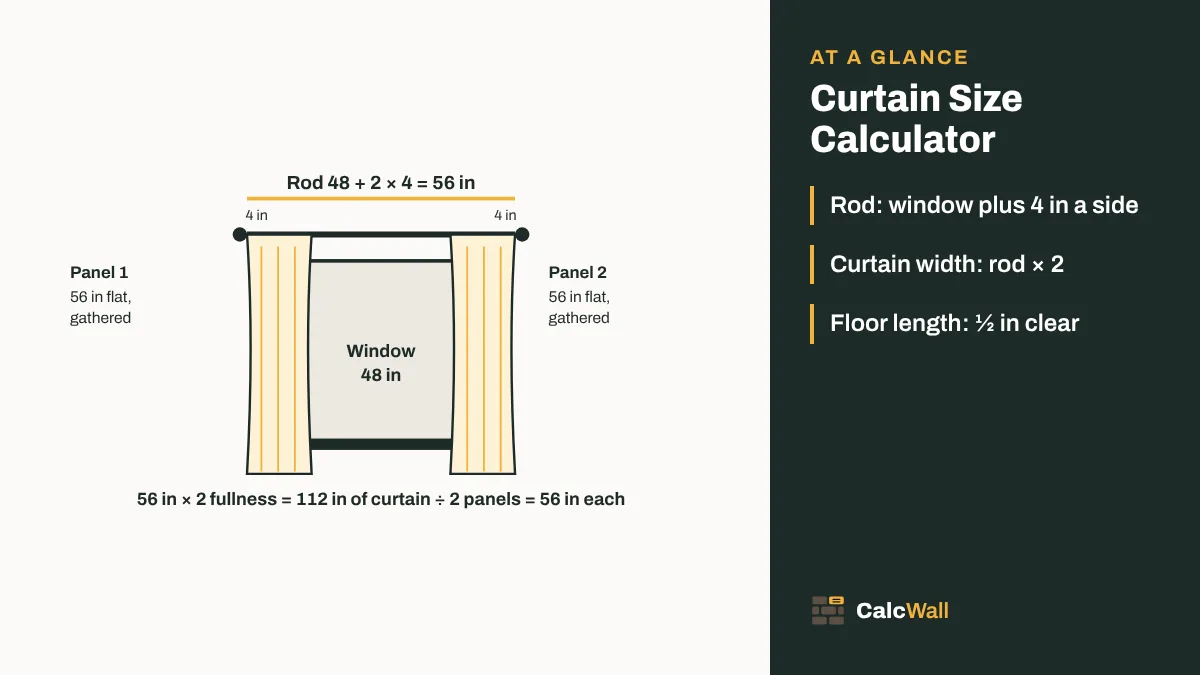
Quick answer: rod = window width + 2 × 4 in; total curtain width = rod × 2; each panel = total ÷ panels. A 48 × 60 in window with the rod 4 in above the frame and 30 in from sill to floor needs a 56 in rod and two 56 × 93.5 in panels (95 in ready-made, hemmed).
How to work out curtain width
Curtain width is not the window width. It is the rod length times the fullness: how much flat fabric gets gathered onto the rod. Get the rod length first.
- Measure the window across the outside of the frame (the trim), not the glass. For a window with no trim, measure the opening.
- Add the rod extension on each side. The calculator starts at 4 in (10 cm) a side, a common rule of thumb. That gives the rod length, not counting the finials.
- Multiply by the fullness. 2× is the usual figure. That is the total flat width of all the curtains together.
- Divide by the number of panels. A pair that meets in the middle is two panels; a single panel pulled to one side is one.
Each panel width = (window width + 2 × extension) × fullness ÷ panels
The panel width is the flat width before it is gathered. A 56 in panel gathered onto half of a 56 in rod covers 28 in, which is why a pair at 2× still closes fully across the window. In metric the defaults are 10 cm a side: a 120 cm window gives a 140 cm rod, 280 cm of curtain and two panels 140 cm wide.
If the result is wider than the panels you can buy, use more panels rather than skimping on fullness. A 96 in window with the rod 8 in past each side needs a 112 in rod and 224 in of curtain: two 112 in panels, or four 56 in panels with two on each side.
How wide and how high to hang the rod
The rod decides both measurements, so settle it before you buy fabric. All of these are design rules of thumb, not requirements.
- Past the frame: 4 in (10 cm) each side is the minimum most guides give for a rod or track outside the recess. 6–12 in each side lets open curtains stack beside the window instead of over the glass. Heavy, lined curtains take up more room when open, so give them more.
- Above the frame: the calculator starts at 4 in (10 cm). Raising the rod makes a window look taller. One designer’s rule is about two-thirds of the way from the top of the frame to the ceiling; a drapery maker suggests halfway on 8 ft ceilings. Under crown molding, go just below it.
- Inside the recess: set the extension to zero and measure the recess width. The curtains will cover part of the glass when open.
Raising the rod changes the floor-length curtain, inch for inch. For the 48 × 60 in example window, with 30 in from sill to floor:
| Rod above frame | Rod height off floor | Floor-length curtain (½ in clear) | In cm | Nearest US ready-made |
|---|---|---|---|---|
| 4 in | 94 in | 93.5 in | 237.5 | 95 in (hem 1.5 in) |
| 6 in | 96 in | 95.5 in | 242.6 | 96 in (hem 0.5 in) |
| 8 in | 98 in | 97.5 in | 247.7 | 108 in (hem 10.5 in) |
| 10 in | 100 in | 99.5 in | 252.7 | 108 in (hem 8.5 in) |
| 12 in | 102 in | 101.5 in | 257.8 | 108 in (hem 6.5 in) |
Notice the jump between 96 and 108 in. If you are buying ready-made, it often pays to set the rod height to suit a stock length, rather than buy 108 in panels and cut 10 in off.
Fullness by heading type
Fullness is how much wider the flat fabric is than the rod. More fullness gives deeper folds and better light and heat blocking; less gives a flatter, more modern look. The heading (how the top of the curtain is made) sets the usual figure, because some headings need more fabric to form their pleats. The calculator offers 1.5×, 2×, 2.5× and 3×.
| Heading | Usual fullness | Flat fabric for a 56 in rod | For a 140 cm rod | Each of two panels (56 in rod) |
|---|---|---|---|---|
| Flat panel, light gathering | 1.5× | 84 in | 210 cm | 42 in |
| Pencil pleat | 2× | 112 in | 280 cm | 56 in |
| Eyelet / grommet | 2× | 112 in | 280 cm | 56 in |
| Pinch pleat | 2.5× | 140 in | 350 cm | 70 in |
| Sheers and voiles | 2.5–3× | 140–168 in | 350–420 cm | 70–84 in |
These are trade rules of thumb from curtain makers and retailers, not a standard, and makers differ: some retailers sell pencil pleats at 2.5× as a “luxury” fullness. If you are buying made-to-measure curtains, ask what fullness the price includes, because it changes the fabric quantity a lot. A 140 cm rod in pinch pleat at 2.5× uses 70 cm more fabric than the same rod in pencil pleat.
How to work out curtain length
Curtain length is measured from the rod (or the point the curtain hangs from) down to where you want the hem. The calculator adds the rod height above the frame to the window height, then adds the drop you pick.
- To the sill: rod above frame + window height. 4 + 60 = 64 in. Some makers stop 1 cm (about ½ in) above the sill so the hem does not rub.
- Below the sill (apron length): the calculator adds 4 in (10.16 cm). 64 + 4 = 68 in. Some guides use 15 cm (6 in); type your own height into the window box if you want a different drop.
- To the floor: rod to floor less ½ in (1.27 cm) clearance. 4 + 60 + 30 − 0.5 = 93.5 in. Drapery makers quote ¼–¾ in; ½ in clears most floors and lets you vacuum.
- Break: the floor length plus 1–2 in, so the hem just kisses the floor: 94.5–95.5 in.
- Puddle: the floor length plus about 3–6 in, so the fabric pools: 96.5–99.5 in. Puddled curtains suit panels that stay put. They catch dust and get stepped on if you open and close them daily.
Floor length = rod above frame + window height + sill to floor − ½ in
The calculator has sill, below-sill and floor settings. For a break or puddle, take the floor result and add the extra yourself. Floors are rarely level, so measure the rod-to-floor height at both ends and the middle, and work from the shortest.
Standard ready-made curtain sizes
Ready-made curtains save money if the sizes suit your window. In the US they are sold as single panels; in the UK and Ireland they are usually sold as a pair, with the width given for each curtain. Neither is a standard; check the packet.
| US panel length | In cm | Usual use |
|---|---|---|
| 63 in | 160 | Sill or apron length on a standard window |
| 84 in | 213 | Floor length with the rod about 84½ in off the floor |
| 95 or 96 in | 241–244 | Floor length with the rod 95½–96½ in up, the usual case in 8 ft rooms |
| 108 in | 274 | Rod about 108½ in up (9 ft rooms), or a puddle with a lower rod |
| 120 in | 305 | Rod about 120½ in up: 10 ft rooms and tall windows |
When you measure in inches, the calculator shows the shortest of these lengths that is long enough, and how much to hem. Over 120 in it says to go custom. UK pairs from Ideal Textiles’ chart, with the widest pole each pair suits:
| Width per curtain | Drops available | Pole up to, at 2× fullness | Pole up to, at 1.5× |
|---|---|---|---|
| 46 in (117 cm) | 48, 54, 72, 90 in (122, 137, 183, 229 cm) | 46 in (117 cm) | 61 in (156 cm) |
| 66 in (168 cm) | 54, 72, 90 in (137, 183, 229 cm) | 66 in (168 cm) | 88 in (224 cm) |
| 90 in (229 cm) | 54, 72, 90, 108 in (137, 183, 229, 274 cm) | 90 in (229 cm) | 120 in (305 cm) |
The quick UK rule: at 2× fullness, each curtain in the pair should be about as wide as the pole. For the metric example (140 cm pole), the 66 in (168 cm) pair is the one to buy. Its two curtains give about 335 cm of fabric, 2.4× the pole.
Worked examples
Living room window, floor length (the defaults)
Window 48 × 60 in, rod 4 in past each side and 4 in above, 2× fullness, two panels, sill 30 in off the floor. Rod 48 + 8 = 56 in. Curtain 56 × 2 = 112 in, so 56 in per panel. Length 4 + 60 + 30 − 0.5 = 93.5 in. The calculator shows 56 × 93.5 in per panel (237.5 cm long) and suggests 95 in ready-made, hemmed 1.5 in.
Metric window, floor length
Window 120 × 150 cm, rod 10 cm past each side and 10 cm above, 2×, two panels, 75 cm sill to floor. Rod 140 cm, curtain 280 cm, so 140 cm per panel. Length 10 + 150 + 75 − 1.27 = 233.73, shown as 140 × 233.7 cm. A 229 cm UK drop is 4.7 cm short. Drop the rod to 5 cm above the frame and the calculator gives 228.7 cm, so a 229 cm drop hangs about 1 cm off the floor.
Pinch pleat, below the sill
Window 72 × 48 in, rod 10 in past each side and 6 in above, pinch pleat at 2.5×, two panels, below the sill. Rod 72 + 20 = 92 in. Curtain 92 × 2.5 = 230 in, so 115 in per panel. Length 6 + 48 + 4 = 58 in. The calculator shows 115 × 58 in and suggests 63 in ready-made, hemmed 5 in.
Wide window, four panels
Window 96 × 60 in, rod 8 in past each side and 4 in above, 2×, sill 30 in off the floor. Rod 112 in, curtain 224 in. With four panels, each is 56 × 93.5 in, the same size as the first example, so two pairs of the same ready-made panels will do.
Notes for curtain makers and installers
Returns and overlap. The calculator gives the face width only. Add the returns (about 4 in each side on a standard bracket, 6 in on a double rod) and any center overlap to the flat width.
Whole fabric widths. Made-to-measure curtains are cut in whole widths of the roll. 340 cm of flat fabric on 140 cm cloth is 2.43 widths, so cut 3.
Stack-back. Open curtains need somewhere to go. One drapery maker’s example allows 30 in (15 in a side) on an 84 in opening. Extend the rod so the stack clears the glass.
Hems. Cutting down ready-mades? Mark the finished length, add 5 cm, then turn up 2.5 cm twice. Hang them for a day first: heavy fabric drops.
Measuring tips
- Use a steel tape, not a cloth one, and measure in three places across the width and the height. Work from the shortest drop.
- Fit the rod first if you can, then measure from it. That removes the guesswork about brackets and rings.
- Match the floor finish. If a rug or new flooring is going in, measure after, or allow for its thickness. The rug size calculator helps plan the floor under the window.
- Doing the whole wall? The wallpaper calculator works out rolls with the window taken off, and the inch fraction calculator turns decimal results like 93.5 in into tape-measure fractions. New floor too? Try the carpet calculator.
Sources
Where the numbers on this page come from. Everything else is plain geometry and unit conversion, which the calculator does with exact factors.
- How to Measure for Curtains, Dunelm. Used for: track outside the recess 10 cm (4 in) past each side; with no pole fitted, add 20 cm a side; 2× standard and 2.5× luxury fullness; eyelet drop from the top of the pole, pencil pleat from the ring eye or track top; finish 1 cm above the sill or floor, 15 cm below the sill, puddle 2–7 cm; hem with 5 cm extra turned up 2.5 cm twice
- Understanding Curtain Fullness, Direct Fabrics. Used for: fullness by heading: pencil pleat 2×, eyelet 2×, pinch pleat 2.5×, stage curtains 1.5×; rounding up to whole fabric widths (340 cm on 140 cm fabric is 2.43, so 3 widths)
- Pinch Pleat Drapery: measuring guide, Drapery Rods Direct. Used for: pinch pleats made at 2.5:1 fullness (100 in rod, 250 in of fabric); stack-back example of 30 in on an 84 in opening; ½–¾ in floor clearance; about 2 in extra to puddle; 4 in standard and 6 in extended returns; measure in several places and use the shortest
- How to Measure for Drapery, The Shade Store. Used for: rod 6–12 in past the frame for an outside mount, about two-thirds of the way from window to ceiling; 1.5–2× fullness for drapery and 2.5–3× for sheers; float, break (+1–2 in) and puddle (+3–6 in) lengths; ready-made lengths of 63, 84, 96, 108 and 120 in
- Curtain Size Chart, Ideal Textiles. Used for: UK ready-made sizes, per curtain and sold in pairs: widths 46, 66 and 90 in; drops 54, 72 and 90 in (and 108 in on the 90 in width); pair width about 1.5–2× the pole
Frequently asked questions
What size curtains do I need?
Measure the window width outside the frame. A common rule of thumb is a rod about 4 in (10 cm) wider than the frame on each side and curtains about twice the rod length in total width. A 48 in window gives a 56 in rod and 112 in of curtain, so two panels about 56 in wide each.
How wide should curtains be compared with the window?
Usually 1.5 to 3 times the rod length in total: 2× is the usual choice for a gathered look, 1.5× for a flatter look and 2.5–3× for sheers. This is a matter of taste, not a rule.
How long should curtains be?
Measure from the rod to where you want the hem: at the sill, about 4 in (10 cm) below the sill, or to the floor. For floor length the calculator leaves 1/2 in (about 1.3 cm) of clearance so the curtains do not drag.
What are standard curtain lengths?
In the US ready-made panels are commonly sold in 63, 84, 95, 96, 108 and 120 in lengths. The calculator suggests the shortest one that is long enough, which you can hem up. UK ready-mades usually come in 54, 72 and 90 in drops (137, 183 and 229 cm), sold in pairs.
How high above the window should the rod go?
About 4 in (10 cm) above the frame is the calculator’s default; many designers go higher, up to about two-thirds of the way to the ceiling, which makes the window look taller. Enter your own figure and the length updates.
How far past the window should a curtain rod go?
At least 4 in (10 cm) each side, and 6–12 in if you want the open curtains to stack clear of the glass. Wide, heavy or lined curtains need more room to stack back.
What fullness do pinch pleat curtains need?
Pinch pleats are usually made at 2.5 times the rod width. A 56 in rod needs 140 in of flat fabric, or two panels 70 in wide. Pencil pleat and eyelet (grommet) curtains are usually made at 2×.
Are 84 or 96 inch curtains better?
It depends on the rod height. Measure from the rod to the floor and take off ½ in. If that is 84 in or less, buy 84 in; if it is up to 96 in, buy 95 or 96 in and hem if needed. For the calculator’s example window the rod is 94 in off the floor, so 95 in panels hemmed by 1½ in.
Do I measure from the top of the rod or the rings?
It depends on the heading. Eyelet and grommet curtains hang from the top of the pole; ring-top and pencil pleat curtains hang from the eye of the ring or the top of the track. Measure from the point the curtain actually hangs from.
How do I make curtains puddle on the floor?
Use the floor-length result and add about 3–6 in for a puddle, or 1–2 in for a slight break. For the example window that is 96.5–99.5 in, so 108 in panels hemmed to suit.
Is this curtain size calculator free to use online?
Yes. The CalcWall Curtain Size Calculator is completely free and works online in any browser, on a phone, tablet or computer. There is nothing to download and no account to create, and the math runs right in your browser, so results appear as you type.