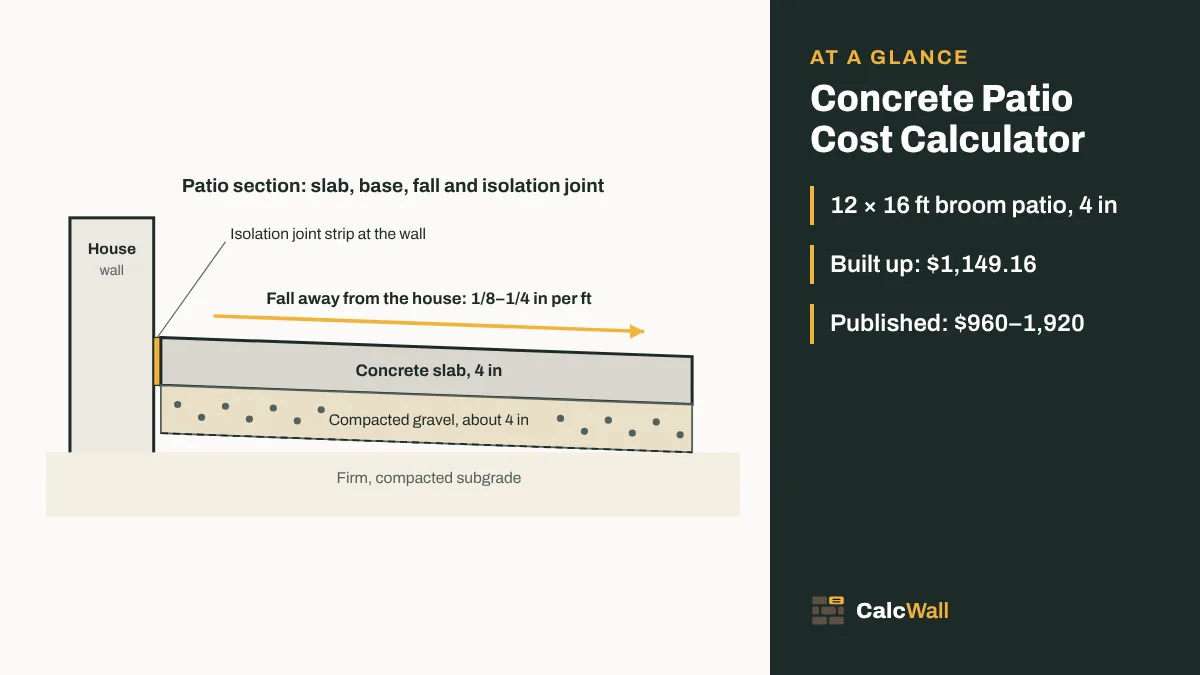
Quick answer: a plain 12 × 16 ft concrete patio, 4 in thick, comes to about $1,149.16 with this calculator’s US defaults: 2.61 cu yd of ready-mix, a short-load fee and labor. HomeGuide’s published range for a plain patio that size is $960–1,920. Stamped runs $1,536–3,648.
When can I pour? Check the next 7 days
Type your US ZIP code to see the next 7 days from the US National Weather Service, with a badge for each day: Good, Risky or No for a concrete patio. It is a planning guide, not a guarantee: check the forecast again the evening before.
The forecast check covers US ZIP codes only (it uses the US National Weather Service). Wherever you are, the rules below still apply: hold them against your own national weather service’s forecast.
How each day is rated
- Good The day’s high and the night after stay at 40 °F (5 °C) or warmer, rain is no more than a slight chance (20%), and the high is 90 °F (32 °C) or less.
- Risky The night drops to 33–39 °F (1–4 °C), a chance of rain (30–50%) in the day, rain likely the night after, or a high above 90 °F (32 °C). Pour only with insulated blankets, plastic sheeting or hot-weather care ready.
- No A high below 40 °F (5 °C), a freezing night (32 °F, 0 °C, or colder) or rain likely (60% or more) in the day.
Fresh concrete must not freeze until it reaches about 500 psi (3.5 MPa), which NRMCA says takes about two days. So a cold night two days after the pour matters too: look at the next day’s badge as well.
Rain words follow the National Weather Service: 20% is a “slight chance”, 30–50% a “chance”, 60–70% “likely”. The forecast is for the ZIP’s center point, so a hilltop or a valley can be a few degrees off.
Where these rules come from
- CIP 27: Cold Weather Concreting, NRMCA, Concrete in Practice series, footer years 1998 and 2014. Used for: cold weather tied to 40 °F (5 °C); fresh concrete must be protected from freezing until it reaches 500 psi (3.5 MPa), about two days
- FM 5-428 Concrete and Masonry, Headquarters, Department of the Army, 18 June 1998. Used for: protect concrete from freezing at 40 °F or lower
- CIP 12: Hot Weather Concreting, NRMCA (citing ACI 305R), Concrete in Practice series, footer years 1982, 1989, 2000, 2014. Used for: hot weather as heat, wind, low humidity and sun together; avoid the hottest part of the day; cure at once
- FAQ: maximum concrete temperature in hot weather, American Concrete Institute, web FAQ citing ACI 301-20 and ACI 305.1-14. Used for: ACI 301-20 and 305.1-14 limit concrete to 95 °F (35 °C) at discharge; the 90 °F (32 °C) air warning here is CalcWall’s own planning margin, not a standard
- API Web Service, US National Weather Service, api.weather.gov documentation, read 16 November 2026. Used for: the 7-day forecast in 12-hour periods; free open data, no key
- Forecast terms (probability of precipitation), NWS Binghamton, NY, web page, read 16 November 2026. Used for: 20% slight chance, 30–50% chance, 60–70% likely
- ZCTA Gazetteer file, US Census Bureau, 2025 Gazetteer (2025_Gaz_zcta_national). Used for: the point each ZIP code is looked up at (ZCTA internal point)
How to use the concrete patio cost calculator
The tool prices a patio the way a contractor builds a bid. It works out the concrete, prices the truck, then adds labor and any extras by the square foot. Each price box starts with a published figure for your country. You can change every one of them, and you should once you have a real quote.
- Enter the size. Length and width in feet (or meters), and the thickness in inches (or cm). The default is 12 × 16 ft at 4 in.
- Pick the waste allowance. 10% is the default. It covers uneven ground, spillage and what stays in the chute.
- Choose ready-mix or bags. For ready-mix, the tool uses a price per cubic yard and adds a short-load fee below the supplier’s minimum. For bags, type your store’s price per bag.
- Check labor. The US default is $3.50 per sq ft to place and finish. Enter 0 if you do the work yourself.
- Tick the extras you need: gravel base, reinforcement, excavation and removal of old concrete. Delivery and pump are flat amounts.
- Pick the finish. This sets which published installed range the tool compares your total with: plain, stamped, colored or exposed aggregate.
Total = (L × W × T ÷ 12 ÷ 27) × (1 + waste) × price per yd³ + short-load fee + (labor + extras) × area + flat fees
One thing to know about the finish box: it changes the comparison line under the result, not the total. Stamping, coloring and exposing aggregate are mostly extra labor and materials that plain-slab math can’t see. To price them, raise the labor box, or compare your total with the published range for that finish.
If your total sits well below the published range, you have probably left something out. Base, forms, the contractor’s minimum charge and the finish premium are the usual gaps. If it sits well above, look at the short-load fee and the pump.
Treat it as a concrete patio estimate calculator, not a bid. It shows what a fair price looks like, so you can spot a quote that is far off in either direction. For slab pricing in general, including pads and bag-vs-truck break-even, see the concrete cost calculator. For odd shapes, split the patio into rectangles and enter one rectangle with the same total area.
Concrete patio cost per square foot in 2026
The guides disagree, so it helps to read several. HomeGuide gives $5–10 per sq ft for a plain slab patio installed. Angi gives $4–7 for a broom finish, Bob Vila $4–7 for a plain rectangle (updated Aug 2023) and Bankrate $4–10 (May 2023). The common ground is roughly $4–10 per sq ft for plain gray concrete.
Only one of these pages, This Old House (June 2026), carries a 2026 date, and it covers stamped and stained finishes only. The HomeGuide and Angi pages show no date at all; Angi’s title says “2025 Data”. The figures here are the ones those pages showed when CalcWall read them in November 2026.
Where does the money go? At 4 in thick, a square foot of patio holds 1/3 cu ft of concrete, or 0.0123 cu yd. With 10% waste at $130 a yard, that is $1.77 per sq ft. Labor at $3.50 brings it to $5.27. The calculator’s $5.99 per sq ft for a 12 × 16 ft patio also includes the $53 per yard short-load fee, because 2.61 cu yd is far below a full 10 yd truck.
HomeGuide’s labor range for patios is $3–9 per sq ft, wider than its $3–5 for plain slabs. The high end covers decorative work, awkward access and poor ground. If you know a stamped or colored job is coming, start the labor box nearer the top of that range.
The US ready-mix default of $130 per cubic yard comes from an Angi page last updated in September 2022. Ask your local plant for this week’s price, and for an exterior mix that suits your climate.
Cost by finish: broom, colored, exposed aggregate and stamped
The finish moves the price more than anything except size. Broom finish is the plain, slip-resistant texture most patios get. Colored concrete uses integral color or a stain. Exposed aggregate washes the surface paste off to show the stones. Stamped (imprinted) concrete is pressed with mats to look like stone, slate or brick.
| Finish | HomeGuide (undated) | Angi (title: 2025 Data) | Other guides | 12 × 16 ft at HomeGuide’s range |
|---|---|---|---|---|
| Plain / broom | $5–10 | $4–7 | Bankrate $4–10 (May 2023); Bob Vila $4–7 (Aug 2023) | $960–1,920 |
| Colored or stained | $8–25 | $5–10 | This Old House $5–10 (Jun 2026) | $1,536–4,800 |
| Exposed aggregate | $7–18 | $2–3 (the add-on; see below) | Bankrate $6–13 | $1,344–3,456 |
| Stamped | $8–19 | $5–15 | Fixr $8–12 basic, $12–18 common, $18–30 complex (Jan 2025); This Old House $5–15; Bankrate $5–30 | $1,536–3,648 |
| Simple coloring or stamping | no figure | HomeAdvisor (Angi Inc., title: 2025): $9–17 | $1,728–3,264 at $9–17 |
The last column is the 192 sq ft default patio × the range, for example 192 × $8 = $1,536 and 192 × $19 = $3,648. The calculator shows the same HomeGuide figures under its result when you pick each finish with US prices.
Angi and HomeAdvisor belong to the same company and often publish the same numbers, so they count as one source, not two. Keep that in mind when two of five guides seem to agree.
Why Angi lists exposed aggregate at $2–3
Angi’s finish table puts exposed aggregate at $2–3 per sq ft. That is below its own broom finish at $4–7, so it can’t be an installed price. HomeAdvisor, Angi’s sister site, uses the same numbers but says exposed aggregate “adds $2 to $3”. HomeGuide says the same in its own words: exposed aggregate costs $2–3 per sq ft more than regular concrete.
So read Angi’s row as the premium over plain concrete. Add $2–3 to Angi’s broom finish and you get $6–10 per sq ft. Add it to HomeGuide’s plain $5–10 and you get $7–13. Both overlap Bankrate’s $6–13. The calculator uses HomeGuide’s $7–18 installed range for its exposed aggregate check.
Stamped concrete: which tier you are buying
Stamped prices spread widely because “stamped” covers everything from one pattern in natural gray to multi-color slate with hand-chiseled borders. Fixr splits it into tiers: $8–12 per sq ft for a basic design, $12–18 for the most common designs and $18–30 for complex work. When you use this as a stamped concrete patio cost calculator, decide the tier first and set labor to match.
Stamped and colored patios also need sealing to protect the color, and resealing every few years. Count that in the long-run cost. Angi puts sealing at $3–5 per sq ft every three to five years, which is $576–960 a time on a 12 × 16 patio.
Concrete patio cost by size (10x10 to 20x30)
Published size tables are the quickest check on a whole-job price. HomeGuide and Angi publish their own. Where a guide has no row for a size, the table works it out from the per-square-foot range and marks it with an asterisk. The calculator column uses the US defaults: 4 in thick, 10% waste, $130 per cu yd, the $53 short-load fee and $3.50 labor, with no extras.
| Size | Area | HomeGuide plain | Angi plain | HomeGuide stamped | Calculator default |
|---|---|---|---|---|---|
| 10 × 10 ft | 100 sq ft (9.29 m²) | $500–1,500 | $600–1,600 | $800–1,900 | $598.52 |
| 12 × 12 ft | 144 sq ft (13.38 m²) | $700–2,150 | $850–2,300 | $1,150–2,750 | $861.87 |
| 12 × 16 ft | 192 sq ft (17.84 m²) | $960–2,880* | no row | $1,536–3,648* | $1,149.16 |
| 16 × 20 ft | 320 sq ft (29.73 m²) | $1,600–4,800* | $1,900–5,100 | $2,560–6,080* | $1,915.26 |
| 20 × 20 ft | 400 sq ft (37.16 m²) | $2,000–6,000 | $2,400–6,400 | $3,200–7,600 | $2,394.07 |
| 20 × 30 ft | 600 sq ft (55.74 m²) | $3,000–9,000* | no row | $4,800–11,400* | $3,591.11 |
HomeGuide’s size table runs at $5–15 per sq ft (100 × $5 = $500, 100 × $15 = $1,500), so the starred plain cells use $5–15 too. Its plain-finish figure is $5–10, which gives a lower top end: $960–1,920 for 12 × 16. The starred stamped cells use HomeGuide’s $8–19, so 320 × $8 = $2,560 and 320 × $19 = $6,080.
The calculator figures sit near the low end of each range. That’s expected. They cover concrete and labor only, with no base, forms, finish premium or contractor’s minimum. Tick the base and reinforcement and a 20 × 20 patio rises to $3,994.07, inside both guides’ ranges.
One quirk to watch on big patios: the US short-load fee applies to every yard of an order under 10 cu yd. A 20 × 30 ft patio at 4 in needs 8.15 cu yd, so it pays the fee. At 5 in it needs 10.19 cu yd, drops the fee and costs $3,424.07, less than the thinner slab. Real plants bill the last part of a load in their own way, so ask.
Concrete, base and reinforcement quantities
Whether you hire out or pour it yourself, know the quantities. They let you check a quote line by line. This table uses 10% waste. The “order” column rounds up to the next quarter yard; check the step your plant sells in.
| Size | 4 in: yd³ with waste | Order | m³ | 80 lb bags | 5 in: yd³ with waste | 80 lb bags | 4 in gravel base |
|---|---|---|---|---|---|---|---|
| 10 × 10 ft | 1.36 | 1.5 | 1.04 | 62 | 1.70 | 77 | 1.23 yd³ |
| 12 × 12 ft | 1.96 | 2 | 1.50 | 88 | 2.44 | 110 | 1.78 yd³ |
| 12 × 16 ft | 2.61 | 2.75 | 1.99 | 118 | 3.26 | 147 | 2.37 yd³ |
| 16 × 20 ft | 4.35 | 4.5 | 3.32 | 196 | 5.43 | 245 | 3.95 yd³ |
| 20 × 20 ft | 5.43 | 5.5 | 4.15 | 245 | 6.79 | 306 | 4.94 yd³ |
| 20 × 30 ft | 8.15 | 8.25 | 6.23 | 367 | 10.19 | 459 | 7.41 yd³ |
How the columns work, using 12 × 16 ft at 4 in: 192 × 4 ÷ 12 = 64 cu ft, ÷ 27 = 2.370 cu yd, × 1.10 = 2.607 cu yd. In metric, 2.607 × 0.764555 = 1.99 m³.
Bags: 64 × 1.10 = 70.4 cu ft ÷ 0.60 cu ft per 80 lb bag (QUIKRETE) = 117.3, so 118 bags. The gravel column is area × 4 in with no waste: 192 × 4 ÷ 12 ÷ 27 = 2.37 cu yd, before compaction.
Gravel is sold by the ton in many yards. The gravel calculator turns cubic yards into tons for the stone you choose. HomeGuide gives gravel at $15–75 per cu yd, so the 2.37 cu yd under a 12 × 16 patio costs about $36–178 for the stone alone.
Reinforcement. The calculator prices rebar or mesh by area: $2 per sq ft in the US, from HomeGuide’s $1–3 for rebar installed. HomeGuide’s patio guide gives $50–360 for rebar on an average patio, and says slabs under 4–5 in that won’t carry much weight don’t always need it. Whatever you choose, it holds cracks tight; joints decide where they form.
Stamping only the border: how much it saves
A stamped band around a plain broom-finished centre gives much of the look for part of the price. The centre is a smaller rectangle: take twice the border width off each dimension. Everything outside it is stamped. The narrower the patio, the bigger the share a border takes.
| Border width | 12 × 16 ft: centre | 12 × 16 ft: border share | 16 × 20 ft: centre | 16 × 20 ft: border share |
|---|---|---|---|---|
| 1 ft | 10 × 14 = 140 sq ft | 52 sq ft, 27% | 14 × 18 = 252 sq ft | 68 sq ft, 21% |
| 1.5 ft | 9 × 13 = 117 sq ft | 75 sq ft, 39% | 13 × 17 = 221 sq ft | 99 sq ft, 31% |
| 2 ft | 8 × 12 = 96 sq ft | 96 sq ft, 50% | 12 × 16 = 192 sq ft | 128 sq ft, 40% |
| 3 ft | 6 × 10 = 60 sq ft | 132 sq ft, 69% | 10 × 14 = 140 sq ft | 180 sq ft, 56% |
To price the saving, use the stamping premium. HomeGuide gives plain at $5–10 and stamped at $8–19 per sq ft. The gap between the low ends is $3 and between the high ends $9. So every square foot you leave plain saves roughly $3–9. On the 16 × 20 patio with a 2 ft border, the plain centre is 192 sq ft: 192 × $3 = $576 up to 192 × $9 = $1,728 saved.
Put another way, the 16 × 20 patio costs $2,560–6,080 fully stamped on HomeGuide’s range. With the border only, it is 192 × $5–10 plus 128 × $8–19, which comes to $1,984–4,352. Ask contractors for both prices, and ask whether the stamping has a minimum charge.
The calculator doesn’t split the area for you. Run it with the plain labor rate, then add the border area × your contractor’s stamping premium per sq ft. Or spread that extra over the whole area and raise the labor box by the same amount.
Patio thickness, slope and control joints
Thickness. Most homeowner patios are 4 in. QUIKRETE’s how-to uses 2 × 4 forms, which give 3½ in of concrete, and HomeGuide prices slabs 4–6 in thick. Ask for a thicker slab, and an engineer’s check, under a hot tub or anywhere a vehicle might drive. Thickness adds concrete, not labor, so going from 4 to 5 in on a 12 × 16 patio adds $119.28 with the defaults.
Slope. Water must run away from the house. QUIKRETE uses a standard fall of 1/8 in per foot, with the low end farther from the house. ConcreteNetwork gives a minimum of 2%, which is 1/4 in per foot. On a 12 ft deep patio that is a drop of 1½ to 3 in. Set it in the forms; you can’t add it after the pour.
Control joints. Concrete shrinks as it dries, and it will crack. Joints make it crack in straight lines where you choose. The National Ready Mixed Concrete Association (NRMCA), following ACI PRC-330-21, gives these maximum spacings: 10 ft for slabs 4 to 5 in thick, 12.5 ft for 5 to 6 in, and 15 ft for 6 in and up. Cut them at least a quarter of the slab depth, so 1 in on a 4 in patio.
NRMCA says conventional saw cuts are usually made 4 to 12 hours after the pour, depending on the weather. QUIKRETE says any patio larger than 10 × 10 ft needs control joints. Against the house, use an isolation joint: a strip of board or foam that lets the slab and the wall move on their own.
If the patio steps down to the yard, the concrete step calculator works out the concrete for the steps. Price them as a separate line. The figures on this page for thickness, slope and joints are a guide. Local code and your engineer decide.
DIY vs hiring a contractor
Pouring your own patio cuts out the biggest line, labor. It doesn’t cut out the truck, the base, the forms or the risk. A 12 × 16 ft slab at 2.61 cu yd is a lot of concrete to place, screed and finish before it sets. Line up helpers and tools before the truck is booked.
| Line | DIY, ready-mix truck | DIY, 80 lb bags | Contractor (calculator defaults) |
|---|---|---|---|
| Concrete | 2.607 yd³ × $130 = $338.96 | 118 bags × $6 example = $708 | $338.96 |
| Short-load fee | 2.607 yd³ × $53 = $138.19 | none | $138.19 |
| Labor | $0 | $0 | 192 × $3.50 = $672 |
| Gravel base | 2.37 yd³ × $15–75 = $36–178 | $36–178 | 192 × $2 = $384 |
| Forms, tools, rentals | your prices | your prices | in labor |
| Total before tools | $513–655 | $744–886 | $1,533.16 |
The $6 bag price is an example only. Angi gives bagged mix at $4.50–27 a bag depending on type, so check your store. Even at a low shelf price, 118 bags cost more than the truck, and they weigh 118 × 80 = 9,440 lb. Each one has to be lifted, mixed and placed before the last batch sets.
For comparison, HomeGuide gives $650–1,900 for a DIY 200 sq ft basic slab. That covers things this table leaves blank, such as forms and tools. Use it as a rough guide to what a DIY job really ends up costing.
To use the tool for the cost to pour a concrete patio yourself, set labor to 0. For bags, switch “Concrete from” to bags and type your shelf price. The result then shows the bag count as well as the cost.
Removing an old patio first
Breaking out an old slab is often the hidden cost of a new patio. HomeGuide gives $3–8 per sq ft including disposal, and $1–3 more for reinforced concrete. Fixr gives $2–4 for unreinforced and $4–6 for reinforced. The calculator’s US default is $4 per sq ft, from Angi’s $2–6.
For a 12 × 16 ft patio, that is 192 × $4 = $768 at the default, or $576–1,536 on HomeGuide’s range. Tick “Remove old concrete” to add it. The tool prices removal over the new patio’s area, so if the old slab is a different size, adjust the price per sq ft to match.
Weight drives disposal. Normal concrete weighs 137–150 lb per cu ft (Portland Cement Association). A 4 in slab of 192 sq ft is 64 cu ft, so 64 × 150 = 9,600 lb, about 4.8 US tons. That is several trips in a pickup. The concrete removal cost calculator works out the weight, loads and disposal for you.
Patio costs by country
The calculator switches to each country’s published prices when you change the country. Every figure stays in its own currency and unit. CalcWall never converts between currencies. Where a market has no published figure for a finish, the table says so, and the tool falls back to the plain price with a note.
| Market | Plain | Stamped | Colored | Exposed aggregate | Calculator default |
|---|---|---|---|---|---|
| United States | $5–10 per sq ft (HomeGuide, undated) | $8–19 | $8–25 | $7–18 | 12 × 16 ft, 4 in: $1,149.16 |
| United Kingdom | £65–120 per m² + VAT (Checkatrade, 16 Jul 2025) | imprinted £25–130, £77.50 typical (Checkatrade, undated; all uses) | colour adds £15–25 per m² (MyJobQuote, Sep 2026, driveway guide) | no patio figure found | 4 × 5 m, 10 cm: £763.00 |
| Canada | $5–15 per sq ft (HomeStars Toronto, Aug 2026) | $8–19 (HomeStars Calgary, undated) | $12–22 (HomeStars Edmonton, undated) | $10–20 with polished (HomeStars Toronto) | 4 × 5 m, 10 cm: $1,586.88 |
| Australia | $80–130 per m² (Yellow Pages, May 2026) | from $120 per m² (iSeekplant, Jul 2023) | $90–140 | $120–160 | 4 × 5 m, 10 cm: $1,796.00 |
| New Zealand | no published patio price found | none found | none found | premium of $30–80 per m² over plain (ArchiPro, 8 Jul 2026, driveway article) | volume only: 2.20 m³ |
| Germany | €100–150 per m² (Hausjournal, Nov 2022) | none found | none found | none found | 4 × 5 m, 10 cm: €601.10 concrete only |
United Kingdom. Checkatrade’s £65–120 per m² is for a standard concrete patio, plus VAT. MyJobQuote (Nov 2026) gives totals of £550–1,100 for 10 m², £900–2,000 for 20 m² and £1,400–3,600 for 40 m². Checkatrade’s imprinted range covers patios, paths and driveways together, and its £25 low end is below its own plain patio price, so lean on the £77.50 typical figure.
Canada. If you want a concrete patio cost calculator for Canada, know that every figure here comes from one publisher, HomeStars, across its city guides. Toronto gives $5–15 per sq ft for a basic patio, including labour and materials. Edmonton runs higher: $8–12 basic and $15–25 stamped. HomeStars’ general slab guide gives stamped at $12–22 and exposed aggregate at $8–15.
The HomeStars Toronto stamped figure. The Toronto guide’s table lists stamped concrete at $7–10 per sq ft. That is below the top of its own basic patio range ($5–15), below its decorative patio row ($14–20+), and well below Edmonton ($15–25) and the general slab guide ($12–22). It may be a typo or a narrow figure. The calculator uses Calgary’s $8–19 for stamped instead.
Australia. Yellow Pages gives a standard 16 m² patio at $1,120–1,600, which is $70–100 per m². Its general rates are $80–130 per m² for plain grey, $90–140 coloured and $120–160 exposed aggregate, with decorative patios at $100–200+ per m². Stamped has only a floor: iSeekplant’s 2023 guide says to expect upwards of $120 per m².
New Zealand. CalcWall found no published per-m² price for a concrete patio from any New Zealand guide it could verify. The only figure is a premium: an Auckland contractor writing on ArchiPro (July 2026) says exposed aggregate is usually $30–80 per m² more than plain, in a driveway article. The calculator has no New Zealand ready-mix price either, so it shows the volume and asks for your supplier’s price.
Germany. Hausjournal gives €100–150 per m² in total for a new concrete terrace (Nov 2022), and €150–250 in a later garden-works guide (Oct 2023). No reliable price was found for Waschbeton (exposed aggregate), colored or stamped terraces. The German defaults have ready-mix and the missing-load fee but no labor rate, so the tool shows the concrete delivered only, before 19% VAT.
Worked examples
These match the calculator exactly with its default prices. Enter the same numbers to check.
US, 12 × 16 ft plain patio, 4 in, +10%. 192 sq ft × 4 ÷ 12 = 64 cu ft ÷ 27 = 2.370 cu yd, × 1.10 = 2.607 cu yd. Concrete: 2.607 × $130 = $338.96. Short load (under 10 yd): 2.607 × $53 = $138.19. Labor: 192 × $3.50 = $672.00. Total $1,149.16, or $5.99 per sq ft. Published check for plain: 192 × $5–10 = $960–1,920 (HomeGuide).
US, 16 × 20 ft stamped patio, 4 in, base and reinforcement ticked. 320 sq ft → 3.951 cu yd, × 1.10 = 4.346 cu yd. Concrete $564.94, short load $230.32, labor 320 × $3.50 = $1,120, gravel base 320 × $2 = $640, reinforcement 320 × $2 = $640. Total $3,195.26, $9.99 per sq ft. Published check for stamped: 320 × $8–19 = $2,560–6,080.
The stamped example lands near the bottom of the range because the labor box is still at the plain-slab rate. Raise it to your contractor’s stamped labor price and the total moves up. With a 2 ft border only, the border table above shows how much of that premium you can skip.
UK, 4 × 5 m patio, 10 cm, +10%. 20 m² × 0.10 m = 2.00 m³, × 1.10 = 2.20 m³. Concrete: 2.20 × £120 = £264.00. Part-load surcharge (under 4 m³): 2.20 × £45 = £99.00. Labour: 20 × £20 = £400.00. Total £763.00, £38.15 per m². Tick sub-base (£11 per m², £220) and excavation (£50 per m², £1,000) and it becomes £1,983.00, £99.15 per m².
The bare UK figure is well under Checkatrade’s £65–120 per m² (£1,300–2,400 for 20 m²). With the dig-out and sub-base added it lands inside it. Published patio prices include ground preparation, so tick those boxes when you compare.
US, 10 × 10 ft DIY patio, bags vs truck. 100 × 4 ÷ 12 = 33.33 cu ft × 1.10 = 36.67 cu ft ÷ 0.60 = 61.1, so 62 bags of 80 lb. At an example $6 a bag that is $372. The truck with labor set to 0: 1.358 cu yd × $130 = $176.54 plus 1.358 × $53 = $71.98, so $248.52.
Notes for pros
Price the finish in labor. The finish box only changes the published-range check. Put the stamping or exposing cost into the labor rate per sq ft.
Watch the 10 yd cliff. The US fee covers every yard under a full truck. A 20 × 30 at 5 in is cheaper than at 4 in on paper. Ask the plant.
Quote the border split. Give clients a full-stamp and a border-only price. A 2 ft border on 16 × 20 stamps only 40% of the area.
Joint before you finish. 10 ft max at 4–5 in, depth ¼ of the slab, sawn within 4–12 hours (NRMCA). Isolate the house wall.
For resealing a finished patio, the sealant calculator works out the gallons from the area, coats and label coverage. If the client is weighing a raised deck instead, the deck calculator counts boards, joists and fasteners.
Sources
Where the numbers on this page come from. Everything else is plain geometry and unit conversion, which the calculator does with exact factors.
- How much does a concrete patio cost?, HomeGuide, page undated, read Nov 2026. Used for: installed cost by finish (plain $5–10, stamped $8–19, stained $8–25, exposed aggregate $7–18 per sq ft), the size table at $5–15 per sq ft (10×10 $500–1,500, 12×12 $700–2,150, 20×20 $2,000–6,000), the calculator’s US published-price check, labor $3–9 per sq ft, gravel $15–75 per cu yd, rebar $50–360 for an average patio, slabs 4–6 in thick, permits $50–300, DIY $650–1,900 for 200 sq ft, pavers $10–17 and decks $25–50 per sq ft
- How much does stamped concrete cost?, HomeGuide, page undated, read Nov 2026. Used for: stamped patio totals: 10×10 $800–1,900, 12×12 $1,150–2,750, 20×20 $3,200–7,600
- How much does it cost to install an exposed aggregate patio?, HomeGuide, page undated, read Nov 2026. Used for: exposed aggregate at $7–18 per sq ft installed and $2–3 per sq ft more than regular concrete
- How Much Does a Concrete Patio Cost? [2025 Data], Angi, undated, title says 2025 Data, read Nov 2026. Used for: finish table (broom $4–7, stamped $5–15, stained $5–10, exposed aggregate $2–3 per sq ft), size table (10×10 $600–1,600, 12×12 $850–2,300, 16×20 $1,900–5,100, 20×20 $2,400–6,400), sealing at $3–5 per sq ft every three to five years, permits $50–400
- How Much Does It Cost to Build a Concrete Patio in 2025?, HomeAdvisor (Angi Inc.), undated, title says 2025, read Nov 2026. Used for: simple coloring or stamping at $9–17 per sq ft, and the wording that exposed aggregate adds $2–3
- How much does it cost to lay a stamped concrete patio?, Fixr, updated January 31, 2025. Used for: stamped patio tiers: basic $8–12, most common $12–18, complex $18–30 per sq ft
- Cost to install a concrete patio, Bankrate, May 24, 2023. Used for: broom finish $4–10, exposed aggregate $6–13 and stamped $5–30 per sq ft
- Concrete Patio Cost Guide, This Old House, updated 06/08/2026. Used for: stamped $5–15 and stained $5–10 per sq ft
- Concrete Patio Cost, Bob Vila, published July 8, 2021; updated August 2, 2023. Used for: a plain rectangular patio at $4–7 per sq ft
- How Much Does It Cost to Deliver Concrete?, Angi, updated Sep 2022. Used for: ready-mix about $130 per cu yd (the calculator’s US default), bagged mix $4.50–27 a bag, removal $2–6 per sq ft (default $4)
- How Much Does Concrete Cost Per Yard?, HomeGuide, page undated, read Nov 2026. Used for: the $53 per cu yd short-load fee below a full truck of about 10 cu yd
- Concrete Slab Cost, HomeGuide, page undated, read Nov 2026. Used for: slab labor $3–5 per sq ft (default $3.50) and gravel pad base $1–3 per sq ft (default $2)
- Concrete Driveway Cost, HomeGuide, page undated, read Nov 2026. Used for: rebar installed at $1–3 per sq ft (default $2) and excavation at $1–5 per sq ft (default $3)
- How much does concrete removal cost?, HomeGuide, page undated, read Nov 2026. Used for: removal $3–8 per sq ft including disposal, $1–3 more for reinforced concrete
- How much does it cost to remove concrete?, Fixr, updated January 31, 2025. Used for: removal $2–4 per sq ft unreinforced and $4–6 reinforced
- Patio laying: Cost breakdown 2025, Checkatrade, last updated 16 July 2025. Used for: UK standard concrete patio £65–120 per m² plus VAT
- Imprinted concrete cost guide, Checkatrade, undated, read Nov 2026. Used for: UK imprinted concrete £25–130 per m², £77.50 typical (patios, paths and driveways together)
- Cost of Laying a Patio, MyJobQuote, last updated 03/11/26. Used for: UK concrete patio totals: 10 m² £550–1,100, 20 m² £900–2,000, 40 m² £1,400–3,600
- Concrete Driveway Cost, MyJobQuote, last updated 07/09/26. Used for: colour adds £15–25 per m² (driveway guide; no patio figure published)
- Ready Mix Concrete Cost, Checkatrade, updated Jul 2024. Used for: UK ready-mix £100–160 per m³, £120 typical (calculator default)
- Ready Mix Concrete Cost, MyBuilder, undated, read Nov 2026. Used for: UK surcharge of £30–60 per m³ under 4 m³ (calculator uses £45)
- Concrete Slab Cost, MyBuilder, undated, read Nov 2026. Used for: UK labour £15–25 per m² (default £20) and 100 mm sub-base £6–16 per m² (default £11)
- Cost of Pouring Concrete, MyJobQuote, Sep 2026. Used for: UK dig out, level and compact at £30–70 per m² (default £50)
- Concrete Contractor Costs in Toronto, HomeStars, updated 21/08/2026. Used for: Toronto basic patio $5–15 per sq ft, exposed aggregate or polished $10–20, decorative patio $14–20+, and the stamped $7–10 table row
- Concrete Contractor Costs in Calgary, HomeStars, undated (“Updated on” with no value), read Nov 2026. Used for: Calgary poured patio $5–15 and stamped patio $8–19 per sq ft
- Concrete Contractor Costs in Edmonton, HomeStars, undated, read Nov 2026. Used for: Edmonton basic $8–12, stamped $15–25 and coloured $12–22 per sq ft
- Concrete Slab Cost: Key Insights, HomeStars, undated, read Nov 2026. Used for: stamped $12–22 and exposed aggregate $8–15 per sq ft
- Concrete Slab Cost (price guide), HomeStars, Aug 2026. Used for: Canadian ready-mix $120–160 per cu yd ($140 default) and labour $3–8 per sq ft ($5.50 default)
- How much does concreting cost?, Yellow Pages Australia, published 12 February 2025; last updated May 2026. Used for: a standard 16 m² patio $1,120–1,600, plain grey $80–130, coloured $90–140, exposed aggregate $120–160 and decorative patios $100–200+ per m²
- How much is concrete per cubic metre?, Yellow Pages Australia, Apr 2026. Used for: Australian ready-mix default $410 per m³ for 25 MPa
- Service fees, Melbourne Metro, Holcim (Australia), effective 1 May 2026. Used for: $80 per undelivered m³ on loads under 4 m³, ex GST
- Concreting services, Airtasker (Australia), Nov 2026. Used for: concreter labour $20–55 per m² ($37.50 default)
- Concreting Cost Guide, iSeekplant, 04 July 2023. Used for: stamped concrete from $120 per m²
- Concrete Driveways NZ: Costs, Options & What to Know, ArchiPro (article by Superior Renovations), 08 July 2026. Used for: exposed aggregate about $30–80 per m² more than plain (driveway article; the only New Zealand figure found)
- Kostenbeispiel: Terrassenbau, Hausjournal, 8. November 2022. Used for: new concrete terrace €100–150 per m² in total
- Kostenbeispiel: Außenanlage, Hausjournal, 16. Oktober 2023. Used for: concrete terraces €150–250 per m² on average
- Preisliste Transportbeton Nordrhein-Westfalen 2026, Heidelberg Materials Beton DE, valid from 1 Oct 2025. Used for: C25/30 at €213 per m³ net and €25 per missing m³ below 7.5 m³ (calculator defaults)
- Jointing Concrete (Design Assistance Program sheet, based on ACI PRC-330-21), National Ready Mixed Concrete Association (NRMCA), hosted by the Pennsylvania Aggregates and Concrete Association, undated, read Nov 2026. Used for: maximum joint spacing (10 ft for 4–5 in, 12.5 ft for 5–6 in, 15 ft for 6 in and over), joint depth of ¼ the thickness, sawing within 4–12 hours, isolation joints
- How to build a concrete patio, QUIKRETE, page undated, read Nov 2026. Used for: a fall of 1/8 in per ft away from the house, about 5 in of gravel tamped to 4 in, 3½ in of concrete with 2 × 4 forms, control joints on patios over 10 × 10 ft, an isolation board against structures
- Concrete slope, ConcreteNetwork.com, undated (© 1999–2026), read Nov 2026. Used for: a minimum slope of 2%, a 1/4 in drop per foot
- Concrete Mix No. 1101 product data sheet, QUIKRETE, revised October 2022. Used for: bag yields: 80 lb about 0.60 cu ft, 60 lb 0.45, 40 lb 0.30
- Design and Control of Concrete Mixtures, Chapter 1, Portland Cement Association (hosted by PDHonline), edition not stated. Used for: normal-weight concrete at 137–150 lb per cu ft, for the weight of an old patio
- SEAL-KRETE Multi-Surface Water Repellent: technical data sheet, Rust-Oleum, SK201001 / SK201005. Used for: sealer coverage of 150–300 sq ft per gallon
- NIST Handbook 44, Appendix C: General Tables of Units of Measurement, National Institute of Standards and Technology, 2026 edition. Used for: 1 cu yd = 27 cu ft and the exact factors 1 cu yd = 0.764555 m³ and 1 sq ft = 0.092903 m²
Frequently asked questions
How much does a concrete patio cost per square foot?
HomeGuide (undated, read Nov 2026) gives $5–10 per sq ft for a plain slab patio installed, and Angi lists broom finish at $4–7. Decorative finishes cost more: HomeGuide gives stamped at $8–19, stained at $8–25 and exposed aggregate at $7–18. The calculator’s US defaults come to $5.99 per sq ft for concrete and labor alone.
How much does a 12x12 concrete patio cost?
HomeGuide’s size table puts a 12 × 12 ft patio (144 sq ft) at $700–2,150, and Angi’s at $850–2,300. Stamped, HomeGuide gives $1,150–2,750. With the calculator’s US defaults, 4 in thick and no extras, it comes to $861.87 for 1.96 cu yd of concrete.
How much does a 20x20 concrete patio cost?
A 20 × 20 ft patio is 400 sq ft. HomeGuide gives $2,000–6,000 for it, Angi $2,400–6,400, and HomeGuide’s stamped guide $3,200–7,600. The calculator’s US default is $2,394.07 for 5.43 cu yd at 4 in. Add a gravel base at $2 per sq ft and it rises by $800.
How much more does stamped concrete cost than plain?
On HomeGuide’s figures, plain runs $5–10 and stamped $8–19 per sq ft, so stamping adds about $3–9 per sq ft. On a 12 × 16 ft patio that is 192 × $3 = $576 to 192 × $9 = $1,728 more. Fixr says most stamped designs cost $12–18 per sq ft, and complex ones $18–30.
Is it cheaper to stamp only the border?
Yes. A 2 ft border on a 16 × 20 ft patio is 128 of its 320 sq ft, or 40%. The plain 192 sq ft centre then skips the stamping premium. At $3–9 per sq ft, which is the gap between HomeGuide’s plain and stamped ranges, that saves about $576–1,728 against stamping the whole patio.
How much does an exposed aggregate patio cost?
HomeGuide gives $7–18 per sq ft installed, or $2–3 per sq ft more than regular concrete. Bankrate (May 2023) gives $6–13. Angi’s table shows $2–3, but that matches the add-on, not the installed price. For a 12 × 16 ft patio, HomeGuide’s range is $1,344–3,456.
How much concrete do I need for a 12x16 patio?
At 4 in thick: 12 × 16 = 192 sq ft × 4 ÷ 12 = 64 cu ft, ÷ 27 = 2.37 cu yd. With 10% waste it is 2.61 cu yd, so order 2.75. In bags, that is 118 bags of 80 lb at 0.60 cu ft each. At 5 in thick it is 3.26 cu yd with waste.
How thick should a concrete patio be?
Most patio guides work with 4 in. HomeGuide’s patio prices cover slabs 4–6 in thick. QUIKRETE’s how-to uses 2 × 4 forms, which give 3½ in of concrete. Go thicker if the patio will carry a hot tub or a vehicle. Your local code and any engineer’s design decide the minimum.
Does a concrete patio need rebar or mesh?
Not always. HomeGuide says concrete under 4–5 in thick doesn’t always need rebar if it won’t carry much weight, and puts rebar at $50–360 for an average patio. Reinforcement holds cracks tight. It does not stop them; control joints decide where they form. The calculator adds rebar at $2 per sq ft by default.
How much gravel goes under a patio?
QUIKRETE suggests about 5 in of compactible gravel tamped down to 4 in. For a 12 × 16 ft patio, 4 in of base is 192 × 4 ÷ 12 ÷ 27 = 2.37 cu yd. HomeGuide gives gravel at $15–75 per cu yd, so $36–178 for the stone. Installed by a contractor, HomeGuide gives $1–3 per sq ft.
Is it cheaper to pour a patio yourself?
Usually. For a 12 × 16 ft patio, the truck and short-load fee come to $477.16 with the US defaults, and gravel adds about $36–178. A contractor’s default bill is $1,533.16 with base. HomeGuide gives $650–1,900 for a DIY 200 sq ft basic slab. You also need forms, tools, helpers and a plan for the truck.
How much does it cost to remove an old concrete patio?
HomeGuide gives $3–8 per sq ft including disposal, plus $1–3 for reinforced concrete. Fixr gives $2–4 unreinforced and $4–6 reinforced. For a 12 × 16 ft patio, the calculator’s $4 default adds $768. A 4 in slab that size weighs about 9,600 lb at 150 lb per cu ft.
Is a concrete patio cheaper than pavers or a deck?
On HomeGuide’s figures, yes. A plain concrete patio is $5–10 per sq ft, a paver patio $10–17 and a deck $25–50 installed. Stamped concrete at $8–19 overlaps with pavers, so a fancy stamped patio can cost about the same. For a deck’s lumber and boards, use the deck calculator.
How often does a patio need sealing, and what does it cost?
Angi says to seal a concrete patio every three to five years, at about $3–5 per sq ft. For a 12 × 16 ft patio that is $576–960 each time, so two or three times in ten years. Doing it yourself, a repellent covering 150–300 sq ft per gallon needs 2–3 gallons for two coats.
How much slope should a patio have?
QUIKRETE uses 1/8 in per foot, falling away from the house. ConcreteNetwork gives a minimum of 2%, which is 1/4 in per foot. Over a 12 ft patio that is a drop of 1½ in to 3 in. Set the forms with the fall before the truck arrives.
Do I need a permit for a concrete patio?
It depends on the city. HomeGuide puts a permit at $50–300 for an average 200 sq ft patio and says some cities don’t require one. Angi gives $50–400. Ask your building department, especially if the patio touches the house, sits near a property line or has a roof over it.
How much does a concrete patio cost in Canada, the UK or Australia?
Canada: HomeStars gives $5–15 per sq ft for a basic patio in Toronto (Aug 2026). UK: Checkatrade gives £65–120 per m² plus VAT (Jul 2025). Australia: Yellow Pages gives $1,120–1,600 for a standard 16 m² patio (May 2026). Each figure stays in its own currency.
Is this concrete patio cost calculator free to use online?
Yes. The CalcWall Concrete Patio Cost Calculator is completely free and works online in any browser, on a phone, tablet or computer. There is nothing to download and no account to create, and the math runs right in your browser, so results appear as you type.