Quick answer: US guides put concrete removal at $2–4 per sq ft for plain slabs and $4–6 for reinforced (Fixr, Jan 2025), disposal included. A 20 × 20 ft patio 4 in thick costs about $1,200 to remove. It weighs 20,000 lb, or 10 tons, which fills a 10-yard dumpster by weight.
How to use the concrete removal cost calculator
The tool does three jobs at once. It prices the work from a published range for your country, it weighs the concrete, and it counts how many loads it takes to haul away. Pick your country at the top of the site, and the prices, units and currency follow. If the slab is coming out because the ground under it moved, price the foundation repair as well.
- Area: enter the length and width of the slab in feet or meters. For an L-shaped patio, add the two rectangles and enter one rectangle with the same area.
- Plain or reinforced: pick whether the slab has rebar or mesh. Look at a broken corner or drill a small test hole at an edge if you are not sure. Reinforced slabs cost more to break and cut.
- Thickness: measure it at an edge. Patios and walks are often 4 in (10 cm), driveways 4–6 in. The default is 4 in or 10 cm.
- Your price (optional): if you have a quote per sq ft or per m², enter it and the tool replaces the middle of the published range with your figure.
- Dumpster or skip size and weight limit (optional): enter both from your hauler’s quote. The tool counts the loads by volume and by weight and tells you to plan on the larger.
- Disposal fee per ton (optional): leave it empty if your removal price includes disposal, which most do. The box shows the published figure for your country as a hint. Fill it in only if you haul the debris yourself or the quote lists the dump fee apart.
Cost = area × price per sq ft · Weight = area × thickness × 150 lb/cu ft · Loads = the larger of (volume ÷ box size) and (weight ÷ weight limit)
The result shows the middle of the published range in large type, with the low–high range, the price per sq ft or m², the volume in place and the weight. The source and its date are printed under the result, so you can see what the number rests on.
Weight is set at 150 lb per cu ft. That is the top of the Portland Cement Association’s 137–150 range for normal-weight concrete (2,200–2,400 kg/m³), and it is the figure WSDOT uses for plain concrete. Using the top of the range means a hauler’s weight limit is not underestimated.
The tool uses the same 150 for reinforced slabs, which is about 3% light. WSDOT adds 5 lb per cu ft for steel, so add 3% to the weight of a reinforced slab yourself.
The tool works from the slab you measure, so the volume it reports is the solid concrete in place. Once broken, the pieces take more space. The load count by volume is therefore a floor. More on that under dumpsters.
Concrete removal cost per square foot in 2026
Contractors quote removal by the square foot, with breaking, loading, hauling and dumping in one rate. US guides agree on the shape of the market but not the exact numbers. Fixr’s $2–4 per sq ft for plain and $4–6 for reinforced concrete are the calculator’s US defaults. They sit in the middle of what the other guides publish.
| Publisher (date) | Plain | Reinforced | What it includes |
|---|---|---|---|
| Fixr (updated Jan 31, 2025) | $2–4 | $4–6 | Labor, equipment, disposal ($0.50–2 of it); average $4 |
| HomeAdvisor (updated Apr 12, 2024) | $2–6 | $4–6 (50–100% more) | Demo, removal and disposal |
| Angi (updated Apr 15, 2024) | $2–6 | not split out | Labor and dumping fees |
| HomeGuide (no date shown) | $3–8 | $1–3 extra | Including disposal |
| SDDOT 2024 bid average, sidewalk | $12.26 per sq yd | n/a | Highway contracts; $12.26 ÷ 9 = $1.36 per sq ft |
Fixr breaks the price into parts. Of its $2–6 range, about $0.50–2 per sq ft is disposal. The rest, $1.50–4, is labor, bringing the equipment to site and other fees, with labor the biggest share. That split is why the calculator leaves the disposal box empty: it is already in the per-sq-ft price.
Small jobs cost more per square foot. HomeAdvisor lists a minimum service charge of $50–150, and its 50 sq ft row is $100–200 plain, the same $2–4 rate. A crew rarely comes out for $100, so expect a minimum to set the price on a single step or a small pad.
The South Dakota DOT figure is a reality check from the other end. On large highway contracts, contractors bid an average of $12.26 per square yard to remove concrete sidewalk in 2024, about $1.36 per sq ft. That is volume work with big machines and no garden to protect, so homeowner prices run well above it.
Reinforcement is the biggest single price driver. HomeGuide puts the extra at $1–3 per sq ft and HomeAdvisor at 50–100% more. On a 500 sq ft drive, HomeAdvisor’s size table gives $1,000–2,000 plain against $2,000–3,000 reinforced.
How much the old concrete weighs
Weight decides how many loads you pay for, and it is the part most people get wrong. Concrete is heavy: a cubic foot of plain concrete weighs about 150 lb, and a cubic yard about 27 × 150 = 4,050 lb. WSDOT’s design memo takes reinforced concrete at 155 lb per cu ft, 5 lb more for the steel. The Eurocode figure is 24 kN/m³ plain and 25 kN/m³ with normal reinforcement, a 4% step.
Per square foot of slab, the weight follows the thickness: 150 × thickness in inches ÷ 12. A 4 in slab is 50 lb per sq ft, 5 in is 62.5 lb and 6 in is 75 lb. In metric, a 10 cm slab is about 240 kg per m².
Some calculators use 140 lb per cu ft, a figure for bagged mix. Hardened slab concrete sits at the top of PCA’s range, so 140 underestimates the load by about 7%. On a 15-ton driveway that is a ton you did not plan for.
| Slab | Area | 4 in plain | 5 in plain | 6 in plain | 4 in reinforced |
|---|---|---|---|---|---|
| 10 × 10 ft | 100 sq ft | 5,000 lb = 2.50 t (2.27) | 6,250 lb = 3.13 t (2.83) | 7,500 lb = 3.75 t (3.40) | 5,167 lb = 2.58 t (2.34) |
| 12 × 12 ft | 144 sq ft | 7,200 lb = 3.60 t (3.27) | 9,000 lb = 4.50 t (4.08) | 10,800 lb = 5.40 t (4.90) | 7,440 lb = 3.72 t (3.37) |
| 12 × 40 ft | 480 sq ft | 24,000 lb = 12.0 t (10.89) | 30,000 lb = 15.0 t (13.61) | 36,000 lb = 18.0 t (16.33) | 24,800 lb = 12.4 t (11.25) |
| 20 × 20 ft | 400 sq ft | 20,000 lb = 10.0 t (9.07) | 25,000 lb = 12.5 t (11.34) | 30,000 lb = 15.0 t (13.61) | 20,667 lb = 10.3 t (9.37) |
| 24 × 24 ft | 576 sq ft | 28,800 lb = 14.4 t (13.06) | 36,000 lb = 18.0 t (16.33) | 43,200 lb = 21.6 t (19.60) | 29,760 lb = 14.9 t (13.50) |
| 24 × 40 ft | 960 sq ft | 48,000 lb = 24.0 t (21.77) | 60,000 lb = 30.0 t (27.22) | 72,000 lb = 36.0 t (32.66) | 49,600 lb = 24.8 t (22.50) |
For other shapes and thicknesses, the concrete slab weight calculator works the weight in pounds, tons and tonnes, with plain and reinforced density. Use it as a concrete weight calculator for steps and footings too, then add their weight to the slab’s.
Broken concrete takes more room than the slab
A slab broken into pieces has gaps between them, so the same tonnage fills more space. Earthmovers call this swell, and they use a load factor: the ratio of bank (in-place) volume to loose volume. Caterpillar gives no figure for broken concrete. Its nearest material, crushed stone, weighs 4,500 lb per bank cu yd and 2,700 lb loose, a load factor of 0.60. One solid yard becomes 1 ÷ 0.60 = 1.67 loose yards.
German guides point the same way. sanier.de puts a cubic meter of loose Bauschutt (mineral rubble) at 800–1,500 kg, against 2,400 kg for solid concrete. That is 2,400 ÷ 1,500 = 1.6 to 2,400 ÷ 800 = 3 times the volume. Slab pieces stack better than mixed rubble, so the lower end is the more likely. Allow at least 1.6 times the in-place volume when you size a box by volume.
Dumpsters, skips, trailers and truck loads
Every dumpster has two limits: how much it holds and how much it may weigh. With household junk you hit the volume first. With concrete you nearly always hit the weight first, and the overweight fee or a refused pickup is where DIY budgets go wrong.
Budget Dumpster lists typical weight limits of 1–2 tons for 10 and 15-yard boxes, 2–3 tons for 20 yards, 3–4 for 30 and 4–5 for 40. Those are for mixed debris. For heavy debris, the same company says a 10-yard box takes up to 10 tons and that 10 tons is the maximum for any of its roll-offs. Dumpsters.com recommends the 10-yard size for concrete and holds its 15 and 20-yard boxes to the same 10 tons.
Run the numbers on a 10-yard box. Ten tons is 20,000 lb, which is 20,000 ÷ 4,050 = 4.94 cu yd of solid slab. Broken, that is about 4.94 × 1.67 = 8.2 cu yd, so the box is about four-fifths full when it hits the limit. That is why haulers use small boxes for concrete. A 20-yard box would sit less than half full.
| Market | Size | Weight limit or tonnage included | Source (date) |
|---|---|---|---|
| US | 10 yd roll-off | up to 10 tons of heavy debris | Budget Dumpster; Dumpsters.com (no date, ©2026) |
| US | 15 and 20 yd | same 10 tons for heavy debris | Dumpsters.com (no date, ©2026) |
| US | 10 / 20 / 30 / 40 yd, mixed debris | 1–2 / 2–3 / 3–4 / 4–5 tons | Budget Dumpster (no date, ©2026) |
| UK | Midi skip, 4–5 yd | 1.5–2 tonnes | MyBuilder (no date) |
| UK | 4 / 6 / 8 yd skip | 4 / 6 / 8 tonnes | ISM Waste (Jun 2026) |
| UK | 6 yd skip | largest to fill with rubble; MyBuilder’s example limit is 3 tonnes | MyBuilder; ISM Waste |
| Canada (Toronto) | 4 yd / 14 yd concrete-only bin | 1 / 1.5 tonnes included, then $120–140 per tonne | Scarborough Disposal (Oct 2026) |
| Australia | 6 m³ bin | 6 tonnes heavy waste (Sydney), 4 tonnes (Melbourne) | Wanless (Feb 2026) |
| Germany | 3 / 7 m³ container | no limit stated; full of rubble about 3.45 / 8.05 t | sanier.de (Jan 2026) |
| New Zealand | n/a | no published skip limit found | n/a |
The UK sources disagree on skip limits. ISM Waste gives a 6-yard skip 6 tonnes; MyBuilder uses 3 tonnes as its example for the same size. Both agree on the rule that matters: a 6-yard skip is the largest you can fill to the top with rubble, and an 8-yard skip should be no more than a third to half full of it. Ask your skip firm for its tonnage before you load.
In the calculator, enter the box size and the weight limit from your quote. It divides the solid volume by the box size and the weight by the limit, rounds each up and tells you to plan on the larger. If the two counts are close, doubt the volume count, because it uses the solid volume, not the broken one.
Trailers and pickups
HomeGuide quotes $30–65 per pickup truck load to haul and dump “up to 6 cubic yards of debris”. Six cubic yards of solid concrete is 6 × 4,050 = 24,300 lb, about 12 tons, far more than any pickup can carry.
Read that figure as a dump fee per load of light debris, not a plan for concrete. A pickup is limited by its payload, printed on the door-jamb label. Divide the weight from the calculator by that payload to count the trips.
Dump trailers are the DIY step up. One Ohio rental store lists a dump trailer at $131 a day and a dump truck at $305 a day (Jan 2026). Check the trailer’s rated payload, your vehicle’s tow rating and the weight of the trailer itself before you book.
Disposal and recycling fees
If you hire a crew, disposal is in the price. If you haul the concrete yourself, you pay the gate fee by the ton at the landfill, transfer station or recycler. That is when to fill in the disposal box: the tool multiplies the weight by your fee.
| Market | Clean concrete or rubble | Mixed or reinforced | Source (date) |
|---|---|---|---|
| US | $30–100 per ton, municipal dump | n/a | HomeAdvisor (Apr 2024) |
| US | $32–40 per ton, self-haul to landfill | n/a | Dumpsters.com (no date, ©2026) |
| US | $90–160 per ton, landfill | n/a | HomeGuide (no date) |
| Canada | $120–140 per tonne over the included tonnage | n/a | Scarborough Disposal (Oct 2026) |
| Australia | about $40 per m³ | n/a | Yellow Pages (Apr 2026) |
| New Zealand | $111 per tonne (Tauranga, Te Maunga) | n/a | Tauranga City Council (Sep 2026) |
| New Zealand | $21.50 per tonne dry clean fill; $31.50 rubble | n/a | Dunedin City Council (2025/26, GST incl.) |
| Germany | €40–90 per tonne; landfill €30–60 | €60–130 per tonne | Hausjournal (Sep 2023); sanier.de (Jan 2026) |
| UK | no per-tonne concrete fee found in the guides used; skips are priced per hire | n/a | |
The US spread, $30 to $160 per ton, is wide enough to change a DIY budget by hundreds. On a 10-ton patio that is $300 against $1,600. Call two sites before you load: the municipal landfill and the nearest aggregate recycler.
Recycling is the usual route for clean concrete. EPA counts about 600 million tons of construction and demolition debris in the US in 2018, with concrete among it.
FHWA describes reclaimed concrete being crushed for granular base, engineered fill and new pavement. Because the recycler sells the product, clean loads often cost less to drop off. Dunedin’s schedule shows it plainly: dry clean fill at $21.50 a tonne against $31.50 for rubble. No dated US recycler gate fee was found for this page, so ask locally.
Clean means concrete only. Soil, wood, plastic and trash push a load into a dearer class. sanier.de puts it bluntly: mixed waste is not Bauschutt, and Hausjournal prices reinforced or mixed concrete at €60–130 a tonne against €40–90 for plain. Some recyclers take concrete with rebar; others want the steel cut flush. Ask before you load.
Recycled concrete can come back to the same job. Crushed concrete makes a good base under a new slab or path; the crushed concrete calculator works out how many tons to order for a given depth.
Concrete demolition cost by project
Guides also publish a price per project. These are useful as a sanity check, but most rows give no size, so the per-sq-ft price is a better guide for your own job. Where a guide gives a size, the table shows it.
| Project | Fixr (Jan 2025) | HomeAdvisor (Apr 2024) | HomeGuide (no date) |
|---|---|---|---|
| Driveway | $1,500–2,500 | $1,000–2,500 | $1,200–4,500 (single to double-car) |
| Patio | $1,000–2,000 | $1,000–2,000 | $1,200–3,000 (20 × 20 ft) |
| Slab | $600–1,000 | $800–2,500 | $300–800 (10 × 10 ft) |
| Sidewalk | $1,200–2,200 | $900–2,500 | $750–1,250 (50 ft long) |
| Steps or stairs | $250–400 | $300–800 per story | $250–500 |
| Garage floor | not listed | not listed | $1,000–3,500 (2-car) |
| Wall | not listed | not listed | $250–800 (50 ft long) |
HomeGuide’s own figures do not quite agree with each other. Its 20 × 20 ft patio row says $1,200–3,000, but its 400 sq ft row, the same area, says $1,200–3,200. The gap is small, but it shows these are rounded ranges, not measured costs.
Driveway. A two-car drive of 12 × 40 ft is 480 sq ft. Many drives have mesh or rebar, so check and price it as reinforced if so: 480 × $4–6 = $1,920–2,880. For a full replacement, HomeGuide gives $8–18 per sq ft to tear out and replace a slab, and the concrete driveway cost calculator prices the new pour by finish. Used together, the two tools work as a concrete driveway replacement cost calculator.
Patio. Patios are often plain 4 in slabs, the cheapest kind to remove. The calculator default, 20 × 20 ft, gives $800–1,600. If the patio is being replaced, price the new one with the concrete patio cost calculator.
Slab. A 10 × 10 ft shed base or pad at Fixr’s plain rate is $200–400. HomeGuide’s $300–800 for the same slab is higher, and HomeAdvisor’s minimum charge of $50–150 bites here. Expect a quote nearer the top for a job this small.
Sidewalk. A 4 ft walk 50 ft long is 200 sq ft, which at $2–4 is $400–800. HomeGuide’s $750–1,250 for 50 ft suggests a minimum charge or a wider walk. For a full concrete sidewalk replacement cost, add the new walk from the concrete sidewalk cost calculator.
Steps. Steps are priced per job because they are solid, heavy and awkward, often with a footing. A set of three steps can hold more concrete than a 10 × 10 ft slab. Measure the block and enter its footprint, with its height as the thickness, to get the weight.
Garage floor. A 24 × 24 ft floor is 576 sq ft, which at $2–4 is $1,152–2,304 plain. Indoor work costs more: the machine may not fit, the dust has to be controlled and the debris comes out through one door. HomeGuide’s $1,000–3,500 for a 2-car floor covers that spread. If you are using this page as a concrete garage demolition cost calculator, the walls, roof and footings of the garage are a separate demolition price.
DIY concrete removal vs hiring a contractor
DIY saves the labor, which Fixr puts at most of the $1.50–4 per sq ft that is not disposal. It costs you the rentals, the dumpster and a lot of hard lifting. On a thin, plain patio, many homeowners do it. On a thick or reinforced driveway, the numbers and the work both favor a crew.
| Item | 4 hours | Day | Notes |
|---|---|---|---|
| Electric breaker jackhammer | $67.00 | $96.00 | The main tool for 4–6 in slabs |
| Demolition hammer (Bosch 11316) | $38.50 | $55.00 | Lighter; fine for thin slabs and steps |
| Concrete saw 12 in, gas | $44.00 | $63.00 | Edge cuts and scoring |
| Concrete saw 14 in, gas | $55.00 | $90.00 | Deeper cut for 5–6 in slabs |
| Dump trailer (10,000 lb GVWR) | $92.00 | $131.00 | Check payload and tow rating |
| Dump truck | $215.00 | $305.00 | License rules apply |
| Concrete saw (HomeAdvisor, Apr 2024) | n/a | $50–100 | National range |
| 10-yard dumpster (Dumpsters.com, ©2026) | $300–795 per rental | Up to 10 tons of concrete | |
No dated skid steer rental rate was found for this page. A skid steer with a breaker is what most crews use on driveways, and its cost sits inside their per-sq-ft price.
Here is the DIY budget for the 12 × 40 ft drive at 5 in. It weighs 15 tons, so it needs two 10-yard boxes at $300–795 each: $600–1,590. Add a breaker for two days at $96 ($192) and a 12 in saw for a day ($63). That totals $855–1,845, before blades, gloves, fuel and your time. The contractor range is $1,920–2,880. You save about $1,000, and you lift 30,000 lb by hand.
DIY makes the most sense on plain slabs up to about 4 in, where a breaker cracks the concrete in a few blows. On reinforced slabs, every piece stays tied to its neighbors by steel that has to be cut. That is where the hours go.
Safety is not optional. Cutting and breaking concrete releases crystalline silica dust; use a saw with a water feed, wet the slab as you break it and wear a fitted respirator. Wear eye and ear protection and steel-toe boots. Call your utility locate service before you cut, since lines can run under a slab.
For partial removal, such as one flag of a walk or a strip for a new drain, cut first. A full-depth saw cut gives a clean edge and stops cracks running into the slab you keep. Place it on an existing joint if you can. Then score the section into a grid and break it out from the middle toward the cut. Hired saw cutting is $5–15 per linear foot at HomeGuide and $10–55 at HomeAdvisor.
What drives the price up
The per-sq-ft range is wide because these jobs differ a lot. Each of the items below moves a quote toward the top of the range.
- Reinforcement. Rebar or mesh adds $1–3 per sq ft (HomeGuide) or 50–100% (HomeAdvisor). Heavy rebar is far slower to break and cut than light mesh.
- Thickness. A 6 in slab weighs 50% more than a 4 in one, so it costs 50% more to haul and dump, and it takes longer to break. None of the US guides prices removal by thickness, so allow for it yourself.
- Access. If a skid steer cannot reach the slab, every piece goes out by wheelbarrow. Backyards behind a house, narrow side passages and indoor floors all cost more.
- Saw cutting. A clean edge next to a slab you keep, a house or a property line is a separate line at $5–15 per linear foot (HomeGuide).
- Distance to the dump. Haul time is paid time. A recycler 5 miles away can beat a landfill 30 miles away, even at a higher gate fee.
- Small jobs. HomeAdvisor lists a $50–150 minimum charge, and a crew’s day rate does not drop because the slab is small.
- Labor rates. HomeGuide gives $50–100 an hour per person, with saw and machine operators at the top.
- What is under it. Old slabs can hide buried footings, pipe or a thickened edge. A test hole before you quote saves an argument later.
Before you remove at all, check if you need to. HomeGuide says an overlay suits slabs with cracks under 1/4 in wide, at $3–7 per sq ft against $8–18 to tear out and replace. Large cracks, crumbling edges, heaving or settlement mean the slab should come out.
Concrete removal costs by country
The calculator uses a published price for each country in its own currency and unit. Nothing is converted between currencies. Where no reliable published figure exists, the tool says so and asks for your quote. Germany and New Zealand have no published price per area for removal, so the tool prices only disposal there, from the fee you enter.
| Country | Removal price | Containers and disposal | Source (date) |
|---|---|---|---|
| US | $2–4 per sq ft plain; $4–6 reinforced | disposal $30–100 per ton; 10 yd dumpster $300–795 | Fixr (Jan 2025); HomeAdvisor (Apr 2024); Dumpsters.com (©2026) |
| UK | about £30 per m² (driveway); older figure £50 per m² + VAT | skip one week £220–280; £60–400 by size | MyJobQuote (Oct 2026, Sep 2026); Checkatrade (page titled 2021) |
| Canada | $2–7 per sq ft (Toronto); $2–8 (Edmonton) | 14 yd concrete bin $495 with 1.5 t; 4–6 yd³ bin $250–350 | HomeStars (Aug 2026; undated); Scarborough Disposal (Oct 2026) |
| Australia | $50–70 per m² thin, simple; $100–150 reinforced or thick | disposal about $40 per m³; 4 m³ skip $450–590 | Yellow Pages (Sep 2025, updated Apr 2026; Dec 2025) |
| New Zealand | no published price per m² found | $111 per tonne (Tauranga); $31.50 rubble, $21.50 clean fill (Dunedin) | Tauranga City Council (Sep 2026); Dunedin City Council (2025/26) |
| Germany | no published price per m² found | €40–90 per tonne plain, €60–130 reinforced; 7 m³ container €200–300 hire | Hausjournal (Sep 2023); sanier.de (Jan 2026) |
United Kingdom. MyJobQuote (updated Oct 2026) gives about £30 per m² to remove a concrete driveway, which is the calculator’s UK default. Checkatrade’s older page, titled 2021 with no update date, gives about £50 per m² plus VAT. MyJobQuote also gives £3,100–5,000 for removing a reinforced driveway as a whole job, but no area, so it cannot be turned into a rate.
No UK source gives a reinforced price per m², so the reinforced option shows no published price for the UK.
Canada. HomeStars gives $2–7 per sq ft to demolish and dispose of concrete in Toronto (Aug 2026) and $2–8 in Edmonton (undated). The Toronto figure is the default.
Scarborough Disposal’s price sheet (Oct 2026) shows how concrete bins are sold: a 4-yard bin for $275 with 1 tonne included and a 14-yard bin for $495 with 1.5 tonnes, then $120–140 per tonne. The page states both rates. On those terms the overweight charge can be most of the bill: a 10 × 10 ft slab 4 in thick is about 2.27 tonnes.
Australia. Yellow Pages (updated Apr 2026) gives $50–70 per m² for thin, simple slabs and $100–150 for reinforced or thick ones. iSeekplant’s older guide (Jul 2023) gives $35–50 per m² for driveway removal, below the Yellow Pages range.
Yellow Pages also gives disposal at about $40 per m³, and 7-day skip bins from $250–350 for 2 m³ to $650–890 for 6 m³. Ask for a heavy-waste bin: Wanless allows 6 tonnes in a 6 m³ heavy-waste bin in Sydney and 4 tonnes in Melbourne.
New Zealand. No reliable published price per m² for concrete break-out was found. Council fee schedules give the disposal side: Tauranga’s Te Maunga transfer station charges $111 per tonne for concrete (fees as at Sep 2026, minimum $111), and Dunedin charges $31.50 per tonne for rubble and $21.50 for dry clean fill (2025/26, GST incl.). The calculator shows the Tauranga figure as its hint. Enter your local site’s fee and a contractor’s quote.
Germany. No reliable published price per m² for removing a Betonplatte was found either. Hausjournal (Sep 2023) gives disposal by weight at €40–90 per tonne for unreinforced concrete and €60–130 for reinforced or mixed loads, or €60–150 and €100–250 per m³ of container volume.
sanier.de (Jan 2026) gives container hire of €100–150 for 3 m³ and €200–300 for 7 m³ for about 14 days, and landfill fees of €30–60 per tonne. Keep the concrete clean: mixed waste is charged as Baumischabfall, not Bauschutt.
US state figures
No state or city homeowner price tables for removal were found. The South Dakota DOT’s 2024 bid report gives weighted averages of $12.26 per sq yd to remove concrete sidewalk and $14.11 per sq yd to remove concrete driveway pavement. Those are highway-scale contracts and run well below homeowner prices, so use them as a floor, not a quote.
Worked examples
Each example below uses the calculator exactly as it ships, with the inputs listed. The numbers match what the tool shows.
US, 20 × 20 ft patio, 4 in, plain (the default). Area 400 sq ft. Published range: 400 × $2 = $800 to 400 × $4 = $1,600. Estimated cost $1,200.00, $3.00 per sq ft. Volume: 400 × 4 ÷ 12 = 133.3 cu ft = 4.94 cu yd. Weight: 133.3 × 150 = 20,000 lb = 10 tons.
With a 10 cu yd dumpster and a 10-ton limit: 1 load by volume, 1 by weight. That is right at the limit, so a slab a little over 4 in thick will need 2.
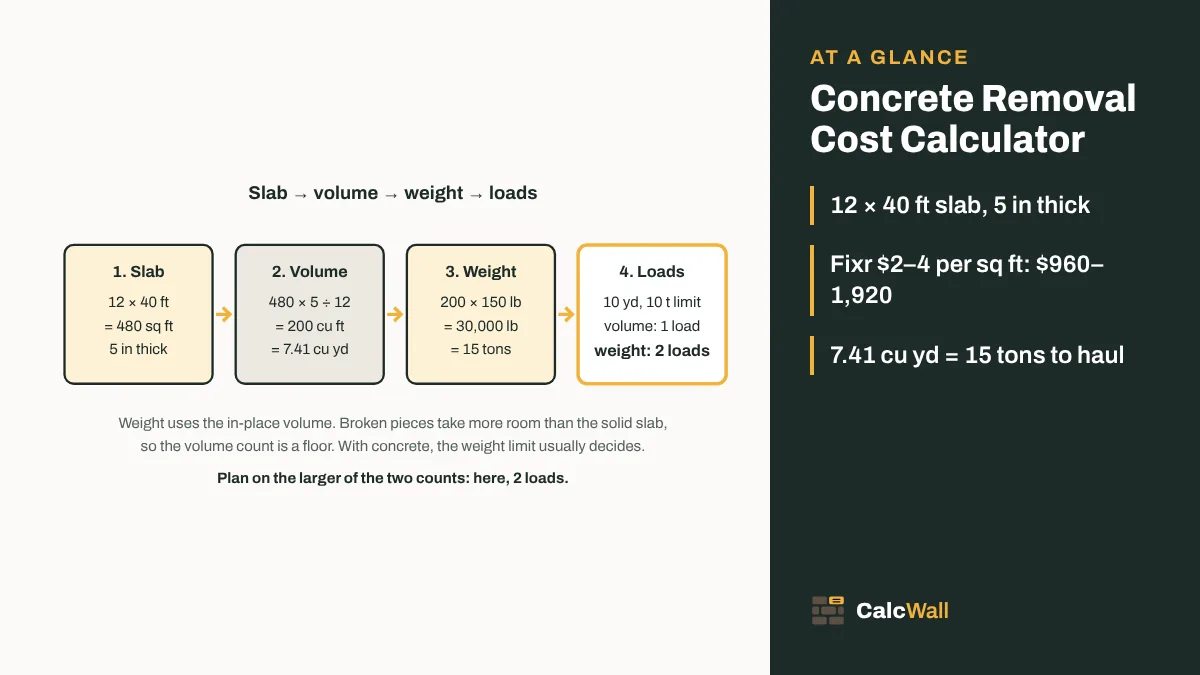
US, 12 × 40 ft driveway, 5 in, reinforced, hauled yourself. Area 480 sq ft. Range 480 × $4–6 = $1,920–2,880; estimated cost $2,400.00, $5.00 per sq ft. Volume: 480 × 5 ÷ 12 = 200 cu ft = 7.41 cu yd. Weight: 200 × 150 = 30,000 lb = 15 tons.
Dumpster 10 cu yd, 10-ton limit: 1 load by volume, 2 by weight, so plan on 2. Disposal fee $65 per ton (the middle of HomeAdvisor’s $30–100): 15 × $65 = $975.00. At WSDOT’s 155 lb for reinforced concrete the weight is 31,000 lb, still 2 loads.
The second example is the one to copy for any driveway. By volume, the solid concrete fits in one box. By weight it needs two, and broken up (7.41 × 1.67 = 12.4 cu yd) it would not fit in one box either.
UK, 6 × 6 m drive, 10 cm, plain. Area 36 m². MyJobQuote’s £30 per m²: £1,080.00. Volume 36 × 0.10 = 3.6 m³. Weight 8,650 kg = 8.65 tonnes. A 6-yard skip is 6 × 0.7646 = 4.59 m³. At ISM Waste’s 6-tonne limit: 1 load by volume, 2 by weight, so plan on 2. At MyBuilder’s 3-tonne example it is 3 by weight.
Canada, 6 × 6 m, 10 cm, plain. Area 36 m² = 387.5 sq ft. HomeStars’ $2–7 per sq ft gives $775.00–2,712.51; estimated cost $1,743.75, $48.44 per m². Weight 8.65 tonnes, the same slab as the UK example.
Germany, 6 × 6 m, 10 cm, plain, disposal only. No published price per m², so the main result stays empty. Weight 8,650 kg = 8.65 t. Disposal fee €65 per tonne (the middle of Hausjournal’s €40–90): 562,25 € for disposal by weight. In New Zealand, the same slab at Tauranga’s $111 per tonne is $960.15.
The metric weight uses the exact metric equivalent of 150 lb per cu ft, which is about 2,403 kg per m³. That is why 3.6 m³ comes to 8,650 kg rather than 3.6 × 2,400 = 8,640 kg.
For a new slab after the tear-out, carry the same size into the concrete cost calculator, which prices the ready-mix, the delivery fees and the labor.
Notes for pros
Quote by weight, not by box. Ten tons is 4.94 cu yd of solid slab. Put the tonnage and the box count on the quote so the customer sees why it takes two dumpsters.
Drill before you price. A small test hole at the edge shows thickness and steel. A 6 in reinforced slab priced as 4 in plain loses the job its margin.
Keep loads clean. Clean concrete is a product at the recycler. Soil and wood in the box move it to a dearer class: in Germany, €40–90 a tonne becomes €60–130.
Check the hauler’s limit. UK guides give a 6-yard skip anywhere from 3 to 6 tonnes. Get the number in writing before the first load goes in.
Prices on this page are published estimates with their dates. Weight figures come from WSDOT, PCA and the Eurocode as cited and are a guide for planning loads. Local rules decide permits, disposal classes and what goes in a skip on the street.
Sources
Where the numbers on this page come from. Everything else is plain geometry and unit conversion, which the calculator does with exact factors.
- How much does it cost to remove concrete?, Fixr, updated January 31, 2025. Used for: the calculator’s US defaults of $2–4 per sq ft unreinforced and $4–6 reinforced, the $4 average, the $0.50–2 per sq ft disposal share, and project prices (driveway $1,500–2,500, patio $1,000–2,000, slab $600–1,000, sidewalk $1,200–2,200, steps $250–400)
- How Much Does Concrete Removal Cost?, HomeAdvisor (Angi Inc.), updated April 12, 2024. Used for: $2–6 per sq ft demo, removal and disposal; reinforced $4–6 (50–100% more); disposal $30–100 per ton (the calculator’s US hint); saw cutting $10–55 per linear ft; saw rental $50–100 a day; $50–150 minimum charge; size and project prices; the note that most areas need no permit
- How much does concrete removal cost?, HomeGuide, no date shown, read Nov 2026. Used for: $3–8 per sq ft with disposal, reinforced +$1–3, cost by size, project prices (2-car garage floor $1,000–3,500, 50 ft sidewalk $750–1,250), labor $50–100 an hour per person, cutting $5–15 per linear ft, dump fees $90–160 per ton, the $30–65 pickup load, permits $50–400, timing, the overlay rule, resurfacing at $3–7 and tear-out and replace at $8–18 per sq ft
- How Much Does Concrete Removal Cost? [2024 Data], Angi, updated April 15, 2024. Used for: $2–6 per sq ft including labor and dumping fees
- Design Memorandum 05-2010: Unit Weight of Concrete, Washington State DOT Bridge and Structures Office, June 1, 2010. Used for: 150 lb per cu ft for plain concrete and 155 with reinforcement; reinforced concrete taken as 5 lb per cu ft heavier
- Design and Control of Concrete Mixtures, Chapter 1 (EB001), Portland Cement Association (hosted by PDHonline), edition not stated; references to 2002. Used for: normal-weight concrete at 2,200–2,400 kg/m³ (137–150 lb per cu ft); the calculator uses the top of the range
- They’ve changed the density of concrete, or have they?, New Steel Construction (SCI), 1 October 2009, on EN 1991-1-1:2002 Annex A. Used for: Eurocode figure of 24 kN/m³ for normal-weight concrete, plus 1 kN/m³ for normal reinforcement
- Earthwork volumes reference tables, Caterpillar, published 1 September 2021. Used for: crushed stone at 4,500 lb per bank cu yd and 2,700 lb loose, load factor 0.60, used as a stand-in for how much broken concrete bulks up
- Swell & void percentage, load factors, Caterpillar, published 30 September 2021. Used for: the definitions of swell and load factor
- How Dumpster Weight Limits Work, Budget Dumpster, no date shown (©2026), read Nov 2026. Used for: typical weight limits by size (10 and 15 yd 1–2 tons, 20 yd 2–3, 30 yd 3–4, 40 yd 4–5), 10-yard boxes taking up to 10 tons of heavy debris, and the 10-ton maximum for any roll-off
- Concrete disposal, Dumpsters.com, no date shown (©2026), read Nov 2026. Used for: 10-yard dumpster recommended for concrete with a 10-ton limit, 15 and 20 yd held to the same 10 tons, 10-yard average cost $300–795, self-haul landfill $32–40 per ton
- Equipment rental price list (Rental Stop, Bowling Green, Ohio), Luckey Farmers, Inc., Rev. 1/1/2026. Used for: one store’s 2026 rates: electric breaker jackhammer $67 for 4 hours or $96 a day, Bosch demo hammer $38.50 / $55, 12 in gas concrete saw $44 / $63, 14 in gas saw $55 / $90, dump trailer $92 / $131, dump truck $215 / $305
- Construction and Demolition Debris: Material-Specific Data, U.S. Environmental Protection Agency, last updated October 19, 2026 (2018 data). Used for: about 600 million tons of C&D debris generated in the US in 2018, concrete counted among it
- User Guidelines for Waste and Byproduct Materials in Pavement Construction: Reclaimed Concrete Material (FHWA-RD-97-148), Federal Highway Administration, 1997; archive page modified 03/08/2016. Used for: reclaimed concrete used as granular and stabilized base, engineered fill and in concrete pavement
- 2024 Bid Item Price Report, South Dakota Department of Transportation, January 1 – December 31, 2024. Used for: weighted average awarded prices: remove concrete sidewalk $12.26 per sq yd, remove concrete driveway pavement $14.11 per sq yd
- Concrete Driveway Removal Cost, MyJobQuote, last updated 07/10/26. Used for: the calculator’s UK default of about £30 per m², reinforced driveway removal £3,100–5,000 a job, skip hire £60–400 a week
- Concrete Driveway Cost, MyJobQuote, last updated 07/09/26. Used for: one-week skip hire for a driveway job at £220–280
- How Much Does Concrete Removal Cost in 2021?, Checkatrade, undated (title says 2021). Used for: older UK figure of about £50 per m² plus VAT
- What Size Skip Do I Need?, MyBuilder, no date shown, read Nov 2026. Used for: UK skip classes (mini 2–3 yd, midi 4–5, builder’s 6–8, maxi 10–12), midi weight limit 1.5–2 tonnes, a 6-yard example at 3 tonnes, 6 yd as the largest skip to fill with heavy waste, 8 yd only a third to half full of rubble, permits £20–60
- Skip weight limits, ISM Waste & Recycling, page modified 22 June 2026. Used for: weight limits of 4, 6 and 8 tonnes for 4, 6 and 8-yard skips (8 tonnes for 10–16 yd) and 6 yd as the largest skip for hardcore, bricks and soil
- Concrete Contractor Costs in Toronto, HomeStars, updated 21/08/2026. Used for: the calculator’s Canadian default of $2–7 per sq ft to demolish and dispose of concrete (Toronto)
- Concrete Contractor Costs in Edmonton, HomeStars, undated. Used for: old concrete removal at $2–8 per sq ft (Edmonton)
- Dumpster rental cost, HomeStars, undated (“Updated on” with no value). Used for: 4–6 yd³ bin at $250–350
- Bin Rental Pricing, Scarborough Disposal, page last modified 2026-10-30. Used for: concrete-only bins in Toronto: 4 yard $275 with 1 tonne included, 14 yard $495 with 1.5 tonnes, and $120–140 per tonne over (the page states both)
- Concrete Removal Cost in Australia [2026], Yellow Pages Australia, published 18 September 2025; updated April 2026. Used for: the calculator’s Australian defaults: $50–70 per m² for thin, simple slabs and $100–150 for reinforced or thick slabs; disposal about $40 per m³
- Concreting Cost Guide, iSeekplant, 04 July 2023. Used for: older driveway removal figure of $35–50 per m²
- How much does a skip bin cost to hire?, Yellow Pages Australia, published 8 December 2025; updated April 2026. Used for: 7-day skip bin prices: 2 m³ $250–350, 4 m³ $450–590, 6 m³ $650–890
- 6 marrel skip bin (6 m³), Wanless, page updated 22 February 2026. Used for: 6 m³ bin limits: 6 tonnes heavy waste in Sydney, 4 tonnes in Melbourne
- Transfer station fees and charges, Tauranga City Council, fees as at 1 September 2026. Used for: concrete at $111 per tonne at Te Maunga (minimum $111), the calculator’s New Zealand hint
- Landfill charges and prices, Dunedin City Council, 2025/26, GST inclusive. Used for: rubble $31.50 and dry clean fill $21.50 per tonne
- Entsorgung von Betonabbruch: Kosten, Hausjournal, 11.09.2023. Used for: German disposal by weight: unreinforced €40–90 per tonne (the calculator’s hint), reinforced €60–130; by container volume €60–150 and €100–250 per m³
- Bauschutt entsorgen: Kosten für Container und Deponie, sanier.de, aktualisiert 4. Januar 2026. Used for: container hire for about 14 days (3 m³ €100–150, 7 m³ €200–300), full-container weights of about 3.45 and 8.05 t, landfill €30–60 per tonne, rubble at 800–1,500 kg per m³, and the rule that mixed waste is not Bauschutt
Frequently asked questions
How much does concrete removal cost per square foot?
US guides put it at $2–8 per sq ft. Fixr (updated Jan 2025) gives $2–4 for plain concrete and $4–6 for reinforced, which are the calculator’s defaults. HomeAdvisor and Angi (both Apr 2024) give $2–6 including dumping. HomeGuide (no date shown) gives $3–8 with disposal and adds $1–3 for reinforcement.
How much does it cost to remove a concrete driveway?
Fixr gives $1,500–2,500, HomeAdvisor $1,000–2,500 and HomeGuide $1,200–4,500 for a single to double-car drive. Priced by area, a 12 × 40 ft reinforced drive is 480 sq ft × $4–6 = $1,920–2,880, and the calculator shows $2,400 in the middle. That drive weighs about 15 tons at 5 in thick.
How much does it cost to remove a 10x10 slab?
HomeGuide lists a 10 × 10 ft slab at $300–800. At Fixr’s $2–4 per sq ft for plain concrete it is $200–400, so the calculator shows $300 in the middle. Small jobs often hit a minimum charge, which HomeAdvisor puts at $50–150. A 4 in slab that size is 1.23 cu yd and weighs about 5,000 lb, or 2.5 tons.
How much does a concrete patio cost to remove?
Fixr and HomeAdvisor both give $1,000–2,000 for a patio. HomeGuide gives $1,200–3,000 for a 20 × 20 ft patio, while its own 400 sq ft row says $1,200–3,200, so treat the top end loosely. The calculator default is a 20 × 20 ft patio at 4 in: $800–1,600, or $1,200 in the middle.
How much does a yard of broken concrete weigh?
A cubic yard of solid concrete weighs about 27 × 150 = 4,050 lb, a little over 2 tons. Broken up, the same concrete takes more room, so a loose yard weighs less. Caterpillar lists crushed stone at 4,500 lb per bank yard and 2,700 lb loose, a load factor of 0.60. The weight to haul never changes, so count it from the slab size.
How much does a 4 inch slab weigh per square foot?
At 150 lb per cu ft, a 4 in slab is 150 × 4 ÷ 12 = 50 lb per sq ft. A 5 in slab is 62.5 lb and a 6 in slab is 75 lb. With rebar or mesh, WSDOT uses 155 lb per cu ft, which makes a 4 in slab about 51.7 lb per sq ft.
What size dumpster do I need for concrete?
Dumpsters.com recommends a 10-yard dumpster for concrete, with a 10-ton limit, and holds its 15 and 20-yard boxes to the same 10 tons. In the UK, MyBuilder and ISM Waste both say 6 yards is the largest skip you can fill with rubble. Size by weight: a 20 × 20 ft slab 4 in thick is already 10 tons.
How many tons can a dumpster hold?
Budget Dumpster lists typical limits of 1–2 tons for a 10 or 15-yard box, rising to 4–5 tons for a 40-yard box, for ordinary debris. For heavy debris such as concrete, it says a 10-yard box takes up to 10 tons, and 10 tons is its cap for any roll-off. Your hauler’s limit is the one that counts.
How much are concrete disposal fees per ton?
In the US, HomeAdvisor gives $30–100 per ton at a municipal dump, Dumpsters.com $32–40 per ton if you haul it yourself and HomeGuide $90–160. In Germany, Hausjournal gives €40–90 per tonne for clean concrete. In New Zealand, Tauranga charges $111 per tonne and Dunedin $31.50 for rubble. The calculator leaves this box empty because most removal prices already include disposal.
Is it cheaper to recycle concrete than landfill it?
Often, where a recycler is near. Clean concrete is a product: FHWA notes it is crushed for road base and fill. Published fees show the gap: Dunedin charges $21.50 per tonne for dry clean fill and $31.50 for rubble, and Hausjournal gives €40–90 per tonne for clean concrete against €60–130 for reinforced or mixed loads. No dated US recycler gate fee was found.
Does rebar or mesh make removal cost more?
Yes. Fixr gives $4–6 per sq ft for reinforced concrete against $2–4 plain. HomeAdvisor says 50–100% more and HomeGuide adds $1–3 per sq ft. The steel has to be cut, and some disposal sites charge more for concrete with steel in it. Hausjournal’s German figures are €60–130 per tonne reinforced against €40–90 plain.
Can I remove a concrete patio myself?
A thin, unreinforced patio is a fair DIY job with a rented breaker, a pry bar and a strong back. One Ohio rental store lists an electric breaker at $96 a day (Jan 2026). The hard part is the weight: a 12 × 12 ft patio at 4 in is 3.6 tons, all lifted by hand. Reinforced slabs, thick slabs and driveways are better left to a crew with a machine.
What tools do I need to break up concrete?
For a home job: an electric breaker (jackhammer) or a demolition hammer, a concrete saw for clean edges, a long pry bar, a sledgehammer, a wheelbarrow, bolt cutters or a grinder for mesh, and eye, ear, hand and foot protection. Cutting concrete makes silica dust, so use a saw with a water feed and a fitted respirator. Crews bring a skid steer with a breaker on bigger jobs.
How long does concrete removal take?
HomeGuide says most slabs take 1–2 days. Small jobs, around 100–200 sq ft of sidewalk or under 100 sq ft of plain slab, take 2–4 hours. A 100 ft retaining wall with its footing takes 5–7 days. Allow extra time for the dumpster swap if the job needs more than one load.
Do I need a permit to remove concrete?
Often not. HomeAdvisor says most areas do not require a permit for residential removal that does not change the structure. Fixr says that if you are pouring new concrete, that permit usually covers the demolition. Where one is needed, HomeGuide puts it at $50–400. A skip on the street may need its own permit; MyBuilder gives £20–60 in the UK. Ask your local building office.
Is resurfacing cheaper than removal and replacement?
Yes, by a wide margin when the slab is sound. HomeGuide gives $3–7 per sq ft to resurface against $8–18 to tear out and replace. Its rule: an overlay suits cracks less than 1/4 in wide. Large cracks, crumbling edges, heaving or structural problems mean the slab should come out.
What is the concrete demolition cost for a garage floor?
HomeGuide puts removal of a 2-car garage floor at $1,000–3,500. A 24 × 24 ft floor is 576 sq ft, so Fixr’s $2–4 per sq ft gives $1,152–2,304 plain and $2,304–3,456 reinforced. At 4 in thick it weighs 28,800 lb, or 14.4 tons. Indoors, access and dust control push the price up.
Is this concrete removal cost calculator free to use online?
Yes. The CalcWall Concrete Removal Cost Calculator is completely free and works online in any browser, on a phone, tablet or computer. There is nothing to download and no account to create, and the math runs right in your browser, so results appear as you type.