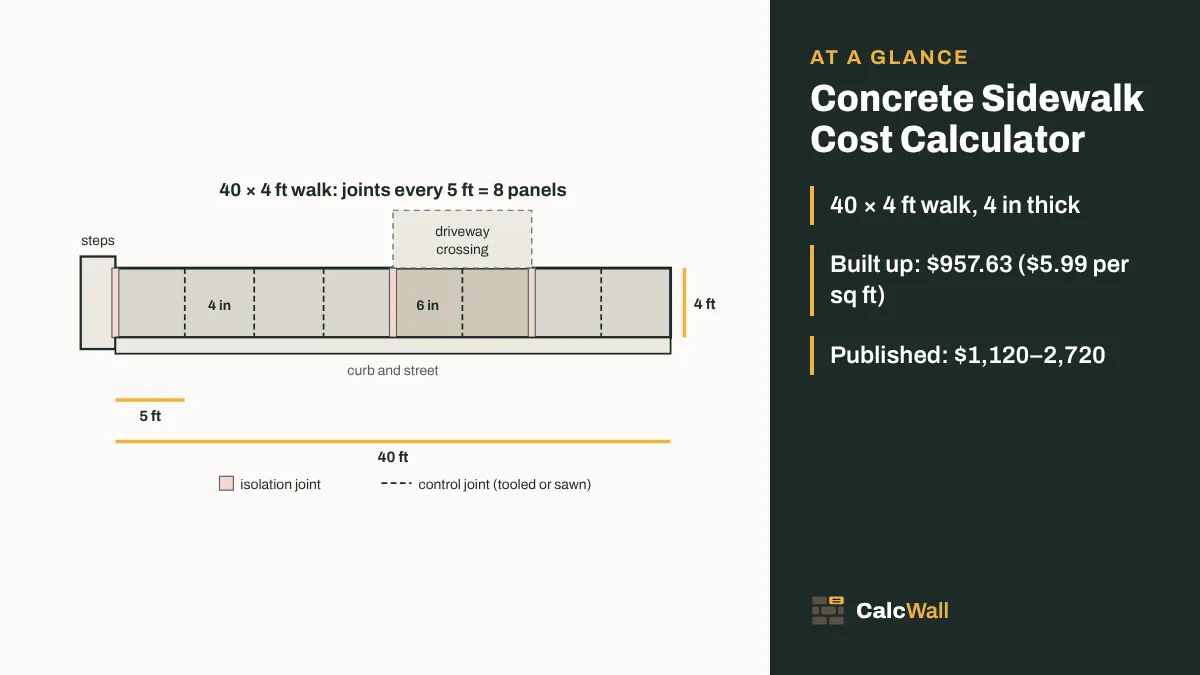
Quick answer: a 40 × 4 ft sidewalk 4 in thick needs 2.17 cu yd with 10% waste. With the US defaults ($130 a yard, a $53 per yard short-load fee and $3.50 per sq ft labor) it costs $957.63, or $5.99 per sq ft. Published installed prices run $7–17 per sq ft, so $1,120–2,720.
How to use the concrete sidewalk cost calculator
The calculator builds the price from the ground up, the way an estimator does. It works out the concrete, adds the supplier’s small-load charge, then adds labor and any extras you tick. Every price box starts with a published figure for the country you picked, and you can type over any of them.
- Enter the size. Length and width in feet (or meters), thickness in inches (or centimeters). The default is a 40 × 4 ft walk at 4 in.
- Pick the waste allowance. 10% is the default. It covers uneven subgrade, spillage and what stays in the chute.
- Choose ready-mix or bags. For a truck, the tool multiplies the volume with waste by the price per yard. For bags, it rounds up to whole bags and asks for your store’s price.
- Check the short-load fee. In the US the default is $53 on every yard of a load under 10 yd. Most sidewalks are well under that, so the fee nearly always applies.
- Set labor. The US default is $3.50 per sq ft for placing and finishing. Enter 0 if you do the work yourself.
- Tick the extras. Gravel base, reinforcement, excavation and removal of an old walk are each priced per sq ft. Delivery and pump are flat amounts.
- Pick the finish. Plain or broom, stamped or exposed aggregate. The finish does not change the build-up. It changes the published price the tool checks your total against.
Total = (L × W × T ÷ 12 ÷ 27) × (1 + waste) × (price + short-load fee) + (labor + extras) × L × W + flat fees
The result shows the total, the cost per square foot and the concrete with and without waste. Under it you’ll see the published installed price for the same area. In the US that comes from HomeGuide: $7–17 per sq ft for a plain walk and $10–21 for a stamped one. For exposed aggregate the tool uses Angi’s $8–12.
Expect the build-up to land below the published range with the defaults. It leaves out forms, the gravel base, the permit, mobilisation and the contractor’s overhead and profit. Tick the base and type a permit fee into the Delivery box, and you’ll move toward the middle. If your total ends up well above the range, look at the short-load fee and the pump first.
One limit to know: in the US mode the short-load fee is charged per yard ordered. That keeps the cost per square foot the same, $5.99, for every walk under 10 yd. Real small jobs cost more per square foot, because of fixed charges. The small-path example below shows how to model that with the Delivery box.
Concrete sidewalk cost per square foot and per linear foot
Contractors quote sidewalks by the square foot, and cities often bill by the foot of frontage. Both come from the same number. Cost per linear foot is the cost per square foot times the width of the walk.
HomeGuide gives $7–17 per sq ft for a new concrete sidewalk. It splits that into basic work at $7–12, mid-range at $12–17 and high-end custom at $17–20. Angi gives $8–12 for standard flat concrete and about $2,000 for a 200 sq ft walk. HomeAdvisor gives $6–12 and about $1,800 for the same 200 sq ft. Angi and HomeAdvisor are the same company, so treat them as one view, not two.
| Source and date | Per sq ft | 3 ft wide, per ft | 4 ft wide, per ft | 5 ft wide, per ft |
|---|---|---|---|---|
| HomeGuide, undated, read Nov 2026 | $7–17 | $21–51 | $28–68 (as published) | $35–85 |
| Angi, title says [2024 Data] | $8–12 | $24–36 | $32–48 | $40–60 |
| HomeAdvisor, title says 2024 | $6–12 | $18–36 | $24–48 | $30–60 |
| San Antonio cost of service, FY 2026 | $18.75–21.25 (÷ 4 ft) | not published | $75 detached, $85 at curb | not published |
| Calculator, US defaults, 4 in, no extras | $5.99 | $17.96 | $23.94 | $29.93 |
HomeGuide says small walks cost more per square foot, yet its own size table is exactly $7–17 times the area at every size, from 50 to 400 sq ft. In practice a small job carries the same truck, crew and setup as a larger one. Fixed costs spread over fewer square feet, so the rate goes up. Model that with a flat charge, as in the small-path example.
Concrete is the smaller part of the bill. At 4 in, a square foot holds a third of a cubic foot, which is 0.0123 cu yd. With 10% waste at $130 a yard, that is $1.77 per sq ft. The short-load fee adds $0.72. Labor at $3.50 is more than both together. HomeGuide’s 4 × 50 ft example shows the same split: $2–6 per sq ft for materials and $5–11 for labor and supplies.
If you use the tool as a concrete cost per square foot calculator, change one box at a time. Set labor to 0 to see the material cost alone. Tick removal to see what an old walk adds. For a slab or pad rather than a walk, the concrete cost calculator uses the same engine with slab price checks.
New sidewalk vs remove and replace
Most sidewalk work is replacement, not new build. The old walk has heaved, cracked or settled into a trip hazard, and the city has sent a notice. That adds three costs: breaking out the old concrete, hauling it away and paying to dump it. Published replacement prices run well above new-walk prices for that reason.
HomeGuide gives $10–25+ per sq ft to remove and replace a sidewalk, against $7–17 for a new one. HomeStars gives exactly the same $10–25+ per sq ft for Toronto (CAD, Aug 2026). For removal alone, HomeGuide gives $3–8 per sq ft including disposal. Fixr (Jan 2025) gives $2–4 for unreinforced concrete and $4–6 for reinforced. The calculator’s US removal default is $4, from Angi’s $2–6.
| Source, date | Rate as published | 4 × 4 ft panel (16 sq ft) | 4 × 5 ft panel (20 sq ft) | 5 × 5 ft flag (25 sq ft) |
|---|---|---|---|---|
| HomeGuide, undated | $10–25+ per sq ft | $160–400 | $200–500 | $250–625 |
| Toledo, OH, 2026 program | $10.50 per sq ft | $168 | $210 (as published) | $262.50 |
| Toledo, OH, 6 in or drive approach | $11.90 per sq ft | $190.40 | $238 (as published) | $297.50 |
| Mount Clemens, MI, Jan 2026 | $195 per 5 × 5 ft flag; $228 at 6 in | not published | not published | $195; $228 at 6 in |
| Lakeside Park, KY, Jan 2025 (engineer’s estimate) | $10–12 per sq ft | $160–192 | $200–240 | $250–300 |
| Weight to haul at 150 lb per cu ft | 50 lb per sq ft at 4 in; 75 lb at 6 in | 800 lb | 1,000 lb | 1,250 lb (1,875 lb at 6 in) |
The weight row uses PCA’s 137–150 lb per cu ft for normal concrete, taking the top of the range. A 4 in slab is a third of a foot thick, so 150 ÷ 3 = 50 lb per sq ft. A 40 × 4 ft walk is 160 sq ft, or 8,000 lb, which is 4 US tons. At HomeAdvisor’s $30–100 per ton for municipal dump disposal, that load costs $120–400 to dump.
Replacing a few flags is the cheapest fix when the rest of the walk is sound. To price it, enter the flags as one rectangle. Two 5 × 5 ft flags are 10 × 5 ft. Tick removal, and the tool prices the new concrete, labor and break-out together. The worked examples below give the result: $499.26, or about $250 a flag.
If the walk is lifting because of a tree root, replacing the flags alone won’t last. The root has to be cut or the walk rerouted, and many cities control street-tree work, so ask first. Settled flags can sometimes be raised by mudjacking instead. Sioux Falls notes that grinding and mudjacking still need a permit.
Used as a concrete sidewalk replacement cost calculator, the tool covers the break-out by area. It does not price haul by weight. For a big tear-out, the concrete removal cost calculator works out tons and disposal separately.
Concrete sidewalk volume: yards and bags
Volume is length × width × thickness. In US units, turn the thickness into feet first by dividing the inches by 12. Then divide the cubic feet by 27 to get cubic yards. A 4 in walk holds a third of a cubic foot per square foot, so every 81 sq ft of walk is 1 cu yd before waste.
The table uses one basis throughout: volume with 10% waste. The bag count is that same volume divided by 0.60 cu ft per 80 lb bag (QUIKRETE’s yield), rounded up. Some sites count bags from the unrounded volume and yards from a rounded order. That makes the two columns disagree. Here they always match, and the order column is simply the next quarter yard up.
| Walk | Area | yd³ net | yd³ with waste | Order (next ¼ yd) | m³ with waste | 80 lb bags | Calculator total, US defaults |
|---|---|---|---|---|---|---|---|
| 3 × 25 ft | 75 sq ft | 0.93 | 1.02 | 1.25 | 0.78 | 46 | $448.89 |
| 4 × 25 ft | 100 sq ft | 1.23 | 1.36 | 1.5 | 1.04 | 62 | $598.52 |
| 3 × 50 ft | 150 sq ft | 1.85 | 2.04 | 2.25 | 1.56 | 92 | $897.78 |
| 4 × 50 ft | 200 sq ft | 2.47 | 2.72 | 2.75 | 2.08 | 123 | $1,197.04 |
| 5 × 50 ft | 250 sq ft | 3.09 | 3.40 | 3.5 | 2.60 | 153 | $1,496.30 |
| 4 × 100 ft | 400 sq ft | 4.94 | 5.43 | 5.5 | 4.15 | 245 | $2,394.07 |
| 5 × 100 ft | 500 sq ft | 6.17 | 6.79 | 7 | 5.19 | 306 | $2,992.59 |
Check one row by hand. A 3 × 50 ft walk is 150 sq ft. At 4 in that is 150 ÷ 3 = 50 cu ft, or 50 ÷ 27 = 1.85 cu yd. With 10% waste it is 55 cu ft, which is 2.04 cu yd. 55 ÷ 0.60 = 91.7, so 92 bags. The numbers agree because they share one volume.
Bags make sense only for short paths. Sixty-two bags for a 4 × 25 ft walk weigh 4,960 lb dry, and each batch has to be placed and finished before the one before it sets. Above about a yard, a truck is the easier choice even with a short-load fee. As a cubic yards concrete sidewalk calculator, the tool shows both: switch “Concrete from” to bags and enter your store’s price.
For curved or L-shaped walks, split them into rectangles and add the areas. A gentle curve can be entered as its center-line length times the width. For other shapes, the concrete calculator handles circles, triangles and cutouts.
Width, thickness and base for a sidewalk
Width. Three feet is the narrowest walk that works for most people. The 2010 ADA Standards set 36 in (915 mm) minimum clear width on an accessible route, with 60 × 60 in passing spaces at least every 200 ft if the route is narrower. Public sidewalks are usually wider. Sioux Falls builds 4 ft walks on local streets. The 2023 PROWAG rule sets 48 in (1220 mm) for a pedestrian access route.
PROWAG is a federal guideline, and the Access Board says it becomes mandatory only after the Department of Justice and the Department of Transportation adopt it for enforcement. Some cities already design to it. Ask your city which standard it uses before you set the width of a public walk. For a garden path on private land, the choice is yours: 3 ft fits one person, and 4 ft lets two walk side by side.
Thickness. Four inches is the residential standard. Angi says most walkways and sidewalks are around 4 in, HomeAdvisor calls 4 in standard, and HomeGuide gives 4–6 in. Where a car or truck crosses the walk, cities thicken it. Sioux Falls asks for 6 in through driveway areas. Toledo and Mount Clemens publish separate 6 in rates.
Thicker costs more, but less than you might think. In the calculator, going from 4 to 6 in on the 40 × 4 ft walk adds 50% to the concrete but nothing to the labor. The total goes from $957.63 to $1,156.44, a 20.8% rise. City rates show a similar step: Toledo’s 6 in rate is 13.3% above its 4 in rate, and Mount Clemens adds 16.9% per flag.
Base. A compacted granular base gives the slab even support and lets water drain away from it. Sioux Falls requires at least 2 in of compacted granular material. The Happy Valley, Oregon, bid item is 4 in concrete sidewalk including a 2 in leveling course of rock. On clay or wet ground, contractors often go deeper.
HomeGuide prices a 4 in gravel base at $10–15 per linear foot for walks up to 4 ft wide, but it doesn’t say whether its $7–17 per sq ft includes the base. Convert it yourself: $10–15 ÷ 4 ft = $2.50–3.75 per sq ft. The calculator’s base default is $2 per sq ft, from HomeGuide’s $1–3 slab figure. To buy the stone yourself, the gravel calculator works out the tons for your depth.
Reinforcement. Plain sidewalks are often poured without steel. Where it’s used, HomeAdvisor gives $1–1.50 per sq ft for wire mesh and $0.40–2.25 per linear foot for rebar. Mesh and rebar hold cracks tight. They do not stop cracking, which is the job of joints.
Control joints, slope and drainage
Concrete shrinks as it dries, and a long, narrow walk will crack across its width if you let it choose where. Control joints are grooves that make it crack in a straight line where you want. NRMCA’s guidance for slabs on grade puts the maximum spacing at 24–36 times the thickness. For a 4 in walk that is 96–144 in, or 8–12 ft.
Sidewalks are jointed closer than that, because panels should be square or nearly so. NRMCA says a panel’s length should not exceed 1.5 times its width. On a 4 ft walk that means no more than 6 ft between joints. Sioux Falls puts contraction joints every 5 ft. A 40 ft walk jointed at 5 ft has 7 joints and 8 panels.
The groove has to be deep enough to work. NRMCA calls for at least a quarter of the slab thickness, so 1 in on a 4 in walk and 1.5 in on 6 in. Tool the joints while the concrete is plastic, or saw them. Conventional saw cuts go in 4–12 hours after finishing, per NRMCA. Cut too late, and the walk cracks first.
Isolation joints are different. They are full-depth gaps filled with compressible material that let the walk move separately from things it touches: the curb, house steps, a driveway, a pole. Sioux Falls requires expansion material between the curb and the sidewalk or driveway approach. It also puts ½ in transverse expansion joints every 50 ft of walk.
Slope. A walk needs a little cross slope to shed water, and on an accessible route it may not be steep. The 2010 ADA Standards (403.3) cap the cross slope at 1:48 and the running slope at 1:20. Steeper than 1:20 is a ramp, which has its own rules, with 1:12 the maximum ramp slope (405.2). The ramp calculator works out how long a ramp has to be for your rise.
| Rule | Ratio | Percent | In US units | In metric |
|---|---|---|---|---|
| Cross slope, maximum (403.3; PROWAG R302.5.1) | 1:48 | 2.08% | ¼ in per ft: 0.75 in across 3 ft, 1 in across 4 ft, 1.25 in across 5 ft | 18.75 mm across 0.9 m, 25 mm across 1.2 m, 31.25 mm across 1.5 m |
| Running slope, maximum (403.3) | 1:20 | 5% | 0.6 in per ft, 6 in over 10 ft | 50 mm per m |
| Ramp slope, maximum (405.2) | 1:12 | 8.33% | 1 in per ft | 83.3 mm per m |
| Clear width, minimum (403.5.1) | n/a | n/a | 36 in | 915 mm |
| Pedestrian access route width (PROWAG R302.2, when adopted) | n/a | n/a | 48 in | 1220 mm |
| Passing space if narrower (403.5.3) | n/a | n/a | 60 × 60 in, every 200 ft max | 1525 × 1525 mm, every 61 m max |
1:48 is a maximum, not a drainage target. Finishers who aim exactly at 2.08% often end up over it in places, because a screeded surface is never perfect. That is why Sioux Falls targets 1.5% and caps it at 2%. Across a 4 ft walk, 1.5% is 0.72 in of fall and 2% is 0.96 in. Slope the walk toward the street or the yard, never toward the house.
Finishes and what they add to the price
A broom finish is the standard for sidewalks. It is quick, cheap and gives grip when wet. Decorative finishes add labor, and sometimes materials, so they add to the price per square foot. The calculator’s finish selector changes the published price it checks against, not the build-up. To price a decorative finish, raise the labor box by the add-on below.
| Finish | US | Other markets | Source and date |
|---|---|---|---|
| Plain or broom | $7–17 per sq ft installed; Angi $8–12 | UK £60–90 per m² (driveway proxy); AU council $288 per m² over 25 m² | HomeGuide; Angi [2024 Data]; MyJobQuote, Oct 2026; Randwick, 2026-27 |
| Stamped or imprinted | $10–21 per sq ft for a 4 ft walk; stamping adds $3–4; HomeAdvisor $9–25 | UK £100–130 per m² (driveway proxy) | HomeGuide; HomeAdvisor; MyJobQuote, Oct 2026 |
| Exposed aggregate | Angi $8–12 per sq ft (see note) | UK £70–100 per m² (driveway proxy); AU council decorative $412 per m²; NZ $150–250 per m² (driveway proxy) | Angi; MyJobQuote, Sep 2026; Randwick; ArchiPro, Jul 2026 |
| Colored or stained | HomeAdvisor stained $3–25 per sq ft | not published for paths | HomeAdvisor, title says 2024 |
| Sealer or coating | Resealing about $1.50 per sq ft; epoxy coatings $5–10 | not published for paths | Angi; HomeAdvisor |
Read Angi’s finish table with care. It lists broom, exposed aggregate, stamped and colored concrete all at the same $8–12 per sq ft. That looks like one overall range copied into every row, not a price for each finish. The calculator uses Angi’s exposed aggregate row for its US check, so that check is a weak one. HomeGuide’s stamped figures are more useful.
The add-on approach works well. HomeGuide says stamping adds $3–4 per sq ft. On the 40 × 4 ft walk, raise labor from $3.50 to $7.00 and the total goes from $957.63 to $1,517.63, or $9.49 per sq ft. Tick the gravel base too and it is $1,837.63, inside HomeGuide’s stamped check of $1,600–3,360. Stamped walks also need sealing, which plain broom walks can do without.
For a concrete walkway cost calculator run on a decorative path, think about grip as well as looks. Deep stamped patterns and sealed surfaces can be slippery when wet. Many installers add a grit to the sealer on walks for that reason.
Who pays for the public sidewalk, and permits
The walk between your yard and the curb is usually on public land, but you may still be the one who pays for it. Rules vary by city, so call public works before you hire anyone. Here is how a few cities handle it.
Owner pays, city permits. In New York City, property owners must install, repair and maintain the sidewalk next to their property, under Administrative Code 19-152. A repair permit costs $70 for every 300 linear feet. If the city does the work, the owner gets the bill and has 90 days to pay before interest.
Shared cost. Chicago’s 2026 Shared Cost Sidewalk Program estimates $1,000–2,400 to the owner of an average mid-block property. Seward, Nebraska, uses a rate of $9.60 per sq ft and reimburses 50%. Lincoln raised its reimbursement for full panel replacement from $6 to $10 per sq ft in 2025.
Assessment or rebate. Toledo assesses $10.50 per sq ft for a 4 in walk in its 2026 program. Akron’s petition program charges $25.25 per front foot. San Antonio rebates part of a cost of service set at $75–85 per linear foot. Littleton, Colorado, rebates by the cubic foot of concrete replaced.
Permit fees. Published ranges are wide. HomeGuide gives $50–100 for a sidewalk permit. HomeAdvisor gives $50–1,000, and Angi $200–1,000, saying permits are almost always required for sidewalk work. The calculator has no permit box. Put the fee in the Delivery box, which adds a flat amount to the total.
A permit usually comes with a spec: thickness, base, joints, slope and sometimes the mix. Pour to that spec, because an inspector can make you tear out a walk that doesn’t meet it. The concrete curb calculator covers the curb and gutter if the city wants that replaced at the same time.
Sidewalk costs by country and US state
Every figure below stays in the currency and unit its source uses. CalcWall never converts between currencies. Where only a proxy exists, such as a driveway price used for a path, it is labelled as a proxy. Where nothing reliable was found, the page says so.
| Market | Plain walk or path | Decorative | Replacement or council rate | Status, source and date |
|---|---|---|---|---|
| United States | $7–17 per sq ft | stamped $10–21 per sq ft | $10–25+ per sq ft | Sidewalk-specific. HomeGuide, undated, read Nov 2026 |
| Canada | $7–17 per sq ft (Toronto, Calgary); pouring $6–12 (Calgary) | Edmonton: exposed $40–50, stamped $45–65 per sq ft (outlier) | $10–25+ per sq ft (Toronto); Edmonton city $212.03 per metre of frontage | Sidewalk-specific. HomeStars, Aug 2026 and undated; City of Edmonton, 2026 |
| United Kingdom | £60–90 per m² (proxy: plain driveway); £40–80 per m² (proxy: light garden base) | imprinted £100–130 per m² (proxy: driveway) | not published | Proxies only. MyJobQuote, Oct 2026; MyBuilder, undated |
| Australia | $80–130 per m² (proxy: general plain concreting) | council decorative footpath $412 per m² | council footpath $288–360 per m²; Burwood $226–293.50; Glenelg $423.50 single panel | Proxies and council works fees. Yellow Pages, May 2026; Randwick 2026-27; Burwood and Glenelg 2025-26 |
| New Zealand | $120–160 per m² (proxy: plain driveway); paths $120+ per m² (one contractor blog) | $150–250 per m² (proxy: decorative driveway) | not published | Proxies only. ArchiPro, Jul 2026; Southern Buildworks, undated |
| Germany | no published price for a poured concrete path | not published | not published | Gap. Only paver material €7–25 and sub-base €10–40 per m² (MyHammer, undated) |
Canada. HomeStars gives $7–17 per sq ft for a new sidewalk in both Toronto and Calgary, which is what the calculator checks against. Its Edmonton page gives $30–35 for a standard walk, two to four times its own Toronto and Calgary figures. Treat Edmonton as an outlier. The City of Edmonton’s 50/50 program charges $212.03 per metre of frontage in 2026, cash rate.
United Kingdom (proxies). No UK cost guide CalcWall could find publishes a per-m² price for a poured concrete garden path. The calculator uses MyJobQuote’s driveway figures instead: £60–90 per m² plain, £100–130 imprinted and £70–100 exposed aggregate. A path is thinner and lighter than a driveway, so these probably sit high. MyBuilder’s £40–80 per m² for a light garden base is the nearest lower bound.
Australia (proxies). No price guide publishes a per-m² figure for a private footpath. The only path-specific numbers are council works charges for restoring a footpath after someone else’s work. Randwick charges $288 per m² for 75 mm concrete over 25 m² and $412 for decorative. Those are two to four times private plain concreting at $80–130 per m² (Yellow Pages). The calculator’s Australian check uses the Randwick rate, so expect a private quote well below it.
New Zealand (proxies). No council fee schedule or price guide CalcWall checked lists a per-m² rate for a concrete path. The calculator uses ArchiPro’s driveway figure of $120–160 per m² supplied and laid. One Christchurch contractor’s blog gives paths from $120 per m². There is also no published NZ ready-mix price, so the calculator shows the volume and asks for your supplier’s price.
Germany (gap). CalcWall found no published price for a poured concrete garden path or Gehweg in German cost guides. The guides that explain how to pour one give no prices. Paved paths are far more common: MyHammer gives €7–25 per m² for concrete pavers as material and €10–40 per m² for the sub-base. The calculator still prices the concrete, at €213 per m³ net from Heidelberg Materials, but shows no installed check.
US municipal sidewalk rates by state
City programs publish real rates, often in their own units. The table keeps each one in the unit the city uses. The last column converts within the same currency only where the arithmetic is exact. These are program rates, assessments or rebates, not market averages.
| State | City and program | Rate as published | Date | Per sq ft, where exact |
|---|---|---|---|---|
| Nebraska | Seward, cost share (city pays 50%), 4 in | $9.60 per sq ft | undated PDF, Mar 2025 | $9.60 |
| Nebraska | Lincoln, reimbursement for full panel replacement | $10 per sq ft (cap) | Aug 5, 2025 | $10.00 |
| Ohio | Toledo, 2026 assessment, 4 in | $10.50 per sq ft | 2026 program | $10.50 |
| Ohio | Toledo, 6 in or drive approach | $11.90 per sq ft | 2026 program | $11.90 |
| Ohio | Akron, petition program | $25.25 per front foot | rev. Mar 1, 2025 | width not stated |
| Michigan | Mount Clemens, 4 in | $195 per 5 × 5 ft flag | Jan 30, 2026 | $7.80 |
| Michigan | Mount Clemens, 6 in | $228 per 5 × 5 ft flag | Jan 30, 2026 | $9.12 |
| Kentucky | Lakeside Park, engineer’s estimate | $10–12 per sq ft | Jan 28, 2025 | $10–12 |
| Oregon | Happy Valley, 9 bids, 4 in with 2 in rock | $140–245 per sq yd | bid Jun 2025 | $15.56–27.22 |
| Texas | San Antonio, detached from curb, 4 ft wide | $75 per linear foot | FY 2026 | $18.75 |
| Texas | San Antonio, attached to curb, 4 ft wide | $85 per linear foot | FY 2026 | $21.25 |
| Colorado | Littleton, rebate | $100 per cu ft of concrete replaced | 2025 rate | $33.33 at 4 in (see note) |
| Illinois | Chicago, Shared Cost Sidewalk Program | $1,000–2,400 per average mid-block property | 2026 program | no unit rate published |
How the last column works: a 5 × 5 ft flag is 25 sq ft, so $195 ÷ 25 = $7.80. A square yard is 9 sq ft, so $140 ÷ 9 = $15.56. A 4 ft wide walk has 4 sq ft per linear foot, so $75 ÷ 4 = $18.75.
At 4 in, a square foot of walk holds a third of a cubic foot, so Littleton’s $100 per cu ft is $33.33 per sq ft. That is far above every other rate here, so read Littleton’s current terms before you count on it.
The spread is real. The Happy Valley bids for the same item ran from $140 to $245 per square yard, from nine bidders. Mount Clemens prices a 4 in flag at $7.80 per sq ft, below every private guide. Small cities that bid a whole district at once get volume prices a single homeowner won’t see.
Worked examples
These match the calculator exactly with its default prices. Enter the same numbers to check them.
US, default 40 × 4 ft walk, 4 in, +10%. 160 sq ft × 4 ÷ 12 = 53.33 cu ft ÷ 27 = 1.975 cu yd, × 1.10 = 2.173 cu yd. Concrete: 2.173 × $130 = $282.47. Short load (under 10 yd): 2.173 × $53 = $115.16. Labor: 160 × $3.50 = $560.00. Total $957.63, or $5.99 per sq ft and $23.94 per linear foot. Published check, plain: 160 × $7–17 = $1,120–2,720.
US, 4 × 50 ft walk with gravel base. 200 sq ft × 4 ÷ 12 ÷ 27 = 2.469 cu yd, × 1.10 = 2.716 cu yd. Concrete: $353.09. Short load: $143.95. Labor: 200 × $3.50 = $700.00. Gravel base at the $2 default: $400.00. Total $1,597.04, or $7.99 per sq ft. HomeGuide’s total for this walk is $1,400–3,400.
US, remove and replace the same 4 × 50 ft walk. Tick base ($2) and removal ($4). Extras: 200 × $6 = $1,200. Total $2,397.04, or $11.99 per sq ft. HomeGuide’s remove-and-replace range of $10–25+ per sq ft gives $2,000–5,000+.
US, replace two 5 × 5 ft flags. Enter 10 × 5 ft, 4 in, and tick removal. 50 sq ft ÷ 3 ÷ 27 × 1.10 = 0.679 cu yd. Concrete $88.27, short load $35.99, labor $175.00, removal 50 × $4 = $200.00. Total $499.26, about $250 a flag. Mount Clemens charges $195 per flag, and Toledo’s rate gives $262.50.
US, small 3 × 25 ft path with a flat small-load charge. With the defaults it is $448.89, still $5.99 per sq ft. If your plant charges per load instead, set the short-load fee to 0 and type the charge into Delivery. At Cleveland Metroparks’ 2026 contract charge of $165 under 2 yd: concrete 1.019 × $130 = $132.41, labor $262.50, delivery $165. Total $559.91, or $7.47 per sq ft.
UK, 12 × 1.2 m path, 10 cm, +10%. 14.4 m² × 0.10 = 1.44 m³, × 1.10 = 1.584 m³. Concrete: 1.584 × £120 = £190.08. Short load under 4 m³: 1.584 × £45 = £71.28. Labor: 14.4 × £20 = £288.00. Total £549.36, or £38.15 per m². Proxy check, plain driveway £60–90 per m²: £864–1,296.
Australia, 12 × 1.2 m path, 10 cm, +10%. 1.584 m³ × $410 = $649.44. Short load on the missing part of 4 m³: (4 − 1.584) × $80 = $193.28. Labor: 14.4 × $37.50 = $540.00. Total A$1,382.72, or $96.02 per m², ex GST. That sits inside private plain concreting at $80–130 per m², and far below the Randwick council check of $4,147.20.
The UK path comes in well under the driveway proxy. That is expected: a path is 10 cm of concrete on a light base, with no heavy dig-out. The Australian example shows why a council restoration fee is a poor guide to a private quote.
Notes for pros
Price the fixed costs. A 75 sq ft path carries the same truck, crew and setup as a 400 sq ft walk. Put mobilisation in the Delivery box so small jobs show their real rate.
Cut on the old joints. When replacing flags, saw on existing joint lines. Keep panels no longer than 1.5 times their width, per NRMCA.
Aim under 1:48. It is a maximum. Target about 1.5% cross slope so screed and float variation doesn’t push you over.
Ask for the spec first. Thickness at drive crossings, base depth and joint spacing are set by the city. Bid to the permit spec, not to habit.
For a driveway that the walk crosses, the concrete driveway cost calculator prices the thicker driveway slab, with published driveway finish prices. Code and slope figures on this page are a guide to what the standards say. Your city or state decides what applies to a public walk, and local code always rules.
Sources
Where the numbers on this page come from. Everything else is plain geometry and unit conversion, which the calculator does with exact factors.
- How much does a concrete sidewalk cost?, HomeGuide, page undated, read Nov 2026. Used for: new sidewalk $7–17 per sq ft (basic $7–12, mid-range $12–17, high-end $17–20), 4 ft walk $28–68 per linear foot, the size table, the 4 × 50 ft example ($400–1,200 materials, $1,000–2,200 labor, $1,400–3,400 total), stamped $10–21 per sq ft and $3–4 extra for stamping, remove and replace $10–25+ per sq ft, removal $3–8 per sq ft with disposal, 4 in gravel base $10–15 per linear foot, permit $50–100, pavers $10–20 and stone $15–40 per sq ft, a 25–50 year life and 4–6 in thickness; also the calculator’s plain and stamped check figures
- How Much Does a Concrete Walkway and Sidewalk Cost? [2024 Data], Angi, undated, title says [2024 Data], read Nov 2026. Used for: about $2,000 for 200 sq ft, $8–12 per sq ft for standard flat concrete, the finish table that lists $8–12 for every finish (the calculator’s exposed aggregate check), resealing about $1.50 per sq ft, a 4 in typical thickness, 30+ year life (wear after about 15 years in extreme climates), permits $200–1,000
- How Much Does a Concrete Walkway Cost?, HomeAdvisor (Angi Inc.), undated, title says 2024, read Nov 2026. Used for: 200 sq ft walk about $1,800, $6–12 per sq ft, stamped $9–25, stained $3–25, epoxy coatings $5–10, wire mesh $1–1.50 per sq ft, rebar $0.40–2.25 per linear foot, permits $50–1,000, 4 in standard thickness, 25–50 year life
- How Much Does It Cost to Deliver Concrete?, Angi, updated Sep 2022. Used for: the calculator’s US ready-mix default of $130 per cu yd ($110–150) and removal default of $4 per sq ft ($2–6)
- How Much Does Concrete Cost Per Yard?, HomeGuide, page undated, read Nov 2026. Used for: the $53 per cu yd short-load fee on anything less than a full truck of about 10 cu yd (the calculator’s US default)
- Concrete Slab Cost, HomeGuide, page undated, read Nov 2026. Used for: labor $3–5 per sq ft (calculator default $3.50) and gravel base $1–3 per sq ft (default $2)
- Concrete Driveway Cost, HomeGuide, page undated, read Nov 2026. Used for: the calculator’s reinforcement default of $2 per sq ft ($1–3) and excavation default of $3 per sq ft ($1–5)
- Concrete Pricing 2026 (ready-mix contract), Cleveland Metroparks, contract period 1 Jan – 31 Dec 2026. Used for: the flat small-load charge of $165 per load under 2 yd, used in the small-path example
- Concrete Removal Cost, Fixr, updated January 31, 2025. Used for: removal $2–4 per sq ft unreinforced and $4–6 reinforced
- Concrete Removal Cost, HomeAdvisor, updated April 12, 2024. Used for: municipal dump disposal $30–100 per ton
- ADA Accessibility Standards, Chapter 4: Accessible Routes (2010 ADA Standards for Accessible Design), U.S. Access Board, 2010 Standards, read Nov 2026. Used for: 402.2 and 403.3 running slope 1:20 maximum and cross slope 1:48 maximum, 403.5.1 clear width 36 in (915 mm) minimum, 403.5.3 passing spaces 60 × 60 in every 200 ft, 405.2 ramp slope 1:12
- Accessibility Guidelines for Pedestrian Facilities in the Public Right-of-Way, final rule (88 FR 53604), U.S. Access Board, Federal Register, August 8, 2023. Used for: PROWAG R302.2 pedestrian access route 48 in (1220 mm) minimum, R302.3 passing spaces where narrower than 60 in, R302.5.1 cross slope 1:48 (2.1%) maximum
- U.S. Access Board issues final rule on public right-of-way accessibility guidelines, U.S. Access Board, August 8, 2023. Used for: PROWAG becomes mandatory only after DOJ and DOT adopt it for enforcement
- CIP 6: Joints in Concrete Slabs on Grade, National Ready Mixed Concrete Association (copy hosted by a member association), revised 2014. Used for: maximum joint spacing 24–36 times the slab thickness, groove depth at least ¼ of the thickness, panels square or no longer than 1.5 times their width, isolation joints, saw-cutting 4–12 hours after finishing
- Sidewalk Construction & Repair, City of Sioux Falls, SD, page undated (footer © 2026), read Nov 2026. Used for: a local spec example: 4 in standard, 6 in through driveways, 4 ft wide on local streets, contraction joints every 5 ft, ½ in expansion joints every 50 ft and at the curb, 2 in granular base, cross slope target 1.5% and not over 2%, permits for grinding and mudjacking
- NYC DOT – Sidewalks, New York City Department of Transportation, page undated, read Nov 2026. Used for: owners install, repair and maintain adjoining sidewalks (Admin. Code 19-152); permit $70 per 300 linear feet; 90 days to pay a city repair bill
- Sidewalk Cost Share Program, City of Seward, NE, undated PDF, uploaded Mar 2025 (Resolution 2024-37). Used for: $9.60 per sq ft rate for a 4 in sidewalk, with the city reimbursing 50%
- 2025 Sidewalk Program Report, City of Lincoln, NE, data as of August 5, 2025. Used for: reimbursement for full panel replacement raised from $6 to $10 per sq ft
- Sidewalk Repair, City of Toledo, OH, 2026 program. Used for: $10.50 per sq ft at 4 in (about $210 for a 4 × 5 ft panel) and $11.90 at 6 in or drive approaches (about $238)
- Residential City-Wide Petition Sidewalk Program, City of Akron, OH (PDF hosted by Signal Akron), revised 3/1/25. Used for: $25.25 per front foot
- Sidewalk Notice, Districts 2 & 3, letter to residents, City of Mount Clemens, MI, January 30, 2026. Used for: $195 per 5 × 5 ft flag at 4 in and $228 at 6 in
- Replacement sidewalk letter to residents, City of Lakeside Park, KY (PDF hosted by LINK nky), January 28, 2025. Used for: city engineer’s estimate of $10–12 per sq ft for replacement
- Bid Tabs CIP 06-25-2025 Sidewalk Maintenance Project, City of Happy Valley, OR, bid June 2025 (per file name), uploaded Nov 2025. Used for: nine bids of $140–245 per square yard for 4 in sidewalk with 2 in leveling rock
- Sidewalk Rebate Program, City of San Antonio, TX, FY 2026 program. Used for: cost of service $75 per linear foot detached and $85 attached to the curb, for a 4 ft wide walk
- Concrete Sidewalk Rebate Program, City of Littleton, CO, 2025 rate. Used for: rebate of $100 per cubic foot of eligible concrete replaced
- 2026 Shared Cost Sidewalk Program overview, City of Chicago CDOT (PDF hosted by the 19th Ward office), 2026 program (dated 2025.12.15). Used for: owner cost of $1,000–2,400 for an average mid-block property
- Concrete Contractor Costs in Toronto, HomeStars, updated 21/08/2026. Used for: new sidewalk $7–17 and replacement $10–25+ per sq ft (CAD); the calculator’s Canada check
- Concrete Contractor Costs in Calgary, HomeStars, undated. Used for: sidewalk $7–17 per sq ft and sidewalk pouring $6–12 per sq ft (CAD)
- Concrete Contractor Costs in Edmonton, HomeStars, undated. Used for: standard sidewalk $30–35, exposed aggregate $40–50 and stamped $45–65 per sq ft (an outlier)
- Sidewalk Reconstruction: About the Program, City of Edmonton, 2026 rates. Used for: $212.03 per metre of frontage, cash rate, under the 50/50 program
- Imprinted Concrete Driveway Cost, MyJobQuote, last updated 06/10/26. Used for: UK plain or brushed concrete £60–90 and imprinted £100–130 per m² (driveway figures used as path proxies)
- Concrete Driveway Cost, MyJobQuote, last updated 07/09/26. Used for: UK exposed aggregate £70–100 per m² (driveway proxy)
- Concrete Slab Cost, MyBuilder, undated, read Nov 2026. Used for: UK light garden or shed base £40–80 per m² (nearest path proxy); labor £15–25 per m² (calculator default £20)
- Ready Mix Concrete Cost, Checkatrade, updated Jul 2024. Used for: UK ready-mix £120 per m³ typical, the calculator’s UK default
- Ready Mix Concrete Cost, MyBuilder, undated, read Nov 2026. Used for: UK surcharge of £30–60 per m³ under 4 m³ (calculator default £45)
- Engineering Services and Domestic Waste fees and charges, Randwick City Council (NSW), 2026-27 Fees and Charges. Used for: council footpath charges: 75 mm concrete $360 per m² under 25 m² and $288 over 25 m², decorative $412 per m² over 25 m² (the calculator’s Australia check)
- Fees and Charges 2025-2026, Burwood Council (NSW), 2025-2026. Used for: footpath replacement $293.50 (15–50 m²) and $226 (100–500 m²) incl. GST; the unit column could not be confirmed
- Works Within Road Reserve Fees and Charges 2025-2026, Glenelg Shire Council (VIC), 1 July 2025 – 30 June 2026. Used for: concrete reinstatement $423.50 per m² for a single panel, GST incl.
- How much does concreting cost?, Yellow Pages Australia, published 12 February 2025; last updated May 2026. Used for: private plain grey concreting $80–130 per m², for comparison with council rates
- How much is concrete per cubic metre?, Yellow Pages Australia, Apr 2026. Used for: the calculator’s Australian ready-mix default of $410 per m³ (25 MPa)
- Service fees, Melbourne Metro, Holcim (Australia), effective 1 May 2026. Used for: $80 per undelivered m³ on loads under 4 m³, ex GST
- Concreting services, Airtasker (Australia), Nov 2026. Used for: concreter labor $20–55 per m² (calculator default $37.50)
- Concrete Driveways NZ: Costs, Options & What to Know, ArchiPro (article by Superior Renovations), 08 July 2026. Used for: NZ plain driveway $120–160 per m² supplied and laid and decorative $150–250 (proxies; the calculator’s NZ check)
- How much does a concrete path or driveway cost in Christchurch, Southern Buildworks (Christchurch contractor blog), undated (footer © 2026). Used for: NZ concrete paths from $120+ per m²
- Was kostet es, einen Gartenweg zu pflastern?, MyHammer, undated. Used for: Germany: concrete paver material €7–25 per m² and sub-base €10–40 per m² (no poured-path price published)
- Preisliste Transportbeton Nordrhein-Westfalen 2026, Heidelberg Materials Beton DE, valid from 1 Oct 2025. Used for: C25/30 at €213 per m³ net and €25 per missing m³ below 7.5 m³ (calculator defaults for Germany)
- Concrete Mix No. 1101 product data sheet, QUIKRETE, revised October 2022. Used for: 80 lb bag yields about 0.60 cu ft
- Design and Control of Concrete Mixtures, chapter 1 (hosted course copy), Portland Cement Association (hosted by PDHonline), edition not stated. Used for: normal-weight concrete 137–150 lb per cu ft (2200–2400 kg/m³), used for panel weights
- Concrete use times for residential flatwork, Illinois Ready Mixed Concrete Association, undated. Used for: foot traffic after 48 hours, vehicles off for 7 days
- Curing of concrete (course page citing PCA), Pennsylvania State University, Civil & Environmental Engineering, undated. Used for: curing at least 7 days or until 70% of specified strength
- NIST Handbook 44, Appendix C: General Tables of Units of Measurement, National Institute of Standards and Technology, 2026 edition. Used for: 1 cu yd = 27 cu ft, 1 sq yd = 9 sq ft, 1 ft = 12 in, and the exact factors behind 1 cu yd = 0.764555 m³
Frequently asked questions
How much does a concrete sidewalk cost per square foot?
HomeGuide (undated, read Nov 2026) gives $7–17 per sq ft installed for a new walk. Angi gives $8–12 for standard flat concrete and HomeAdvisor $6–12. City programs land in the middle: Toledo charges $10.50 per sq ft for a 4 in walk in 2026 and Seward, Nebraska, uses $9.60. Expect the low end for a plain walk on easy ground.
How much does a 4 x 50 ft concrete sidewalk cost?
A 4 × 50 ft walk is 200 sq ft. HomeGuide puts it at $1,400–3,400, with $400–1,200 of materials and $1,000–2,200 of labor. The calculator’s US defaults give $1,197.04 for the concrete, short-load fee and labor, or $1,597.04 with a $2 per sq ft gravel base. Add removal if an old walk is there.
How much does a sidewalk cost per linear foot?
Multiply the price per sq ft by the width. HomeGuide gives $28–68 per linear foot for a 4 ft walk, which is its $7–17 range × 4. A 3 ft walk at the same rates is $21–51 and a 5 ft walk $35–85. San Antonio’s FY 2026 cost of service is $75 per linear foot for a 4 ft walk set back from the curb.
How much does it cost to replace a sidewalk panel?
City rates give the clearest numbers. Mount Clemens, Michigan, charges $195 per 5 × 5 ft flag at 4 in and $228 at 6 in (January 2026). Toledo’s 2026 rate works out to about $210 for a 4 × 5 ft panel. A private contractor may charge more for one or two panels, because the crew, saw and truck cost the same either way.
How much does sidewalk removal and replacement cost?
HomeGuide gives $10–25+ per sq ft to remove and replace, and HomeStars gives the same range in Toronto (CAD, Aug 2026). Removal alone is $3–8 per sq ft with disposal (HomeGuide) or $2–4 for unreinforced concrete (Fixr, Jan 2025). In the calculator, tick Remove old concrete; the $4 US default adds $640 to a 40 × 4 ft walk.
How much concrete do I need for a sidewalk?
Length × width × thickness in feet, divided by 27, gives cubic yards. A 40 × 4 ft walk at 4 in is 160 × 0.333 = 53.3 cu ft, or 1.98 cu yd. With 10% waste the calculator orders 2.17 cu yd. A 4 × 50 ft walk needs 2.47 cu yd, or 2.72 with waste.
How many bags of concrete for a 4x25 sidewalk?
A 4 × 25 ft walk at 4 in is 33.3 cu ft. With 10% waste that is 36.7 cu ft, and at 0.60 cu ft per 80 lb bag (QUIKRETE) it is 61.1, so 62 bags. That is nearly 5,000 lb of dry mix to lift and mix by hand. A short-loaded truck is usually the easier choice at this size.
How thick should a concrete sidewalk be?
Four inches is the common residential thickness. Angi and HomeAdvisor both call 4 in standard, and HomeGuide says 4–6 in. City specs usually thicken the walk where cars cross it: Sioux Falls asks for 6 in through driveways, and Toledo and Mount Clemens price 6 in sections separately. Your city’s spec decides for a public walk.
How wide does a sidewalk need to be?
The 2010 ADA Standards set 36 in minimum clear width on an accessible route, with 60 × 60 in passing spaces at least every 200 ft. The 2023 PROWAG rule sets 48 in for public sidewalks, but it is mandatory only once DOJ and DOT adopt it. Many cities, such as Sioux Falls, build 4 ft walks on local streets.
What slope should a sidewalk have?
On an accessible route the cross slope may not be steeper than 1:48, about 2.08%, and the running slope not steeper than 1:20 (2010 ADA Standards 403.3). 1:48 is a maximum, not a target. Sioux Falls, for example, aims for 1.5% and caps it at 2%. Across a 4 ft walk, 1.5% is 0.72 in of fall.
How far apart should sidewalk control joints be?
Most city specs joint a 4 or 5 ft walk every 4–5 ft, so the panels are close to square. Sioux Falls uses 5 ft. NRMCA’s general slab rule caps spacing at 24–36 times the thickness, which is 8–12 ft for a 4 in slab, with panels no longer than 1.5 times their width. Cut grooves at least a quarter of the depth.
Do I need gravel under a sidewalk?
On most soils, yes. A compacted granular base gives even support and lets water drain. Sioux Falls requires at least 2 in, and the Happy Valley, Oregon, bid item includes 2 in of leveling rock. HomeGuide prices a 4 in gravel base at $10–15 per linear foot for walks up to 4 ft wide, which is $2.50–3.75 per sq ft.
Who is responsible for the sidewalk in front of my house?
It depends on the city. In New York City the owner must install, repair and maintain the adjoining sidewalk (Admin. Code 19-152). Chicago, Seward, Lincoln, San Antonio and Littleton run shared-cost or rebate programs. HomeGuide says homeowners are often responsible but some cities handle it. Ask your public works office before you hire anyone.
Do I need a permit to replace a sidewalk?
For the public walk, almost always. NYC DOT charges $70 for every 300 linear feet. HomeGuide gives $50–100 for a sidewalk permit, HomeAdvisor $50–1,000 and Angi $200–1,000. Sioux Falls needs a permit even for grinding or mudjacking a trip hazard. A private garden path often needs none, but check first.
Is a concrete walkway cheaper than pavers?
Usually, yes. HomeGuide gives $7–17 per sq ft for a concrete sidewalk against $10–20 for walkway pavers and $15–40 for stone. Stamped concrete at $10–21 overlaps pavers, so the saving shrinks once you want a pattern. Pavers can be lifted and relaid, which helps where roots or frost move the ground.
How long does a concrete sidewalk last?
HomeGuide and HomeAdvisor both give 25–50 years. Angi says upward of 30 years under normal conditions, and that extreme climates can show wear after about 15 years. A good base, joints at the right spacing, proper curing and resealing every few years are what move a walk toward the long end.
How soon can I walk on a new sidewalk?
The Illinois Ready Mixed Concrete Association says foot traffic is fine after 48 hours under normal conditions, and vehicles should stay off for 7 days. Keep the walk moist-cured for at least 7 days or until it reaches 70% of its strength (Penn State, citing PCA). Cold weather slows all of this down.
Is this concrete sidewalk cost calculator free to use online?
Yes. The CalcWall Concrete Sidewalk Cost Calculator is completely free and works online in any browser, on a phone, tablet or computer. There is nothing to download and no account to create, and the math runs right in your browser, so results appear as you type.