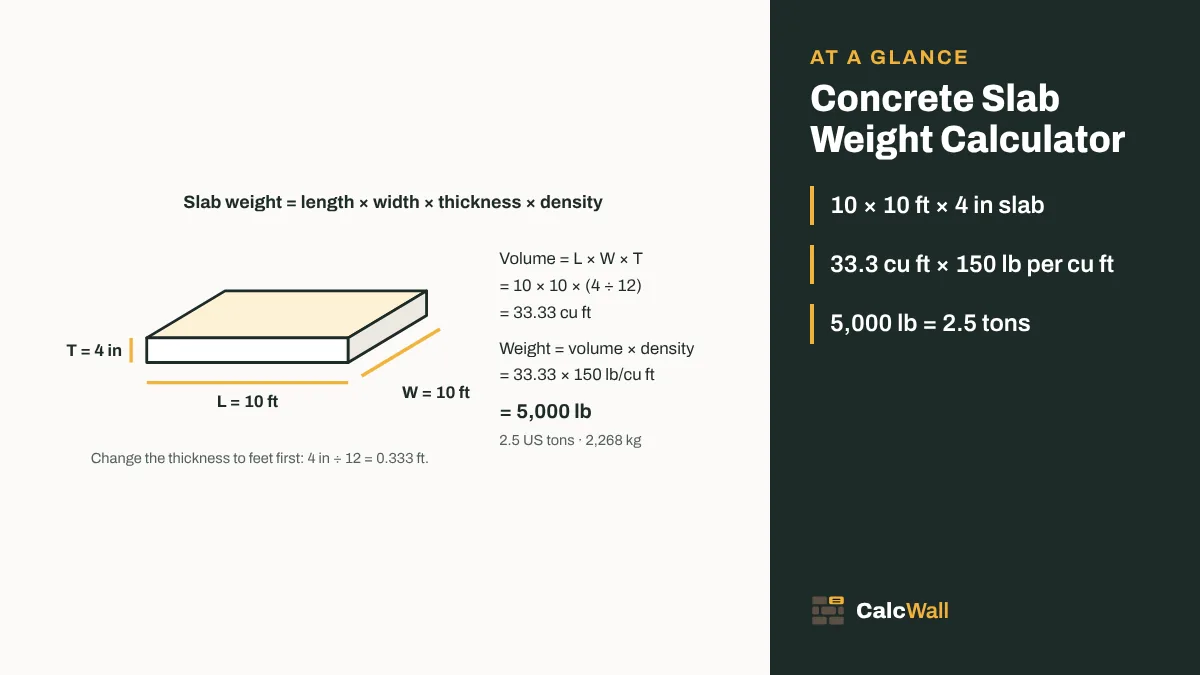
Quick answer: slab weight = length × width × thickness (all in feet) × density. Normal-weight concrete is about 150 lb per cu ft, so each inch of thickness weighs 12.5 lb per sq ft. A 10 × 10 ft slab 4 in thick weighs 5,000 lb, or 2.5 US tons (2,268 kg).
How to use the concrete slab weight calculator
The calculator works out the volume of concrete in your shape, then multiplies it by the density you pick. The big number is the weight in pounds, or in kilograms if your country is set to metric. Below it you'll see the volume in cubic feet, cubic yards and cubic metres, and the weight in US tons and metric tonnes.
- Pick the shape. Box is a rectangular slab or pad. Area × depth takes a square footage you already know. Cylinder is a round pad, pier or test cylinder. Slab with cut-outs takes holes off, like a sink opening or a drain box. Steps / stairs handles solid steps poured on the ground.
- Enter the sizes. Length and width go in feet by default and thickness in inches. You can switch both. In metric countries the tool starts in metres and centimetres.
- Set "How many?" if you have several identical pieces, such as 12 pier pads.
- Pick the density. Normal-weight at 150 lb per cu ft is the default. There's a lower-end 145, reinforced at 159 and structural lightweight at 115. "Custom density…" lets you type your own.
- Leave waste at None for weight. Waste matters when you order concrete, not when you weigh a slab that's already there.
- Add pieces to a total for a slab with a thickened edge, an L-shaped patio or a slab plus steps. Each piece keeps its own density.
One thing to know in metric countries: the density box is always in pounds per cubic foot, even when results show in kilograms. To use 2,400 kg/m³, choose Custom and enter 149.83, because 1 lb/ft³ is 16.018 kg/m³ and 2,400 ÷ 16.018 = 149.83.
If you'd rather order concrete than weigh it, the main concrete calculator gives cubic yards, bags and trucks. This page is the concrete weight calculator for slabs that are planned, poured or about to come out. For poured foundation walls, the poured wall calculator works out yards and bags with openings taken off.
Concrete slab weight formula
Weight is volume times density. For a rectangular slab, the volume is length times width times thickness, all in the same unit.
Weight (lb) = L (ft) × W (ft) × T (in) ÷ 12 × density (lb/ft³)
The divide-by-12 turns inches into feet. Forget it and the answer comes out 12 times too heavy, which is the most common slip in slab weight sums.
In metric the sum is the same, with thickness in metres:
Weight (kg) = L (m) × W (m) × T (m) × density (kg/m³)
A 4 × 3 m slab 100 mm thick is 1.2 m³. At 2,400 kg/m³ that's 2,880 kg. The calculator's 150 lb preset is 2,403 kg/m³, so it shows 2,883 kg for the same slab.
Other shapes follow the same pattern. The cylinder is π × r² × height, the cut-out shape subtracts each hole before multiplying by thickness, and the steps shape stacks solid blocks: W × tread × rise × n(n + 1) ÷ 2. The calculator shows the formula for whichever shape you pick.
Concrete weight per square foot and per square metre
Per-square-foot weight is the handiest number on the page. It's also the slab's dead load in psf, which is how engineers think about weight on a floor or deck.
lb per sq ft = density (lb/ft³) × thickness (in) ÷ 12
At 150 lb per cu ft each inch adds 12.5 lb per sq ft. That matches the 12.5 psf per inch for reinforced regular-weight concrete in Boise Cascade's GE-1 tech note, which cites ASCE 7-16. The table below works every common thickness at the calculator's four densities.
| Thickness | Lightweight 115 | Normal 145 | Normal 150 | Reinforced 159 | kg/m² at 150 lb/ft³ |
|---|---|---|---|---|---|
| 2 in | 19.2 | 24.2 | 25.0 | 26.5 | 122 |
| 3 in | 28.8 | 36.3 | 37.5 | 39.8 | 183 |
| 4 in | 38.3 | 48.3 | 50.0 | 53.0 | 244 |
| 5 in | 47.9 | 60.4 | 62.5 | 66.3 | 305 |
| 6 in | 57.5 | 72.5 | 75.0 | 79.5 | 366 |
| 8 in | 76.7 | 96.7 | 100.0 | 106.0 | 488 |
| 10 in | 95.8 | 120.8 | 125.0 | 132.5 | 610 |
| 12 in | 115.0 | 145.0 | 150.0 | 159.0 | 732 |
Values are lb per sq ft unless marked. The kg/m² column is the 150 lb/ft³ figure converted with NIST factors: 1 lb per sq ft is 4.882 kg/m².
Metric users usually work from a round slab thickness in millimetres. Here each 10 mm at 2,400 kg/m³ adds 24 kg/m². The kN/m² columns are what a designer would use for load, worked at EN 1991-1-1's 24 kN/m³ for plain and 25 kN/m³ for reinforced.
| Thickness | kg/m² at 2,400 kg/m³ | kg/m² at 2,549 kg/m³ (25 kN/m³) | kN/m², plain (24 kN/m³) | kN/m², reinforced (25 kN/m³) |
|---|---|---|---|---|
| 50 mm | 120 | 127 | 1.20 | 1.25 |
| 75 mm | 180 | 191 | 1.80 | 1.88 |
| 100 mm | 240 | 255 | 2.40 | 2.50 |
| 125 mm | 300 | 319 | 3.00 | 3.13 |
| 150 mm | 360 | 382 | 3.60 | 3.75 |
| 200 mm | 480 | 510 | 4.80 | 5.00 |
| 250 mm | 600 | 637 | 6.00 | 6.25 |
| 300 mm | 720 | 765 | 7.20 | 7.50 |
1 kN/m² is the same as 1 kPa. If you need psf from kN/m², multiply by 20.885.
Weight of common slab sizes
These are the sizes people search for most, worked at 150 lb per cu ft with no waste. A US ton here is 2,000 lb.
| Slab | 4 in thick | 5 in thick | 6 in thick |
|---|---|---|---|
| 3 × 3 ft pad | 450 lb (204 kg) | 563 lb (255 kg) | 675 lb (306 kg) |
| 4 × 4 ft pad | 800 lb (363 kg) | 1,000 lb (454 kg) | 1,200 lb (544 kg) |
| 10 × 10 ft | 5,000 lb, 2.5 tons (2,268 kg) | 6,250 lb, 3.13 tons (2,835 kg) | 7,500 lb, 3.75 tons (3,402 kg) |
| 12 × 12 ft | 7,200 lb, 3.6 tons (3,266 kg) | 9,000 lb, 4.5 tons (4,082 kg) | 10,800 lb, 5.4 tons (4,899 kg) |
| 20 × 20 ft | 20,000 lb, 10 tons (9,072 kg) | 25,000 lb, 12.5 tons (11,340 kg) | 30,000 lb, 15 tons (13,608 kg) |
| 24 × 24 ft | 28,800 lb, 14.4 tons (13,063 kg) | 36,000 lb, 18 tons (16,329 kg) | 43,200 lb, 21.6 tons (19,595 kg) |
The 3 × 3 ft pad at 5 in comes to 562.5 lb, shown rounded. For any size not listed, take the per-square-foot figure from the first table and multiply by the area. A 14 × 22 ft slab at 4 in is 308 sq ft × 50 = 15,400 lb.
A two-car garage slab around 24 × 24 ft weighs over 14 tons at 4 in. That's why removing one is a job for a machine and a roll-off, not a pickup.
Plain, reinforced and lightweight concrete density
Density is where most of the disagreement between published numbers comes from. The geometry is exact; the density is an assumption. Here's where each figure the calculator uses comes from, plus a few you'll meet elsewhere.
| Concrete | lb/ft³ | kg/m³ | Source |
|---|---|---|---|
| Normal-weight, published range | 137–150 | 2,200–2,400 | PCA, Design and Control of Concrete Mixtures, ch. 1 |
| Normal-weight, calculator default | 150 | 2,403 | WSDOT memo 05-2010 (plain concrete) |
| Normal-weight, lower preset | 145 | 2,323 | inside the PCA range |
| Reinforced, US bridge practice | 155 | 2,483 | WSDOT memo 05-2010 (dead load) |
| Reinforced, EN 1991-1-1 (calculator preset) | 159 | 2,549 | 25 kN/m³ ÷ 9.806 65 |
| Structural lightweight | 90–115 | 1,442–1,842 | NRMCA TIP 9, citing ACI 318 |
| Insulating lightweight | from 15 | from 240 | PCA, ch. 1 |
| Heavyweight (shielding, counterweights) | up to 375 | up to 6,000 | PCA, ch. 1 |
| Bagged mix, dry weight per cu ft placed | about 133 | about 2,136 | QUIKRETE 1101: 80 lb yields 0.60 cu ft |
Most driveways, patios and garage floors are normal-weight concrete with ordinary stone aggregate. For those, 145 to 150 is the right bracket. Pick 150 if you want the heavier answer for hauling or lifting.
Rebar and mesh add a little. WSDOT takes reinforced concrete as 5 lb per cu ft heavier than plain, so 155. EN 1991-1-1 adds 1 kN/m³ to 24 for "normal" reinforcement, giving 25 kN/m³, about 159 lb per cu ft. A home slab with light mesh is closer to plain. A heavily reinforced beam or wall is closer to the reinforced figure.
The bagged mix figure is the dry powder you pour in, not the cured slab. QUIKRETE doesn't publish a cured weight. The cured piece holds some of the mix water too, so it ends up heavier than 133 lb per cu ft, but we found no maker's figure for how much.
If you know the mix your supplier delivered, use Custom density. Ready-mix tickets sometimes give a unit weight from the plant's mix design.
2,400 or 2,500 kg/m³: the EN 1991-1-1 rounding
Metric sources quote both 2,400 and 2,500 kg/m³ for concrete, and they aren't contradicting each other. They're rounding two different design values from Eurocode EN 1991-1-1, Annex A.
- 24 kN/m³ is the Annex A value for normal-weight concrete. Divide by gravity (9.806 65 m/s²) and it's 2,447 kg/m³. People round that to 2,400, which also happens to be the top of PCA's range.
- 25 kN/m³ is the same concrete plus 1 kN/m³ for a normal amount of reinforcing steel. That's 2,549 kg/m³, usually written as 2,500.
- 26 kN/m³ is reinforced concrete that is still wet, with another 1 kN/m³ added. It's for formwork and construction-stage checks.
The shortcut "kN/m³ × 100 = kg/m³" treats gravity as 10. It's close enough for most jobs but runs about 2% light. New Steel Construction's 2009 article on the change told designers to use 25 kN/m³ for routine reinforced concrete design rather than 24.
So a kitchen-table answer of "2,400 kg per cubic metre" is fine for plain concrete. For a reinforced floor, 2,500 is the better round number. The calculator's reinforced preset uses 25 kN/m³ and rounds it to 159 lb per cu ft.
EN 1991-1-1 itself isn't free to read, and a 2025 edition has since been published, so check which edition your project uses. Australia and New Zealand use AS/NZS 1170.1 for loads. We didn't have a copy to quote, so confirm its values with your designer.
Concrete weight per cubic foot, yard and metre
If you're asking how much concrete weighs, this is usually the answer you're after. These are straight multiples of each density: 27 cu ft to the cubic yard, 35.315 cu ft to the cubic metre.
| Density | 1 cu ft | 1 cu yd | 1 m³ |
|---|---|---|---|
| Lightweight, 115 lb/ft³ | 115 lb | 3,105 lb (1.55 tons) | 1,842 kg |
| Normal, 145 lb/ft³ | 145 lb | 3,915 lb (1.96 tons) | 2,323 kg |
| Normal, 150 lb/ft³ | 150 lb | 4,050 lb (2.03 tons) | 2,403 kg |
| Reinforced, 155 lb/ft³ (WSDOT) | 155 lb | 4,185 lb (2.09 tons) | 2,483 kg |
| Reinforced, 159 lb/ft³ (25 kN/m³) | 159 lb | 4,293 lb (2.15 tons) | 2,547 kg |
The handy one to remember: a cubic yard of normal concrete weighs about 4,050 lb, just over 2 tons. A 10 cu yd ready-mix load is roughly 40,500 lb of concrete, before the weight of the truck itself.
The reinforced row at 159 shows 2,547 kg rather than 2,549 because the preset is rounded to a whole pound. The difference is under 0.1%.
You can also read it the other way. A cubic yard covers 81 sq ft at 4 in, so a 10 × 10 ft slab at 4 in is 100 ÷ 81 = 1.235 cu yd. Times 4,050 lb, that's 5,000 lb.
Wet vs cured concrete weight
Fresh concrete is a bit heavier than the same concrete a few months later. Some of the mix water reacts with the cement and stays. The rest slowly evaporates.
PCA's Design and Control puts the evaporated water at about 0.5% to 3% of the concrete's weight for concrete drying at 50% relative humidity. On a 5,000 lb slab that's roughly 25 to 150 lb. Structural lightweight concrete changes more, which is why NRMCA's TIP 9 talks about "equilibrium density": the weight it settles at once it has dried.
For design, EN 1991-1-1 adds 1 kN/m³ for unhardened concrete. That's about a 4% bump over 24 kN/m³, and it covers formwork, shoring and composite decks during the pour.
The calculator gives cured, hardened weight. If you want the wet weight for a form or a fresh precast piece, choose Custom density and add about 4%: 150 × 1.04 = 156 lb per cu ft. That's an approximation from the EN allowance, not a measured value for your mix.
"Dry concrete weight" can also mean bagged mix in the bag. That's printed on the bag: 40, 60 or 80 lb. Use the bag yields to turn that into volume.
Slab weight as dead load: what it does and does not tell you
Dead load is the permanent weight a structure carries: the slab itself, plus fixed finishes. A slab's per-square-foot weight is its own dead load. That number matters when the slab sits on something else, such as a suspended floor, a deck or a roof.
What it doesn't tell you is how much weight the slab can support. People look for a concrete weight support calculator and land on weight tables, but the two are different questions. A 6 in slab weighs 75 lb per sq ft. How much it can carry depends on the subgrade, the base, the concrete strength, the reinforcement, the joints and where the load sits.
- Slab on grade: the soil carries the weight. Soft or poorly packed subgrade, not concrete weight, is what usually cracks a patio under a hot tub.
- Suspended or raised slab: the slab's own weight uses up part of what the beams and supports can carry. This is where dead load in psf matters, and it's a design job.
- Point loads: a car jack, a safe on small feet or a post base puts a lot of weight on a small patch. Weight per square foot of slab doesn't cover that.
Some pages claim slab weight decides beam and column sizes on its own. It's one input of many. Use this calculator for the self-weight number, then hand it to whoever is doing the design. Local code and a qualified engineer decide what's adequate.
Breaking up and hauling an old slab
Once a slab is coming out, its weight drives three decisions: how big to break the pieces, how to move them, and how many loads it takes. The calculator gives the total. This section turns it into pieces and loads.
How big to break the pieces
The NIOSH lifting equation starts from a load constant of 51 lb (23 kg). That's the recommended weight for an "ideal" lift: close to the body, no twisting, not done often. Lifts off the ground are worse, so the recommended weight drops. The UK HSE filter for men starts at 25 kg close to the body at knuckle height, less with arms out, and lower for women. HSE is clear these are guidelines, not safe limits.
Broken concrete rarely comes out as neat squares, but the sums give a useful target. A piece's weight is its area times the slab's weight per square foot.
| Piece size | 4 in slab | 6 in slab |
|---|---|---|
| 1 × 1 ft | 50 lb (22.7 kg) | 75 lb (34.0 kg) |
| 18 × 18 in | 113 lb (51.0 kg) | 169 lb (76.5 kg) |
| 2 × 2 ft | 200 lb (90.7 kg) | 300 lb (136.1 kg) |
| 3 × 3 ft | 450 lb (204.1 kg) | 675 lb (306.2 kg) |
Look at the 2 × 2 ft row. At 4 in thick it's 4 sq ft × 50 = 200 lb, four times the 1 ft piece. Every time you double the side of a piece you get four times the weight, which is why pieces that look small can't be lifted.
To size pieces for a target weight, work backwards from the area:
Max side (in) = 12 × √(target lb ÷ lb per sq ft)
For a 50 lb piece that gives 13.9 in at 3 in thick, 12 in at 4 in, 10.7 in at 5 in, 9.8 in at 6 in and 8.5 in at 8 in. In metric, a 25 kg piece of a 100 mm slab at the calculator's 2,403 kg/m³ is about 32 × 32 cm.
Anything heavier needs two people, a pry bar and dolly, a wheelbarrow or a small machine. Rebar or mesh holds broken pieces together, so cut it as you go. HomeAdvisor's April 2024 guide prices reinforced removal at $4 to $6 per sq ft against $2 to $6 overall, which reflects that extra work.
Trucks, trailers and dumpsters
Concrete runs out of weight allowance long before it runs out of space. Plan loads by weight first.
- Pickup truck: the door-pillar placard required by 49 CFR 571.110 states the most that occupants and cargo can weigh together. Subtract the people in the cab. One solid cubic yard of concrete is 4,050 lb, so even a single yard is a lot for a light pickup.
- Trailer: use the payload, or the gross rating minus the empty weight, from the trailer's plate. Your tow vehicle and hitch ratings also apply.
- Dumpster: Dumpsters.com lists a typical 10 ton (20,000 lb) limit for its 10-yard concrete dumpster, and the same 10 tons for its 15 and 20 yard sizes. No wet concrete. Other haulers set their own limits, so ask.
Loads = slab weight ÷ load limit, rounded up
A 20 × 20 ft slab at 4 in is exactly 20,000 lb, one 10 ton dumpster with nothing to spare. The same slab at 6 in is 15 tons, two loads. A thickened edge adds weight you can't see, as the figure further down shows.
Be careful with volume-based hauling quotes. HomeGuide (no date shown) prices haul-and-dump at $30 to $65 per pickup load "for up to 6 cubic yards of debris." Six solid cubic yards of concrete would weigh 6 × 4,050 = 24,300 lb, far more than a pickup can carry. That volume suits light mixed debris, not concrete.
What disposal costs by weight
Landfills and transfer stations often charge by the ton, so the calculator's tons line is your disposal quantity. These are published estimates, each in its own market's currency:
- US, HomeGuide (no date shown): dump fees $90 to $160 per ton. A 10 × 10 ft, 4 in slab at 2.5 tons is 2.5 × $90 = $225 to 2.5 × $160 = $400.
- US, HomeAdvisor (updated April 12, 2024): disposal $30 to $100 per ton, or $75 to $250 for the same slab.
- UK, MyJobQuote (last updated 07/10/26): skip hire £60 to £400 per week. We found no reliable UK per-tonne figure for concrete, and no published skip weight limit we could cite. Ask the hire firm.
- Canada, Australia, New Zealand, Germany: we found no reliable published disposal price per tonne. Call your local transfer station.
Clean concrete with no soil or wood mixed in is often taken by recyclers, sometimes for less than landfill. Crushed, it becomes base material: the crushed concrete calculator works out how much you'd need back. For the whole tear-out price, the concrete removal cost calculator uses published per-square-foot rates by country.
Thickened edges and footings
Garage and shed slabs often have a thickened edge, a strip around the outside that goes deeper than the slab. It's easy to miss in a weight estimate because it's below ground.
Take the extra below the slab only, so you don't count the slab twice.
For a 20 × 20 ft slab with an edge 12 in wide and 12 in deep overall, the strip is 8 in deeper than the 4 in slab. Its area is 80 ft of outside edge × 1 ft, minus 4 corner squares of 1 sq ft that would be counted twice: 76 sq ft. That's 76 × 8 ÷ 12 = 50.67 cu ft, or 7,600 lb. Add the 20,000 lb slab and it's 27,600 lb, two dumpster loads instead of one.
Worked examples
Each example uses the calculator's own inputs and gives the number it shows.
1. A 10 × 10 ft patio (the default)
Box: length 10 ft, width 10 ft, thickness 4 in, normal-weight 150 lb/ft³. Volume = 10 × 10 × 4 ÷ 12 = 33.33 cu ft (1.23 cu yd). Weight = 33.33 × 150 = 5,000 lb, 2.50 US tons, 2.27 metric tonnes. Broken into 1 ft squares, that's 100 pieces of 50 lb.
2. A garage slab with a thickened edge, reinforced
Pick reinforced (159). Box 1: 20 × 20 ft × 4 in = 133.33 cu ft = 21,200 lb; press "+ Add this piece to a total". Box 2: 76 × 1 ft × 8 in = 50.67 cu ft = 8,056 lb; add it. Project total: 184 cu ft, 29,256 lb (14.63 tons). At a 10 ton dumpster limit that's 2 loads. At 150 lb/ft³ the same slab is 27,600 lb.
3. A 12 × 12 ft lightweight slab
Box: 12 × 12 ft × 5 in, structural lightweight 115 lb/ft³. Volume = 144 × 5 ÷ 12 = 60 cu ft (2.22 cu yd). Weight = 60 × 115 = 6,900 lb, 3.45 tons. In normal-weight concrete at 150 it would be 9,000 lb.
4. A slab with a hole for a drain box
Slab with cut-outs: length 10 ft, depth (front to back) 10 ft, thickness 4 in, one 2 × 2 ft cut-out. Volume = (100 − 4) × 4 ÷ 12 = 32 cu ft. Weight = 32 × 150 = 4,800 lb, 200 lb less than the solid slab.
5. Three solid steps and a round pad
Steps: 3 steps, 4 ft wide, 11 in tread, 7 in rise. Volume = 4 × (11 ÷ 12) × (7 ÷ 12) × 3 × 4 ÷ 2 = 12.83 cu ft. Weight = 1,925 lb at 150. Cylinder: 2 ft across, 6 in thick. Volume = 3.1416 × 1² × 0.5 = 1.57 cu ft, weight 236 lb.
6. A metric slab
Country set to UK, Australia or another metric country. Box: 4 m × 3 m × 10 cm, normal-weight preset. Volume = 1.2 m³. Weight = 1.2 × 2,402.8 = 2,883 kg, 2.88 tonnes. At a round 2,400 kg/m³ it would be 2,880 kg; at 2,500 for reinforced, 3,000 kg.
Steps work out heavier than people expect. If you're building new ones from block, the concrete block calculator counts the units, and the concrete countertop calculator handles thin cast tops with sink holes.
Notes for pros
Say which density you used. 145, 150, 155 and 159 lb/ft³ are all defensible. On a 20 × 20 ft, 4 in slab they span 19,333 to 21,200 lb. Write the figure on the estimate.
Find the edges before quoting removal. A thickened edge or buried footing can add a third to the weight, and an extra dumpster.
Round kN/m³ honestly. 24 kN/m³ is 2,447 kg/m³, not 2,400. The ×100 shortcut runs about 2% light.
Weight is not capacity. Self-weight is a dead load input. Bearing, slab design and point loads are separate checks.
- Densities on this page are published typical values. Your actual concrete can differ with aggregate, air content and moisture.
- Design dead loads come from your loading code and edition. This page is a guide; local code and your designer decide.
Sources
Where the numbers on this page come from. Everything else is plain geometry and unit conversion, which the calculator does with exact factors.
- Design and Control of Concrete Mixtures, Chapter 1: Fundamentals of Concrete, Portland Cement Association (reproduced as a PDHonline course), edition not stated; references run to 2002. Used for: normal-weight concrete density of 2,200 to 2,400 kg/m³ (137 to 150 lb/ft³); heavyweight concrete up to 6,000 kg/m³ (375 lb/ft³); insulating lightweight concrete as low as 240 kg/m³ (15 lb/ft³); mix water evaporating at 50% humidity is about 0.5% to 3% of the concrete weight
- Design Memorandum 05-2010, Unit Weight of Concrete, Washington State Department of Transportation, Bridge and Structures Office, June 1, 2010. Used for: 150 pcf for plain normal-weight concrete and 155 pcf for dead load with reinforcement; reinforced concrete is generally taken as 5 pcf heavier than plain
- They’ve changed the density of concrete – or have they?, New Steel Construction (BCSA, SCI and Steel for Life), by Alastair Hughes of SCI, October 1, 2009, on EN 1991-1-1:2002 Annex A. Used for: EN 1991-1-1 Annex A gives 24 kN/m³ for normal-weight concrete, plus 1 kN/m³ for a normal percentage of reinforcement and 1 kN/m³ more for unhardened concrete; the advice to use 25 kN/m³ for routine reinforced design
- TIP 9: Density of Structural Lightweight Concrete, hosted by the National Ready Mixed Concrete Association (publisher not named on the sheet), undated. Used for: structural lightweight concrete equilibrium density of 90 to 115 lb/ft³; fresh density is the highest value and falls as the concrete dries
- Tech Note GE-1, Weights of Building Materials, Boise Cascade, Rev 06.20 and 07.20 (2020), citing ASCE 7-16 Table C3.1-1a. Used for: design dead loads of 12.5 psf per inch of reinforced regular-weight concrete and 8 psf per inch of plain lightweight concrete
- Concrete Mix No. 1101 product data sheet, The QUIKRETE Companies, revised October 2022. Used for: bag yields: 80 lb ≈ 0.60 cu ft, 60 lb ≈ 0.45 cu ft, 40 lb ≈ 0.30 cu ft, which works out to about 133 lb of dry mix per cubic foot placed
- NIST Handbook 44, Appendix C: General Tables of Units of Measurement, National Institute of Standards and Technology, 2026 edition. Used for: 1 cu yd = 27 cu ft, 1 lb = 0.453 592 37 kg, 1 cu ft = 0.028 316 85 m³ and the other unit conversions on this page
- NIST Guide to the SI (SP 811), Footnotes, National Institute of Standards and Technology, web edition, undated. Used for: standard acceleration of gravity, 9.806 65 m/s², used to turn kN/m³ into kg/m³
- Assessment of Manual Lifting: The NIOSH Approach (chapter 13 of Ergonomics in Manufacturing), T. R. Waters and V. Putz-Anderson (NIOSH), Society of Manufacturing Engineers; hosted by CDC Stacks, 1998. Used for: the revised NIOSH lifting equation’s load constant of 51 lb (23 kg), the recommended weight for an ideal lift
- Manual handling at work: a brief guide (INDG143), Health and Safety Executive (UK), INDG143 rev4. Used for: the lifting filter: 25 kg for men at knuckle height close to the body, lower with arms extended and lower for women; the guidelines are not safe limits
- 49 CFR 571.110, Tire selection and rims and motor home/recreation vehicle trailer load carrying capacity information, US Code of Federal Regulations (Legal Information Institute, Cornell Law School), current text. Used for: the door-pillar placard stating that the combined weight of occupants and cargo should never exceed a stated number of pounds
- Concrete disposal, Dumpsters.com, no date shown (footer © 2026). Used for: a typical 10 ton (20,000 lb) weight limit for a 10-yard concrete dumpster, with the same 10 ton limit on its 15 and 20 yard sizes; no wet concrete; break concrete into manageable pieces
- How much does concrete removal cost?, HomeGuide, no date shown on the page. Used for: published estimates: landfill dump fees of $90 to $160 per ton; $30 to $65 per pickup load to haul and dump “up to 6 cubic yards of debris”
- How Much Does Concrete Removal Cost?, HomeAdvisor (Angi Inc.), updated April 12, 2024. Used for: published estimates: disposal fees of $30 to $100 per ton; removal $2 to $6 per sq ft, reinforced $4 to $6
- Concrete driveway removal costs, MyJobQuote, last updated 07/10/26. Used for: published UK estimate: skip hire £60 to £400 per week
Frequently asked questions
How much does a 10x10 concrete slab weigh?
At 4 in thick and 150 lb per cu ft, a 10 × 10 ft slab is 33.33 cu ft and weighs 5,000 lb, or 2.5 US tons (2,268 kg). At 5 in it is 6,250 lb and at 6 in it is 7,500 lb.
How much does a 12x12 slab weigh?
A 12 × 12 ft slab 4 in thick is 48 cu ft, so it weighs 7,200 lb (3.6 tons, 3,266 kg) at 150 lb per cu ft. At 6 in thick it is 72 cu ft and 10,800 lb.
How much does a 20x20 concrete slab weigh?
At 4 in thick, a 20 × 20 ft slab is 133.33 cu ft and 20,000 lb, exactly 10 US tons (9,072 kg). At 6 in it is 30,000 lb. A thickened edge adds more: 7,600 lb for an edge 12 in wide and 12 in deep all round.
How much does concrete weigh per square foot?
It depends on thickness. At 150 lb per cu ft, every inch of thickness adds 12.5 lb per sq ft. So 3 in is 37.5, 4 in is 50, 5 in is 62.5 and 6 in is 75 lb per sq ft. Multiply by your area for the slab weight.
How much does a 6 inch slab weigh per square foot?
About 75 lb per sq ft at 150 lb per cu ft (150 × 6 ÷ 12). At 145 lb per cu ft it is 72.5 lb, and reinforced at 159 lb per cu ft it is 79.5 lb. In metric, a 150 mm slab at 2,400 kg/m³ is 360 kg/m².
How much does a cubic yard of concrete weigh?
A cubic yard is 27 cu ft, so at 150 lb per cu ft it weighs 4,050 lb, a little over 2 US tons. At 145 lb it is 3,915 lb; reinforced at 159 lb it is 4,293 lb; structural lightweight at 115 lb it is 3,105 lb.
How much does a cubic metre of concrete weigh?
Normal-weight concrete is about 2,200 to 2,400 kg per m³ (PCA). The calculator’s 150 lb per cu ft preset works out to 2,403 kg. Reinforced concrete is about 2,549 kg if you use EN 1991-1-1’s 25 kN/m³, usually rounded to 2,500.
How much does a cubic foot of concrete weigh?
Around 145 to 150 lb for normal-weight concrete. PCA gives a range of 137 to 150 lb per cu ft. Reinforced concrete is about 155 lb (WSDOT) to 159 lb (EN 25 kN/m³), and structural lightweight is 90 to 115 lb.
Does reinforced concrete weigh more?
Yes, slightly. WSDOT takes reinforced concrete as 5 lb per cu ft heavier than plain, and EN 1991-1-1 adds 1 kN/m³ for normal reinforcement. On a 10 × 10 ft, 4 in slab the 159 lb preset adds 300 lb over plain at 150.
Does wet concrete weigh more than cured concrete?
A little. Fresh concrete loses water as it dries: PCA puts the evaporated water at about 0.5% to 3% of the weight. EN 1991-1-1 adds 1 kN/m³ for unhardened concrete, about 4% on top of 24. The calculator gives hardened weight.
How much does lightweight concrete weigh?
Structural lightweight concrete has an equilibrium density of 90 to 115 lb per cu ft (NRMCA TIP 9, citing ACI 318). Insulating lightweight mixes go as low as 15 lb per cu ft (PCA). The calculator’s lightweight preset uses the top of the structural range, 115.
How much weight can a concrete slab hold?
This calculator can’t tell you, and neither can the slab’s own weight. What a slab can carry depends on the soil, base, thickness, strength, reinforcement and how the load is spread. A heavy slab is not a strong one. For a hot tub, safe or vehicle pad, ask an engineer.
What is the dead load of a 4 inch slab in psf?
About 50 psf at 150 lb per cu ft. Boise Cascade’s tech note, citing ASCE 7-16, lists 12.5 psf per inch for reinforced regular-weight concrete, which is also 50 psf at 4 in. Plain lightweight is listed at 8 psf per inch, or 32 psf at 4 in.
How big should I break a slab so I can lift the pieces?
At 4 in thick, a 1 × 1 ft piece weighs 50 lb, close to the 51 lb NIOSH load constant for an ideal lift. At 6 in, keep pieces under about 10 × 10 in for the same weight. Bigger pieces need two people, a dolly or a machine.
How many trailer or dumpster loads is my slab?
Divide the slab weight by the load limit and round up. Dumpsters.com lists 10 tons for its 10-yard concrete dumpster, so a 20 × 20 ft slab 4 in thick (10 tons) is one load and the same slab at 6 in (15 tons) is two. For a trailer, use the payload on its plate.
How much does a concrete countertop or pad weigh?
At 150 lb per cu ft, a 1.5 in countertop is 18.75 lb per sq ft, so a 25 × 96 in top is about 312 lb before cut-outs. A 3 × 3 ft pad 4 in thick is 450 lb. Use the cut-out shape to take off a sink hole.
Is this concrete slab weight calculator free to use online?
Yes. The CalcWall Concrete Slab Weight Calculator is completely free and works online in any browser, on a phone, tablet or computer. There is nothing to download and no account to create, and the math runs right in your browser, so results appear as you type.