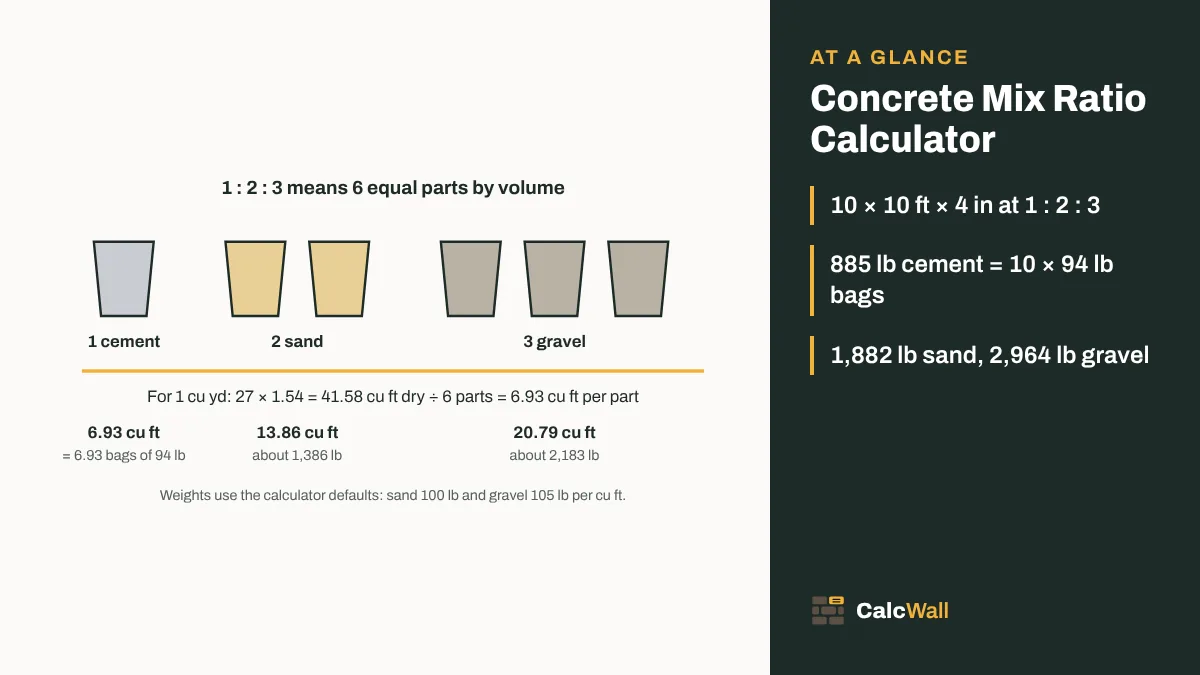
Quick answer: 1 cu yd of 1:2:3 concrete takes about 41.6 cu ft of dry material: 6.93 bags (94 lb) of cement, 13.86 cu ft of sand and 20.79 cu ft of gravel, plus 39.1 US gal of water at a 0.50 water-cement ratio. In metric, 1 m³ takes 386 kg of cement.
How to use the concrete mix ratio calculator
The tool works in one direction: from the concrete you want to place, back to the dry materials you need to buy. It does the same job as any concrete mix calculator, but it shows every factor it uses, and you can change them.
- Size of the pour. Pick "Length × width × depth" and enter a slab or pad, or pick "I know the volume" and enter cu yd or m³. For posts, footings or walls, work out the volume first with the concrete calculator and paste it in.
- Units. Feet and inches, or metres and centimetres. US visitors start in feet; UK, Australia, New Zealand, Germany and Canada start in metric.
- Extra for waste. None, 5, 10 or 15%. The default is 10%, added to the wet volume before anything else.
- Mix ratio. Cement : sand : gravel by volume. The presets are 1:1:2, 1:1.5:3, 1:2:3 (the default), 1:2:4 and 1:3:6. "Custom ratio" takes any three numbers, as long as cement is above zero.
- Water-cement ratio. Default 0.50, allowed 0.25 to 1.0. Above 0.68 the tool warns that the ACI 211.1 table puts that under 3,000 psi.
- Cement bag. 94 lb (US sack), 25 kg, 20 kg, 50 kg or 40 kg. The count is rounded up to whole bags.
- Advanced. The dry volume factor (default 1.54, allowed 1 to 2), sand density (default 100 lb per cu ft, or 1,602 kg/m³) and gravel density (105 lb per cu ft, or 1,682 kg/m³).
The whole sum is short enough to do by hand:
dry = wet × 1.54 · one part = dry ÷ (c + s + g) · cement lb = cement cu ft × 94 · bags = cement lb ÷ bag weight · water = cement weight × w/c
Sand and gravel weights are their volumes times the densities you set. Water in US gallons is its weight divided by 8.34 lb. That 8.34 is the weight of one gallon, 231 cu in or 3.785 L, of water: 3.785 kg ÷ 0.4536 = 8.34 lb.
Three things the tool doesn't do, so you know where to add your own judgement. It doesn't correct for damp sand. It doesn't split the job into mixer batches. And it doesn't convert to premixed bags. The sections below show how to handle each by hand. If you are casting a kitchen or outdoor top, the concrete countertop calculator counts premix bags for each piece instead.
What a concrete mix ratio means
A ratio such as 1:2:3 lists cement, sand and gravel in that order, as parts of loose volume. Use the same bucket, shovel or box for every part. One bucket of cement, two of sand, three of gravel. QUIKRETE's portland cement data sheet gives exactly that mix, with ASTM C33 sand and gravel. Mortar for brick and block has no gravel, so work out the mortar bags separately.
The share of cement is what matters most for cost and strength. It is 1 divided by the total number of parts. Here are the five presets side by side, with two leaner mixes you can enter as custom ratios.
| Ratio (c : s : g) | Total parts | Cement share of dry volume | Name in Indian practice |
|---|---|---|---|
| 1 : 1 : 2 | 4 | 25.0% | M25 (lecture notes; not a nominal mix in IS 456:2000) |
| 1 : 1.5 : 3 | 5.5 | 18.2% | M20 |
| 1 : 2 : 3 | 6 | 16.7% | QUIKRETE general mix (no grade) |
| 1 : 2 : 4 | 7 | 14.3% | M15 |
| 1 : 3 : 6 | 10 | 10.0% | M10 |
| 1 : 4 : 8 (custom) | 13 | 7.7% | M7.5 |
| 1 : 5 : 10 (custom) | 16 | 6.25% | M5 |
So 1:1:2 is the richest preset, not 1:1.5:3. Some guides get that wrong. The last two rows are lean mixes JK Cement lists for M7.5 and M5.
Sand is the fine aggregate and gravel is the coarse aggregate. Crushed stone works in place of gravel; enter its own density in the advanced settings. If you are ordering stone for other jobs on the same site, the gravel calculator converts area and depth to tons.
Why dry materials exceed the finished volume (the 1.54 factor)
A heap of loose gravel is mostly stone, but it has plenty of air between the stones. Sand fills much of that air. Cement and water fill the gaps between sand grains. So when you mix 1.54 m³ of loose dry material with water and place it, you end up with about 1 m³ of concrete.
This is about voids, not shrinkage. Drying shrinkage of hardened concrete is a separate and much smaller effect. One popular guide calls the 1.54 factor shrinkage; it isn't.
Where does 1.54 come from? It is a common rule of thumb, used by every competing mix calculator we checked. We could not find a government, university or standards source that states it.
The closest reliable check is the US Navy's "Rule of 42". It says 42 cu ft of dry materials make about 1 cu yd of concrete. For 1:2:4 that is 6 cu ft of cement, 12 of sand and 24 of gravel. 42 ÷ 27 = 1.556, about 1% more than 1.54.
For most jobs the gap doesn't matter. On 1 cu yd of 1:2:4, 1.54 gives 5.94 bags of cement and the Navy rule gives 6. If you trust the Navy figure more, type 1.556 into the advanced field.
Real void content depends on how well graded the sand and stone are, so no single number is exact. If a pour comes up short, raise the factor next time. QUIKRETE's data sheet points the other way: it says five to six 94 lb bags make 1 cu yd at 1:2:3, which is leaner than the 6.93 bags the 1.54 rule gives. We show the arithmetic and let you choose.
Cement, sand and gravel per cubic yard and per cubic metre
These tables come straight from the calculator with no waste, the default densities and a 0.50 water-cement ratio. Use them for a quick order, or to check any other concrete mix calculator, bag count or quote.
Per cubic yard (27 cu ft, dry volume 41.58 cu ft). Tons are US short tons of 2,000 lb. Cement bags are 94 lb, which is 1 cu ft each.
| Ratio | Cement, 94 lb bags | Sand, cu ft | Sand, tons | Gravel, cu ft | Gravel, tons | Water at 0.50, US gal |
|---|---|---|---|---|---|---|
| 1 : 1 : 2 | 10.39 | 10.39 | 0.52 | 20.79 | 1.09 | 58.6 |
| 1 : 1.5 : 3 | 7.56 | 11.34 | 0.57 | 22.68 | 1.19 | 42.6 |
| 1 : 2 : 3 | 6.93 | 13.86 | 0.69 | 20.79 | 1.09 | 39.1 |
| 1 : 2 : 4 | 5.94 | 11.88 | 0.59 | 23.76 | 1.25 | 33.5 |
| 1 : 3 : 6 | 4.16 | 12.47 | 0.62 | 24.95 | 1.31 | 23.4 |
Per cubic metre (dry volume 1.54 m³). Cement is worked at 94 lb per cu ft, which is 1,506 kg/m³ loose. Tonnes are metric, 1,000 kg.
| Ratio | Cement, kg | 25 kg bags | 50 kg bags | Sand, m³ | Sand, t | Gravel, m³ | Gravel, t | Water at 0.50, L |
|---|---|---|---|---|---|---|---|---|
| 1 : 1 : 2 | 580 | 23.19 | 11.59 | 0.385 | 0.62 | 0.770 | 1.30 | 290 |
| 1 : 1.5 : 3 | 422 | 16.86 | 8.43 | 0.420 | 0.67 | 0.840 | 1.41 | 211 |
| 1 : 2 : 3 | 386 | 15.46 | 7.73 | 0.513 | 0.82 | 0.770 | 1.30 | 193 |
| 1 : 2 : 4 | 331 | 13.25 | 6.63 | 0.440 | 0.70 | 0.880 | 1.48 | 166 |
| 1 : 3 : 6 | 232 | 9.28 | 4.64 | 0.462 | 0.74 | 0.924 | 1.55 | 116 |
Round the bags up when you order. Builders' merchants usually sell sand and gravel by the tonne or the bulk bag, so the weight columns are often the useful ones. Use the merchant's own density if they give one: the figures here are our defaults, not measured values for your material.
The densities used, and where they come from:
| Material | Calculator default | Published range or basis |
|---|---|---|
| Portland cement, loose | 94 lb per cu ft (1,506 kg/m³), fixed | US Army FM 5-428: a 94 lb sack equals 1 loose cu ft |
| Sand | 100 lb per cu ft (1,602 kg/m³), editable | Penn State: normal-weight aggregate 1,100–1,750 kg/m³ dry-rodded; no sand-only figure |
| Gravel or crushed stone | 105 lb per cu ft (1,682 kg/m³), editable | FHWA: No. 5 to No. 9 coarse aggregates about 86–124 lb per cu ft dry |
| Water | 8.34 lb per US gal, 1 kg per litre | 231 cu in per gallon (NIST) |
Which mix ratio to use for slabs, footings and posts
A ratio is a recipe, not a design. What you pick should follow your local code, the engineer's drawings or the bag maker's instructions. With that said, here is what the published sources put where.
| Job | What a source says | Ratio to start from in the calculator |
|---|---|---|
| General concrete, small slabs and pads | QUIKRETE: 1 cement, 2 sand, 3 gravel | 1 : 2 : 3 |
| Fence posts, unreinforced strip footings (UK) | Tarmac: ST2, 10 N/mm² | No direct ratio; ST mixes are set by BS 8500 quantities |
| House foundations, patio bases (UK) | Tarmac: ST3, 15 N/mm² | As above |
| Garage and shed bases, floor slabs (UK) | Tarmac: ST4, 20 N/mm² | As above |
| Reinforced concrete, mild exposure (India) | IS 456 Table 5: M20 minimum, at least 300 kg/m³ cement, w/c 0.55 max | 1 : 1.5 : 3 (M20 nominal) |
| Plain concrete, mild exposure (India) | IS 456 Table 5: no minimum grade, 220 kg/m³ cement, w/c 0.60 max | 1 : 2 : 4 (M15) or 1 : 3 : 6 (M10) |
| Blinding and lean fill | Tarmac: ST1 for blinding; JK Cement: M7.5 is 1:4:8 | 1 : 3 : 6 or a custom 1 : 4 : 8 |
A check worth doing: IS 456 asks for at least 300 kg of cement per m³ in reinforced work. The per m³ table shows 1:1.5:3 at 422 kg and 1:2:4 at 331 kg, so both pass that one test on paper. 1:3:6, at 232 kg, does not, though it clears the 220 kg minimum for plain concrete.
For the size of the job, use the shape tools first. The concrete footing calculator handles strip and pad footings, and the post hole concrete calculator works out round holes, less the post. Then bring the volume here with "I know the volume". Building a block wall on that footing? The concrete block calculator counts the blocks.
Water-cement ratio and how much water to add
The water-cement ratio, or w/c, is the weight of water divided by the weight of cement. It is the main dial on strength. More water makes concrete easier to place and weaker once hard. QUIKRETE's own instruction is to use the minimum water that gives the consistency you need.
water weight = cement weight × w/c
Multiply by the cement only, never by the whole dry mix. One well-known calculator multiplies w/c by the total dry weight. For 1 cu yd of 1:2:3 that is 4,220 lb of dry material × 0.50 = 2,110 lb, or 253 gal of water. The right answer is 651 lb of cement × 0.50 = 326 lb, which is 39.1 gal. The mistake overstates water more than sixfold.
The ACI 211.1 table, as published by the Pennsylvania Aggregates and Concrete Association, links w/c to 28-day strength.
| 28-day strength, psi | MPa (× 0.006894757) | w/c, no entrained air | w/c, air-entrained |
|---|---|---|---|
| 7,000 | 48.3 | 0.33 | – |
| 6,000 | 41.4 | 0.41 | 0.32 |
| 5,000 | 34.5 | 0.48 | 0.40 |
| 4,000 | 27.6 | 0.57 | 0.48 |
| 3,000 | 20.7 | 0.68 | 0.59 |
| 2,000 | 13.8 | 0.82 | 0.74 |
Treat the table as a guide for designed mixes with good materials and proper curing. A volume-batched site mix won't hit those numbers as reliably. The calculator uses the no-air column for its warning; it doesn't model entrained air.
Here is the water per bag at common ratios. It's the bag weight times w/c, with a litre of water taken as 1 kg.
| w/c | 94 lb bag | 25 kg bag | 20 kg bag | 50 kg bag |
|---|---|---|---|---|
| 0.40 | 37.6 lb = 4.51 US gal | 10.0 L | 8.0 L | 20.0 L |
| 0.45 | 42.3 lb = 5.07 US gal | 11.3 L | 9.0 L | 22.5 L |
| 0.50 | 47.0 lb = 5.64 US gal | 12.5 L | 10.0 L | 25.0 L |
| 0.55 | 51.7 lb = 6.20 US gal | 13.8 L | 11.0 L | 27.5 L |
| 0.60 | 56.4 lb = 6.76 US gal | 15.0 L | 12.0 L | 30.0 L |
IS 456 Table 9 sets a maximum of 34 L per 50 kg bag for M10, 32 L for M15 and 30 L for M20. That is w/c 0.68, 0.64 and 0.60.
Mixing in batches: buckets, wheelbarrows and mixers
The calculator gives totals for the whole pour. On site you mix a bag at a time, so it helps to know what one bag of cement makes. Each figure is bag volume × total parts ÷ 1.54, with cement at 94 lb per cu ft.
| Ratio | Per 94 lb bag: sand + gravel | Concrete from one 94 lb bag | Per 25 kg bag: sand + gravel | Concrete from one 25 kg bag | One 20 kg bag | One 50 kg bag |
|---|---|---|---|---|---|---|
| 1 : 1 : 2 | 1 + 2 cu ft | 2.60 cu ft | 16.6 + 33.2 L | 43.1 L | 34.5 L | 86.3 L |
| 1 : 1.5 : 3 | 1.5 + 3 cu ft | 3.57 cu ft | 24.9 + 49.8 L | 59.3 L | 47.4 L | 118.6 L |
| 1 : 2 : 3 | 2 + 3 cu ft | 3.90 cu ft | 33.2 + 49.8 L | 64.7 L | 51.8 L | 129.4 L |
| 1 : 2 : 4 | 2 + 4 cu ft | 4.55 cu ft | 33.2 + 66.4 L | 75.5 L | 60.4 L | 150.9 L |
| 1 : 3 : 6 | 3 + 6 cu ft | 6.49 cu ft | 49.8 + 99.6 L | 107.8 L | 86.3 L | 215.6 L |
A 25 kg bag holds 25 ÷ 1,506 kg/m³ = 16.6 L of loose cement. That is why one "part" for a 25 kg bag is 16.6 L in the table.
Buckets. A 5 US gal bucket holds 5 × 231 = 1,155 cu in, or 0.668 cu ft. Filled level with loose cement it holds about 0.668 × 94 = 63 lb. A 94 lb sack is therefore about one and a half buckets. Use the same bucket for all three materials, and level each one off the same way.
Wheelbarrows and mixers. The calculator has no batch mode, but you can make one. Choose "I know the volume", set waste to None, and enter one batch of finished concrete. Use the mixed-concrete output the maker states for your mixer, not the drum's total size. The result is the cement, sand, gravel and water for that batch.
Premix bags instead. For very small jobs, premix saves the measuring. QUIKRETE's 80 lb Concrete Mix yields about 0.60 cu ft, so 1 cu yd takes 27 ÷ 0.60 = 45 bags, or 3,600 lb to lift. QUIKRETE rates it at 4,000 psi at 28 days. A hand-mixed cubic yard of 1:2:3 needs about 7 bags of cement plus loose sand and gravel delivered by the load.
Safety. Wet cement is alkaline and burns skin with prolonged contact. Arizona's occupational safety division advises alkali-resistant gloves, long sleeves, waterproof boots high enough to keep concrete out and safety glasses with side shields. Wash wet cement off skin straight away with plenty of clean water. QUIKRETE's bag warning says the same, and adds a mask for the dry dust.
Damp sand, bulking and measuring by weight
Sand bought from a yard is rarely bone dry. A thin film of water on each grain pushes the grains apart, so damp sand takes up more room than dry sand. This is called bulking. Virtual Labs puts maximum bulking at 4–6% moisture. Past that, bulking falls off, and fully saturated sand goes back to its dry volume.
Two effects follow, and the calculator corrects for neither.
- Less sand per bucket. A bucket of bulked sand holds less actual sand than a bucket of dry sand, so the mix ends up short of sand. Rama University's notes add that fine sand bulks more than coarse. We found no reliable published figure for the size of the effect, so test your own sand.
- Extra water. The water in damp sand joins the mix. IS 456 sets its limits as "free" water-cement ratios, which counts that water. If you add the full water from the calculator on top, your real w/c goes up.
A simple test for bulking: fill a container part way with loose damp sand and mark the level. Then flood it with water and stir until the sand settles. The drop in level shows how much the damp sand had bulked. Virtual Labs works it out as (damp height − saturated height) ÷ saturated height × 100.
Say the damp sand stands at 120 mm and settles to 100 mm. That is 20 ÷ 100 × 100 = 20% bulking, so you'd use 1.2 buckets of that sand for each bucket the ratio calls for.
Measuring by weight sidesteps the problem, and IS 456 sets its nominal mixes by mass. Use the weight lines in the result, and set the sand density to your own figure: weigh a level bucket of your sand and divide by the bucket's volume. A 0.668 cu ft bucket of sand weighing 66.8 lb is 100 lb per cu ft.
For water, hold some back when the sand feels damp, then add the rest a little at a time until the mix is workable. That is the same advice QUIKRETE gives: the minimum water for the job.
Mix ratio vs psi and MPa: what a ratio can and cannot promise
Many pages print a strength next to each ratio, as though 1:2:4 always gives the same psi. It doesn't. Strength depends mainly on the water-cement ratio, then on the cement, the aggregates, how well it's compacted and how long it's kept moist. Two batches at 1:2:4 with different water can differ widely.
What the sources do support:
- QUIKRETE's 80 lb Concrete Mix, a factory-blended premix, tests at 2,500 psi at 7 days and 4,000 psi at 28 days under ASTM C39.
- The ACI 211.1 table, above, ties 3,000 psi to w/c 0.68 and 4,000 psi to 0.57 without entrained air.
- IS 456 lets nominal (recipe) mixes be used only for M20 or lower. Above that, it calls for a designed mix.
The grade names also measure different things, which is where many comparisons go wrong.
| System | Example | What the number is | Test specimen |
|---|---|---|---|
| US (ACI; QUIKRETE tests to ASTM C39) | 3,000 psi | 28-day compressive strength | Cylinder |
| India (IS 456) | M20 | 20 N/mm² characteristic strength at 28 days | 150 mm cube |
| Europe and UK (EN 206, BS 8500) | C20/25 | 20 N/mm² on cylinders / 25 N/mm² on cubes | Both, cylinder first |
| UK prescribed | ST4 | 20 N/mm² at 28 days, per Tarmac | Set by BS 8500 |
Heidelberg Materials explains the two numbers in a C class: the first is a crushed cylinder, the second a cube of the same concrete. A cube gives the higher reading. So an M20 cube result is not the same as 20 MPa on a cylinder. 3,000 psi is 3,000 × 0.006894757 = 20.7 MPa on a cylinder, which sits nearer C20/25 than M20.
If you need a stated strength, order it: ready-mix by strength class, or a premix bag that lists one. Use this calculator for quantities and as a starting recipe. Then cure it well. The concrete curing time calculator shows how strength builds day by day.
UK, Indian and Australian mixes and bag sizes
The ratio arithmetic is the same everywhere. What changes is the bag size, how mixes are named and whether the local standard uses volume or weight.
United Kingdom
Cement comes in 25 kg bags, as Holcim UK sells its general purpose cement. Ready-mix is ordered by a mix name rather than a ratio. Tarmac lists the standardised prescribed mixes made to BS 8500 quantities:
| Mix | Strength at 28 days | Typical uses (Tarmac) | Designated mix to use instead (Heidelberg) |
|---|---|---|---|
| ST1 | 7.5 N/mm² | Kerb bedding, backing, blinding, drainage | GEN0 |
| ST2 | 10 N/mm² | Unreinforced strip footings, fence posts, small bases, trench fill | GEN1 |
| ST3 | 15 N/mm² | House foundations, patio bases, unreinforced oversites | GEN2 |
| ST4 | 20 N/mm² | Garage and shed bases, floor slabs | GEN3 |
| ST5 | 25 N/mm² | Agricultural stores, external paving bases | RC20/25 |
Heidelberg Materials recommends the designated GEN or RC mix when it comes from a quality-assured supplier. Tarmac doesn't publish the cement and aggregate weights behind each ST mix, so we can't give an exact hand ratio for them.
India
Indian site practice names volume ratios by grade: M10 1:3:6, M15 1:2:4, M20 1:1.5:3, as in the Bearys Institute of Technology lecture notes. IS 456:2000 Table 9 itself is by mass, per 50 kg bag of cement:
| Grade | Dry aggregate per 50 kg cement | Fine : coarse by mass | Max water per 50 kg cement |
|---|---|---|---|
| M5 | 800 kg | generally 1 : 2 (1 : 1.5 to 1 : 2.5) | 60 L |
| M7.5 | 625 kg | as above | 45 L |
| M10 | 480 kg | as above | 34 L |
| M15 | 330 kg | as above | 32 L |
| M20 | not legible in the public scan we read | as above | 30 L |
The copy we could open is an OCR scan, and the M20 aggregate figure didn't come through cleanly, so check it against an official BIS copy. For M15, 330 kg of aggregate at 1:2 is 110 kg sand and 220 kg gravel per 50 kg of cement. By mass that is 1 : 2.2 : 4.4. The calculator's ratio is by volume, so don't type a mass ratio into it; compare against its weight lines instead.
Note that 1:1:2, labelled M25 in the calculator and in lecture notes, isn't a nominal mix in IS 456:2000, which stops nominal mixes at M20. JK Cement also lists M25 outside its nominal table.
Australia and New Zealand
Cement Australia sells bagged cement in 20 kg bags, and the calculator starts there for Australian and New Zealand visitors. We found no reliable published source for New Zealand bag sizes, so check the bag you buy. Water per 20 kg bag at w/c 0.50 is 10 L.
Germany and the rest of Europe
The calculator's 25 kg option is labelled for the UK and Europe and is the German default. We didn't find a German manufacturer source to confirm local bag sizes, so check the label. Strength classes follow the same C cylinder/cube pattern as the UK.
Worked examples
Each example uses the live calculator, with the outputs as it shows them.
A 10 × 10 ft patio, 4 in thick, at 1:2:3 (the default)
Volume = 10 × 10 × 4 ÷ 12 = 33.33 cu ft. With 10% waste: 36.67 cu ft (1.36 cu yd). Dry = 36.67 × 1.54 = 56.47 cu ft. One part = 56.47 ÷ 6 = 9.41 cu ft.
Cement 9.41 × 94 = 885 lb = 9.41 bags of 94 lb, so buy 10 bags. Sand 18.82 cu ft ≈ 1,882 lb. Gravel 28.23 cu ft ≈ 2,964 lb. Water at 0.50: 885 × 0.50 = 442 lb = 53 US gallons.
A 3 × 3 m shed base, 10 cm thick, at 1:2:4 with 25 kg bags (UK)
Volume = 3 × 3 × 0.10 = 0.900 m³, plus 10% = 0.99 m³. Dry = 0.99 × 1.54 = 1.525 m³. One part = 1.525 ÷ 7 = 0.218 m³.
Cement 328 kg = 13.12 bags of 25 kg, so buy 14 bags. Sand 0.436 m³ ≈ 698 kg. Gravel 0.871 m³ ≈ 1,465 kg. Water at 0.50: 164 litres, less if the sand is damp. Tarmac lists ST4 for shed bases, so if you order ready-mix, order that.
2 m³ of M20 (1:1.5:3) with 50 kg bags (India)
Choose "I know the volume", metric, 2 m³, waste 5%, ratio 1:1.5:3, w/c 0.45, bag 50 kg. Wet = 2.1 m³. Dry = 3.234 m³. One part = 3.234 ÷ 5.5 = 0.588 m³.
Cement 885 kg = 17.71 bags, so buy 18 bags. Sand 0.882 m³ ≈ 1,413 kg. Gravel 1.764 m³ ≈ 2,967 kg. Water at 0.45: 398 litres, which is 22.5 L per bag, inside the IS 456 Table 9 limit of 30 L. Cement is 885 ÷ 2.1 = 422 kg/m³, above the 300 kg minimum for reinforced work.
1.5 cu yd of footings at 1:2:4, aiming for 4,000 psi
Volume 1.5 cu yd, waste 5%, ratio 1:2:4, w/c 0.57 (the ACI 211.1 figure for 4,000 psi without air). Wet = 42.53 cu ft (1.58 cu yd). Dry = 65.49 cu ft. One part = 65.49 ÷ 7 = 9.36 cu ft.
Cement 879 lb = 9.36 bags, so buy 10 bags of 94 lb. Sand 18.71 cu ft ≈ 1,871 lb. Gravel 37.42 cu ft ≈ 3,929 lb. Water 501 lb = 60.1 US gallons. The 0.57 is a target from the table, not a promise: site batching and curing decide what you get.
Notes for pros
Check the 1.54 against your yield. It's a rule of thumb; the Navy rule is 1.556. If your last pour came up short, raise the factor in the advanced settings.
Free water, not added water. Damp sand brings its own water. Hold back part of the calculated water and add to workability.
Weigh the sand once. A level bucket of your sand on a scale gives a density for the advanced field and shows up bulking.
Cube is not cylinder. M20 and C20/25 aren't the same thing. A US psi figure means cylinders.
- This page gives quantities and published reference values, not a mix design. Local code and your engineer decide the mix.
- The strengths in the tables come from the named sources for designed or factory mixes. A hand-mixed batch can come out lower.
Sources
Where the numbers on this page come from. Everything else is plain geometry and unit conversion, which the calculator does with exact factors.
- QUIKRETE Portland Cement data sheet, Product No. 1124-31, -42, -47, -94, The QUIKRETE Companies, revised August 2022. Used for: the 1 cement : 2 sand : 3 gravel concrete mix by volume, "five to six 94 lb bags" per cu yd, Type S mortar proportions, the advice to use the minimum water, and the skin and eye burn warning with gloves, mask and eye protection
- Concrete Mix No. 1101 product data sheet, The QUIKRETE Companies, revised October 2022. Used for: premix yield of about 0.60 cu ft per 80 lb bag, and 2,500 psi at 7 days and 4,000 psi at 28 days (ASTM C39)
- FM 5-428 Concrete and Masonry, para 1-16, Headquarters, Department of the Army (archived copy on vulcanhammer.net), 18 June 1998. Used for: a standard sack of portland cement weighs 94 lb and equals 1 loose cu ft, which the calculator uses as cement bulk density
- Builder training manual: Book Method ("Rule of 42"), U.S. Navy (NAVEDTRA series), reproduced by Integrated Publishing, NAVEDTRA number and date not shown on the reproduction. Used for: 42 cu ft of dry materials (6 cement, 12 sand, 24 gravel for 1:2:4) to make 1 cu yd of concrete, which is a dry factor of 42 ÷ 27 = 1.556, and 1 bag of cement = 1 cu ft
- Water to Cementitious Materials Ratio (Table 1, after ACI 211.1), Pennsylvania Aggregates and Concrete Association, undated. Used for: water-cementitious ratio by mass against 28-day compressive strength, with and without air entrainment (2,000–7,000 psi)
- Concrete mix design tool: w/c ratio for non-air-entrained concrete, Union College, undated web page. Used for: a cross-check of the non-air-entrained ACI 211.1 values (0.41 to 0.82)
- IS 456:2000 Plain and Reinforced Concrete, Code of Practice, Bureau of Indian Standards (public scan on law.resource.org), fourth revision, 2000. Used for: clause 9.3 (nominal mixes only for M20 or lower), Table 9 aggregate and water per 50 kg of cement by mass, Table 5 limits for mild exposure, free water-cement ratio, and the 150 mm cube basis of M grades
- Concrete Technology (BCV503), Module 3 lecture notes, Bearys Institute of Technology, Mangalore, uploaded May 2025. Used for: nominal volume ratios used in Indian practice: M10 1:3:6, M15 1:2:4, M20 1:1.5:3, M25 1:1:2
- What Is Concrete Mix Ratio? Types, Grades & Proportioning Methods, JK Cement, published June 23, 2023, modified December 18, 2025. Used for: M5 1:5:10 and M7.5 1:4:8, and M25 1:1:2 listed outside its nominal mix table
- Standardised Prescribed Concrete, Tarmac, product page, no date shown, accessed November 11, 2026. Used for: UK ST1 to ST5 mixes (7.5 to 25 N/mm² at 28 days) and their typical domestic uses, made to the quantities in BS 8500
- Types of concrete (technical information), Heidelberg Materials UK, no date shown, accessed November 11, 2026. Used for: what the two numbers in a class like C28/35 mean (cylinder, then cube), and the ST1–ST5 to GEN0–GEN3 and RC20/25 equivalents
- General Purpose+ Cement, 25 kg bag, Holcim UK, product page, accessed November 11, 2026. Used for: UK bagged cement sold in 25 kg bags
- Western Australia Bagged Cement, Cement Australia, product page, accessed November 11, 2026. Used for: Australian bagged cement sold in 20 kg bags
- Classification of Aggregates (CE 584 course library), Pennsylvania State University, Department of Civil and Environmental Engineering, undated course page. Used for: dry-rodded bulk density of normal-weight aggregate, 1,100–1,750 kg/m³
- Strength Characterization of Open-Graded Aggregates for Structural Backfills, Table 7, Federal Highway Administration (FHWA-HRT-15-034), June 2015. Used for: dry unit weight of AASHTO No. 5 to No. 9 coarse aggregates, about 86–124 lb per cu ft
- Bulking of Fine Aggregate (theory), Virtual Labs (IIT Delhi), undated web page. Used for: maximum bulking at 4–6% moisture, saturated sand returning to its dry volume, and the bulking percentage formula
- Building Materials, Lecture 10 (bulking of sand), Rama University, Faculty of Engineering and Technology, undated. Used for: fine sand bulks more than coarse sand, and fully saturated sand shows no bulking
- Portland Cement Hazards (Hazard Highlight), Arizona Division of Occupational Safety and Health, dated 02/09. Used for: wet cement burns, alkali-resistant gloves, waterproof boots, safety glasses with side shields and washing skin at once with clean water
- NIST Handbook 44, Appendix C: General Tables of Units of Measurement, National Institute of Standards and Technology, 2026 edition. Used for: 1 cu yd = 27 cu ft, 1 cu ft = 0.028316846592 m³, 1 lb = 0.45359237 kg, 1 gallon = 231 cu in, 1 psi = 0.006894757 MPa
Frequently asked questions
What does a 1:2:4 concrete mix ratio mean?
One part cement, two parts sand and four parts gravel, measured by loose volume with the same container. That is 7 parts in all. For 1 cu yd the calculator takes 41.58 cu ft of dry material, so each part is 5.94 cu ft: 5.94 bags of 94 lb cement, 11.88 cu ft of sand and 23.76 cu ft of gravel.
What is the best concrete mix ratio for a slab?
There is no single best ratio. QUIKRETE gives 1:2:3 as its general concrete mix. In the UK, Tarmac lists ST4 (20 N/mm²) for garage and shed bases and floor slabs. For a reinforced slab, IS 456 asks for at least M20 in mild exposure, which is 1:1.5:3 in Indian nominal practice. Local code decides.
What mix ratio should I use for footings and fence posts?
Tarmac lists ST2 (10 N/mm²) for unreinforced strip footings and fence posts, and ST3 (15 N/mm²) for house foundations. Those are prescribed mixes, not hand ratios. For a hand mix, QUIKRETE gives 1:2:3 as its general recipe. Size the job with the footing or post hole calculator, then enter its volume here.
How many bags of cement are in a cubic yard of concrete?
At 1:2:3 with the 1.54 dry factor, 6.93 bags of 94 lb. At 1:2:4 it is 5.94 bags, close to the US Navy Rule of 42 (6 bags). QUIKRETE says five to six 94 lb bags per cu yd are typical at 1:2:3, so its own estimate runs leaner than the arithmetic.
How many 25 kg bags of cement per cubic metre?
With the calculator defaults: 23.19 bags at 1:1:2, 16.86 at 1:1.5:3, 15.46 at 1:2:3, 13.25 at 1:2:4 and 9.28 at 1:3:6. Round up for the order. Those come from 580, 422, 386, 331 and 232 kg of cement per m³.
How much sand and gravel do I need for 1 cubic metre of concrete?
At 1:2:4: 0.440 m³ of sand (about 0.70 t) and 0.880 m³ of gravel (about 1.48 t), plus 331 kg of cement. At 1:2:3: 0.513 m³ of sand and 0.770 m³ of gravel. Tonnes use the default densities of 1,602 and 1,682 kg/m³; enter your supplier's figures if you have them.
Why do I need 1.54 times the volume in dry materials?
Loose cement, sand and gravel are full of air gaps. When you add water and mix, the sand slips into the gaps between stones and cement paste fills the gaps between sand grains, so the pile shrinks. It is not shrinkage of the concrete. The 1.54 figure is a rule of thumb; the US Navy Rule of 42 works out to 1.556.
How much water do I add per bag of cement?
Water weight = cement weight × water-cement ratio. At 0.50 that is 47 lb (5.64 US gal) per 94 lb bag, 12.5 L per 25 kg bag, 10 L per 20 kg bag and 25 L per 50 kg bag. Water already in damp sand counts toward it, so add less if the sand is wet.
What is the water-cement ratio?
The weight of mixing water divided by the weight of cement. A ratio of 0.50 means 0.5 kg of water for every 1 kg of cement. The ACI 211.1 table links lower ratios to higher strength: 0.68 for 3,000 psi and 0.57 for 4,000 psi in concrete without entrained air.
What ratio gives 3,000 psi or 4,000 psi concrete?
No volume ratio guarantees a psi. Strength depends mostly on the water-cement ratio, the materials and curing. The ACI 211.1 table gives about 0.68 for 3,000 psi and 0.57 for 4,000 psi without air entrainment, or 0.59 and 0.48 with it. For a guaranteed strength, order ready-mix by strength or use a premix with a stated value.
Is 1:2:3 stronger than 1:2:4?
Usually, because 1:2:3 has more cement per cubic yard (6.93 bags against 5.94). At the same water-cement ratio, both pastes are equally strong, but the richer mix has more paste to coat and bind the stone. If the 1:2:3 batch gets extra water, it can come out weaker. Keep the water-cement ratio in check either way.
Should I measure by volume or by weight?
Weight is more consistent, because damp sand bulks up and a bucket of it holds less sand. Indian standard IS 456 sets its nominal mixes by mass. For small jobs, volume with one bucket is fine if you keep the sand dry or allow for bulking. The calculator gives both volumes and weights.
How does damp sand change the mix?
Two ways. It bulks: Virtual Labs puts the peak at 4–6% moisture, so a bucket of damp sand holds less sand than a bucket of dry. And the water in it counts toward the mix water. The calculator does not correct for either, so add a little more sand by volume and hold some water back.
How much concrete does one bag of cement make?
One 94 lb bag (1 cu ft) at 1:2:3 makes 6 ÷ 1.54 = 3.90 cu ft of concrete. At 1:2:4 it makes 4.55 cu ft. A 25 kg bag at 1:2:3 makes about 65 litres, and a 20 kg bag about 52 litres. These follow from the 1.54 factor and 94 lb per cu ft of loose cement.
What is the mix ratio for mortar, and is it different?
Yes. Mortar has no gravel. QUIKRETE gives Type S mortar as 1 part portland cement, 1/2 part hydrated lime and 3-1/2 to 4-1/2 parts masonry sand, per ASTM C270. This calculator is for concrete. The 1.54 factor is a concrete rule, so don't apply it to mortar without a source.
Is site-mixed concrete as strong as ready-mix?
It can be, but it is harder to control. A plant batches to a specified strength. Indian standard IS 456 only allows nominal mixes up to M20, and in the UK Heidelberg Materials advises using designated GEN mixes from a quality-assured supplier instead of ST prescribed mixes. Larger and structural pours are usually ordered as ready-mix.
What is M15, M20 or C20 concrete?
M grades are Indian: M20 is 20 N/mm² on 150 mm cubes at 28 days (IS 456). C classes are European, written with two numbers: C20/25 means 20 N/mm² on cylinders and 25 N/mm² on cubes. Cubes read higher than cylinders for the same concrete, so M20 and C20/25 are not the same.
How accurate is a concrete mix calculator for ordering materials?
The arithmetic is exact, but the inputs are estimates. The 1.54 dry factor, the sand and gravel densities and the waste allowance all vary with your materials. Order cement by the rounded-up bag count, and check the sand and gravel against your supplier's density. On a first pour, keep a few spare bags of cement on hand.
How do I mix concrete in a wheelbarrow or bucket?
Use one bucket for everything. For 1:2:3 tip in 1 bucket of cement, 2 of sand and 3 of gravel, turn them dry until the colour is even, then add water a little at a time. Per 94 lb of cement at w/c 0.50 that is 5.64 US gal. Wear gloves and eye protection: wet cement burns skin.
Is this concrete mix ratio calculator free to use online?
Yes. The CalcWall Concrete Mix Ratio Calculator is completely free and works online in any browser, on a phone, tablet or computer. There is nothing to download and no account to create, and the math runs right in your browser, so results appear as you type.